
Section 01
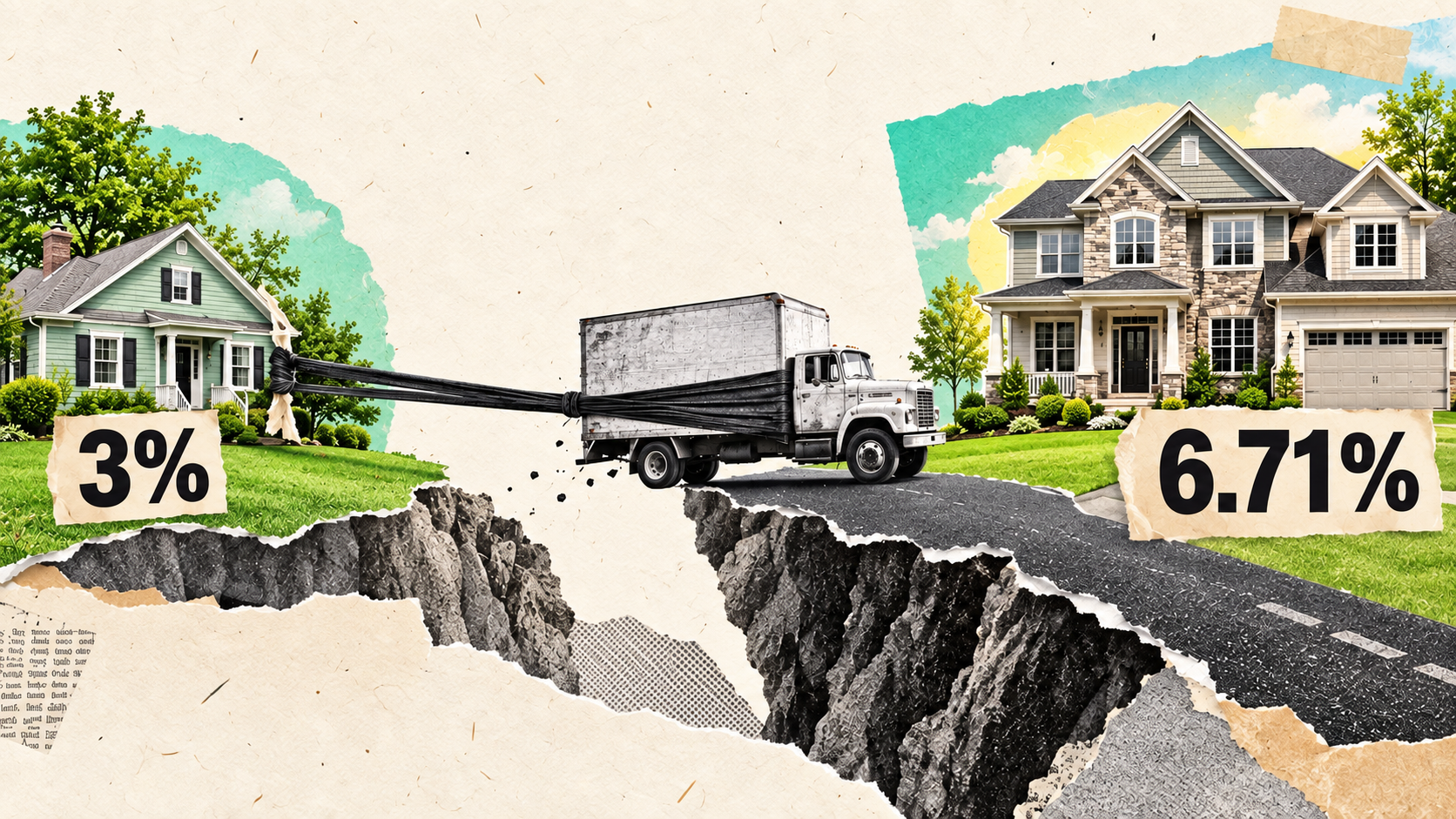
Imagine buying a home when mortgage rates were around 3%. Now imagine wanting to move, only to discover that replacing that mortgage could mean taking on a rate more than double what you’re paying now.
As of September 3, 2026, Freddie Mac reported that the average 30-year fixed mortgage rate stood at 6.71%. Meanwhile, according to Realtor.com‘s analysis of FHFA mortgage data, 19.5% of outstanding U.S. mortgages still carried rates at or below 3% in the first quarter of 2026, and 49.9% carried rates at or below 4%.
It would be inaccurate to say Americans simply cannot sell their homes. A more precise way to put it: many homeowners have a strong financial incentive not to sell. That distinction matters, and it sits at the center of what economists call the mortgage rate lock-in effect.
Here is the basic chain of logic this article walks through. Low mortgage rates created a financial incentive for millions of homeowners to stay in their current homes. That incentive reduced the number of potential sellers. Fewer sellers meant a tighter supply of existing homes on the market. And a tighter supply of existing homes, combined with today’s higher rates, made the overall housing market less fluid, meaning fewer transactions, longer holding periods, and reduced mobility for both homeowners and workers.
Section 02
What Is the Mortgage Rate Lock-In Effect?
A low mortgage rate becomes an economic asset
A 3% mortgage is not just “3%.” It represents a long-term loan with a payment fixed at a level well below what a new loan would cost today. Freddie Mac describes the mortgage rate lock-in effect as the impact that owning a mortgage on more favorable terms than current market rates has on a homeowner’s incentive to sell their home.
Why selling usually means giving up the old mortgage
The mechanics here are fairly simple. A homeowner owns a house. A mortgage is attached to that property. If they sell, the existing mortgage is generally paid off as part of the transaction. If they buy another home, they generally need new financing at whatever rate is available at that time.
It’s worth being precise here: not every U.S. mortgage works identically, and this article isn’t suggesting otherwise. But except in limited cases, mortgages are generally not portable and are not assumable by a homeowner moving to a new property, and many carry due-on-sale clauses that require the loan to be paid off when the property changes hands. In practice, this means most homeowners genuinely cannot simply carry a 3% rate over to a different house.
Section 03
Why a 3% Mortgage Is So Valuable
The real cost of replacing a low-rate mortgage
Illustrative example: Suppose a homeowner has a remaining mortgage balance of $300,000 at a 3% fixed rate. At that rate, the monthly principal and interest payment on a 30-year loan works out to roughly $1,265. If that same $300,000 balance were instead financed at 6.71%, the prevailing average rate as of early September 2026, the monthly principal and interest payment would rise to roughly $1,936. That’s a difference of about $671 a month, or roughly $8,050 a year, in principal and interest alone.
This example uses simplified, hypothetical numbers for illustration only. It does not include property taxes, homeowners insurance, HOA dues, or mortgage insurance, and it does not represent a rate quote, payment quote, or guaranteed outcome for any specific borrower. Actual payments depend on the loan amount, term, rate, and other factors specific to each mortgage.
The payment difference is not the whole story
Beyond the monthly payment gap, a homeowner considering a move also faces property taxes that may reset to a higher assessed value, homeowners insurance premiums, HOA dues if applicable, closing costs on both the sale and the purchase, moving expenses, real estate agent commissions, and ongoing maintenance on a new property. Some of these are one-time transaction costs rather than ongoing borrowing costs, so it would be inaccurate to lump everything together as “the cost of the mortgage.” But taken together, they add real weight to the financial case for staying put.
Section 04
The Numbers Behind America's 3% Mortgage Problem
How many mortgages are still below 4%?
According to Realtor.com‘s analysis of FHFA National Mortgage Database figures, 19.5% of outstanding mortgages carried rates at or below 3% in the first quarter of 2026, essentially unchanged from the prior quarter after several years of steady decline. Mortgages in the 3% to 3.99% range made up another 30.4%, bringing the combined share below 4% to 49.9%, the first time since the third quarter of 2020 that this ultra-low-rate group has represented less than half of all outstanding mortgages. Separately, Realtor.com has reported that roughly 80% of outstanding mortgages carry rates below 6%.
Why 2020 and 2021 matter
Freddie Mac’s data shows that average 30-year mortgage rates fell to 3.20% in 2020 and 3.06% in 2021, including a record weekly low of 2.65% in January 2021. That environment prompted a wave of home purchases and refinances, and as of 2023, Freddie Mac estimated that nearly six out of every ten borrowers held a mortgage rate below 4%.
The 3% mortgage was not just for homebuyers
It’s worth clarifying a common assumption: not everyone with a rate near 3% bought their home in 2020 or 2021. Many homeowners who purchased earlier refinanced into these historically low rates during that window, which is one reason the group of ultra-low-rate borrowers is larger and more varied than a simple “2020 homebuyers” narrative would suggest.
Section 05
Why Homeowners Are Not Selling Their Homes
Moving creates a financial reset
The basic sequence looks like this: a homeowner with a 3% mortgage sells their home, the old loan is paid off, they purchase a new home, and they take on a new mortgage at whatever rate is available, currently averaging in the mid-6% range. The result is a meaningfully higher monthly payment, even if the new home costs roughly the same as the old one.
The homeowner may still want to move
This is a nuance worth stating clearly: the lock-in effect is not primarily about homeowners losing the desire to move. It’s that the financial cost of moving may now outweigh the benefit of moving for some households, even when the underlying reason for wanting to move, a bigger house, a smaller house, a better school district, proximity to family, a new job, retirement, divorce, marriage, or caregiving needs, hasn’t gone away.
It would be an overreach to claim that mortgage lock-in “causes” or “prevents” any of these specific life events. A more accurate framing: major life events can create a genuine reason to move, but the cost of giving up a low-rate mortgage may affect whether, and when, a household actually follows through.
Section 06
How Mortgage Lock-In Reduces Housing Inventory
Fewer sellers mean fewer existing homes for sale
The supply-side logic is fairly direct. When low-rate homeowners choose to stay put, fewer homes get listed. Fewer listings mean fewer choices for buyers. Less turnover in the existing housing stock means lower overall transaction volume across the market.
This is different from a shortage of physical homes
It’s worth separating two related but distinct ideas: a broader housing shortage, meaning not enough homes exist to meet long-run demand, and an existing-home inventory shortage, meaning homeowners who already own a home are reluctant to list it for sale. Mortgage lock-in primarily affects the second category, the flow of existing homes coming onto the market, rather than the total physical housing stock. Freddie Mac has described lock-in as “another layer” contributing to a broader shortage of for-sale inventory, not as the sole cause of that shortage.
Section 07
Does the Mortgage Lock-In Effect Push Home Prices Higher?
This is an area that calls for careful, non-oversimplified explanation, since two forces are pulling in different directions at once.
Less supply can support prices
Basic economics suggests that when fewer homes are listed while buyer demand persists, that combination tends to put upward pressure on prices for the homes that are available.
Mortgage rates can also push prices down
At the same time, higher mortgage rates reduce how much home a given buyer can afford to finance, which tends to put downward pressure on prices.
The housing market gets squeezed from both sides
An FHFA staff working paper released in 2024 attempted to quantify both effects directly. The researchers estimated that for every percentage point that current market mortgage rates exceed a homeowner’s original rate, the probability that homeowner lists their home for sale decreases by 18.1%. Applying this relationship, the paper estimated that mortgage rate lock-in produced a 57% reduction in home sales among fixed-rate mortgage holders in the fourth quarter of 2023 and prevented roughly 1.33 million home sales between the second quarter of 2022 and the fourth quarter of 2023. The same paper estimated that this supply reduction increased home prices by 5.7% over that period, an effect the researchers found actually outweighed the direct, price-dampening impact of higher rates on buyer demand, which they estimated reduced prices by 3.3% over the same period.
These figures come from a single FHFA staff working paper and represent that paper’s specific modeling estimates for a specific time period. They are working paper findings rather than official FHFA policy conclusions, and they should not be read as a precise, universally agreed-upon measurement of the housing market as a whole.
Buyers face expensive financing. Sellers face an expensive reason to leave their existing mortgage. The result, according to this research, is a market where both sides have a financial incentive to wait.
Section 08
The Hidden Cost: Americans Are Moving Less
Mortgage lock-in affects household mobility
A 2024 study published in the Journal of Finance by economists Julia Fonseca and Lu Liu examined this question using individual-level credit record data. The researchers found that a 1 percentage point decline in the “mortgage rate delta,” the gap between a household’s locked-in mortgage rate and the current market rate, was associated with a 9% reduction in overall moving rates, and a 16% reduction specifically during the 2022 to 2024 period.
It’s worth being precise about what this study measured: it’s describing the relationship between the size of an individual household’s rate gap and that household’s likelihood of moving, not a claim that market rates rising by one percentage point automatically reduces national moving activity by a fixed amount.

Job opportunities can become harder to pursue
The same study found that mortgage lock-in reduced how responsive households were to nearby employment opportunities that would have required relocating, based on measures of local wage growth. This is a genuinely significant finding. Mortgage lock-in isn’t just a housing market phenomenon. According to this research, it can also function as a labor mobility constraint, potentially keeping some workers from pursuing higher-paying jobs that would require moving.
Section 09
What Happens When Someone Gets a Better Job in Another City?
Illustrative example: Consider a homeowner who receives a higher-paying job offer several states away. If selling their current home means replacing a low-rate mortgage with a much higher-rate loan, that household may have a stronger financial reason to stay than it would have had if the gap between old and new rates were smaller.
This example is illustrative only and does not represent an actual household, job offer, or financial outcome. It is not intended to predict how any specific person would respond to a relocation opportunity.
The decision in a scenario like this involves weighing the value of the new job offer against the higher mortgage payment, moving costs, and family considerations. This isn’t meant to suggest that a household in this position would necessarily turn down the job. It simply illustrates that the mortgage attached to the current home can change the underlying economics of that decision.
Section 10
The 3% Mortgage "Trap" Is Not Really a Trap
Low mortgage rates are actually valuable
It’s worth resisting the temptation to treat the 3% mortgage as some kind of villain in this story. A low, fixed mortgage rate protects a homeowner from future rate increases, keeps monthly payments lower than they would otherwise be, provides payment stability over the life of the loan, and can meaningfully increase a household’s overall financial flexibility. Freddie Mac itself frames the lock-in effect as, first and foremost, a benefit to homeowners holding fixed-rate mortgages.
The “trap” appears when circumstances change
The tension shows up specifically when a homeowner’s life circumstances point toward moving. The same mortgage that protects a homeowner from higher rates can make moving considerably more expensive than it would otherwise be.
It is a trade-off, not a mistake
None of this reflects poor decision-making by homeowners, borrowers, or policymakers. It’s the natural outcome of how fixed-rate mortgages, interest rate cycles, home prices, and real transaction costs interact with genuine household needs over time.
Section 11
Why the Problem Is Bigger Than 3%
The lock-in effect applies beyond 3% mortgages
A homeowner with a rate of 3.5%, 4.0%, or 4.5% can experience a meaningful version of this same lock-in effect if a replacement mortgage would cost significantly more. The phenomenon isn’t unique to the specific number 3%.
The rate gap matters
What actually drives the size of the effect is the mortgage rate differential, the gap between a homeowner’s existing rate and whatever rate they’d face on a new loan. A household moving from a 3% rate to a 6.71% rate faces a very different calculation than one moving from 5.8% to 6.71%, even though both technically hold a “low” rate relative to the peak. This is why the mortgage rate lock-in effect, rather than the specific figure of 3%, is the more useful concept for understanding the broader housing market.
Section 12
Is the 3% Mortgage Trap Finally Going Away?
Some homeowners are slowly unlocking
Realtor.com‘s Q1 2026 data shows the combined share of mortgages at or below 4% has fallen to 49.9%, and separate Realtor.com reporting from early 2026 noted that, for the first time since the pandemic-era boom, the share of outstanding mortgages carrying rates of 6% or higher had surpassed the share carrying rates below 3%. That said, the same Q1 2026 data noted that the pace of this shift stalled somewhat compared to prior quarters, meaning the composition of the mortgage market is changing, but slowly and not always steadily.
Mortgage rates do not have to fall back to 3%
An underappreciated point: the market doesn’t need to return all the way to 3% for lock-in to meaningfully ease. If current market rates simply drift closer to the rates many homeowners already hold, the financial penalty for moving shrinks, which could encourage more homeowners to list their properties.
Time itself can weaken the lock-in effect
Freddie Mac has also noted that ordinary loan amortization, homeowners gradually paying down principal over time, tends to reduce the calculated value of the lock-in effect even without any change in mortgage rates. Combined with homeowners who eventually move for life reasons regardless of the financial penalty, and some who choose to refinance or sell despite the cost, this suggests the lock-in effect should be expected to ease gradually over time rather than disappearing all at once.
Section 13
What Could Unlock the U.S. Housing Market?
Lower mortgage rates
A smaller gap between current rates and the rates many homeowners already hold would generally be expected to weaken the lock-in effect. That said, it would be inaccurate to suggest that the Federal Reserve simply sets mortgage rates directly. Mortgage rates respond to a range of factors, including Federal Reserve policy, Treasury yields, inflation expectations, and investor demand for mortgage-backed securities, among other market forces.
More new construction
New homes can add to overall housing supply without requiring an existing homeowner to sell first, which makes new construction one of the more direct paths toward easing inventory pressure independent of the lock-in effect.
Life events
Over time, retirements, family changes, relocations, and estate transfers will continue to bring homes to market regardless of prevailing mortgage rates, gradually adding inventory even while broader lock-in conditions persist.
More homeowners simply decide the move is worth it
Ultimately, mortgage lock-in functions as a financial hurdle rather than an absolute barrier. As the size of that hurdle shrinks, whether because rates move, life circumstances change, or enough time passes, more homeowners are likely to conclude that moving is worth the cost.
Section 14
What This Means for Buyers
Buyers may face less inventory
To the extent that low-rate homeowners continue to stay in place, buyers may continue to encounter fewer resale homes on the market than they would in a more typical rate environment.
New construction may matter more
Buyers navigating a tight resale market may find more available options by looking at new construction, markets with comparatively more inventory, or areas where prices have already adjusted downward to reflect current rate conditions.
A lower mortgage rate is not the only variable
Whatever the rate environment, buyers generally benefit from evaluating the full picture of a purchase, including the purchase price, the interest rate, property taxes, insurance costs, HOA dues if applicable, ongoing maintenance, and closing costs, rather than focusing on the interest rate in isolation.
Section 15
What This Means for Sellers
Your 3% mortgage has economic value
A low, locked-in mortgage rate represents real, quantifiable financial value. That doesn’t mean a homeowner should never sell.
Life can outweigh the mortgage
The relevant comparison for any individual household is the financial benefit of staying against the combined financial and personal benefit of moving. This is a highly individual calculation, and this article isn’t offering a specific recommendation about when any particular homeowner should sell.
Section 16
The Bigger Economic Story Behind the 3% Mortgage
Mortgage rate lock-in extends well beyond a single housing statistic. In the housing market, it affects listings, available inventory, prices, and overall transaction volume. In the labor market, research suggests it can affect relocation decisions, job matching, and access to higher-wage opportunities that require moving. At the household level, it touches ordinary life decisions like downsizing, upsizing, and retirement timing.
There’s also a broader monetary policy angle worth noting. A household holding a 3% fixed-rate mortgage is largely insulated from today’s higher market rates, in a way that a renter or a prospective first-time buyer entering the market today is not. In other words, the structure of the U.S. mortgage system, built heavily around long-term fixed-rate loans, can cause the same broad monetary policy environment to affect existing homeowners and prospective buyers very differently. This is precisely the kind of friction the Fonseca and Liu research in the Journal of Finance set out to measure.
Section 17
So, Are Americans Really "Trapped" in Their Homes?
Not literally. Mortgage rate lock-in doesn’t prevent a homeowner from selling their home. It doesn’t prevent refinancing in every case. It doesn’t eliminate a homeowner’s ability to move if they choose to. And it doesn’t affect every homeowner to the same degree, since the size of the effect depends heavily on each household’s specific rate gap.
What the research consistently suggests is narrower, but still significant: the cost of giving up a low mortgage rate can be substantial enough that some homeowners choose to stay put, even when their current home is no longer their first choice.
Section 18
How the Mortgage Rate Lock-In Effect Works
A simplified way to visualize the chain of events discussed throughout this article:
2020-2021
Mortgage rates fall to record lows near 3%
↓
Millions of households buy or refinance
↓
Homeowners lock in historically cheap, fixed-rate debt
↓
2022-2026
Mortgage rates rise sharply and stay elevated
↓
A new mortgage becomes significantly more expensive
↓
Many homeowners hesitate to sell
↓
Fewer existing homes come onto the market
↓
Household and labor mobility decline
↓
The housing market becomes less fluid
This diagram is a simplified summary of the general dynamic described in this article and the cited research. It does not represent a precise economic model, and actual outcomes for any specific market or household will vary.
Section 19
Frequently Asked Questions About the 3% Mortgage Trap
What is the mortgage rate lock-in effect?
The mortgage rate lock-in effect refers to the reduced incentive a homeowner has to sell their home when their existing mortgage carries a rate well below current market rates, since selling generally means giving up that favorable rate in exchange for a new, more expensive loan.
Why are homeowners with 3% mortgages reluctant to sell?
Selling typically requires paying off the existing low-rate mortgage and financing a new home purchase at current market rates, which as of September 2026 averaged 6.71% for a 30-year fixed loan, resulting in a meaningfully higher monthly payment for many households.
How does a 3% mortgage affect housing inventory?
When homeowners with low-rate mortgages choose to stay in their current homes rather than sell, fewer existing homes are listed for sale, which contributes to tighter inventory in the resale housing market.
Are homeowners actually trapped by low mortgage rates?
Not literally. Homeowners retain the ability to sell, refinance in some cases, or move. Research suggests the lock-in effect functions as a significant financial disincentive rather than an absolute barrier, and its strength varies by household depending on the specific gap between their old rate and current rates.
How many U.S. mortgages are at 3% or lower?
According to Realtor.com‘s analysis of FHFA data, 19.5% of outstanding U.S. mortgages carried rates at or below 3% in the first quarter of 2026, while a combined 49.9% carried rates at or below 4%.
Will mortgage rates return to 3%?
This cannot be assumed. Mortgage rates depend on a range of economic factors, including Treasury yields, inflation, Federal Reserve policy, and investor demand, and a return to 3% rates is possible but not something this article predicts or assumes.
Does mortgage lock-in increase home prices?
Research from an FHFA staff working paper estimated that reduced housing supply tied to mortgage rate lock-in increased home prices by 5.7% between the second quarter of 2022 and the fourth quarter of 2023, an effect the researchers found larger than the roughly 3.3% price decrease attributable to the direct dampening effect of higher rates on buyer demand over the same period. These are estimates from a single study and should not be treated as definitive nationwide figures.
Does mortgage lock-in affect job mobility?
A 2024 study published in the Journal of Finance found that mortgage rate lock-in reduced how responsive households were to employment opportunities that would require relocating, suggesting the effect extends into labor market mobility and not just housing transactions.
Can homeowners keep their 3% mortgage when they move?
Generally, no. A conventional mortgage is tied to a specific property and is typically paid off when that property is sold. Mortgage portability is limited and depends on the specific loan program and lender, so most homeowners cannot simply transfer a low rate to a new home.
Section 20
Final Thoughts
A 3% mortgage was, and still is, a genuine financial advantage for the households that hold one. But that same advantage creates a real switching cost the moment a homeowner considers moving, since replacing that mortgage today generally means taking on a rate more than double what they’re currently paying.
When millions of households face this same financial incentive at roughly the same time, what looks like an individual household decision starts to show up as a market-level phenomenon, affecting how many homes get listed, how home prices behave, and how easily people can move for new jobs or changing life circumstances.
The 3% mortgage was a genuine gift to many homeowners. But when millions of people receive that same financial incentive to stay put at the same time, that gift can end up reshaping the entire housing market around it.
Section 21
Sources
- Freddie Mac, Mortgage Rates Average 6.71% (September 3, 2026)
- Freddie Mac, Mortgage Rate Lock-In and the Housing Market
- Freddie Mac, The Year in Review: Top Three Trends of 2023
- FHFA Staff Working Paper 24-03, The Lock-In Effect of Rising Mortgage Rates
- Fonseca, J. and Liu, L. (2024), Mortgage Lock-In, Mobility, and Labor Reallocation, The Journal of Finance
- Realtor.com Research, Mortgage Lock-In Persists, With Ultralow Rate Holders Refusing To Budge
- Consumer Financial Protection Bureau (CFPB), Owning a Home
Disclaimer: This article is for general informational and educational purposes only. It is not mortgage, financial, tax, legal, real estate, or investment advice. Mortgage rates, loan terms, home prices, taxes, insurance costs, and housing conditions vary by borrower, property, location, lender, and market conditions. Examples in this article are simplified illustrations and are not predictions of actual payments, savings, home values, or financial outcomes. Statistics and research findings cited in this article reflect the specific time periods, methodologies, and data sources of the original studies and reports, and may not reflect current conditions at the time you are reading this. Readers should consult a qualified mortgage professional, financial adviser, tax professional, attorney, or real estate professional before making decisions based on their individual circumstances.
Duc Pham, Mortgage Broker | NMLS# 844897 | 408-600-1900 | dp@wonderrates.com Wonder Rates, Inc. | NMLS# 1518655 | DRE# 02047445 | DFPI# 60DBO-59134 Equal Housing Opportunity. Equal Housing Lender. Licensed in: AL, AZ, CA, CO, FL, GA, LA, MI, NC, OH, OK, OR, PA, SC, TX, VA, WA