
Section 01
Hard Money Loans vs Bridge Loans
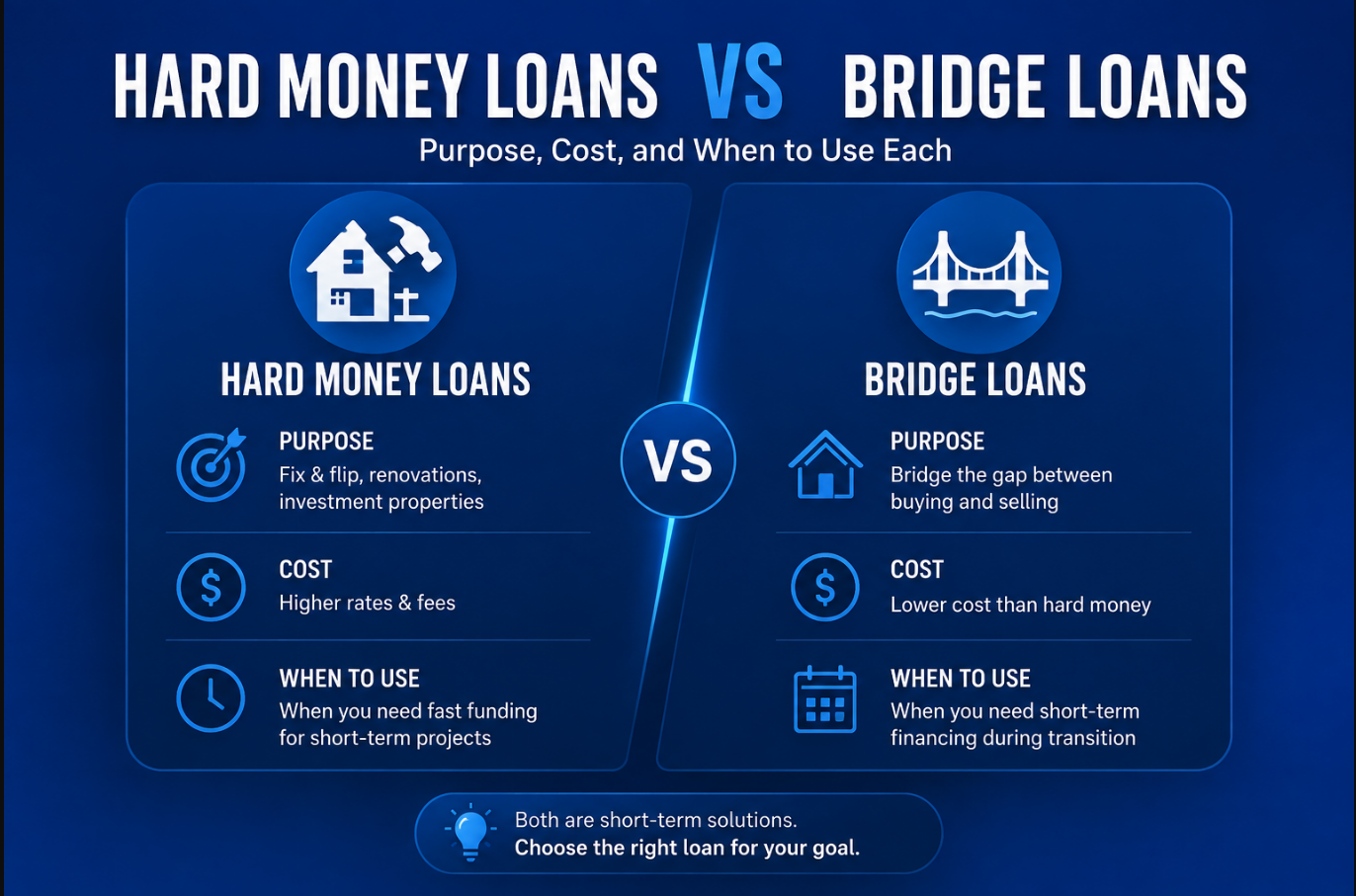
The short answer: A bridge loan is defined by its purpose, connecting two financial events with temporary financing. A hard money loan is defined by its underwriting method, asset-based lending where the property value and exit strategy drive the approval rather than traditional credit and income documentation. A bridge loan can be a hard money loan, but not all hard money loans are bridge loans, and not all bridge loans are hard money.
Section 02
Definitions First
A hard money loan is a short-term loan funded by a private lender or investor, underwritten primarily on the value of the property rather than the borrower’s credit score or income. Approval is typically faster than conventional financing. Documentation is lighter. The trade-off is cost: rates are high and terms are short.
A bridge loan is a short-term loan designed to bridge a gap between two transactions or financial events. The classic example is a borrower who needs to buy a new property before selling an existing one. The bridge loan covers the gap. When the existing property sells, the bridge loan is repaid. A bridge loan can be funded by a bank, a private lender, or a hard money lender depending on the deal.
The confusion comes from overlap. Many bridge loans are structured as hard money loans because the borrower needs speed and does not want to go through conventional underwriting. But the term “hard money” describes how the loan is underwritten. The term “bridge” describes what the loan is for.
Section 03
Side-by-Side Comparison
| Factor | Hard Money Loan | Bridge Loan |
|---|---|---|
| Defined by | Underwriting method (asset-based) | Purpose (bridging two events) |
| Funded by | Private lenders, investor groups | Banks, private lenders, or hard money lenders |
| Primary use | Fix-and-flip, distressed property, fast acquisition | Gap between purchase and sale, stabilization, pre-agency refi |
| Interest rate (2026) | Typically 9% to 15%+ depending on deal risk | Typically 8.5% to 13%, lower for institutional bridge |
| Origination points | 2 to 4 points typical | 1 to 3 points for institutional; 2 to 4 for private |
| Loan term | 6 to 36 months | 6 months to 3 years |
| LTV | 65% to 75% of as-is or ARV | Up to 75% to 80% for stronger deals |
| Credit requirement | Property value and exit strategy are primary factors; lenders vary on whether and how much credit, liquidity, and experience they review | Varies: banks require good credit and full documentation; private bridge lenders vary |
| Documentation | Lighter than conventional; specific requirements vary by lender | Moderate to heavy for institutional bridge |
| Approval speed | Faster than conventional financing; timeline depends on lender, deal complexity, and documentation | 1 to 3 weeks institutional; faster for private bridge |
| Payment structure | Interest-only, balloon at maturity | Interest-only, balloon at maturity |
| Prepayment penalty | Common with some lenders, confirm upfront | Less common for institutional bridge |
Rates and terms reflect general market conditions as of July 2026. Actual terms depend on lender, property type, borrower experience, and market. Confirm all terms directly with your lender.
Section 04
Where They Differ in Practice
Purpose and Exit Strategy
Hard money loans are built around the property and the project. A fix-and-flip investor buys a distressed home, borrows against the after-repair value, renovates, and sells. The exit is the sale. The loan pays off from sale proceeds.
Bridge loans are built around the gap between two events. A commercial investor finds a multifamily property that is 60% occupied and cannot yet qualify for agency debt. They take a bridge loan, stabilize the property to 90% occupancy over 12 months, then refinance into a DSCR loan or Fannie Mae product. The exit is the refinance. See: DSCR Loan Program
The distinction matters because lenders underwrite differently based on the exit. A hard money lender underwrites the renovation plan and ARV. A bridge lender, especially an institutional one, underwrites the stabilization plan and the likely terms of the take-out loan.
Cost Structure
Hard money loans in 2026 typically carry rates from 9% to 15% depending on property type, borrower experience, and LTV, with 1 to 4 origination points. When you factor in points and interest over the hold period, the total annualized cost often runs 15% to 25%.
Commercial bridge loan rates in major markets like Los Angeles typically range from 8.5% to 12.5% as of early 2026, notably lower than hard money alternatives for the same asset class. Institutional bridge lenders charge fewer points and carry more documentation requirements, which is the trade-off for better pricing.
The cost difference comes from risk. Hard money lenders focus primarily on the asset and the exit strategy rather than the borrower’s credit history, which is priced into higher rates and fees. Bridge lenders, especially banks, still run credit checks and require more documentation, so they can price closer to market.
Documentation and Speed
Bridge loan documentation from institutional lenders resembles conventional financing: detailed loan agreements, personal guarantees, environmental indemnities, and extensive property-level reporting. Expect 100 or more pages of closing documents. Hard money documentation is lighter: a promissory note, deed of trust, and personal guarantee are common, though specific requirements vary by lender.
The lighter documentation on hard money loans generally allows for faster processing than institutional bridge loans. If you need to close quickly on a distressed property that a bank would not touch, hard money is typically the tool. If you have more time and a cleaner deal, an institutional bridge loan will likely cost less.
Section 05
When to Use Each
Use a Hard Money Loan When:
- The property is distressed or would not qualify for conventional financing
- You need to close faster than conventional or institutional financing allows
- You are doing a fix-and-flip and need a rehab holdback built into the loan
- Traditional credit and income documentation is limited
- The deal is too small or too unusual for institutional lenders
Use a Bridge Loan When:
- You need to buy before your current property sells
- You are stabilizing a commercial or multifamily property before refinancing into agency debt
- The property is functional but needs time to qualify for permanent financing
- You want lower rates and are willing to provide more documentation
- Your exit is a refinance rather than a sale
When They Overlap:
Many residential investors use hard money bridge loans, essentially a hard money loan structured around a bridging purpose. This is common for buy-and-hold investors who acquire a property with hard money, do light renovation, then refinance into a DSCR loan once the property is leased.
If this is your strategy, the most important thing is underwriting the exit before you take the entry loan. Know what DSCR or LTV the take-out lender will require, and make sure the numbers work at that exit before you close on the hard money loan.
Section 06
Cost Comparison: What You Actually Pay
The numbers below are illustrative examples based on general 2026 market conditions.
| Scenario | Loan Amount | Rate | Points | Term | Total Interest Cost | Total Points Cost |
|---|---|---|---|---|---|---|
| Hard money fix-and-flip | $500,000 | 11% | 3 | 9 months | ~$41,250 | $15,000 |
| Private bridge loan | $500,000 | 10% | 2 | 12 months | ~$50,000 | $10,000 |
| Institutional bridge | $2,000,000 | 9% | 1.5 | 18 months | ~$270,000 | $30,000 |
All figures are hypothetical and for illustration only. Actual costs depend on lender, property, and market conditions.
The hard money fix-and-flip looks cheaper in total dollars, but that is partly because the term is shorter. If the project runs long and you need an extension, the cost rises quickly. Always model a base case and a delayed case before committing.
Section 07
Frequently Asked Questions
What Is the Main Difference Between a Hard Money Loan and a Bridge Loan?
A hard money loan describes the underwriting method: asset-based, with property value and exit strategy as primary factors, funded by private lenders. A bridge loan describes the purpose: temporary financing between two events. A bridge loan can be a hard money loan. Not all hard money loans are bridge loans. The distinction matters because it determines which lender to approach and how to structure the deal.
Which Is More Expensive?
Hard money loans generally cost more. In 2026, both products typically carry rates of 9% to 14% or higher with 2 to 4 origination points, but hard money lenders at the riskier end of the spectrum can push higher. Institutional bridge lenders price lower because they run credit checks and require more documentation, which reduces their risk. If your deal qualifies for institutional bridge financing, it is usually the cheaper option.
Can I Use a Hard Money Loan as a Bridge Loan?
Yes, and many investors do. The most common version is a buy-and-hold investor who closes with hard money, stabilizes the property, then refinances into a DSCR loan. If this is your plan, underwrite the exit before you take the entry loan. Know what the DSCR lender will require and confirm your numbers work at that exit.
Do Hard Money Loans Check Credit?
It depends on the lender. Most hard money lenders focus primarily on the property value, the exit strategy, and the deal structure. Some also review the borrower’s credit, liquidity, prior real estate experience, or require personal guarantees. Requirements vary significantly between lenders. Confirm exactly what each lender requires before you apply.
How Fast Can These Loans Close?
Hard money loans typically close faster than conventional or institutional bridge financing, but the timeline depends on the lender, the deal, and how quickly documentation is assembled. Institutional bridge lenders generally take longer due to more extensive documentation requirements. If closing speed is critical, confirm the realistic timeline with each specific lender before committing.
What Happens If the Exit Takes Longer Than Expected?
Some lenders offer extension options, typically for a fee and subject to lender approval at the time of the request. Extensions are not guaranteed and terms vary. Some hard money loans also carry prepayment penalties if you pay off early, so confirm both the extension terms and the prepayment provisions before you sign. Model a delayed exit scenario before you close so you know the cost if the sale or refinance takes longer than planned.
Section 08
Ready to Structure Your Deal?
Hard money and bridge loans work best when the structure matches the exit. If you are not sure which product fits your deal, or whether the numbers work at your planned exit, that is exactly the conversation to have before you commit.
Want to know what your monthly housing payment might be so you can estimate your DTI? Try the Wonder Rates team’s mortgage calculator before you talk to a loan officer.
Duc Pham, Mortgage Broker | NMLS# 844897,
Wonder Rates, Inc. | NMLS# 1518655 | DRE# 02047445 | DFPI# 60DBO-59134 |
Equal Housing Opportunity. Equal Housing Lender. |
Licensed in: AL, AZ, CA, CO, FL, GA, LA, MI, NC, OH, OK, OR, PA, SC, TX, VA, WA.