
Section 01
Picture a rental home that brings in $2,800 a month in rent. The owner pays $1,700 a month toward the mortgage. At first glance, it looks like the owner keeps $1,100 every month. But that number leaves out a lot. It does not count property taxes, insurance, repairs, empty months, HOA dues, or the cost of someone to manage the home.
Rent minus the mortgage is not profit.
That is why a mortgage cash flow analysis matters. It is a step-by-step way to see how much cash a property really brings in, or costs you, once the key bills are paid. In this guide, you will learn what the term means and how the formula works. You will also see which costs to include and how your loan choices change the result. You will also walk through a full example. One thing to know up front: this cash flow is not the income a lender uses to approve a loan. It is not the profit on a tax return either.
Disclaimer: The figures above are hypothetical and are used only to introduce the topic. They do not represent an actual property, payment, or investment result.
Section 02
What Is a Mortgage Cash Flow Analysis?
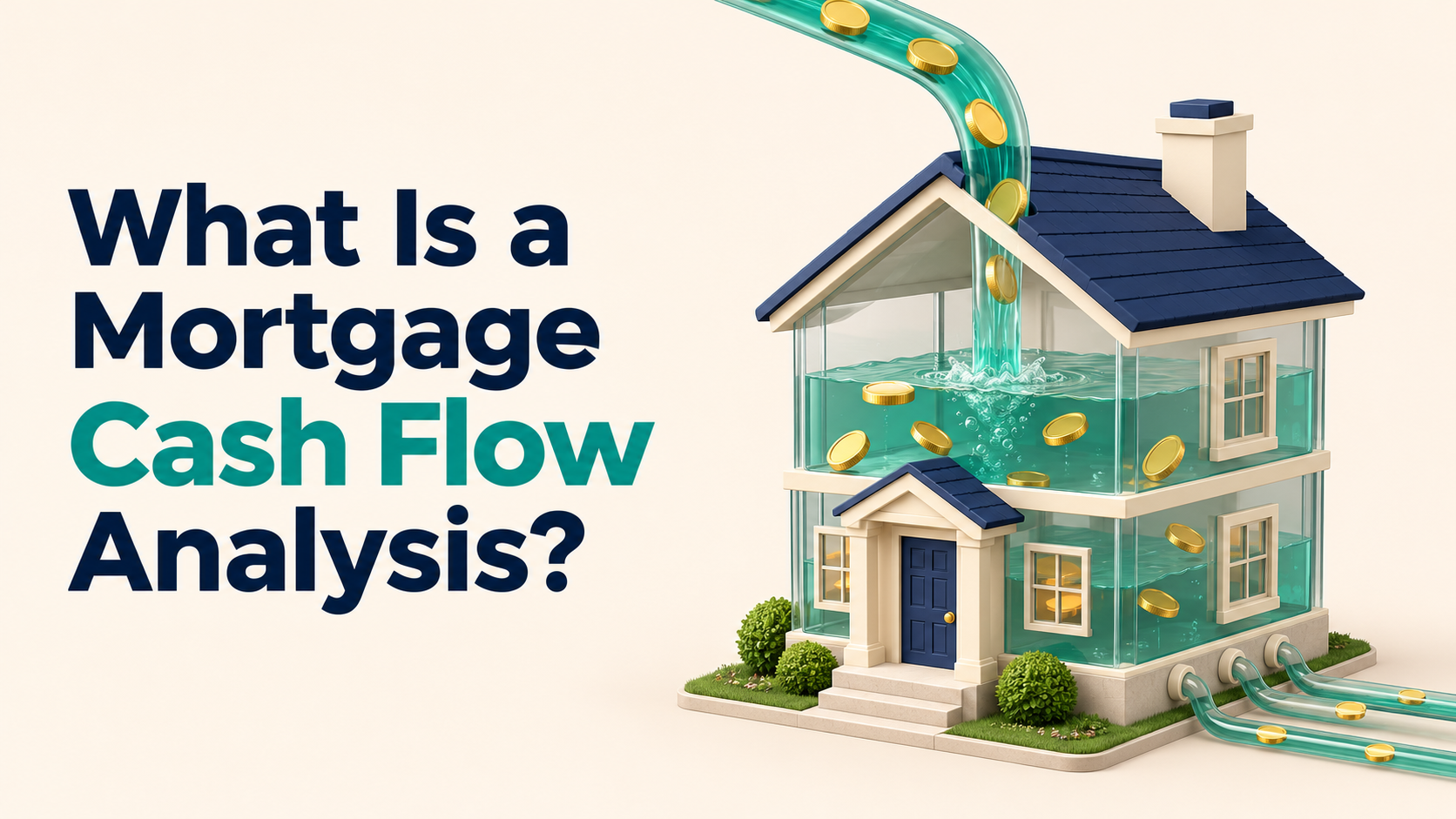
A mortgage cash flow analysis is a review of the cash that comes into a property and the cash that goes out of it. For a rental, you start with the rent, then take out the costs of running the property and the mortgage payments. What is left is your cash flow. If the home is one you live in, the review looks a little different. It focuses on how much cash your household has left after the full housing payment and other related costs.
The result can land in one of three places:
- Positive cash flow: The property brings in more cash than it uses during the period you are measuring.
- Negative cash flow: The owner has to add money from their own pocket to cover the property’s costs.
- Break-even cash flow: The rent roughly covers the costs included in the math.
Keep in mind that positive cash flow is not the same as your total return. Cash flow does not count a rise in the home’s value or the equity you build as the loan shrinks. It also leaves out taxes and the money you might get when you sell. It only tracks the cash that moves in and out over a set time.
What Does Cash Flow Tell a Property Owner?
Cash flow helps you answer a few plain questions. Can the rent cover the ongoing bills? How much money may be left each month? How much should you keep in savings in case something goes wrong? It also lets you compare loan options side by side before you buy. That way, you can see how each one changes the monthly result.
When Should You Perform a Mortgage Cash Flow Analysis?
The most common time is before you make an offer on a rental. Running the numbers early helps you see whether the rent can support the property before you are locked in. It is also smart to run them again on a rental you own when something changes. A jump in insurance, a new tax bill, or a refinance are good reasons. Finally, if you own a rental and want to buy another home, the analysis helps you see how that rental fits into your bigger plan.
Still, no single number can tell you whether a property is a good investment. The answer depends on the inputs you use, how long you plan to hold the property, and what you want it to do for you.
Section 03
Mortgage Cash Flow Analysis vs. Rental Income, Profit, and Return on Investment
Several money terms can describe the same property, and they are easy to mix up. Each one answers a different question, so it helps to know which one you are looking at.
Gross Rental Income vs. Net Cash Flow
Gross rental income is the rent you collect before you pay any bills. Net cash flow is what is left after you subtract the costs and loan payments you chose to include. Using the numbers from earlier, $2,800 in monthly rent does not mean the owner earns $2,800. The mortgage, taxes, insurance, and running costs all come out first. What is left after that is the real cash flow.
Disclaimer: This figure is hypothetical and is used for illustration only. Actual rent and costs vary by property and market.
Cash Flow vs. Net Operating Income (NOI)
Net operating income, or NOI, is the property’s income after its operating costs. It is measured before the mortgage and before income taxes. In a standard rental analysis, NOI generally leaves out principal and interest, big replacement costs, and depreciation. Depreciation is a tax deduction for wear and tear, not cash you pay out.
Cash flow after debt service goes one step further. It takes NOI and then subtracts the mortgage payment. People do not always build these numbers the same way, so whenever you share a figure, say clearly what you included. That way no one compares apples to oranges.
Cash Flow vs. Return on Investment (ROI)
Return on investment, or ROI, is a wider measure. Depending on the formula, it can weigh the cash you put in against several parts of how the investment does over time. Cash flow is narrower. It shows the cash a property brings in or uses during a set period. On its own, it does not measure a rise in value, equity growth, or total return.
This matters because a property with the highest monthly cash flow is not always the best choice. Another property with less cash flow might fit your goals better once you look at the full picture.
Section 04
How to Calculate Mortgage Cash Flow
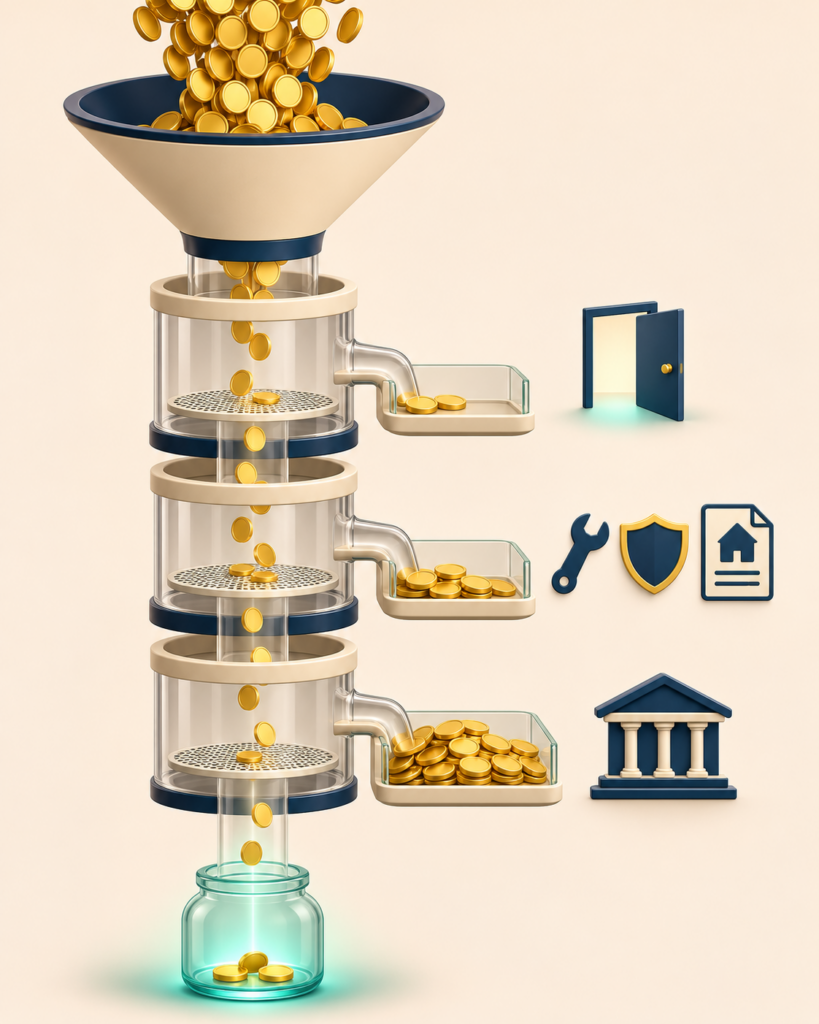
The math is not hard once you know what goes in each slot. Here is the basic mortgage cash flow analysis formula, followed by what each part means.
The Mortgage Cash Flow Analysis Formula
Monthly cash flow formula
Gross rental income
minus vacancy and collection losses
minus operating expenses
minus mortgage debt service
= Estimated monthly cash flow
Operating expenses are the costs of running the property. They include property taxes, insurance, HOA dues, repairs, upkeep, property management, any utilities the owner pays, and other regular costs that apply.
Mortgage debt service usually means the principal and interest part of your loan payment. Many loans also collect taxes and insurance in the same payment through an escrow account. If you use that full payment in the formula, do not subtract taxes and insurance a second time. The same goes for mortgage insurance. Include it if your loan has it, but count it only once.
If the home is not a rental, swap out the rent for the money that flows into your household budget. Then look at the full cost of the home on its own line, so you can see how it fits your monthly budget.
How to Calculate Annual Cash Flow
The quick way to get a yearly number is to multiply your monthly cash flow by 12. That works well only if your monthly numbers are a fair picture of the whole year. For a more realistic result, think about the months that are different. A tenant may move out, a repair may pop up, or the insurance bill may go up at renewal. Some costs simply do not land evenly each month.
Be careful not to take one great month and multiply it by 12. That can make a property look much better than it is. It is safer to use honest yearly numbers than to assume the home will be rented and fully paid every single month.
Why Your Mortgage Payment Matters to Cash Flow
Your loan payment is often the biggest cost in the formula. Four things shape it: how much you borrow, the interest rate, the length of the loan, and how the loan is paid down over time. A bigger down payment can shrink the loan and lower the monthly payment. But it also locks up more of your cash at the start.
That is the trade-off to keep in mind. A lower payment can boost your monthly cash flow. On the other hand, keeping more cash on hand gives you room for repairs, empty months, and other surprises.
Section 05
Which Expenses Should You Include in a Mortgage Cash Flow Analysis?
Your result is only as good as the costs you put in. If you count only the costs you can see easily, the number will look better than real life. This section walks through the main investment property mortgage expenses and other costs to include, so you capture the full cost of owning the home.

Mortgage Principal and Interest
Principal is the part of your payment that pays down what you owe. Interest is what you pay the lender for the loan. Both count in cash flow, because the whole payment leaves your bank account each month.
That said, the full payment is not money thrown away. The principal part lowers your loan balance, which builds equity in the home. So it is a cash cost, but it is not a pure loss. Mixing those two ideas up can make it hard to see how your money is really working.
Property Taxes and Insurance
Property taxes depend on where the home is and how the local area values it. Insurance costs depend on the home, the coverage you choose, its location, and its risks.
Use real quotes and current tax bills when you can. Also think about whether these costs may rise over time. If your math uses old numbers, the property can look more affordable than it really is.
Maintenance, Repairs, and Capital Expenditures
Some costs are small and frequent, like fixing a leaky faucet or servicing the yard. Others are big and rare, like a new roof, a new heating and cooling system, or another major part of the building. These big ones are often called capital expenditures. They may not show up every month, but leaving them out can make the property look far more profitable than it is.
There is more than one way to plan for these costs. You can set aside a monthly amount, budget a yearly allowance, or build a detailed schedule of what will need replacing and when. The method matters less than the habit, because big repairs still take real cash when they arrive.
Vacancy, Property Management, and HOA Fees
A rental will not always collect the full rent. Units can sit empty between tenants, rent can come in late, and some rent may never be paid at all. That lost income is called vacancy and collection loss, and it belongs in your math.
If you hire a property manager, include the monthly fee and any fees for finding new tenants. Add HOA dues and any utilities or services the owner pays. And if you plan to manage the home yourself, remember that it is not truly free. It may save cash, but it costs you time and effort.
Cash Reserves and Unexpected Expenses
Reserves are a bit different from regular bills. Money you move into a savings account for the property is not spent in the same way an insurance premium is spent. Still, you need to plan for the cash it takes to get through a big repair, a long vacancy, or another hard stretch.
Reserves help you test whether your cash flow can last. Picture a property that shows a small surplus each month but leaves you unable to pay for a surprise repair. It can still put real strain on your finances.
Section 06
Mortgage Cash Flow Analysis Example
Let’s put it all together with one full example. All of the numbers below are made up for learning. They stay the same through each step, so you can follow along with your own figures.
Example Property and Monthly Assumptions
Say a rental property collects $2,800 a month in rent. Here is what a month might look like:
| Item | Monthly amount |
|---|---|
| Gross rental income | $2,800 |
| Mortgage principal and interest | $1,650 |
| Property taxes | $300 |
| Insurance | $120 |
| HOA dues | $80 |
| Maintenance reserve | $150 |
| Vacancy allowance | $140 |
| Property management | $140 |
| Total expenses | $2,580 |
| Estimated monthly cash flow | $220 |
In this example, the mortgage line covers principal and interest only. Taxes, insurance, HOA dues, upkeep, vacancy, and management each have their own line. Because nothing is counted twice, the total stays accurate. To keep the table simple, vacancy is shown as a monthly cost. It works the same as taking it out of the rent first.
Calculate the Monthly and Annual Cash Flow
Start with the monthly number:
Monthly cash flow = $2,800 − $2,580 = $220
Then turn it into a yearly estimate:
Annualized cash flow = $220 × 12 = $2,640
This yearly number assumes the monthly figures hold steady all year. Your real results can be different if the rent, the number of months the home is rented, repairs, taxes, insurance, or other costs change.
Disclaimer: This example uses hypothetical figures for educational purposes only. It does not represent an actual property, guaranteed return, profit forecast, or investment recommendation. Actual rental income, mortgage payments, taxes, insurance, HOA dues, vacancy, management costs, and repairs vary by property and market. The calculation excludes any expenses not specifically listed, including potential major capital expenditures and income taxes. Review the complete costs and risks of a specific property before making an investment decision.
What the Result Actually Means
The $220 monthly surplus is a starting point. It is not proof that the property is safe. One large repair, a long stretch with no tenant, a jump in insurance, or a change in the loan payment could wipe it out. For example, a $3,000 repair in one year would be more than the full $2,640 yearly surplus in this example.
A small surplus can vanish with one bad month.
This math also does not tell you the property’s full ROI. It does not tell you whether you can qualify for another mortgage either. Both of those questions need more analysis.
Disclaimer: The repair cost above is a hypothetical figure for illustration only. Actual repair costs vary widely by property, location, and the work needed.
Section 07
How Mortgage Rates, Down Payments, and Loan Terms Affect Cash Flow
Your loan choices plug straight into the formula. Since the mortgage payment comes right out of the rent, any change to that payment changes your cash flow by the same amount.

How a Higher Interest Rate Can Reduce Monthly Cash Flow
When the loan amount and length stay the same, a higher rate usually means a higher principal and interest payment. That bigger payment comes out of the rent, so less cash is left over.
Here is a quick look. On a $250,000 loan paid over 30 years, a 6.5% rate leads to a principal and interest payment of about $1,580 a month. At 7.5%, the payment rises to about $1,748. That is roughly $168 less cash flow each month, or about $2,000 a year, from the rate alone.
Disclaimer: These payments are rounded, hypothetical estimates of principal and interest only. They are not rate quotes or loan offers. Actual rates, payments, and terms depend on the borrower, the property, the loan program, and market conditions.
The lesson is to compare full loan options, not just the rate on an ad. Look at the cash you need up front, the monthly payment, and the loan terms together.
How a Larger Down Payment Changes the Analysis
A larger down payment usually means you borrow less, which can lower the monthly payment. The catch is that the extra cash you put down is no longer there for savings or other needs.
For example, imagine a $400,000 home with a 30-year loan at 7%. With 20% down, the loan is $320,000 and the principal and interest payment is about $2,129. With 25% down, the loan is $300,000 and the payment is about $1,996. You gain about $133 a month in cash flow, but you need $20,000 more at closing.
Disclaimer: This comparison is hypothetical and shows principal and interest only. It is not a rate quote, a loan offer, or a down payment recommendation. Actual requirements and payments vary by loan program, lender, and borrower.
So the right comparison looks at both monthly cash flow and the cash you keep on hand. A lower payment is not always better if it leaves you short when the property needs something.
Fixed-Rate vs. Adjustable-Rate Mortgages
A fixed-rate mortgage keeps the same principal and interest payment for the fixed-rate period. An adjustable-rate mortgage, or ARM, usually has a set rate for a first period. After that, the rate and payment can change based on the terms in the loan contract.
Thinking about an ARM for a rental? Test your cash flow with the payment it could reach later, not just the starting payment. No one can say for sure whether rates will go up or down, or by how much. That is exactly why it helps to check how the property holds up if the payment changes.
Section 08
How to Use a Mortgage Cash Flow Calculator
A calculator can save you time and help you avoid math mistakes. The Wonder Rates Rental Property ROI Calculator is built for rental property cash flow analysis. Instead of looking only at the loan payment, it brings several numbers together in one place, including monthly cash flow, cap rate, cash-on-cash return, and DSCR. If you also want to estimate your full monthly loan payment, including taxes, insurance, mortgage insurance, and HOA dues, try the Wonder Rates Mortgage Payment Calculator.
Enter the Property and Financing Details
Start with the purchase price, your down payment, the interest rate, and the loan details. Next, add the monthly rent you expect, then the property costs that apply, such as taxes, insurance, HOA dues, upkeep, vacancy, and management. Take your time with each input. If a number is missing or too hopeful, the result will be off as well.
Compare More Than One Scenario
Once you have a first result, change a few inputs and run it again. Try a different rate, a bigger or smaller down payment, lower rent, or higher costs. This is called a sensitivity analysis, and it shows whether the property still works when things do not go as planned.
Remember that a calculator only works with what you enter. Its results are estimates. They do not replace real cost quotes, a full investment review, or an actual mortgage review.
Section 09
How Mortgage Cash Flow Analysis Differs From Mortgage Qualification
This is where many new investors get confused. Your own cash flow math and a lender’s income math are built for different jobs. You may subtract every real cost to see how much money the property makes. A lender, on the other hand, follows the documentation and approval rules of the specific loan program.

How Lenders May Evaluate Rental Income
Lenders may count documented rental income when they review a loan application. How they count it depends on the loan program, the type of property, your rental history, and your paperwork. Fannie Mae’s general rental income guidelines, for example, set out its own rules for when rent can be used and how it must be documented.
Because of these rules, the amount a lender uses can be different from your gross rent and from your own cash flow number. There is no single percentage that applies to every loan, and positive cash flow does not promise that you can borrow more. Always check the current guidelines for the program and your situation.
How an Existing Rental Can Affect a Future Home Purchase
Say you own a rental and want to buy another home. The lender may look at both the rent from that property and its mortgage payment as part of your new application. A positive monthly cash flow does not, on its own, mean you will qualify for a new primary home.
To learn more, read our guide on how lenders evaluate rental income when qualifying a borrower for a mortgage. If you are still early in the process, our guide to financing an investment property covers down payments, reserves, and other basics.
Section 10
Common Mistakes to Avoid in Mortgage Cash Flow Analysis
Even a correct formula can give you a misleading answer if the inputs are incomplete or too hopeful. These four mistakes come up again and again.
Subtracting Only the Mortgage Payment From Rent
This shortcut skips property taxes, insurance, HOA dues, repairs, vacancy, and management. The result can look great on paper while the property quietly loses money. Always look at the full cost of owning the home, not just the biggest bill.
Assuming the Property Will Always Be Occupied
Tenants move out, new ones take time to find, and some rent comes in late. All of that can cut your yearly income. A model that assumes the home is rented and paid every month, with no reason to believe it, will likely overstate your cash flow.
Treating Appreciation as Monthly Cash Flow
A rise in your home’s value does not put cash in your hands. Appreciation and equity growth can help your long-term results, but they should not be added to monthly cash flow as if they were rent.
Equity is real, but you cannot pay a plumber with it.
Confusing Personal Cash Flow With Qualifying Income
Lenders follow specific rules and paperwork standards when they review a loan. Your own cash flow math is great for planning, but it is not a stand-in for a real mortgage qualification review.
Section 11
A Practical Checklist Before Buying a Rental Property
Before you make an offer or settle on your loan plan, walk through this list:
- Confirm realistic monthly and annual rental income.
- Estimate vacancy and collection losses.
- Get current property tax and insurance estimates.
- Include HOA dues, owner-paid utilities, management fees, upkeep, and repair allowances.
- Calculate the full mortgage payment without counting escrowed costs twice.
- Estimate monthly and annual cash flow.
- Test different loan and cost scenarios.
- Keep a reserve plan for empty months and surprise costs.
- If you plan to buy another home, ask how your current rental and its income may be treated during mortgage approval.
The goal is not to find one pretty number. It is to understand whether the property’s cash flow can hold up under realistic conditions, month after month.
Section 12
Evaluate Your Property Costs Before Choosing a Mortgage
A mortgage cash flow analysis helps you estimate how much cash a property brings in or uses. It weighs the rent against running costs and the mortgage. It turns a hopeful guess into a clear, honest number you can plan around.
Still, cash flow is only one part of the story. Your loan terms, upkeep, vacancy, and savings all shape the bigger decision. So do your equity and your plans for future loans.
Connect the Calculation to Your Mortgage Plan
A rental property can look affordable on paper and still put pressure on your monthly budget when the full costs are included. Before committing to a property, compare your expected cash flow with the financing terms and cash reserves you will need.
Are you looking at a rental purchase, or planning to buy another home while keeping the one you own? Wonder Rates can help you review mortgage options based on your situation. Explore home-buying options with Wonder Rates or get started with a personalized mortgage review.
Section 13
Disclaimer
This article is for general educational and informational purposes only. It is not financial, investment, tax, legal, or mortgage advice, and it does not constitute an offer to lend, a commitment to lend, a loan approval, or a guarantee of mortgage qualification or investment performance. All examples and calculations are hypothetical and are provided for illustration only. Actual rental income, property expenses, mortgage payments, interest rates, taxes, insurance costs, vacancy rates, maintenance costs, and investment outcomes vary by property, location, loan terms, market conditions, and individual circumstances. Cash flow estimates do not represent guaranteed profits or total investment returns. Rental income used for mortgage qualification may be calculated differently from an owner’s personal cash flow analysis and is subject to applicable loan program requirements, lender guidelines, and documentation. Calculator results are estimates based on the information entered and do not replace a personalized review of a specific property or mortgage application. Consult qualified financial, tax, legal, and mortgage professionals as appropriate before making decisions.
Duc Pham, Mortgage Broker | NMLS# 844897, Wonder Rates, Inc. | NMLS# 1518655 | DRE# 02047445 | DFPI# 60DBO-59134 | Equal Housing Opportunity. Equal Housing Lender. | Licensed in: AL, AZ, CA, CO, FL, GA, LA, MI, NC, OH, OK, OR, PA, SC, TX, VA, WA.