
Section 01
What Is PACE Financing?
PACE financing pays for energy upgrades like solar panels, roofing, windows, and HVAC systems. A local PACE program covers the upfront cost. You repay it as a special assessment added to your property tax bill, usually over 10 to 25 years.

The loan is tied to the property, not to you personally. If you sell your home, the remaining PACE balance usually transfers to the new owner. You do not need to pay it off at closing, unless your buyer’s mortgage requires it. More on that below.
PACE is not available everywhere. Residential PACE programs mainly operate in California, Florida, and Missouri, though a handful of other states have authorized programs at the local level. Coverage depends on your county and city, so check availability before you assume you qualify.
Section 02
How PACE Financing Works, Step by Step
- You choose a contractor and get a solar installation quote.
- You apply through a PACE program administrator, not a bank.
- The program evaluates and verifies your ability to repay under applicable requirements; some programs may not use FICO as the main criterion.
- Once approved, the administrator pays your contractor directly.
- The cost, plus interest, gets added to your property tax bill as a line item assessment.
- You pay it twice a year with your regular property taxes, typically through your mortgage escrow account or directly to the tax collector.
Section 03
PACE Financing: The Pros and The Cons
PACE Financing: The Pros
No down payment. Most PACE programs finance 100% of the project cost. You do not need cash upfront.
Qualification doesn’t hinge on a FICO score. Approval follows the applicable PACE program and federal ability-to-repay requirements, which weigh factors like your home equity and property tax payment history alongside verified income and debt information — not primarily your credit score. This can open the door for homeowners who don’t fit a standard loan’s credit criteria, though you still need to demonstrate you can repay the assessment.
Fixed rates over a long term. PACE rates typically run from 5% to 9%, fixed for the life of the assessment. Terms often stretch to 20 or even 30 years, which keeps the payment low.
The debt can transfer at sale. Because PACE is tied to the property, a new owner can take over the remaining balance instead of you paying it off before you move. This depends on the buyer’s financing, which we cover in the cons section.
Possible tax treatment as property tax. In some cases, the interest portion of a PACE assessment may be deductible in the same way property tax is deductible. Rules vary and this is not guaranteed. Confirm your specific situation with a tax professional before assuming any deduction applies.
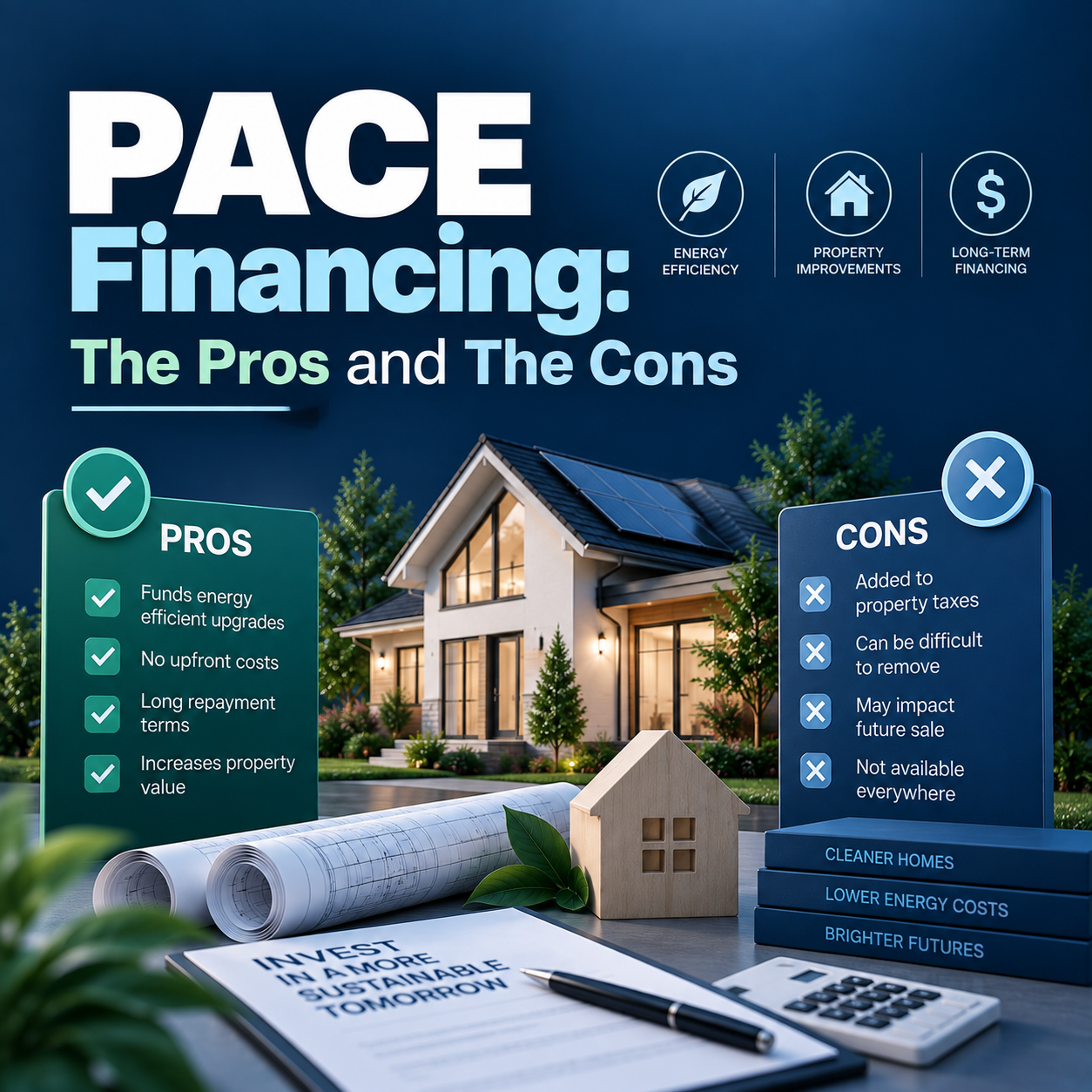
PACE Financing: The Cons
Higher cost than most solar loans. PACE rates of 5% to 9% often run higher than a solar loan through a credit union or a HELOC secured against home equity. Over a 20 or 25 year term, that gap adds up to thousands of dollars in extra interest.
PACE liens can take first position ahead of your mortgage. This is the single biggest risk to understand. In many PACE programs, the assessment lien has senior priority over your existing mortgage. That means if your home is ever foreclosed, the PACE lender gets paid before your mortgage lender.
Fannie Mae, Freddie Mac, FHA, and VA restrict PACE liens. Because of that senior lien position, federal mortgage rules generally block these agencies from buying or insuring a mortgage on a home with a first lien PACE assessment still outstanding. This creates two real problems. First, if you want to refinance your current mortgage, your lender will likely require you to pay off the PACE balance as part of the refinance. Second, if you want to sell, your buyer may be unable to get a conventional, FHA, or VA loan unless the PACE balance is paid off or subordinated at closing.
Selling can get complicated. Some buyers can absorb a transferring PACE assessment. Many cannot, because their lender will not approve the loan with the lien in place. That can shrink your buyer pool, slow down a sale, or force you to pay off the balance out of your sale proceeds.
New federal disclosure and repayment rules took effect March 1, 2026. The Consumer Financial Protection Bureau finalized a rule that applies standard Truth in Lending Act protections to residential PACE loans, including an ability to repay requirement and new disclosure forms similar to a mortgage Loan Estimate. This is a meaningful consumer protection improvement. It does not, however, change the underlying lien priority issue described above. That structural risk remains part of how PACE works.
Missed payments put your home at risk faster than a typical loan. Because PACE payments ride on your property tax bill, missing a payment is treated like missing property taxes. That can lead to tax lien penalties and, in serious cases, foreclosure, on a faster timeline than a missed personal loan payment would trigger.
Section 04
PACE vs. a Standard Solar Loan vs. a HELOC
Every homeowner’s numbers look different depending on credit score, home equity, and system cost. The table below uses one illustrative example so you can see how the structures differ. It is not a quote and your actual terms will vary by lender and location.
Assumptions used in this example: $26,000 solar system, homeowner with average home equity and a credit score in the high 600s to low 700s.
| Factor | PACE Financing | Solar Loan (Credit Union) | HELOC |
|---|---|---|---|
| Qualification basis | Program-specific criteria plus a federally required ability-to-repay determination; some programs don’t weigh FICO as the main factor | Traditional credit check and underwriting | Traditional credit check and underwriting |
| Typical rate range | 5% to 9%, fixed | 5.9% to 8%, fixed | 7% to 9%, variable |
| Down payment | Usually $0 | Usually $0 | Depends on available equity |
| Typical term | 10 to 25 years | 5 to 20 years | 10 to 20 years, often with a draw period |
| Repaid through | Property tax bill | Direct loan payment | Direct loan payment |
| Lien position | Often senior to your mortgage | Not a property lien in most cases | Junior to your first mortgage |
| Effect on refinancing | Often must be paid off first | No direct effect | Must be accounted for in new loan payoff |
| Best fit for | Homeowners whose FICO score doesn’t fit standard loan criteria but who can show ability to repay under applicable requirements | Homeowners with decent credit who want a simple fixed loan | Homeowners with strong home equity who want the lowest realistic rate |
A quick note on installer-offered solar loans specifically. Some come with an advertised rate that looks lower than a credit union loan, but include a hidden dealer fee, often 20% to 25% of the system cost, rolled into the loan balance. Always ask for the total financed amount, not just the advertised rate, before comparing offers.
Section 05
How PACE Financing Interacts With Your Mortgage
This is the part most homeowners miss. A PACE assessment is not a second mortgage. It behaves more like an unpaid property tax bill that happens to fund a home improvement. That distinction matters in three specific situations.
Buying a home with an existing PACE assessment. If you are purchasing a home that already carries a PACE lien, your lender will likely require it to be paid off at closing, or ask the seller to subordinate it, before approving a Fannie Mae, Freddie Mac, FHA, or VA loan. Budget for this if you are house hunting in a state with active PACE programs.
Refinancing your own mortgage after adding PACE financing. If you took out a PACE assessment and later want to refinance, expect your lender to require payoff of the PACE balance as part of the transaction. This is standard guidance from Fannie Mae for loans it purchases.
Selling your home. You can sell with a PACE balance outstanding, but your buyer’s financing options may be limited. Cash buyers and some portfolio lenders can work around it. Conventional, FHA, and VA buyers generally cannot, unless the balance is settled at or before closing.
None of this means PACE financing is a bad choice for every homeowner. It means you should treat it as a decision that affects your property, not just your solar installation, and plan around that from day one.
Who PACE Financing Actually Makes Sense For
PACE financing tends to fit a narrow group of homeowners well.
- Your FICO score doesn’t fit a standard solar loan or HELOC’s criteria, but you have meaningful home equity and can demonstrate ability to repay under the applicable PACE program and federal requirements.
- You plan to stay in the home for the full term of the assessment and are not planning to refinance your mortgage soon.
- You have confirmed your specific PACE program’s lien position and understand whether it sits senior or junior to your mortgage.
- You have compared the total cost, principal plus interest over the full term, against a standard solar loan and still come out ahead or accept the tradeoff for the different qualification path.
If none of those apply to you, a standard solar loan or a HELOC is usually the more flexible and often cheaper path.
Section 06
Questions to Ask Before You Sign a PACE Agreement
Ask your PACE administrator or contractor these questions directly, and get the answers in writing.
- Does this program’s assessment take lien priority over my existing mortgage?
- What is the total amount I will repay, principal plus interest, over the full term?
- What happens to the balance if I sell my home before the term ends?
- Will this assessment affect my ability to refinance my mortgage?
- What happens if I miss a payment? What is the timeline before penalties or foreclosure risk begin?
- Is the interest portion of my payment actually tax deductible, or is that only a possibility depending on my situation?
A legitimate PACE program and a reputable contractor will answer these clearly. If you get vague answers, or pressure to sign quickly, treat that as a warning sign.
Section 07
Frequently Asked Questions
Is PACE financing the same as a solar loan?
No. A solar loan is a personal loan or a secured loan tied to you as the borrower, repaid directly to a lender. PACE financing is a property tax assessment tied to the home itself, repaid through your property tax bill, with different lien rules and different effects on your mortgage.
Does PACE financing require a credit check?
Not necessarily a traditional credit check, but that doesn’t mean there’s no underwriting. As of March 1, 2026, federal rules require PACE lenders to make a reasonable, good-faith determination of your ability to repay, based on verified financial information rather than a FICO score alone. Some programs weigh your home equity and property tax payment history heavily, but you still need to show you can afford the payments.
Can I still get a mortgage or refinance if I have a PACE lien?
It depends on the lien’s position and your lender. If the PACE assessment holds senior lien priority, Fannie Mae, Freddie Mac, FHA, and VA guidelines generally require it to be paid off or subordinated before your loan can be approved or refinanced. Confirm your specific program’s lien terms with your lender before assuming either way.
What states offer residential PACE financing?
Residential PACE programs are most established in California, Florida, and Missouri. Some other states have authorized programs at the local level, so availability depends heavily on your specific city and county, not just your state.
What happens to my PACE balance if I sell my house?
The balance can transfer to the new owner in many cases, since the assessment is tied to the property. Whether that actually happens depends on your buyer’s financing. A cash buyer or certain portfolio lenders may accept the transfer. Conventional, FHA, and VA buyers generally cannot, unless the balance is paid off or subordinated at closing.
Are PACE interest rates higher than a regular solar loan?
Often, yes. PACE rates typically run from 5% to 9%. A well qualified borrower can often find a lower rate through a credit union solar loan or a HELOC secured by home equity. PACE tends to cost more in exchange for a qualification path that doesn’t hinge primarily on a FICO score.
Did new rules change how PACE loans work in 2026?
Yes. A federal rule from the Consumer Financial Protection Bureau took effect March 1, 2026. It applies standard Truth in Lending Act protections to residential PACE transactions, including an ability to repay requirement and new mortgage style disclosures. It improves transparency and borrower protection. It does not change the underlying lien priority that PACE assessments typically hold over a first mortgage.
Section 08
The Bottom Line
PACE financing offers a qualification path for homeowners whose FICO score doesn’t fit a standard solar loan or HELOC’s criteria. It doesn’t skip an assessment of your ability to pay, though: as of March 1, 2026, federal rules require PACE lenders to verify you can reasonably afford the payments before approving the assessment. No down payment is a genuine advantage. But the tradeoff is structural, not just financial. A senior lien position can complicate your ability to refinance or sell, and the interest rate is often higher than what a qualified borrower could get elsewhere.
Before you choose PACE financing, run the total cost against a standard solar loan or a HELOC, confirm the lien position with your specific program, and think through how it affects your next mortgage move, whether that is a refinance in five years or a sale in ten. The panels will save you money on your power bill either way. How you finance them determines what else that savings costs you.
Want to know what your monthly housing payment might be so you can estimate your DTI? Try the Wonder Rates team’s mortgage calculator before you talk to a loan officer.
Disclaimer: This content is for educational purposes only and is not financial, tax, or legal advice. PACE program rules, interest rates, and lien priority vary by state, county, and program administrator. Confirm current terms with your specific PACE program and consult a licensed lender or tax professional before making a financing decision.
Duc Pham, Mortgage Broker | NMLS# 844897,
Wonder Rates, Inc. | NMLS# 1518655 | DRE# 02047445 | DFPI# 60DBO-59134 |
Equal Housing Opportunity. Equal Housing Lender. |
Licensed in: AL, AZ, CA, CO, FL, GA, LA, MI, NC, OH, OK, OR, PA, SC, TX, VA, WA.