Section 01
Many independent contractors, freelancers, and gig workers assume they cannot qualify for a mortgage because they do not receive a traditional W-2 paycheck.
The good news is that receiving Form 1099 does not automatically prevent you from buying a home. Mortgage lenders regularly approve loans for borrowers with 1099 income. The key difference is how your income is documented and evaluated during underwriting.
This guide explains how mortgage lenders view 1099 income, what documents you may need, and practical ways to prepare before applying.
Section 02
What Is a 1099 Worker?
A 1099 worker is generally someone who earns income as an independent contractor, freelancer, or sole proprietor, rather than as a traditional employee. Instead of receiving a W-2 that reports wages and withheld taxes, a 1099 worker typically receives IRS Form 1099-NEC from clients or businesses that paid them for services during the year.
The main distinctions come down to how the work relationship is structured:
- Employee: Works under an employer’s direction, receives a W-2, and has taxes withheld automatically.
- Independent contractor: Provides services under a contract, is generally responsible for their own taxes, and receives Form 1099-NEC.
- Freelancer: Often works with multiple clients on a project basis, typically also receiving 1099 forms.
- Sole proprietor: Runs an unincorporated business, generally reporting business income and expenses on Schedule C of their personal tax return.
1099 income is common across many occupations, including real estate agents, insurance agents, consultants, truck drivers, delivery drivers, freelance designers, software developers, healthcare contractors, and home inspectors.
Section 03
Can You Get a Mortgage with 1099 Income?
Yes. Lenders approve mortgages for self-employed and 1099 borrowers regularly, every year, across nearly every loan program available.
Employment classification alone does not determine mortgage eligibility. What matters most is whether your income can be documented as stable and likely to continue, along with the rest of your financial profile, including credit, assets, and debt.
Section 04
Why 1099 Borrowers Are Evaluated Differently
Traditional W-2 employees receive a fixed salary or hourly wage, with income that is generally straightforward to verify through pay stubs and W-2 forms.
1099 workers often have a different income structure:
- Income can vary from month to month or year to year
- Business expenses reduce taxable income
- Tax deductions can significantly lower the income reported on tax returns
Because of these differences, lenders need a more detailed review to determine whether 1099 income is stable and likely to continue, rather than relying on a single pay stub or employer letter.
Section 05
How Lenders Calculate 1099 Income
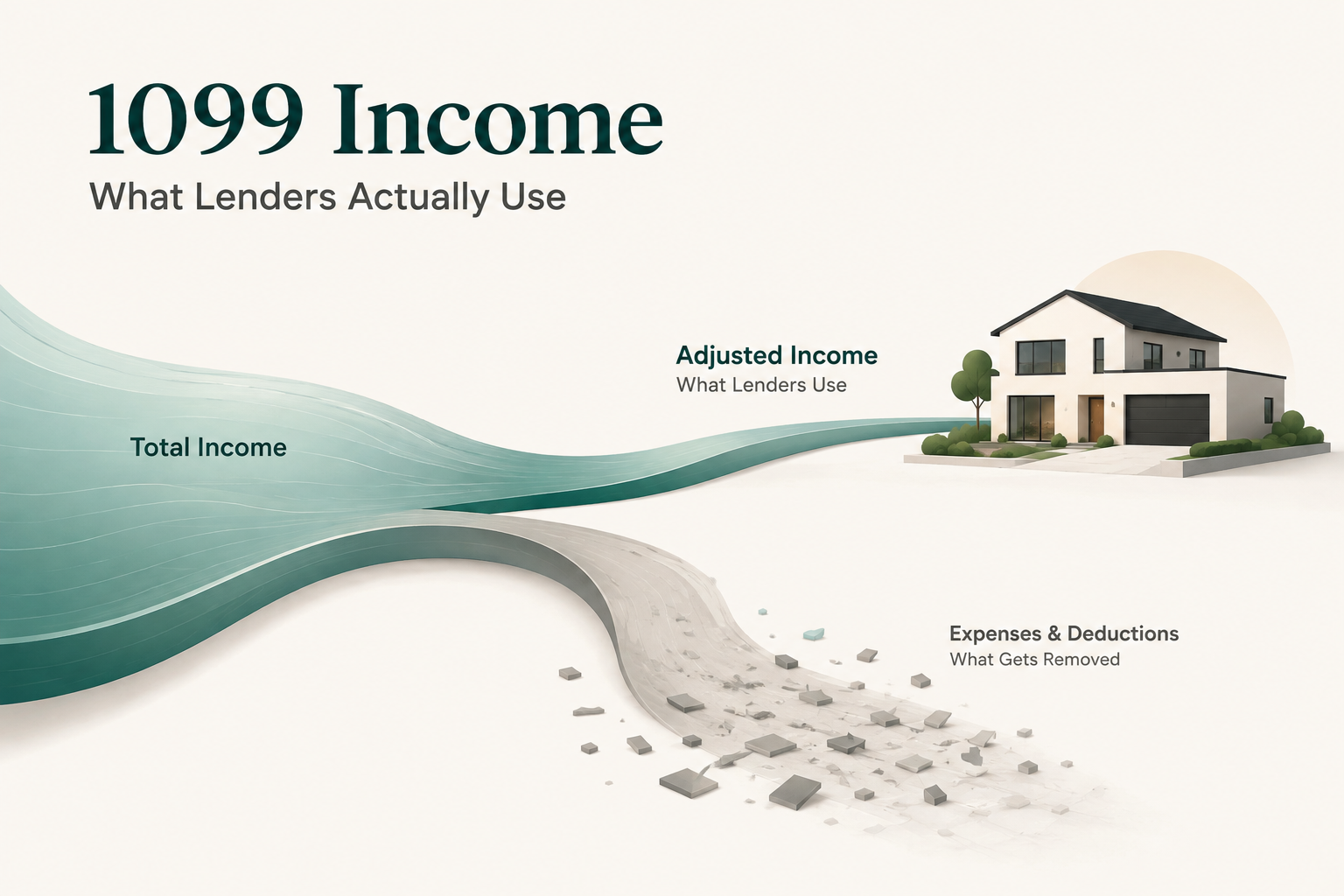
A common misconception is that lenders use gross income, meaning total revenue before any expenses, when qualifying a 1099 borrower. That is generally not the case.
Instead, underwriters typically review your adjusted business income, meaning income after eligible business expenses have been deducted, based on the applicable underwriting guidelines for your loan program.
This calculation often involves:
- Net income: The income remaining after business expenses are subtracted from gross revenue, as reported on your tax returns.
- Tax deductions: Legitimate business write-offs that reduce your taxable income.
- Depreciation: A non-cash expense that reduces taxable income but does not represent actual cash leaving your business.
- One-time expenses: Expenses that occurred once and are not expected to recur, which may be treated differently depending on the loan program.
- Business write-offs: General deductions taken against business income.
Certain non-cash deductions, such as depreciation, may be added back to your income in some underwriting calculations, since they do not reflect an actual reduction in cash flow. Whether and how this applies depends on the specific loan program and investor guidelines involved.
Section 06
Example: How Income May Be Calculated
Illustrative example 1: Basic net income calculation
Gross income: $150,000
Business expenses: $55,000
Taxable income: $150,000 minus $55,000 = $95,000
In many cases, it is this taxable income figure, not the original gross revenue, that becomes the starting point for calculating qualifying income. This is why a borrower’s qualifying income for mortgage purposes can look quite different from their total business revenue. This example is illustrative only and uses simplified, hypothetical numbers. It does not represent an actual underwriting calculation or guaranteed qualifying income.
Illustrative example 2: Large depreciation expense
A borrower’s tax return may show a large depreciation deduction that significantly lowers their taxable income. Because depreciation is a non-cash expense, meaning no actual money left the business for it, some underwriting guidelines allow all or part of that amount to be added back when calculating qualifying income. This example is illustrative only. Whether a specific expense can be added back, and by how much, depends on the loan program, investor guidelines, and the specific details of the borrower’s tax returns, and should be reviewed directly with a licensed mortgage professional.
Section 07
How Long Do You Need to Be Self-Employed?
A common general guideline across much of the mortgage industry is two years of self-employment history, generally documented through two years of tax returns.
That said, exceptions can apply. Some loan programs may consider a shorter history, such as one year of self-employment, in certain situations, particularly when the borrower has related prior experience in the same field or line of work, and when other specific guideline requirements are met. Continuity between a borrower’s previous employment and their current self-employment can sometimes support this kind of exception.
Meeting a minimum self-employment history is not, by itself, a guarantee of approval. It is one of several factors lenders review as part of a complete underwriting evaluation.
Section 08
Documents You May Need
| Document | Why It Matters |
|---|---|
| Personal tax returns | Typically the primary source lenders use to verify self-employed income over time |
| Business tax returns | Required when the business is structured as its own tax-filing entity, such as a partnership or corporation |
| 1099 forms | Show income reported to you by clients or businesses during the year |
| Profit and Loss Statement | Provides a more current snapshot of business performance, often requested alongside tax returns |
| Business license | Helps verify that the business is active and properly registered |
| CPA letter | Sometimes requested to confirm details about the business structure or income, depending on the situation |
| Bank statements | Used to review cash flow and confirm deposits align with reported income |
| Year-to-date income documentation | Helps show more recent income trends beyond the most recent tax filing |
| Asset statements | Used to verify funds available for down payment, closing costs, and reserves |
Not every borrower will need every document listed here. The specific documentation required depends on your lender, loan program, and individual financial situation.
Section 09
Common Challenges for 1099 Borrowers
High Business Deductions
Legitimate business deductions lower your taxable income, which can also lower the income a lender uses to qualify you, even if your actual cash flow is strong.
Inconsistent Income
Seasonality, commission-based work, or bonus-heavy income can create year-to-year or month-to-month variation that lenders need to evaluate carefully.
Recent Self-Employment
A limited self-employment history can make it harder to demonstrate a stable income trend, though certain exceptions may apply depending on the loan program and your background.
Large Deposits
Large or unusual deposits into personal or business bank accounts often require additional documentation to confirm their source.
Mixing Personal and Business Expenses
When personal and business finances are not clearly separated, it can make it more difficult for underwriters to get a clear picture of your actual business income and expenses.
Section 10
Tips to Strengthen Your Mortgage Application
- Organize tax documents early. Having clean, complete tax returns ready can help streamline the underwriting process.
- Separate business and personal finances. Using dedicated business accounts can make your income and expenses easier to document and verify.
- Avoid unnecessary write-offs before applying. Because deductions can lower your qualifying income, it may be worth discussing timing with your CPA before making major tax strategy decisions. This is not a recommendation to change how you file your taxes, only a general point of awareness. Always consult a qualified CPA or tax professional regarding your specific tax strategy.
- Maintain healthy cash reserves. Reserves can serve as a compensating factor for some self-employed files.
- Improve your credit score. A stronger credit profile can support your overall application.
- Reduce debt. Lowering your debt-to-income ratio can strengthen your file.
- Avoid opening new credit accounts shortly before or during the mortgage process.
- Keep business income consistent where possible, since stability is a central part of how self-employed income is evaluated.
- Discuss your situation before shopping for homes, so you understand your likely qualifying income ahead of time.
Section 11
Loan Programs That May Work for 1099 Borrowers
- Conventional loans: Widely used by self-employed borrowers who can document steady income through tax returns.
- FHA loans: May offer flexibility for certain self-employed borrowers, subject to program guidelines.
- VA loans: Available to eligible veterans, active-duty service members, and certain surviving spouses who are self-employed and meet program requirements.
- USDA loans: May be an option for eligible self-employed borrowers purchasing in eligible rural or certain suburban areas.
- Bank statement loans: Designed specifically for self-employed borrowers, using bank deposits rather than tax returns to help demonstrate income, often useful when tax returns show significant deductions.
- Non-QM loans: A broader category of loan programs outside standard conventional and government guidelines, which can sometimes accommodate more complex or non-traditional income situations.
The right program depends on your income documentation, credit profile, and overall financial picture. A licensed mortgage professional can help match your situation to the appropriate program.
Section 12
1099 vs. W-2 Borrowers
| 1099 Borrower | W-2 Borrower | |
|---|---|---|
| Employment | Independent contractor or self-employed | Traditional employee |
| Income documentation | Tax returns, 1099 forms, often a Profit and Loss Statement | Pay stubs, W-2 forms, employer verification |
| Tax returns required | Typically yes, often two years | Sometimes requested, but not always the primary source |
| Income stability review | More detailed, due to variable income and deductions | Generally more straightforward to verify |
| Typical documentation burden | Higher | Lower |
| Flexibility in loan programs | Multiple options, including programs designed specifically for self-employed borrowers | Broad access to standard conventional and government-backed programs |
| Approval considerations | Net income after deductions, business continuity, income trend | Verified salary or wages, employment history |
Section 13
What If Your Tax Returns Show Low Income?
This is a very common concern among self-employed borrowers.
Legitimate business deductions reduce your taxable income, which can help at tax time but may also reduce the income a lender uses to qualify you for a mortgage. This can be frustrating for business owners whose actual cash flow is stronger than their taxable income suggests.
Some borrowers in this situation explore alternatives such as bank statement loan programs, which evaluate income based on bank deposits rather than tax returns. Whether this or another option is a good fit depends on your specific financial picture, and it does not guarantee approval. A licensed mortgage professional can review your tax returns and bank statements together to help identify which programs may be worth exploring.
Section 14
Should You Delay Buying a Home?
In some situations, waiting before applying may help, such as when a borrower wants to:
- Improve their credit score
- Build additional cash reserves
- Establish a longer self-employment income history
- Reduce their debt-to-income ratio
That said, waiting is not always necessary. Many self-employed borrowers qualify for a mortgage with their current income and documentation. The best way to know whether waiting makes sense for your situation is to review your specific numbers with a licensed mortgage professional.
Section 15
When Should You Talk to a Mortgage Professional?
It is generally worth speaking with a mortgage professional early if your situation includes:
- Complex or layered income sources
- Multiple businesses
- A combination of 1099 and W-2 income
- Rental income
- Commission income
- Recent business growth or significant changes in income
A mortgage professional can help you understand how your specific income picture is likely to be evaluated before you begin house hunting.
Section 16
Common Myths About 1099 Mortgages
Myth: You Cannot Get a Mortgage with 1099 Income
Reality: Many lenders offer mortgage programs designed for self-employed and independent contractor borrowers, provided the income is stable and well documented.
Myth: Gross Revenue Is the Income Lenders Use
Reality: Underwriters generally evaluate qualifying income based on tax returns and applicable underwriting guidelines, not simply total business revenue.
Myth: All 1099 Borrowers Need Exactly Two Years of Self-Employment
Reality: Two years is a common benchmark, but some loan programs may consider a shorter self-employment history when a borrower meets specific guideline requirements, such as prior experience in the same field. Whether an exception applies depends on the lender and loan program.
Section 17
Final Thoughts
Receiving Form 1099 does not prevent you from qualifying for a mortgage. What matters most is demonstrating stable, well-documented income and meeting the lender’s underwriting requirements.
Preparing your financial documents early and understanding how lenders evaluate self-employed income can help make the mortgage process smoother and reduce surprises during underwriting.
Section 18
Sources
- IRS Form 1099-NEC Instructions
- IRS Publication 334 (Tax Guide for Small Business)
- Fannie Mae Selling Guide (Self-Employment Income)
- Freddie Mac Seller/Servicer Guide
- Consumer Financial Protection Bureau (CFPB)
- U.S. Department of Housing and Urban Development (HUD)
- U.S. Department of Veterans Affairs (VA)
- U.S. Department of Agriculture (USDA)
- Official lender underwriting guidelines, where applicable
This article is intended for educational purposes only. Mortgage qualification for borrowers with 1099 income depends on multiple factors, including income history, documentation, loan program requirements, credit profile, assets, and underwriting guidelines. The examples in this guide are simplified illustrations and should not be interpreted as approval criteria or lending requirements.
Wonder Rates, Inc. (NMLS #1518655) is an Equal Housing Lender. All mortgage applications are subject to credit approval, underwriting review, property eligibility, and applicable lending guidelines. Loan programs, documentation requirements, interest rates, and qualification standards may change without notice. This article is not intended as financial, tax, or legal advice. Borrowers should consult with a licensed mortgage professional, tax advisor, or attorney regarding their individual circumstances.
Duc Pham, Mortgage Broker | NMLS# 844897, Wonder Rates, Inc. | NMLS# 1518655 | DRE# 02047445 | DFPI# 60DBO-59134 | Equal Housing Opportunity. Equal Housing Lender. | Licensed in: AL, AZ, CA, CO, FL, GA, LA, MI, NC, OH, OK, OR, PA, SC, TX, VA, WA.