
Section 01
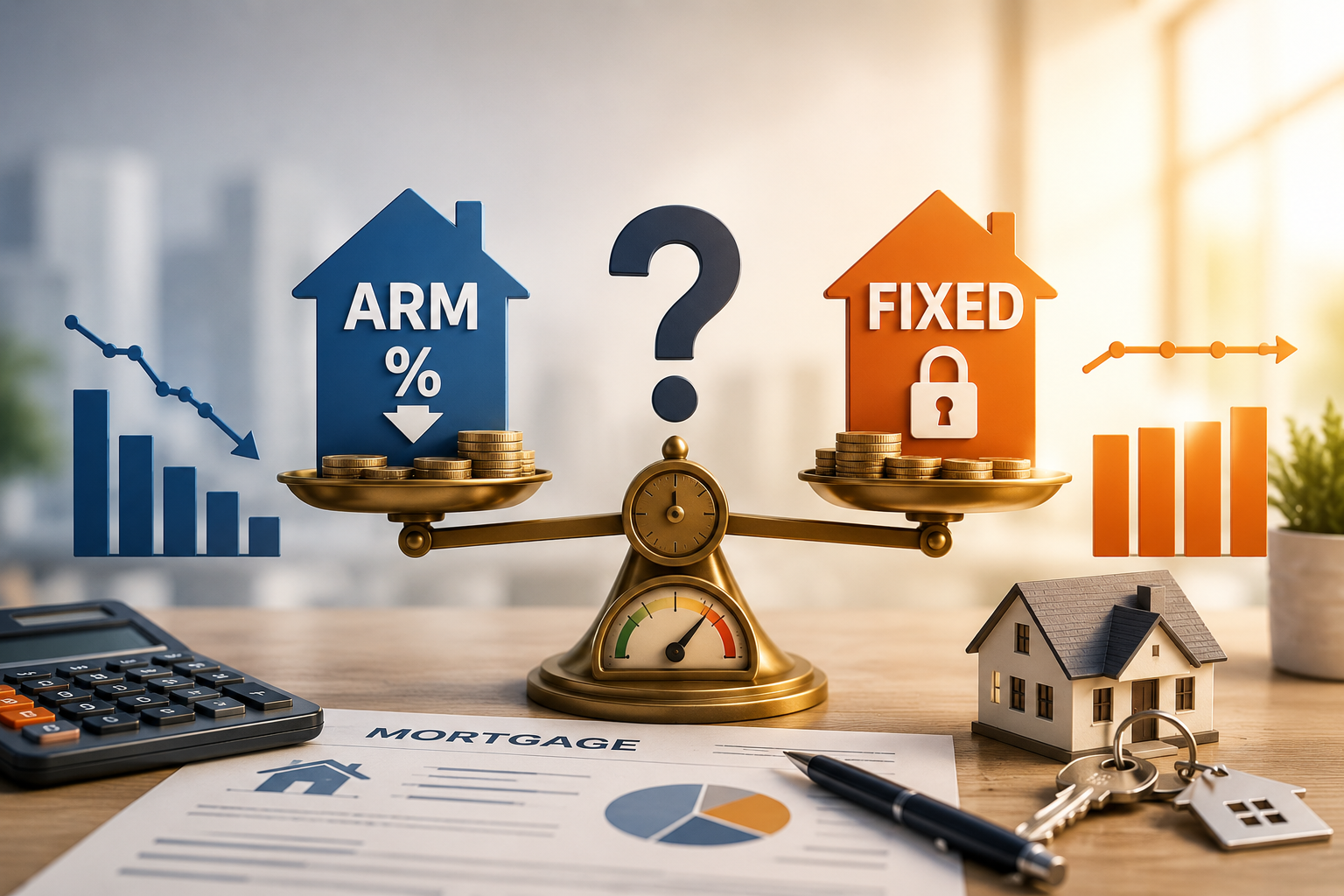
Choosing an ARM vs fixed rate mortgage 2026 is one of the biggest financing decisions many homebuyers will make this year.
For most of the past decade, choosing between an adjustable-rate mortgage (ARM) and a fixed-rate mortgage was relatively simple. Fixed rates stayed low enough that the small savings from an ARM rarely justified taking on future rate uncertainty.
That equation has changed.
As of July 2, 2026, the average 30-year fixed mortgage rate was 6.43%, according to Freddie Mac’s Primary Mortgage Market Survey. Meanwhile, many ARM products have been pricing roughly 0.75% to 1% lower for qualified borrowers.
On a $600,000 mortgage, that difference can translate into approximately $280 to $380 less per month during the initial fixed period.
That is no longer a small number.
Rather than automatically choosing one loan over another, buyers should understand when each option makes financial sense.
Section 02
Why ARM vs Fixed Rate Mortgage Decisions Changed in 2026
Over the last several years, the spread between ARM rates and 30-year fixed rates remained relatively small.
When both products were sitting near historic lows, the payment savings from an ARM often were not enough to justify the possibility of future adjustments.
Today’s market looks different.
Fixed mortgage rates have remained elevated while many adjustable-rate mortgages have become noticeably cheaper during their introductory fixed period.
According to Bank of America, ARM applications have climbed to their highest share since 2023 as more buyers compare monthly payment savings instead of focusing only on long-term rate stability.
A difference of nearly one percentage point may sound modest, but over the first five years of ownership it can represent tens of thousands of dollars in lower interest costs for some borrowers.
That makes running both scenarios worthwhile instead of automatically choosing a 30-year fixed mortgage.
Section 03
How an Adjustable Rate Mortgage (ARM) Works
One of the biggest misconceptions about adjustable-rate mortgages is that the interest rate changes immediately.
It does not.
Every ARM begins with a fixed-rate period.
Common products available in 2026 include:
- 5/1 ARM
- 7/1 ARM
- 10/1 ARM
The first number tells you how long the interest rate remains fixed.
The second number tells you how often it can adjust after that period ends.
For example, a 5/1 ARM keeps the same rate for the first five years.
Beginning in year six, the rate adjusts once per year based on a benchmark index such as the Secured Overnight Financing Rate (SOFR) plus a fixed lender margin.
Importantly, ARMs are not unlimited.
Most include three levels of protection:
- Initial adjustment cap – limits how much the rate can rise at the first adjustment.
- Periodic adjustment cap – limits future annual increases.
- Lifetime cap – limits the maximum increase over the life of the loan.
For example:
A borrower starts with a 5.625% ARM.
If the loan includes a 2/1/5 cap structure, the first adjustment cannot exceed 7.625%, annual adjustments afterward are limited, and the lifetime maximum would be 10.625%.
Understanding these caps is an important part of comparing an ARM vs fixed rate mortgage 2026 because they define your potential worst-case payment.
For additional information about SOFR, see the Federal Reserve’s explanation of the Secured Overnight Financing Rate (SOFR).
Section 04
When an ARM Makes Sense in 2026
An adjustable-rate mortgage is not better than a fixed-rate mortgage for everyone.
However, there are situations where it becomes a very reasonable financial strategy.
You expect to move before the adjustment period
Suppose you expect to own the property for only five to seven years.
If your loan is a 7/1 ARM, you may sell the home before the first adjustment ever occurs.
In that case, you receive the benefit of the lower introductory rate without ever experiencing an adjustment.
You believe refinancing is a realistic possibility
Some borrowers intentionally use an ARM as a bridge strategy.
The idea is simple:
- enjoy the lower payment today
- refinance into a fixed-rate loan later if market rates improve
No one can predict future interest rates, so refinancing should never be considered guaranteed.
However, for borrowers with stable income and good credit, it may be one reasonable planning scenario rather than pure speculation.
Monthly payment affects qualification
Sometimes qualifying is the issue.
A payment based on a 5.6% ARM may qualify under debt-to-income guidelines, while the same borrower using a 6.4% fixed-rate mortgage may not.
In those situations, the ARM becomes more than a preference.
It becomes a practical financing solution that allows the purchase to happen today.
You plan to buy a starter home
Many first-time buyers expect to upgrade within several years.
If your anticipated ownership period fits entirely inside the ARM’s fixed period, the lower payment may better match your actual homeownership timeline.
As always, compare this decision with how buyers think about rate decisions before assuming waiting for lower rates is automatically the better financial choice. (Internal link: Why Waiting for Lower Rates Can Cost More Than a Higher Mortgage Payment.)
Section 05
When a Fixed Rate Mortgage Makes More Sense
While an adjustable-rate mortgage can be the right choice in certain situations, a fixed-rate mortgage continues to make more sense for many buyers in 2026.
You plan to stay in the home for many years
If this is your long-term or forever home, payment stability often outweighs the initial savings an ARM may provide.
A fixed-rate mortgage gives you one interest rate and one principal-and-interest payment for the life of the loan. You never have to worry about annual rate adjustments or changing monthly payments because market rates increased.
You prefer payment certainty
Some buyers simply sleep better knowing exactly what their mortgage payment will be year after year.
If an increase in your housing payment would create financial stress, paying a slightly higher rate today may be worth the peace of mind.
A predictable payment also makes long-term budgeting easier, especially for families planning around childcare, education, retirement, or other major financial goals.
Your refinance plans are uncertain
Some borrowers choose an ARM expecting to refinance before the first adjustment.
That strategy can work but only if refinancing is available when the time comes.
Future interest rates, home values, income changes, employment, and credit scores can all affect whether refinancing is possible.
If your long-term financial situation is difficult to predict, a fixed-rate mortgage removes that uncertainty.
Section 06
ARM vs Fixed Rate Mortgage 2026: A Simple Decision Framework
If you are comparing an ARM vs fixed rate mortgage 2026, start with these four questions instead of focusing only on today’s interest rate.
1. How long do you realistically expect to own this home?
If you expect to sell within five to seven years, an ARM deserves serious consideration.
If you plan to own the property much longer, a fixed-rate mortgage often provides greater long-term stability.
2. What is the actual monthly payment difference?
National average rates are helpful, but they are not your rate.
Ask your loan officer to compare both options using your actual loan amount, credit profile, down payment, and property type.
A difference of only half a percent could mean hundreds of dollars each month.
3. Could you comfortably afford the payment if the ARM adjusted?
Understanding the maximum possible payment is just as important as understanding today’s payment.
Ask your loan officer to calculate the payment using the loan’s adjustment caps so you know what the highest realistic payment could look like.
4. Does the loan fit your overall financial plan?
The lowest payment is not always the best financial decision.
Think about:
- your emergency savings
- future career plans
- expected time in the home
- other monthly obligations
- retirement goals
Just as importantly, consider how payment fits into your real monthly budget, not simply the maximum amount a lender is willing to approve.
Section 07
Current Mortgage Rates (July 2026)
According to the Freddie Mac Primary Mortgage Market Survey, the national average 30-year fixed mortgage rate was 6.43% for the week ending July 2, 2026.
The average 15-year fixed mortgage rate was 5.79%.
ARM pricing varies by lender, product, loan size, and borrower qualifications. For many well-qualified borrowers, the spread between a 30-year fixed mortgage and a 5/1 ARM has recently been around 0.75% to 1%.
Because mortgage pricing changes daily, buyers should compare personalized loan estimates rather than relying only on national averages.
Section 08
The Bottom Line
There is no universal winner in the ARM vs fixed rate mortgage 2026 discussion.
The better loan depends on your timeline, financial goals, risk tolerance, and how long you realistically expect to keep the mortgage.
For buyers planning to move within the ARM’s initial fixed period, the payment savings may be meaningful enough to justify considering an adjustable-rate mortgage.
For buyers planning to stay in their home for many years, or those who value payment certainty above all else, a fixed-rate mortgage may still be the better long-term fit.
The important step is not choosing the product with the lower advertised rate.
It is understanding how each option fits your financial plan before you commit.
Section 09
Want to Compare Both Options Using Your Numbers?
Every borrower’s situation is different.
A Wonder Rates loan officer can compare an ARM and a fixed-rate mortgage side by side using your actual purchase price, down payment, credit profile, and expected timeline, so you can understand the payment difference before making a decision.
Duc Pham, Mortgage Broker | NMLS# 844897
Wonder Rates, Inc. | NMLS# 1518655
Equal Housing Lender.
This content is provided for educational purposes only and is not a commitment to lend. Mortgage approval depends on creditworthiness, income verification, property eligibility, and current underwriting guidelines. Interest rates, loan programs, and terms may change without notice. ARM products, adjustment caps, and qualification requirements vary by lender and loan program. Please consult a qualified loan officer regarding your specific financial situation.