
Section 01
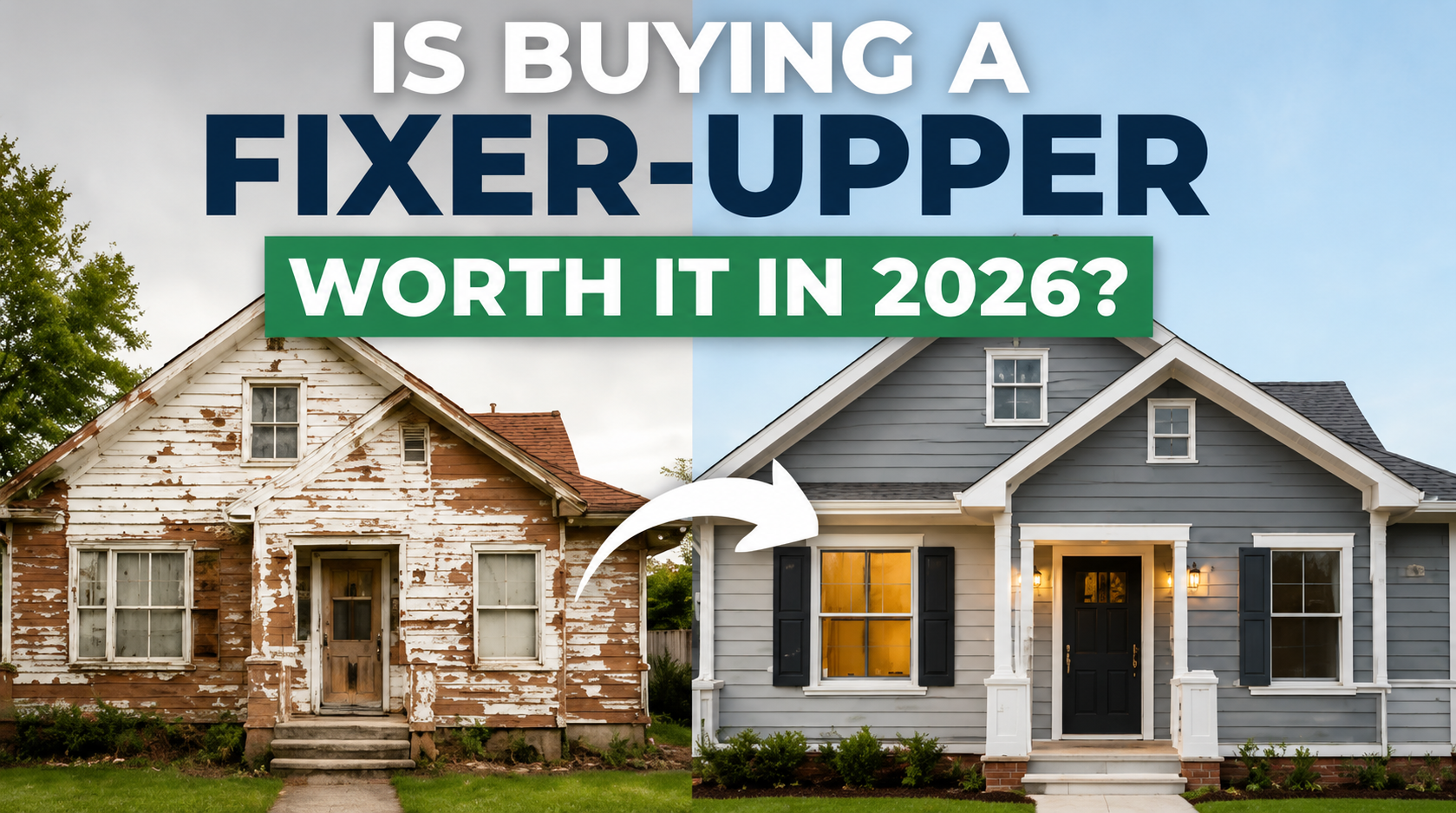
Buying a fixer-upper can be worth it if the purchase price, renovation costs, and potential future value align. However, buyers should consider unexpected repairs, financing requirements, and project delays before making an offer.
The appeal of a fixer-upper is easy to understand: a lower purchase price, the potential to build equity through renovations, and the ability to customize a home.
But a fixer-upper can also become an expensive mistake if buyers underestimate repair costs, renovation timelines, and financing challenges. The difference often comes down to understanding the risks before making an offer, not after the work begins.
Here is what first-time buyers should know before deciding whether a fixer-upper makes sense in 2026.
Section 02
When a Fixer-Upper Actually Makes Financial Sense
The math on a fixer-upper adds up when three things are true:
- The purchase price is much lower than similar move-in-ready homes nearby.
- Renovation costs are estimated accurately, with a good contingency.
- The after-repair value supports the total investment.
When all three align, buying a fixer-upper may provide an opportunity to build equity compared with buying a move-in-ready home at market price.
Here is a simplified example. A move-in-ready home in a neighborhood sells for $350,000. A comparable fixer-upper on the same street is listed at $285,000 and needs approximately $45,000 in renovation work.
Total investment: $330,000 before accounting for closing costs, financing expenses, and any unexpected renovation costs that may arise. If the renovated home appraises at $350,000 or higher, the buyer may have built approximately $20,000 in potential equity if the home’s appraised value supports that valuation.
That is the scenario fixer-upper advocates describe. It is real and it happens. But it requires all three variables to go right, and in practice, at least one of them usually does not.
Section 03
The Real Costs Most First-Time Buyers Underestimate
The purchase price is visible. The renovation costs are where most buyers get into trouble.
Contractor estimates are starting points, not final numbers. Every experienced renovator knows that once walls open and floors come up, surprises appear. Older wiring that needs replacing. Plumbing that does not meet current code. A subfloor that looked solid from above but is not. Hidden water damage behind a wall that was freshly painted before listing.
Many renovation professionals recommend building a contingency reserve of 15% to 30% because unexpected costs can arise during construction, with older homes and larger projects more likely to land at the higher end of that range. A buyer who budgets $45,000 based on a contractor quote and does not build in a contingency may find themselves at $55,000 to $60,000 by the time the work is done.
| Initial Budget | 15% Contingency | 25% Contingency | 30% Contingency |
|---|---|---|---|
| $30,000 | $34,500 | $37,500 | $39,000 |
| $45,000 | $51,750 | $56,250 | $58,500 |
| $60,000 | $69,000 | $75,000 | $78,000 |
| $80,000 | $92,000 | $100,000 | $104,000 |
Contingency figures are illustrative guidelines based on general industry experience. Actual cost overruns vary significantly by project scope, property age, contractor, and unforeseen conditions.
The $20,000 equity from the earlier example disappears quickly if renovation costs run $10,000 to $15,000 over budget. And if carrying costs during renovation, meaning mortgage payments on a home you cannot yet live in, are also not accounted for, the math gets tighter still.
Section 04
What the Market Looks Like for Fixer-Uppers in 2026
The fixer-upper opportunity in 2026 is real but more competitive than it was a few years ago.
Inventory remains limited in many markets, which means fixer-uppers can still attract interest from buyers looking for value opportunities. The days of a fixer-upper sitting on the market for months at a steep discount because no one wanted the hassle are less common in high-demand areas.
Buyers looking for a true bargain on a fixer-upper may need to consider markets or neighborhoods with lower overall demand. However, this introduces another risk: buying in an area where the ARV ceiling limits how much of the renovation investment can actually be recovered.
Construction and material costs have remained elevated. Labor shortages in skilled trades, including electricians, plumbers, and HVAC technicians, persist in many markets. A renovation budget that would have covered specific work two or three years ago may not cover the same scope today.
On the financing side, renovation loans like the FHA 203(k) loan program and Fannie Mae HomeStyle Renovation loan allow eligible buyers to combine the purchase price and renovation costs into a single mortgage. However, these programs come with their own requirements, timelines, and costs that add complexity to an already complex transaction.
Section 05
The Honest Trade-Off Table
| Factor | Fixer-Upper | Move-In Ready |
|---|---|---|
| Purchase price | Lower | Higher |
| Upfront cash needed | Lower for purchase, higher total with renovation | Higher for purchase, lower additional costs |
| Time to move in | Weeks to months after closing | Immediately |
| Customization | High | Limited to what is already there |
| Equity upside | High if renovation goes well | Lower, closer to market price at purchase |
| Risk of cost overrun | Significant | Minimal |
| Financing complexity | Higher (renovation loan required for major work) | Standard mortgage |
| Emotional stress | Higher | Lower |
This table provides general guidance only. Actual trade-offs depend heavily on the specific property, market, renovation scope, and individual buyer circumstances.
Section 06
Who a Fixer-Upper Is Actually Right For
A fixer-upper makes the most sense for a first-time buyer who meets a specific profile.
You have time and flexibility. If you need to move in within 30 days, a property that needs three months of renovation work is not the right choice regardless of the price. A fixer-upper works best when you have housing flexibility during the renovation period, whether that means staying in your current rental, moving in with family, or accepting a longer timeline.
You have a realistic renovation budget with contingency built in. Not an optimistic estimate from one contractor. A realistic budget based on at least two or three bids, with 20% to 25% contingency on top, that you can actually access without depleting all of your financial reserves.
You have a support system for the renovation process. This does not mean you need to be handy yourself. It means you have either prior experience managing a renovation project, a trusted contractor relationship, or a knowledgeable advisor who can help you navigate contractor selection, permit requirements, and project management.
The numbers work even in the worst case. If renovation costs run 25% over budget and the ARV comes in slightly lower than projected, does the deal still make financial sense? If yes, proceed. If the deal only works when everything goes exactly as planned, it is not the right deal.
Section 07
What to Do Before You Make an Offer on a Fixer-Upper
Get a thorough inspection before you are under contract, not after. Many fixer-uppers are sold as-is, which means the seller is not going to fix anything. Your inspection is your only opportunity to understand what you are actually buying.
Get contractor bids on specific work before you make an offer. Walk through the property with a general contractor who can give you a rough estimate of scope and cost. This does not need to be a formal bid, but it needs to be a realistic number from someone who has actually looked at the property.
Understand the renovation financing before you need it. If the work required is significant, a standard mortgage will not fund the loan until the property meets minimum habitability standards. Knowing whether you need a renovation loan, a construction loan, or whether you have cash reserves to handle the renovation separately is a conversation to have with your loan officer before the offer, not after.
Know your ARV ceiling. Research what fully renovated comparable homes in that specific neighborhood are actually selling for. Not the best sales in the broader area. The most relevant sales within the closest distance. That number is the ceiling on your upside, and no amount of renovation quality can push the value above what the market will support.
Section 08
Frequently Asked Questions
Is a fixer-upper harder to get a mortgage on than a move-in-ready home?
Yes, in some cases. A standard conventional or FHA mortgage requires the home to meet basic property standards at closing. If the property has major issues like structural damage, an unsafe roof, or no functional heating, it may not qualify for standard financing.
For homes that need significant repairs, renovation loans such as FHA 203(k) or Fannie Mae HomeStyle can combine the purchase price and renovation costs into one loan. These programs have additional requirements and a more complex process. If the home only needs cosmetic updates like paint, flooring, or minor improvements, standard mortgage financing may still work.
How do I know if a fixer-upper price is actually a good deal?
A lower listing price does not always mean you are getting a bargain. Start by comparing the home with recently sold, fully renovated properties in the same neighborhood. Then calculate your total investment, including purchase price, renovation costs, contingency funds, and other expenses.
If your total cost is meaningfully below the value of comparable renovated homes, the fixer-upper may have potential. If the numbers are close, the discount may simply reflect the actual condition of the property rather than a true opportunity.
Should I use my emergency fund to cover renovation cost overruns?
No. Your emergency fund should remain available for unexpected expenses such as job changes, medical costs, or urgent home repairs after you move in.
Instead, plan for possible renovation overruns before starting the project by adding a contingency reserve to your budget. Many buyers set aside additional funds because repairs can uncover unexpected issues once construction begins. If covering the renovation would leave you without savings for emergencies, the project may create unnecessary financial pressure.
What financing options are available for fixer-upper homes?
Fixer-uppers can be financed in several ways depending on the property’s condition and your financial situation. A standard mortgage may work for homes that only need minor updates, while renovation loans such as FHA 203(k) or Fannie Mae HomeStyle are designed to include repair costs in the financing.
The right option depends on the scope of work, property eligibility, timeline, and loan requirements. Speaking with a loan officer before making an offer can help you understand which financing path fits your situation.
Section 09
Final Thought
If you are looking at a fixer-upper and want to understand how the financing would work, what the renovation loan options are, and whether the numbers actually make sense for your situation, that is a conversation worth having before you make an offer.
Send Duc Pham or the Wonder Rates team a message. We can help you review your renovation loan options and understand the financing before you make an offer.
Disclaimer: All figures, renovation cost estimates, contingency percentages, and market observations in this article are for illustrative and educational purposes only and do not constitute an offer of credit, investment advice, or a prediction of market conditions. Renovation costs, contractor availability, and material prices vary significantly by location, project scope, and market conditions. ARV is not guaranteed and depends on comparable sales at the time of appraisal. Consult your loan officer, contractor, and real estate professional for guidance specific to your situation.
Duc Pham, Mortgage Broker | NMLS# 844897 | Wonder Rates, Inc. | NMLS# 1518655 | DRE# 02047445 | DFPI# 60DBO-59134 | Equal Housing Opportunity. Equal Housing Lender. | Licensed in: AL, AZ, CA, CO, FL, GA, LA, MI, NC, OH, OK, OR, PA, SC, TX, VA, WA.