Section 01
Can I buy a house with $10,000 saved? For many buyers, that amount can feel like a starting point, but whether it’s enough depends on your loan options and costs.
Not quite there. Close, but probably not close enough. So they keep saving, keep renting, and keep watching home prices move in the wrong direction while they wait for a number that feels more certain.
Here is what most people in that position do not know: depending on where you live, what you earn, and which loan program you qualify for, $10,000 may actually be enough to buy a home right now. Not in theory. In practice.
This article breaks down exactly how the math works so you can stop guessing and start making a real plan.
Section 02
The Three Buckets Your Savings Need to Cover
Before you can answer whether $10,000 is enough, you need to understand what that money actually needs to do. There are three things your savings have to cover, and most buyers only think about the first one.
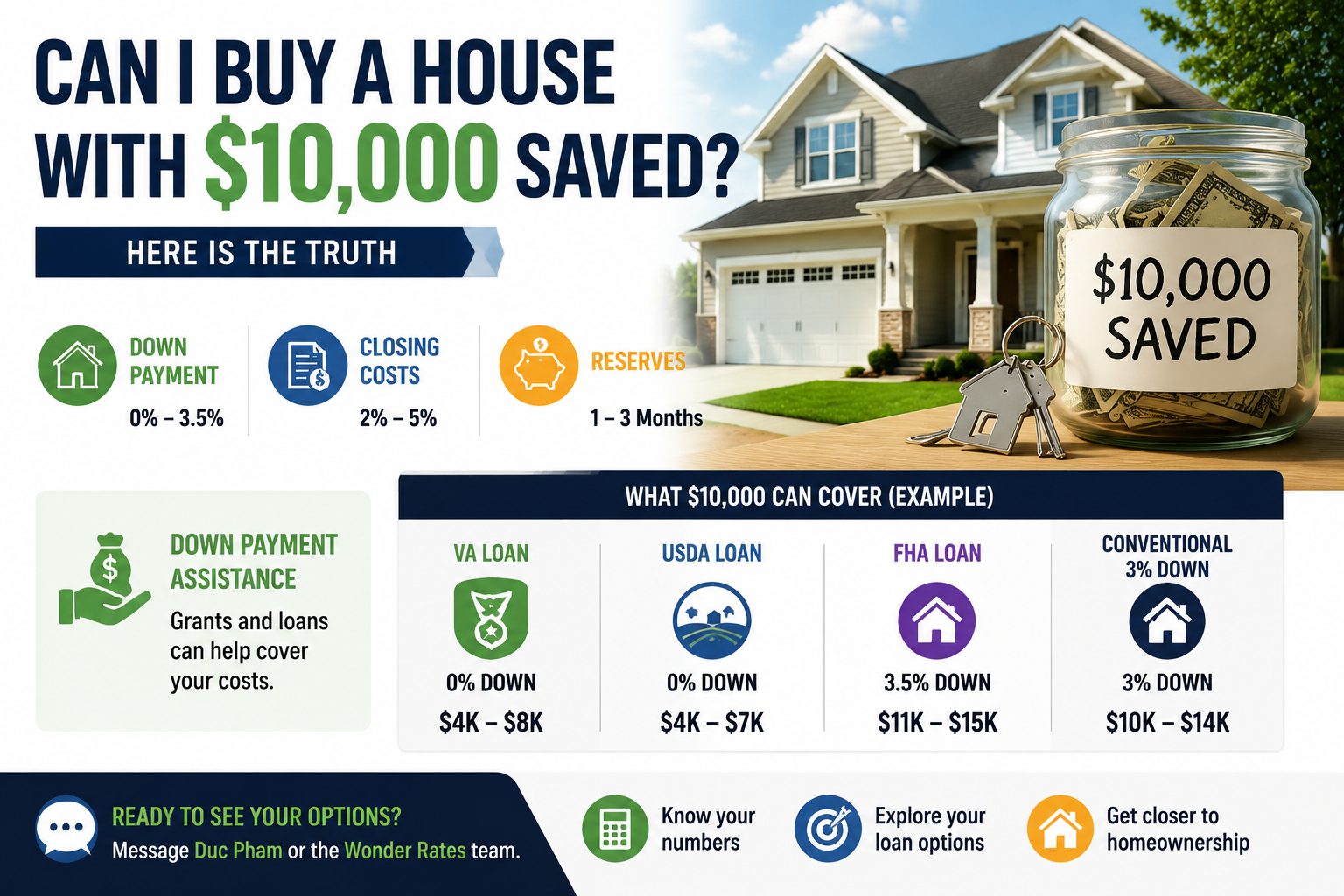
Down payment: This is the percentage of the purchase price you pay upfront. Most people think 20% is the minimum. It is not. Depending on the loan program, the minimum down payment can be as low as 0% for VA and USDA loans, 3% for certain conventional programs, and 3.5% for FHA.
Closing costs: These are the fees required to finalize your mortgage and buy the home. They often range from about 2% to 4% of the purchase price and include lender fees, title, appraisal, and prepaid taxes and insurance. Many buyers overlook this expense.
Reserves: Many loan programs ask you to keep some money after closing. Usually, this means having one to three months’ worth of your mortgage payment. This shows that you can manage unexpected costs without falling behind. Some programs and lenders require more.
| Bucket | What It Covers | Typical Range |
|---|---|---|
| Down payment | Upfront purchase price contribution | 0% to 3.5% of purchase price |
| Closing costs | Lender fees, title, appraisal, prepaids | 2% to 5% of purchase price |
| Reserves | Post-closing liquidity requirement | 1 to 3 months PITI |
Figures are general estimates. Actual amounts vary by loan program, lender, location, and individual borrower profile.
Section 03
What $10,000 Actually Buys You Depending on the Loan Program
The loan program you use determines how far $10,000 stretches. Here is how it plays out across the most common options.
VA Loan: $0 down, closing costs only.
If you are a veteran, active duty service member, or eligible surviving spouse, a VA loan is almost certainly the most powerful tool available to you. No down payment is needed. There’s no private mortgage insurance. Also, the VA limits some closing costs that lenders can charge.
For a $250,000 purchase, you might pay only $5,000 to $8,000 upfront. This depends on how closing costs are set up, if the seller covers any costs, and if you include the VA funding fee in the loan. For many eligible buyers, $10,000 may be enough, depending on local closing costs and the structure of the transaction.
USDA Loan: $0 down for eligible rural and suburban areas.
USDA loans don’t need a down payment. They work for properties in eligible areas. These areas include many suburbs near big cities, not just rural farmland. Income limits apply, but they are higher than many buyers expect.
On a $200,000 purchase in an eligible area, your primary out-of-pocket cost is closing costs, which might run $4,000 to $8,000. Again, seller concessions can help offset this.
FHA Loan: 3.5% down with a 580+ credit score.
FHA is the most commonly used low-down-payment program for buyers who do not qualify for VA or USDA. With a 580 credit score or higher, the minimum down payment is 3.5%.
On a $200,000 purchase, 3.5% down is $7,000. Add closing costs of $4,000 to $8,000 and the total cash needed is $11,000 to $15,000 before seller concessions.
With seller concessions, which allow the seller to contribute toward your closing costs as part of the negotiated deal, FHA allows up to 6% of the purchase price in seller contributions. On a $200,000 home, that is up to $12,000 the seller can contribute toward your closing costs. With a full seller concession, $10,000 in savings could be enough to cover the down payment and reserves with the seller handling the rest.
Conventional 3% Down: For buyers with stronger credit.
Fannie Mae and Freddie Mac both offer conventional loan programs with 3% down for first-time buyers. On a $200,000 purchase, that is $6,000 down plus closing costs. Unlike FHA, conventional loans do not carry upfront mortgage insurance, but they do require private mortgage insurance until you reach 20% equity.
| Loan Program | Min Down Payment | $200K Home Down Payment | Est. Closing Costs | Total Cash Needed (Before Concessions) |
|---|---|---|---|---|
| VA | 0% | $0 | $4,000 to $8,000 | $4,000 to $8,000 |
| USDA | 0% | $0 | $4,000 to $7,000 | $4,000 to $7,000 |
| FHA (580+ score) | 3.5% | $7,000 | $4,000 to $8,000 | $11,000 to $15,000 |
| Conventional 3% | 3% | $6,000 | $4,000 to $8,000 | $10,000 to $14,000 |
| Conventional 5% | 5% | $10,000 | $4,000 to $8,000 | $14,000 to $18,000 |
Illustrative estimates only. Actual costs vary significantly by location, lender, credit profile, and negotiated terms. These figures do not constitute an offer of credit.
Section 04
Down Payment Assistance: The Option Most Buyers Never Explore
Down payment assistance programs exist in nearly every state, and most buyers have never heard of them.
These programs, offered by state housing finance agencies, local governments, and nonprofit organizations, provide grants or forgivable loans to help cover down payment and closing costs. Some are outright grants that never need to be repaid. Others are second loans that are forgiven after three to five years of living in the home.
Income and purchase price limits apply, and eligibility varies by program and location. But for buyers in the $10,000 savings range, a down payment assistance program that covers $5,000 to $15,000 in costs can be the difference between buying now and waiting another two years.
The challenge is that these programs are not widely advertised and the application process varies. A loan officer who works regularly with first-time buyers can identify which programs you qualify for in your specific area.
The Honest Answer
Whether $10,000 is enough depends on four things: the purchase price you are targeting, the loan program you qualify for, what closing costs look like in your market, and whether you negotiate seller concessions or access down payment assistance.
For a buyer targeting a $150,000 to $200,000 home with a VA or USDA loan, $10,000 is likely enough today.
For a buyer targeting a $300,000 home with an FHA loan and no seller concessions, $10,000 is probably not quite enough on its own, but it may be close enough that a small down payment assistance grant or a seller concession closes the gap.
For a buyer targeting a $400,000 home with conventional financing, $10,000 is likely not enough without significant assistance.
The only way to know which category you are actually in is to look at your specific numbers, in your specific market, with the loan programs you actually qualify for. That is a 20-minute conversation, not a year of continued saving in the dark.
Section 05
Frequently Asked Questions
Can the seller pay my closing costs?
Yes. Most loan programs allow seller concessions to help cover closing costs. FHA allows up to 6% of the purchase price, conventional loans allow 3% to 9% depending on the down payment, and VA loans permit even more flexibility. Negotiating seller concessions can significantly reduce your cash needed at closing.
Does the down payment have to come from my own savings?
No. Many loan programs allow gift funds from family members, down payment assistance grants, and forgivable second loans. The key requirement is that the funds are properly documented and not an undisclosed loan.
Should I use all of my $10,000 for the down payment?
Usually not. Some loan programs require reserves, and keeping extra savings after closing can help cover unexpected homeownership expenses. Preserving one to two months of mortgage payments in savings is often a smart approach.
Section 06
Conclusion
Have around $10,000 saved and wondering if it’s enough to buy? Message Duc Pham or the Wonder Rates team. We’ll help you understand your options, estimate how much cash you may need, and determine whether you’re closer to homeownership than you think.
All figures, program details, and examples in this article are for illustrative and informational purposes only and do not constitute an offer of credit or financial advice. Loan program requirements, down payment minimums, closing cost estimates, and seller concession limits vary by lender, location, and individual borrower profile and are subject to change. Down payment assistance program availability, eligibility requirements, and benefit amounts vary by state, county, and program. Consult your loan officer for guidance specific to your situation.
Duc Pham, Mortgage Broker | NMLS# 844897 | Wonder Rates, Inc. | NMLS# 1518655 | DRE# 02047445 | DFPI# 60DBO-59134 | Equal Housing Opportunity. Equal Housing Lender. | Licensed in: AL, AZ, CA, CO, FL, GA, LA, MI, NC, OH, OK, OR, PA, SC, TX, VA, WA.