
Section 01
Cash-Out Refinance vs HELOC: You have $200,000 sitting in home equity. The question isn’t whether you can use it to buy another property.
It’s whether the way you access that equity could cost you tens of thousands of dollars over the next decade.
Using your equity is the easy part. Choosing the right way to access it is where the real financial trade-offs begin. Cash-out refinance and HELOC can both pay for your next purchase. However, they work in different ways. Choosing the wrong option can lead to costly mistakes.
Section 02
The Core Difference
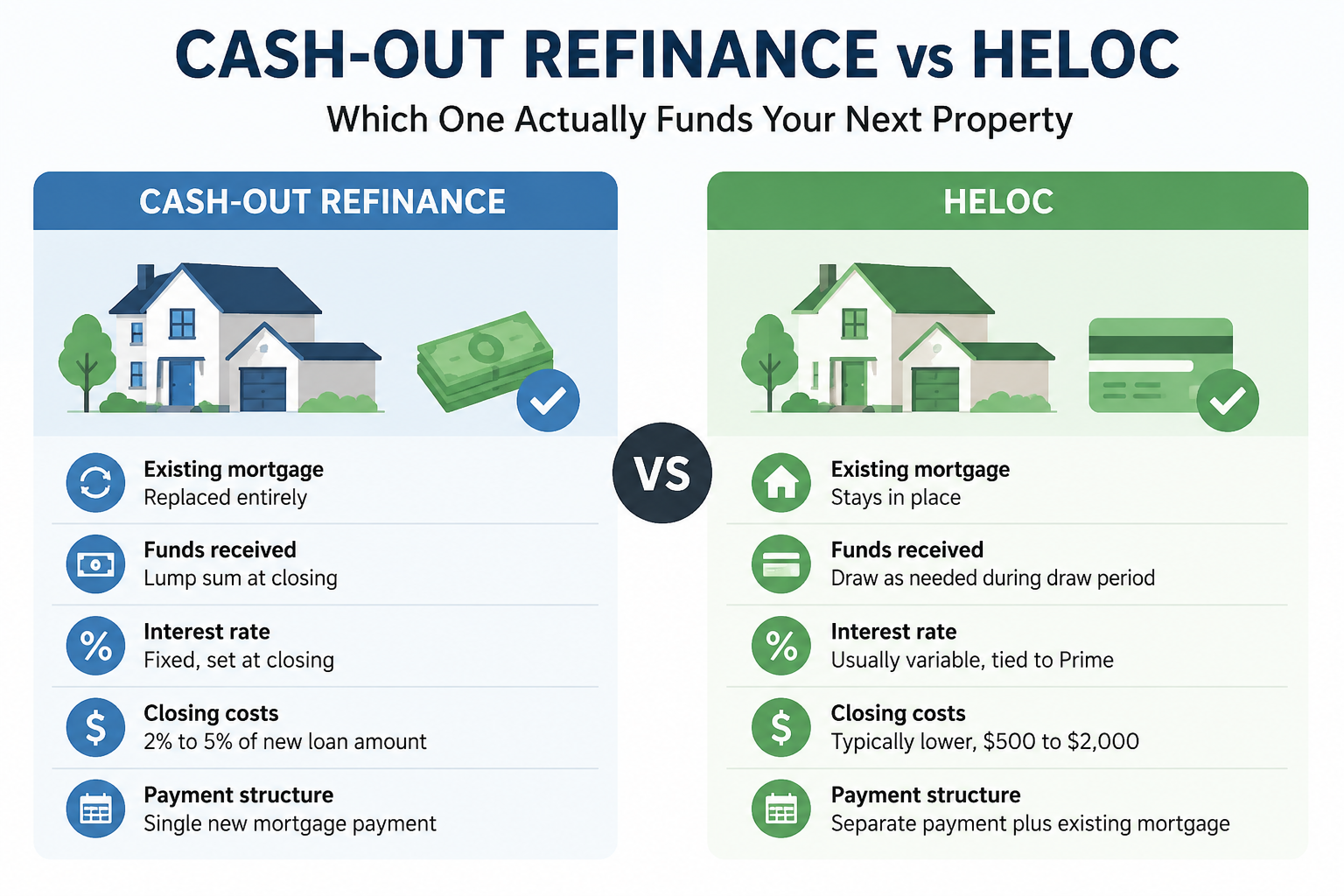
A cash-out refinance replaces your entire existing mortgage with a new, larger one. You pay off the old loan, the new loan covers that payoff plus the cash you are pulling out, and you walk away with a lump sum and a brand new mortgage at today’s rate.
A HELOC, home equity line of credit, sits on top of your existing mortgage. Your original loan stays exactly as it is, untouched. A HELOC is a separate credit line backed by your equity. You can use it as needed, much like a credit card, but your property serves as collateral.
Once you understand that structural difference, the rest of the comparison starts to make a lot more sense.
| Cash-Out Refinance | HELOC | |
|---|---|---|
| Existing mortgage | Replaced entirely | Stays in place |
| Funds received | Lump sum at closing | Draw as needed during draw period |
| Interest rate | Fixed, set at closing | Usually variable, tied to Prime |
| Closing costs | 2% to 5% of new loan amount | Typically lower, $500 to $2,000 |
| Payment structure | Single new mortgage payment | Separate payment plus existing mortgage |
Section 03
When Cash-Out Refinance Makes Sense
One thing I’ve noticed over the years is that many borrowers assume a cash-out refinance is automatically the cheaper option. Sometimes it is. Sometimes the math points in the opposite direction.
One situation where a cash-out refinance works well is when your current mortgage rate is close to, or even higher than, today’s market rate. In that case, refinancing doesn’t necessarily mean giving up a favorable loan.
It also makes sense when you need a large lump sum for a specific purpose, such as a 20% to 25% down payment on your next investment property.
Borrowers who want steady monthly payments usually choose a cash-out refinance. This is because the rate is fixed right from the start.
Example: You own a rental property worth $450,000 with $220,000 remaining on your mortgage at 7.25%. You want to pull $100,000 for a down payment on your next property.
Cash-out refinance: New loan amount $320,000, current market rate roughly 6.875% for investment property refinance. New monthly payment on a 30-year term is approximately $2,102. Closing costs estimated at $9,000 to $14,000 based on 3% to 4% of the new loan amount.
Section 04
When HELOC Makes Sense
A HELOC often becomes the stronger option when flexibility matters more than locking in one fixed loan.
One of the biggest advantages of a HELOC shows up when your existing mortgage already carries a rate well below today’s market.
Another advantage is flexibility. If you are not sure exactly how much you will need, or when you will need it, a HELOC lets you draw funds as needed instead of borrowing everything upfront. You usually pay interest only on the amount you’ve drawn, not the entire credit line. This is important if you’re funding a renovation in phases or waiting for the right property to invest in.
Upfront costs are another consideration. Because you are not replacing the entire mortgage, HELOC closing costs are usually much lower than a full refinance.
Example: Same property, same $100,000 need, but this time your existing mortgage is at 5.25%, well below today’s market.
HELOC: Existing mortgage stays untouched at 5.25%. New HELOC for $100,000 at a variable rate, currently around 8.5% to 9% for investment property HELOCs. Interest-only payment during the draw period on the full $100,000 drawn is approximately $708 to $750 per month. Closing costs estimated at $500 to $2,000.
| Scenario | Cash-Out Refinance | HELOC |
|---|---|---|
| Existing mortgage rate is above today’s market (7.25% vs. 6.875%) | New payment: ≈ $2,102/mo on a new $320,000 mortgage | Existing mortgage: ≈ $1,501/mo + HELOC interest-only payment: ≈ $708–$750/mo = ≈ $2,209–$2,251/mo |
| Existing mortgage rate is well below today’s market (5.25% vs. 8.5% HELOC) | New payment: ≈ $2,102/mo (gives up the lower fixed rate) | Existing mortgage: ≈ $1,214/mo + HELOC interest-only payment: ≈ $708–$750/mo = ≈ $1,922–$1,964/mo |
All figures in this table are illustrative examples based on hypothetical rates and loan amounts. Actual rates, payments, and closing costs vary by lender, borrower profile, property type, and market conditions. These examples do not constitute an offer of credit.
The numbers don’t point to one clear winner. A HELOC can be the better option if you want to keep a low existing mortgage rate. A cash-out refinance may make more sense if refinancing also lowers your current rate. Ultimately, the right choice depends on your financing goals and the loan you already have.
Section 05
What This Means for Funding Your Next Property
For investors specifically, there is one more factor worth considering beyond the rate comparison: how each option affects your ability to qualify for the next loan.
A cash-out refinance raises your total mortgage debt on the property. This increase adds to your overall DTI when the new loan is reviewed. A HELOC works similarly. It’s a liability like any other credit line. However, if you don’t use the full amount right away, some lenders only consider what you’ve drawn. They don’t count the entire available credit line for your DTI calculation. Check with your lender about how they evaluate a HELOC. Each lender has a different method, so don’t assume it will boost your qualification.
If you’re buying a property and nearing conventional financing limits, a DSCR loan can help. This loan doesn’t consider your personal income or DTI for approval. This is true no matter how you funded the down payment.
Section 06
Frequently Asked Questions
Can I use a HELOC on an investment property, or only on my primary residence?
Yes. Some lenders offer HELOCs on investment properties, but qualification is typically stricter. Expect more equity needed. Credit checks will be stricter. Interest rates are often higher than for a primary residence HELOC. Since availability varies by lender, it’s best to confirm your options early.
Is the interest on a cash-out refi or HELOC tax deductible if I use it to buy another property?
It depends on how the funds are used and your individual tax situation. Interest may be deductible in some cases, but tax rules are complex and change over time. Check with your CPA before assuming any tax benefits.
How long does each option take to close?
A cash-out refinance typically closes in 30 to 45 days because it requires full underwriting. A HELOC often closes in 2 to 3 weeks, depending on the lender and whether a full appraisal is required.
Section 07
Conclusion
Every equity position is unique. The best option often depends on details that generic online calculators miss.
If you’re choosing between a cash-out refinance and a HELOC, let’s compare them. We’ll look at your mortgage balance, current interest rate, equity, and financing goals.
Send Duc Pham or the Wonder Rates team a message. We’ll walk through both scenarios with you, so you can make an informed decision before submitting an application.
All figures, rates, and payment examples in this article are for illustrative purposes only and do not constitute an offer of credit or financial, investment, or tax advice. Actual rates, payments, and qualification requirements vary by lender, borrower profile, property type, and market conditions, and are subject to change. Consult your loan officer and tax advisor for guidance specific to your situation.
Duc Pham, Mortgage Broker | NMLS# 844897 | Wonder Rates, Inc. | NMLS# 1518655 | DRE# 02047445 | DFPI# 60DBO-59134 | Equal Housing Opportunity. Equal Housing Lender. | Licensed in: AL, AZ, CA, CO, FL, GA, LA, MI, NC, OH, OK, OR, PA, SC, TX, VA, WA.