
Section 01
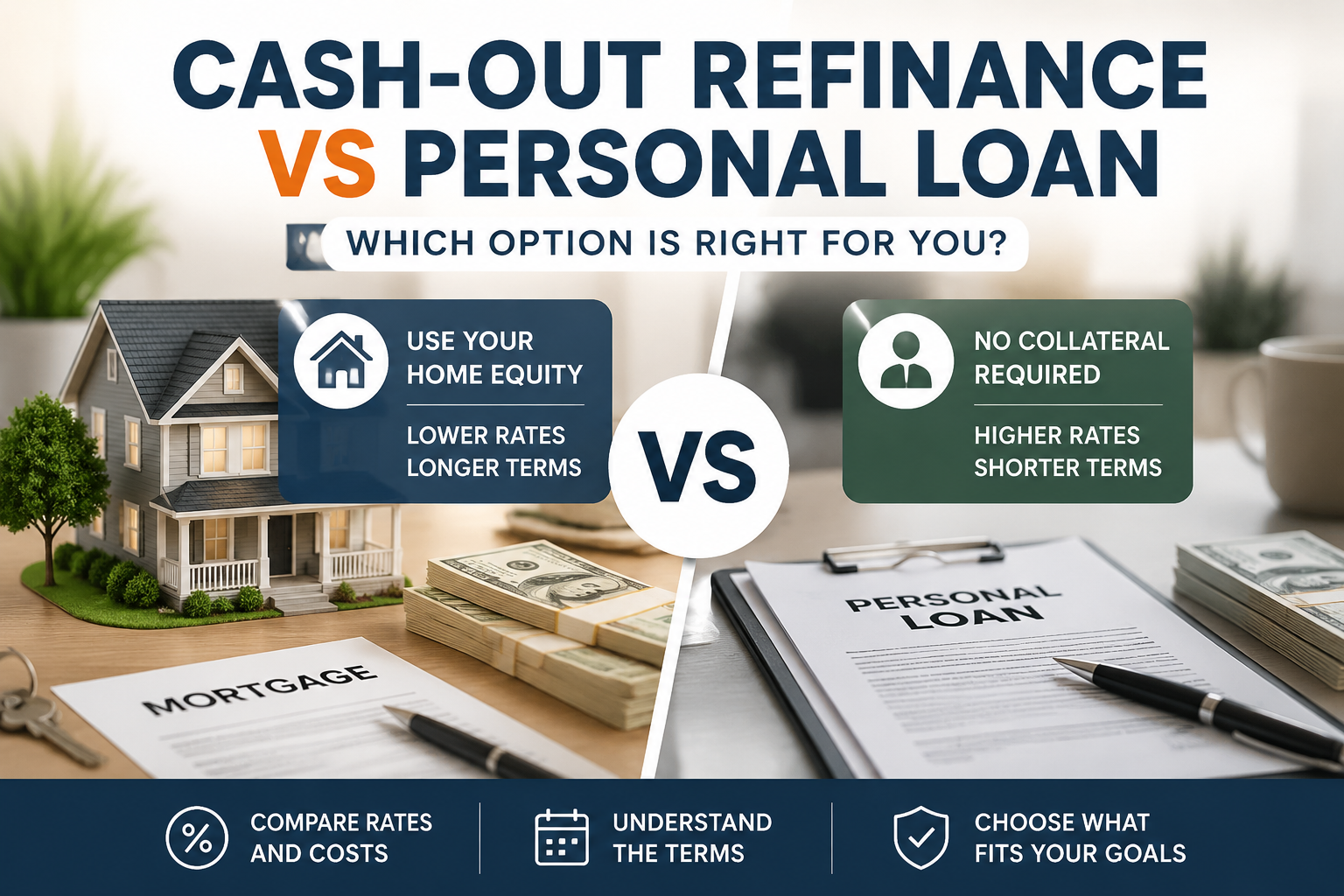
Cash-out refinance vs personal loan is a common comparison for homeowners who need access to cash. Both options can help you borrow money, but they work differently in terms of interest rates, repayment terms, costs, and risks.
When you need a significant amount of money and you own a home, two options come up most often: tap your home equity through a cash-out refinance, or take out a personal loan.
Both put cash in your hand. Both have monthly payments. But beyond that, they work very differently, cost very differently, and fit very different situations.
Many borrowers focus on which option is easier to access, but the better choice depends on your current mortgage, available equity, borrowing needs, and repayment timeline. Understanding how each option works can help you compare the total cost before making a decision.
Section 02
Cash-Out Refinance vs Personal Loan: What’s the Difference?
A cash-out refinance replaces your existing mortgage with a new, larger loan. The difference between your existing mortgage balance and the new loan amount is provided to you as cash at closing, after accounting for applicable closing costs and fees. Your existing mortgage disappears and is replaced by the new one, with a new rate, new term, and new monthly payment.
A personal loan is an unsecured installment loan. No collateral is required, which means your home is not on the line. You apply, get approved based on your credit and income, receive a lump sum, and repay it over a fixed term, typically two to seven years, at a fixed interest rate.
The fundamental difference is collateral. A cash-out refinance is secured by your home. A personal loan is not. That single difference drives almost every other distinction between the two products.
Section 03
Why Secured Loans Often Have Lower Rates Than Personal Loans
Because a cash-out refinance is secured by your property, lenders generally consider it lower risk than an unsecured personal loan. This is one reason secured loans often have lower interest rates compared with unsecured borrowing options.
Cash-out refinance rates are often priced higher than standard purchase mortgage rates because the borrower is replacing an existing mortgage while accessing equity from the property. The rate you receive depends on factors such as your credit profile, loan-to-value ratio, property type, loan amount, and lender requirements.
For context, Freddie Mac Primary Mortgage Market Survey (PMMS) reported the average 30-year fixed mortgage rate for purchase loans at 6.66% as of July 30, 2026. Cash-out refinance rates may differ from purchase mortgage rates and can vary based on borrower qualifications, loan characteristics, and market conditions.
| Factor | Cash-Out Refinance | Personal Loan |
|---|---|---|
| Collateral | Secured by your home | Usually unsecured |
| Loan term | Often follows mortgage repayment terms | Usually has a shorter fixed repayment period |
| Interest rate considerations | May have lower rates because the loan is secured by property | May have higher rates because the loan does not use collateral |
| Approval factors | Credit, income, property value, and available equity | Credit, income, and existing debt obligations |
Mortgage rates vary based on market conditions, loan type, credit profile, loan amount, property characteristics, and lender requirements. Any rate examples are for educational purposes only and do not constitute an offer of credit.
Section 04
How the Repayment Structures Differ
Lower rate does not always mean lower total cost when the terms are so different. Here is how the repayment structure can differ between a cash-out refinance and a personal loan:
| Loan Type | Repayment Structure | Payment Consideration |
|---|---|---|
| Cash-out refinance | Longer mortgage repayment period | Lower monthly payment but interest may accumulate over a longer period |
| Personal loan | Shorter fixed repayment period | Higher monthly payment but debt may be paid off faster |
The comparison above is for educational purposes only. Actual repayment terms, monthly payments, and total costs vary based on loan amount, interest rate, repayment term, and borrower qualifications.
This is the comparison many borrowers miss. The interest rate is only one part of the borrowing decision. A loan with a lower monthly payment may take longer to repay, while a shorter repayment period may reduce the time you carry the debt. The right option depends on your goals, current mortgage terms, and overall financial situation.
Section 05
When a Cash-Out Refinance May Make Sense
A cash-out refinance may be worth considering in certain situations.
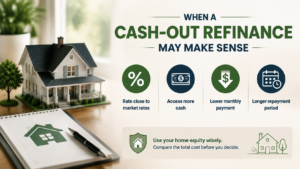
Your current mortgage rate is close to current market rates. If refinancing does not require giving up a significantly lower existing rate, a cash-out refinance may be worth considering depending on your goals and financial situation.
You need to access a larger amount of money. Because a cash-out refinance is tied to your home’s equity, it may provide access to more funds than some unsecured borrowing options. Personal loan amounts are usually limited by lender requirements, your credit profile, income, and existing debts. For larger needs, home equity products may be worth considering for borrowers who need access to larger amounts.
You need a lower monthly payment for cash flow reasons. Because a cash-out refinance is typically repaid over a longer mortgage term, it may result in a lower monthly payment compared with a shorter-term personal loan. However, a longer repayment period may increase the total interest paid over time.
You want to spread repayment over a longer period to manage monthly cash flow. Keep in mind that a longer repayment period may increase the total interest paid over time. Home improvements, debt consolidation of high-rate obligations, or other large expenses may be reasons some borrowers consider longer-term borrowing. However, it is important to compare the total cost and understand that a cash-out refinance uses your home as collateral.
Section 06
When a Personal Loan May Be a Better Fit
A personal loan may be worth considering in different circumstances.
Your current mortgage rate is well below today’s market rates. If you have an existing low-rate mortgage, a cash-out refinance may increase your overall borrowing cost because it replaces your entire mortgage balance with a new loan, not just the additional cash you receive. In this situation, some borrowers may consider alternatives that allow them to access funds without changing their existing mortgage.
You need the money quickly. Personal loans may have a faster application and funding process compared with a mortgage refinance. A cash-out refinance typically involves more steps, including underwriting, appraisal, title review, and closing. It may also include closing costs that vary based on the loan and borrower situation. For urgent needs, some borrowers may prefer a personal loan because the process can be simpler and faster.
You want to keep your home equity intact. Equity is an asset. Using it changes your LTV and reduces the financial cushion your property provides. If you are close to a milestone like dropping PMI or maintaining a specific equity position for future borrowing flexibility, a personal loan preserves that equity entirely.
Section 07
How to Compare the Cost of Each Option
Before choosing between these two options, compare the total cost.
Compare the potential cost of refinancing your existing mortgage with the cost of borrowing through a personal loan. Consider your current mortgage rate, remaining balance, closing costs, repayment timeline, and monthly payment impact.
The goal is to compare the total cost of each option, not just the monthly payment.
Section 08
Frequently Asked Questions
Does a cash-out refinance hurt my credit score?
A cash-out refinance may temporarily affect your credit score because it involves a hard credit inquiry and a new loan account. The impact is usually minor, and making on-time payments can help maintain your credit profile over time.
Can I use a personal loan for a down payment on another house?
It depends on the lender and your overall financial situation. Borrowed funds must be properly disclosed during the mortgage application because the new debt affects your DTI. Using a personal loan for a down payment without disclosure can create issues during underwriting.
What if I do not have enough equity for a cash-out refinance?
If you do not have enough equity, you may not qualify for a cash-out refinance. Many lenders set maximum LTV requirements, so your available cash depends on your property value, current mortgage balance, and loan program. Other options, such as a HELOC or personal loan, may be worth considering depending on your situation.
Is a cash-out refinance better than a personal loan?
Neither option is better for every borrower. A cash-out refinance may work well for homeowners who need larger funds and want a longer repayment period, while a personal loan may fit borrowers who want to avoid changing their existing mortgage.
Section 09
Conclú
If you own a home and need to borrow money, the right product depends on your current mortgage rate, how much equity you have, how much you need, and how long you plan to repay it. Those four variables tell you most of what you need to know.
Reach out to Duc Pham or the Wonder Rates team. We can help you compare your options and understand the factors that may affect your decision, including your mortgage, equity, and borrowing needs.
All figures, rate examples, payment calculations, and comparisons in this article are for illustrative and educational purposes only and do not constitute an offer of credit or financial advice. Actual rates, terms, payments, and eligibility vary by lender, credit score, loan amount, property value, and individual borrower profile and are subject to change. Consult your loan officer and financial advisor for guidance specific to your situation.
Duc Pham, Mortgage Broker | NMLS# 844897 | Wonder Rates, Inc. | NMLS# 1518655 | DRE# 02047445 | DFPI# 60DBO-59134 | Equal Housing Opportunity. Equal Housing Lender. | Licensed in: AL, AZ, CA, CO, FL, GA, LA, MI, NC, OH, OK, OR, PA, SC, TX, VA, WA.