
Section 01
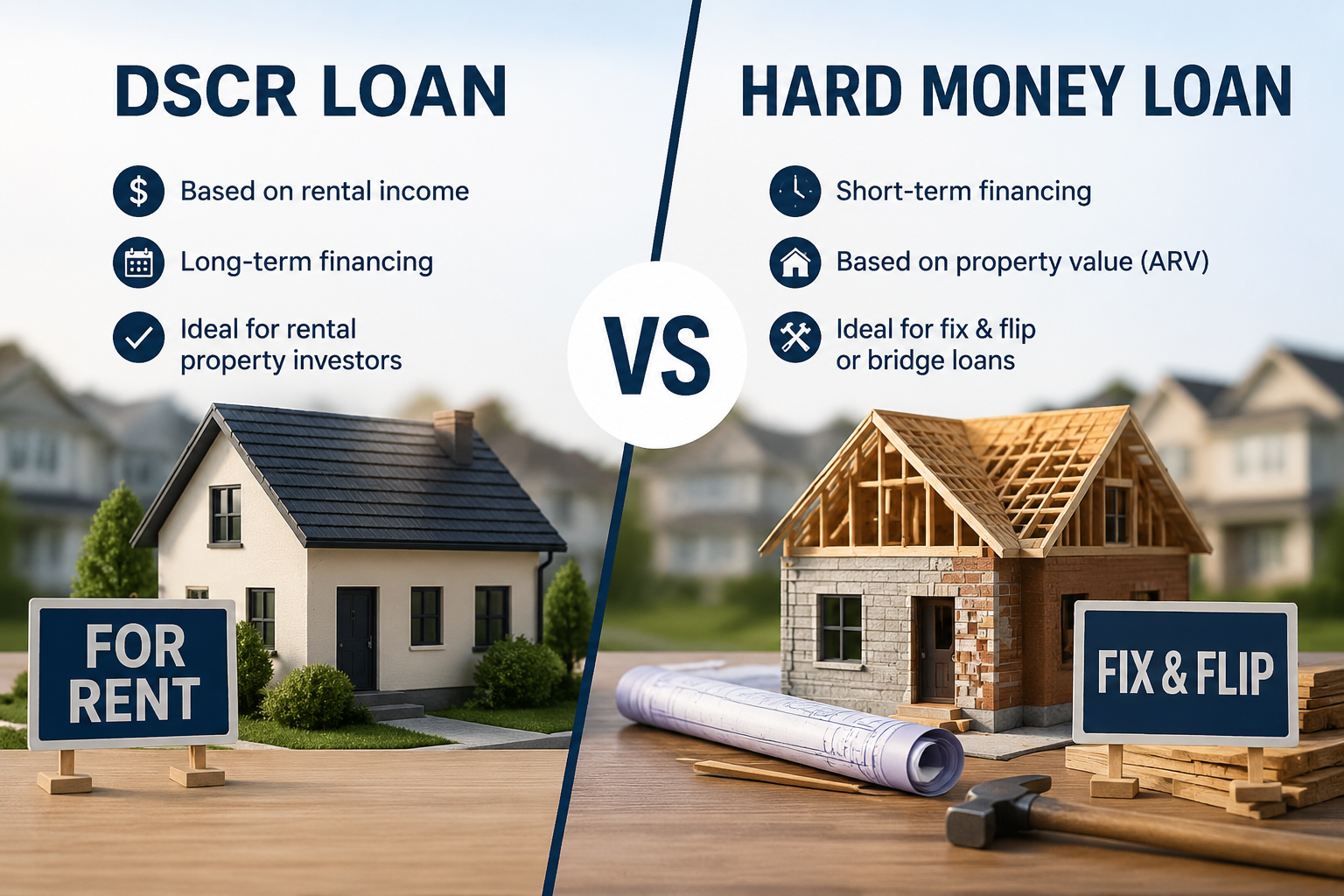
DSCR Loan vs Hard Money Loans are two financing options that real estate investors often compare when choosing the right strategy for a property. While both can help investors acquire real estate, they are designed for different situations, timelines, and investment goals.
The honest answer is that they are not really competing with each other. DSCR loans and hard money loans are designed for different situations, different hold periods, and different investor profiles. Choosing between them is less about which one is better in the abstract and more about which one fits what you are actually trying to do with a specific property.
Here is how they actually compare, and more importantly, how to know which one belongs in your deal.
Section 02
What Each Product Is Actually Designed For
A DSCR loan, which stands for Debt Service Coverage Ratio, is a long-term financing product designed for real estate investors. Instead of relying primarily on the borrower’s personal income documentation, the lender evaluates the property’s rental income compared with its monthly debt obligations. Many DSCR loans are structured as long-term investment property loans, including fixed-rate or adjustable-rate options, with qualification based largely on the property’s cash flow rather than the borrower’s personal debt-to-income ratio.
Like other mortgage products, DSCR loans have lender-specific requirements and must follow applicable lending regulations. Borrowers can review general mortgage consumer protection resources from the Consumer Financial Protection Bureau (CFPB) to better understand mortgage lending practices and their rights during the loan process
Those differences in design tell you almost everything you need to know about when to use each one.
| DSCR Loan | Hard Money Loan | |
|---|---|---|
| Loan term | 30 years (fixed or ARM) | 6 to 24 months |
| Primary qualification | Property cash flow (DSCR ratio) | Property value (ARV) |
| Personal income required | No | No |
| Credit score requirement | Typically 680+ | Typically 600 to 620+ |
| Interest rate | 7% to 9% typically | 10% to 15% typically |
| Origination fees | 1% to 2% | 2% to 5% (points) |
| Time to close | 3 to 4 weeks | 7 to 14 days |
| Property condition requirement | Must be rent-ready | Distressed properties accepted |
| Best for | Long-term hold rental property | Fix and flip, bridge, or distressed acquisition |
Rates, fees, and terms are illustrative estimates based on current market conditions and vary significantly by lender, borrower profile, property type, and location. These figures do not constitute an offer of credit.
Section 03
The DSCR Ratio Explained
The core mechanic of a DSCR loan is simple. The lender divides the property’s gross monthly rental income by the monthly debt service, which is the principal, interest, taxes, insurance, and HOA if applicable.
DSCR = Gross Monthly Rent ÷ Monthly PITIA
A DSCR of 1.0 means the property exactly breaks even. The rent covers the debt payment and nothing more. Most lenders require a minimum DSCR of 1.0 to 1.25, with 1.25 being the more common threshold for standard pricing. Some lenders will go below 1.0, called a no-ratio or sub-1 DSCR loan, but these carry higher rates and stricter requirements.
A property renting for $2,400 per month with a proposed monthly PITIA of $1,850 produces a DSCR of 1.30, which may meet some lenders’ DSCR requirements. A property renting for $1,800 per month with a proposed PITIA of $1,850 produces a DSCR of 0.97, which falls below 1.0 and would require a no-ratio DSCR product or a different loan structure entirely.
| Monthly Rent | Monthly PITIA | DSCR | Likely Result |
|---|---|---|---|
| $2,600 | $1,900 | 1.37 | Strong approval |
| $2,200 | $1,850 | 1.19 | May need larger down payment or rate adjustment |
| $1,950 | $1,850 | 1.05 | Borderline, lender dependent |
| $1,800 | $1,900 | 0.95 | Requires no-ratio DSCR or different product |
DSCR calculations and lender thresholds are illustrative. Actual requirements vary by lender and loan program.
Section 04
How Hard Money Lenders Actually Think
Hard money lenders are not trying to underwrite your financial life. They are underwriting the collateral.
The primary number they care about is the loan-to-value ratio based on the after-repair value of the property. Most hard money lenders will lend up to 65% to 75% of ARV. If a property has an ARV of $300,000 and the lender will go to 70% LTV, the maximum loan is $210,000.
If the purchase price is $180,000 and renovation costs are $40,000, total project cost is $220,000. At a $210,000 maximum loan, the borrower needs to bring $10,000 to the table plus cover points and fees separately.
Hard money lenders charge points upfront, typically 2 to 5 points where one point equals 1% of the loan amount, plus monthly interest during the loan term. For example, on a $210,000 loan with 3 points, the upfront fee would be $6,300. At a 12% annual interest rate, the monthly interest-only payment would be approximately $2,100.
Over a six-month loan term, the estimated financing cost would include approximately $12,600 in interest plus $6,300 in points, for a total of $18,900 before accounting for other expenses.
In a real estate investment project, these financing costs must be considered alongside renovation expenses, holding costs, taxes, insurance, selling costs, and market conditions. Whether the financing structure makes sense depends on the individual property and the investor’s overall strategy.
Whether that is worth it depends on the deal, the market, and the execution.
Section 05
The Strategy Question: Which One Belongs in Your Deal
The clearest way to decide is to match the financing to the hold strategy.
If you are buying a property that is already rent-ready or needs only cosmetic work, planning to hold it as a rental for five or more years, and the DSCR ratio qualifies at your proposed loan amount, a DSCR loan may be a better fit for many investors. Lower rate, longer term, no balloon payment pressure, and the monthly payment is structured for sustainable long-term ownership.
If you are buying a distressed property that needs significant work before it can be rented or sold, needs to close in less than two weeks because the seller requires it, or is being acquired specifically to flip, a hard money loan may be considered because traditional lenders may not be able to finance properties requiring significant repairs or a faster closing timeline.
Where it gets more nuanced is the middle ground: a property that needs moderate renovation, could be rented after the work, and the investor is not sure whether to flip or hold. In that scenario, many investors use hard money to acquire and renovate, then refinance into a DSCR loan once the property is stabilized with a tenant in place. This is sometimes called a BRRRR strategy, buy, renovate, rent, refinance, repeat, and it uses hard money and DSCR financing sequentially rather than choosing between them.
| Investor Scenario | Recommended Product | Why |
|---|---|---|
| Buying stabilized rental, holding long-term | DSCR loan | Lower rate, 30-year term, no balloon |
| Flipping distressed property, selling in 6 to 12 months | Hard money | Fast close, funds distressed properties |
| Buying distressed, renovating, then renting | Hard money then DSCR refi | Use each product for what it does best |
| Need to close in under 2 weeks | Hard money | Institutional lenders cannot move this fast |
| Property is rent-ready, cash flow qualifies | DSCR loan | No reason to pay hard money rates |
| Self-employed, no tax return income to show | DSCR loan | Qualifies on property cash flow, not personal income |
Section 06
What Investors Often Get Wrong When Choosing
The most common mistake is using hard money on a property they plan to hold long-term because they could not qualify for conventional financing at the time of purchase.
Hard money is designed to be temporary. The rates, points, and balloon payment structure assume the borrower will refinance or sell within 12 to 24 months. Using it as long-term financing means paying 10% to 15% interest indefinitely,which can significantly reduce cash flow on many rental properties.
If you cannot qualify for a DSCR loan on a rental property today, the right question is what needs to change to qualify, such as the property’s DSCR ratio, your credit score, or the down payment amount, rather than defaulting to hard money as a long-term solution.
The second most common mistake is assuming hard money is only for experienced investors. Hard money lenders care primarily about the deal and the collateral, not your experience level. A first-time investor with a solid deal at a realistic ARV can often secure hard money financing when an experienced investor with a marginal deal cannot.
Section 07
Frequently Asked Questions
Can I use a DSCR loan if the property needs renovation before it can be rented?
Most DSCR lenders require the property to be rent-ready at closing. If major renovations are needed, consider using a hard money or renovation loan first, then refinance into a DSCR loan after the property is repaired, stabilized, and generating rental income.
How does a hard money lender determine the after-repair value?
Hard money lenders typically use an appraisal or broker price opinion to estimate ARV based on the property’s expected value after renovations. They usually lend a percentage of the ARV, so borrowers may need to cover the remaining project costs. A realistic renovation plan and strong comparable sales are important.
What happens if I cannot sell or refinance before my hard money loan matures?
Hard money loans usually mature within 12–24 months, requiring the balance to be repaid. If you cannot sell or refinance, lenders may offer an extension for a fee, or you may need alternative financing or sell the property. A clear exit strategy is essential before taking the loan.
Section 08
Final Thought
If you are looking at a property and trying to figure out whether DSCR or hard money is the right structure for your deal, or if you are ready to refinance an existing hard money loan into longer-term DSCR financing, that is a conversation worth having before you commit to anything.
Send Duc Pham or the Wonder Rates team a message to discuss DSCR loans, hard money loans, and which financing approach may align with your goals.
All figures, rates, fees, DSCR thresholds, and examples in this article are for illustrative and educational purposes only and do not constitute an offer of credit or investment advice. DSCR loan rates, hard money rates, LTV limits, and lender requirements vary significantly by lender, market, property type, borrower profile, and current market conditions and are subject to change. Actual DSCR calculations depend on lender-specific income and expense definitions. Consult your loan officer for guidance specific to your situation and investment strategy.
Duc Pham, Mortgage Broker | NMLS# 844897 | Wonder Rates, Inc. | NMLS# 1518655 | DRE# 02047445 | DFPI# 60DBO-59134 | Equal Housing Opportunity. Equal Housing Lender. | Licensed in: AL, AZ, CA, CO, FL, GA, LA, MI, NC, OH, OK, OR, PA, SC, TX, VA, WA.