
Section 01
Why Did My Mortgage Payment Suddenly Increase?
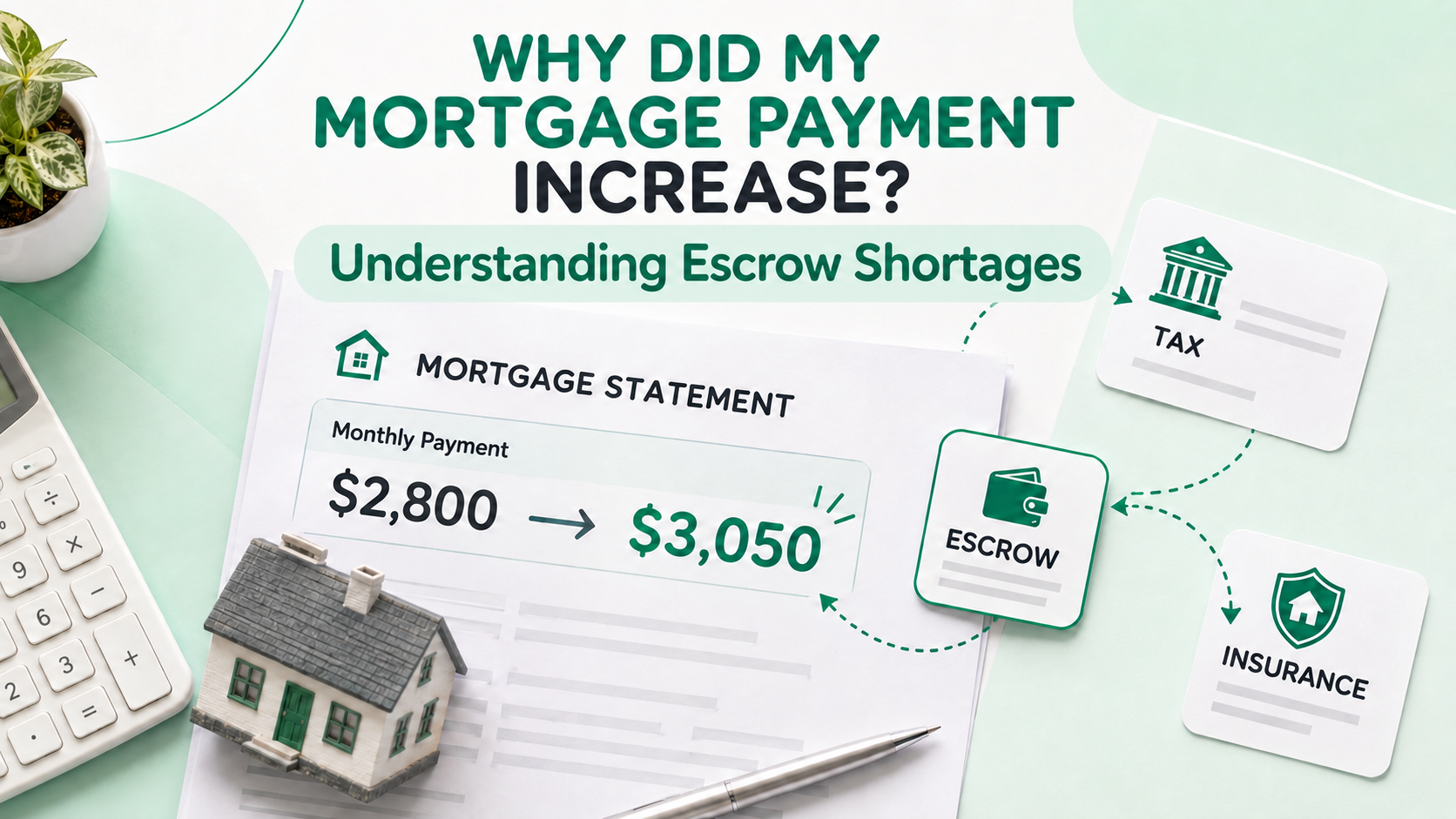
Last year, a homeowner was paying $2,800 a month. This year, a new statement arrives showing $3,050 a month instead. The homeowner’s first thought is usually something like, “My interest rate hasn’t changed. Why did my mortgage payment go up?”
If your mortgage includes an escrow account, the answer is that your total monthly payment was never just principal and interest. Escrow is generally used to pay property-related expenses on your behalf, most commonly property taxes and homeowners insurance. The Consumer Financial Protection Bureau (CFPB) confirms that property taxes and insurance premiums can change from year to year, and when they do, your escrow payment, and therefore your total monthly mortgage payment, can change along with them.
This is where the concept of an escrow shortage comes in, and it’s worth understanding clearly rather than assuming your lender simply decided to charge you more.
Section 02
What Is an Escrow Shortage?
Under Regulation X, the federal rule governing escrow accounts, a shortage means the amount by which a current escrow account balance falls short of the target balance at the time of an escrow analysis.
In everyday terms, your servicer projects how much money your escrow account needs to have on hand to cover upcoming property tax and insurance bills. If the actual amount in the account turns out to be lower than that projected target, the account has a shortage.
It’s worth being direct about something important here: a shortage does not necessarily mean you’ve missed a mortgage payment or fallen behind. It typically shows up because the actual cost of property taxes or insurance ended up higher than what was originally estimated, or because the account simply doesn’t hold enough to meet the updated target balance identified during the escrow analysis.
Section 03
Escrow Shortage Happens Because the Original Estimate Changed
When your escrow account was first set up, your servicer based your monthly escrow payment on an estimate of your annual property-related expenses. The trouble is that those expenses don’t always stay the same.
Property taxes increased
Example: Last year, your property taxes were $6,000 annually, which works out to $500 a month. This year, taxes rise to $7,200 annually, or $600 a month, a difference of $100 a month. If you continued paying escrow based on the old, lower estimate for a period of time, your account may not have accumulated enough to match the new projection. This kind of gap is one of the most common reasons an escrow shortage develops.
This example is illustrative only and uses hypothetical numbers. Actual property tax amounts and changes vary significantly by location and are set by local taxing authorities, not by your lender or servicer.
Section 04
Homeowners Insurance Can Also Cause an Escrow Shortage
Property taxes aren’t the only moving piece. Insurance premiums can shift too, sometimes significantly.
Example: Suppose homeowners insurance was $1,800 annually last year, or $150 a month, and this year the premium rises to $2,400 annually, or $200 a month, a difference of $50 a month. If property taxes are increasing at the same time, these two effects can compound each other in the same escrow analysis. A homeowner can end up seeing their total monthly mortgage payment rise even though the principal and interest portion of their loan hasn’t changed at all.
This example is illustrative only and uses hypothetical numbers. Actual insurance premium changes depend on your policy, your insurer, your property, and broader market conditions.
Section 05
Escrow Shortage vs. Higher Escrow Payment: They Are Not the Same Thing
This distinction trips up a lot of homeowners, so it deserves its own section.
Many people look at their annual statement, see the word “shortage,” and assume that’s the entire explanation for why their payment went up. In reality, there are often two separate things happening at once. One is the need to repay a shortage that has already developed. The other is that your ongoing monthly escrow payment has been recalculated because projected taxes or insurance for the coming year are higher than before.
Example: Your current escrow payment is $600 a month. Your servicer’s new analysis projects that going forward, the escrow requirement should actually be $700 a month based on updated tax and insurance estimates. On top of that, your account currently has a $1,200 shortage. If that shortage is spread over 12 months, that works out to $1,200 divided by 12, or $100 a month. In this hypothetical scenario, your escrow-related portion of the payment could rise from $600 to $700 because of the new projection, plus an additional $100 a month to repay the shortage, for a combined escrow portion of roughly $800 a month during the repayment period.
This is a hypothetical illustration only and does not represent how every escrow account is calculated or repaid. Actual figures depend on your specific escrow analysis, servicer, and loan terms.
Section 06
How an Escrow Analysis Determines Whether You Have a Shortage
Under Regulation X, a servicer performs an escrow account analysis to determine target balances, calculate the monthly escrow payment for the upcoming computation year, and determine whether the account has a shortage, a surplus, or a deficiency.
Without diving into the full legal formula, here’s a simplified way to picture it. Suppose your servicer expects to pay $7,200 in property taxes and $2,400 in insurance over the coming year, for a total of $9,600. Divided evenly across 12 months, that comes out to $800 a month.
This calculation is a simplified illustration meant to show how an annual expense estimate translates into a rough monthly figure. An actual escrow analysis also accounts for the timing of disbursements throughout the year and any applicable cushion or target balance, so $800 would not automatically be your final required escrow payment.
Section 07
What Is the Escrow Cushion?
This is a detail worth getting exactly right, since it’s easy to describe inaccurately.
A servicer may maintain a cushion in your escrow account to help cover unanticipated disbursements or timing differences between when funds come in and when bills go out. Under Regulation X, for escrow accounts subject to the rule, this cushion generally cannot exceed one-sixth of the estimated total annual disbursements from the account, which works out to roughly two months’ worth of estimated escrow payments, unless your specific loan documents or applicable state law set a lower limit.
Example: If your estimated annual escrow disbursements total $9,600, the maximum allowable cushion under the one-sixth limit would be $9,600 divided by 6, or $1,600.
This $1,600 figure represents the maximum cushion allowed under the Regulation X limit in this specific hypothetical scenario. It does not mean your servicer is required to collect that exact amount, and actual cushion amounts vary by servicer and loan.
Section 08
Escrow Shortage Is Different From an Escrow Deficiency
These two terms sound similar but mean different things under Regulation X, and mixing them up can lead to real confusion.
Shortage
A shortage exists when the account balance is lower than the target balance at the time of the escrow analysis. Importantly, the account doesn’t necessarily have to have a negative balance for a shortage to exist.
Deficiency
A deficiency, by contrast, refers specifically to a negative balance in the escrow account.
Example: Suppose your account needs to hold $2,000 according to the target balance, but it actually holds $1,500. That $500 gap is a shortage. But if your account balance were instead negative $500, meaning the account had actually gone below zero, that would be classified as a $500 deficiency, not a shortage.
This example is illustrative only and is meant to clarify the distinction between these two terms as defined under Regulation X, not to represent any specific account.
Section 09
Do You Have to Pay an Escrow Shortage All at Once?
This is usually the first question homeowners want answered, and the honest response is that it depends on the size of the shortage.
Under Regulation X, if the shortage is less than one month’s escrow account payment, the servicer has three possible courses of action: allowing the shortage to exist without requiring repayment, requiring the borrower to repay the shortage amount within 30 days, or requiring the borrower to repay the shortage in equal monthly payments spread over at least a 12-month period.
If the shortage is equal to or greater than one month’s escrow account payment, the servicer has fewer options: it may allow the shortage to exist and do nothing, or it may require repayment in equal monthly payments over at least a 12-month period. Notably, a servicer generally cannot require a lump-sum repayment on the annual escrow statement when the shortage meets or exceeds one month’s escrow payment, since the CFPB has clarified that Regulation X’s listed repayment options are exclusive.
Example: Say your monthly escrow payment is $700, and your shortage is $600. Since $600 is less than one month’s escrow payment of $700, your servicer has more flexibility in how it can require repayment compared to a shortage of $700 or more.
This example is illustrative only. Do not assume every shortage must be repaid over exactly 12 months. The applicable treatment depends on the size of the shortage relative to your specific monthly escrow payment, and your servicer determines which permitted option applies within the rules that govern your loan.
Section 10
Why Your Monthly Payment Can Stay Higher Even After the Shortage Is Repaid
This is one of the more counterintuitive parts of how escrow works, and it trips up a lot of homeowners.
It’s natural to assume that once a shortage is fully repaid, your payment should drop back down to where it was before. That isn’t necessarily true.
Example: Suppose last year’s property taxes and insurance totaled $9,600, but this year the same expenses total $11,400. The new projected monthly escrow comes out to $11,400 divided by 12, or $950. If a separate $1,200 shortage is being repaid over 12 months, that adds another $100 a month, for a combined total of $950 plus $100, or $1,050, during the repayment period. Once the shortage portion is fully repaid, that extra $100 goes away. But the underlying projected escrow payment can remain around $950 a month, assuming tax and insurance estimates stay at that level.
This example is illustrative only. The key point is that repaying a shortage and the ongoing escrow requirement are two separate things, and only one of them (the shortage repayment) is temporary.
Section 11
What Happens to Your Escrow Payment When Property Taxes Increase?
Here’s a fuller case study to bring these pieces together.
Before: Property taxes of $6,000 a year plus insurance of $1,800 a year total $7,800 annually, or roughly $650 a month.
After: Property taxes rise to $7,200 a year and insurance rises to $2,100 a year, for a new total of $9,300 annually, or roughly $775 a month.
The difference: About $125 a month.
If the mortgage’s principal and interest payment hasn’t changed at all, the homeowner can still see their total monthly payment increase by roughly this escrow difference, subject to the actual escrow analysis and any other adjustments that may apply.
This case study uses hypothetical, simplified numbers for illustration only and does not represent an actual escrow analysis or guaranteed payment change for any specific loan.
Section 12
What Should You Look for in Your Annual Escrow Statement?
According to the CFPB, your annual escrow statement is required to show your account history and a projection for the coming year, along with details like your current monthly payment, your previous payment, the total amounts paid into and out of escrow, your ending balance, and how any shortage or deficiency will be handled.
When you receive this statement, it’s worth reviewing a few specific things.
Your previous escrow payment. What were you paying each month over the past year?
Actual tax and insurance disbursements. How much did your servicer actually pay out on your behalf?
Your current escrow balance. How much is left in the account at the end of the computation year?
Projected expenses. What is your servicer expecting to pay for taxes and insurance in the coming year?
Shortage or deficiency. Is there one? If so, what does the statement say about how it will be repaid?
Section 13
Example: Reading an Escrow Shortage Statement
Let’s walk through a complete, hypothetical statement to see how all these pieces fit together.
A homeowner receives their annual escrow statement. It shows a previous escrow payment of $650 a month, a new projected escrow payment of $775 a month, and an escrow shortage of $1,200.
If that shortage is spread over 12 months, the math is $1,200 divided by 12, or $100 a month. During the repayment period, the new escrow payment becomes $775 plus $100, or $875 a month. If principal and interest remain at $2,100 a month, the total monthly payment becomes $2,100 plus $875, or $2,975 a month. Compared to the previous total of $2,100 plus $650, or $2,750 a month, that’s a difference of $225 a month. Of that increase, $125 comes from the higher projected escrow expenses, and $100 comes from the shortage repayment.
Once the shortage is fully repaid, the hypothetical escrow portion could drop back down from $875 to the projected $775, assuming the underlying tax and insurance estimates don’t change again in the meantime.
This entire example uses hypothetical, simplified numbers for illustration purposes only. It does not represent an actual borrower, loan, or guaranteed payment calculation.
Section 14
Can You Dispute an Escrow Shortage?
It’s not accurate to assume every shortage statement contains an error. Most reflect real changes in property taxes or insurance costs. That said, it’s reasonable to review the numbers if something doesn’t add up.
Worth checking for: whether the property tax amount matches your actual tax bill, whether the insurance premium matches your actual policy, whether your payment history shows any discrepancies, whether an escrow disbursement looks incorrect, or whether a previous shortage that you already repaid still appears to be outstanding.
The CFPB recommends contacting your mortgage servicer directly if you have concerns about your escrow or impound account, and depending on the situation, you may need to submit an information request or a notice of error.
Section 15
What If Your Property Taxes or Insurance Increase Again?
It’s worth understanding that an escrow shortage isn’t necessarily a one-time event that resolves itself permanently. Escrow is fundamentally a projection system, and if your property taxes or insurance premiums continue to change, your monthly escrow requirement can be adjusted again in future annual analyses.
Example: In Year 1, escrow is $650 a month. In Year 2, it rises to $775 a month after taxes and insurance increase. In Year 3, property taxes rise again, and the projected escrow is adjusted once more. None of this necessarily means your servicer is arbitrarily raising your costs. It’s often simply a reflection of the fact that the underlying expenses tied to your property have genuinely changed.
This example is illustrative only and does not predict how any specific homeowner’s escrow account will change over time.
Section 16
How to Prepare for an Escrow Shortage
Monitor property taxes
Don’t rely solely on your mortgage statement to know where your property taxes stand. Check with your local taxing authority directly if you want the most current figure.
Review your homeowners insurance
Has your premium changed? Did your policy renew at a different rate than before?
Read your annual escrow statement
It’s easy to set this aside as routine paperwork, but it contains the exact information you need to understand any payment changes.
Keep some room in your monthly budget
If taxes or insurance rise, your total payment can rise along with them, so building in some buffer can help avoid a budgeting surprise.
Contact your servicer when something looks wrong
Don’t wait until a payment adjustment becomes a major, unexpected shock. Reach out as soon as something on your statement doesn’t make sense.
Section 17
Escrow Shortage Does Not Automatically Mean Your Mortgage Rate Changed
This is a common and understandable point of confusion worth clearing up directly.
Example: Suppose your mortgage has a fixed interest rate of 6.50%. If an escrow shortage develops, your interest rate does not change as a result. Your monthly payment can still increase because the escrow portion of your payment changed, for example, from $700 to $900, while principal and interest remain fixed at $2,500. In this scenario, the $200 increase in your total payment comes entirely from the escrow-related portion, not from any change to your fixed interest rate.
This example is illustrative only and uses a hypothetical fixed rate and payment figures for explanation purposes.
Section 18
The Bottom Line: Your Mortgage Payment Is More Than Principal and Interest
It’s easy to think of your mortgage payment as a single, fixed number, something like “my mortgage is $2,500.” But if that payment actually includes principal, interest, taxes, insurance, and any other applicable escrow items, the total can move even when your loan’s core terms haven’t changed at all.
An escrow shortage tends to feel like a surprise mainly when a homeowner hasn’t been keeping an eye on their property taxes, their insurance premiums, or their annual escrow statement along the way.
If your payment goes up, it’s worth resisting the urge to simply ask, “Why did my lender raise my payment?” A more useful question is, “Which part of my payment is increasing, and why?” That shift in framing tends to help homeowners actually understand their statement, rather than just reacting to a higher number on the page.
If your mortgage payment recently increased and you’re not sure whether it’s related to an escrow shortage, a new projection, or something else, your loan officer or mortgage servicer can walk through your specific annual escrow statement with you.
Section 19
Sources
- Consumer Financial Protection Bureau (CFPB), 12 CFR § 1024.17, Escrow accounts
- Consumer Financial Protection Bureau (CFPB), Mortgage Servicing FAQs
- Consumer Financial Protection Bureau (CFPB), Owning a Home
- eCFR, 12 CFR Part 1024, Subpart B, Mortgage Settlement and Escrow Accounts
This article is provided for general educational and informational purposes only and does not constitute legal, financial, tax, mortgage servicing, or lending advice. Escrow requirements, payment calculations, shortage treatment, and available options may vary depending on the loan, servicer, applicable federal or state law, and the terms of the mortgage documents. The examples in this article are hypothetical mathematical illustrations only and do not represent actual escrow calculations, payment requirements, or a guarantee of any specific outcome. The federal escrow rules discussed here generally apply to federally related mortgage loans subject to Regulation X, and exceptions or additional requirements may apply. A borrower should review their annual escrow statement and contact their mortgage servicer with questions about a specific escrow account. For legal or financial advice, consult an appropriately licensed professional.
Duc Pham, Mortgage Broker | NMLS# 844897 | 408-600-1900 | dp@wonderrates.com Wonder Rates, Inc. | NMLS# 1518655 | DRE# 02047445 | DFPI# 60DBO-59134 Equal Housing Opportunity. Equal Housing Lender. Licensed in: AL, AZ, CA, CO, FL, GA, LA, MI, NC, OH, OK, OR, PA, SC, TX, VA, WA