
Section 01
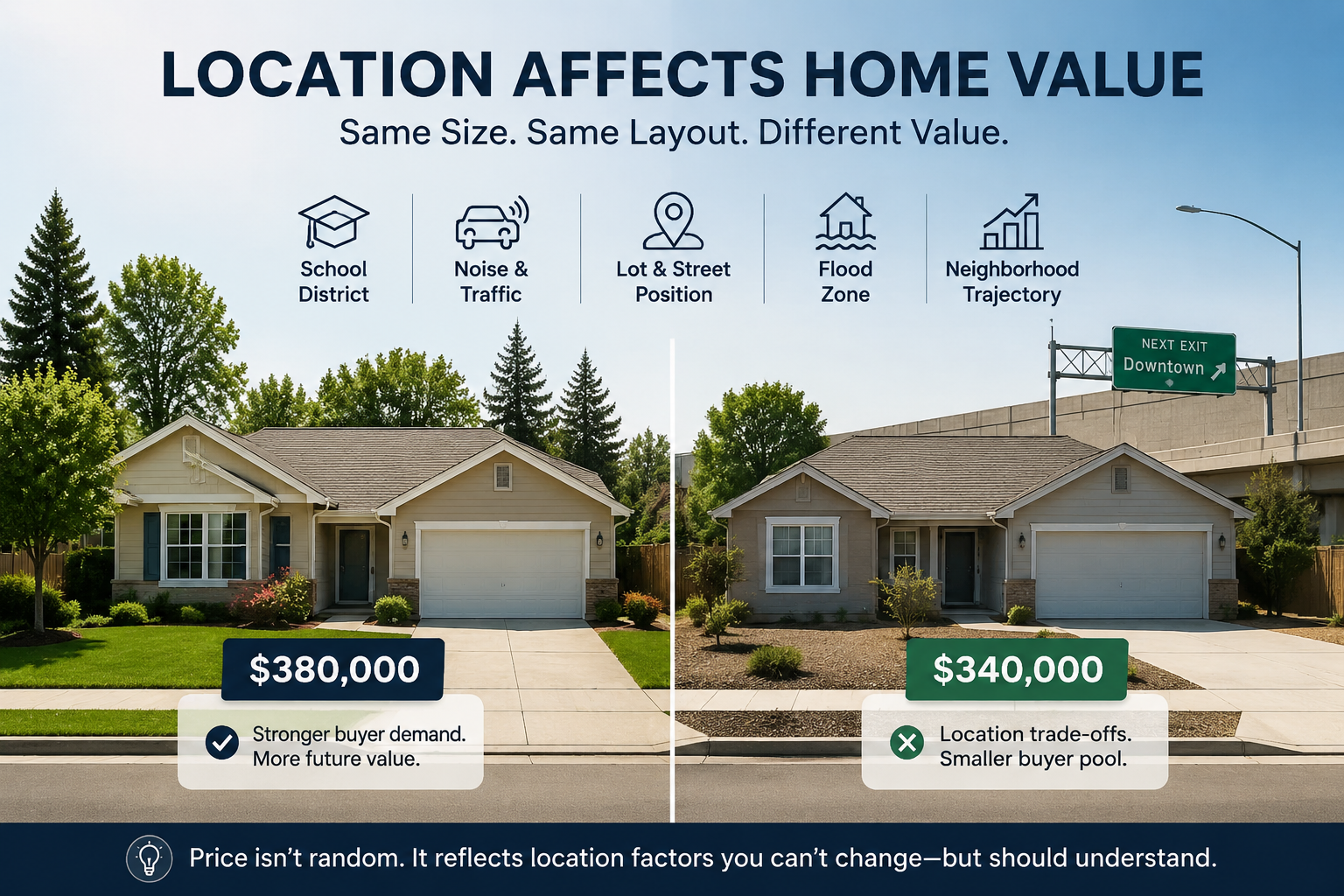
Two houses on the same street. Same square footage. Same number of bedrooms and bathrooms. One sells for $380,000. The other sells for $340,000.
For first-time buyers, this price difference can be confusing. The cheaper home may look like the better deal, but price differences often reflect factors that square footage and bedroom count do not capture.
But the price difference is not a mistake. It reflects factors about those two properties that are not always visible in a listing.
Location is one of the biggest factors affecting home value, and understanding how it works can help you compare properties more confidently.
Section 02
Why Location Matters More Than the House Itself
You can renovate a kitchen, add a bathroom, or update appliances. Those changes improve the house.
But you cannot change its location, school district, traffic conditions, or nearby surroundings. Those things are fixed, and they affect not just how you experience living there but how the next buyer will price it when you eventually want to sell.
This is why two identical houses can have different values. The cheaper one isn’t always the better choice once you consider the trade-offs involved.
Section 03
Factor 1: School District
In most markets, school district is one of the most powerful value drivers in residential real estate, even for buyers who do not have children.
Properties in highly regarded school districts often attract stronger buyer demand. Even buyers without children may consider school quality because it can influence future resale demand.
Research from the National Bureau of Economic Research has found that school quality can influence nearby home values, although the impact varies by market, school district, and local demand.
| School District Factor | Potential Impact on Home Value | Why It Matters |
|---|---|---|
| Highly regarded school districts | Often associated with stronger buyer demand | Larger future buyer pool |
| Average school districts | Depends on local demand | Moderate resale impact |
| Lower-rated school districts | May reduce buyer demand | Smaller resale audience |
The impact of school quality varies significantly by market, neighborhood, and buyer demand. Actual price differences vary significantly by specific market, city, and neighborhood. School ratings referenced are general categories and do not correspond to any specific rating system.
Section 04
Factor 2: Proximity to Noise and Traffic
A home backing up to a highway, sitting on a busy arterial road, or located near a railroad track or airport flight path may sell for less than a comparable home in a quieter location. These differences often reflect the impact on daily living and future buyer demand.
Research from various real estate studies suggests that homes near major highways, busy roads, or other sources of noise may sell for less than comparable properties in quieter locations. The impact depends on factors such as distance, visibility, noise level, and local buyer preferences.
Section 05
Factor 3: Street Position and Lot Characteristics
Within the same neighborhood and even the same street, lot and position characteristics create measurable price differences.
A cul-de-sac home may attract buyer interest because of lower traffic and a quieter environment. However, any price difference depends on local buyer preferences, inventory, and comparable sales in that specific market.
Corner lots are more nuanced. They offer larger total lot size and more light, which some buyers value. But they also have two street-facing sides, less backyard privacy, and more sidewalk maintenance responsibility, which makes them less desirable to others. Corner lots often sell at a slight discount to interior lots of comparable size in many markets.
Lot size itself matters, but the relationship is not always linear. A significantly larger lot in a neighborhood where lots are already generous adds relatively little value. A larger lot in a neighborhood where most properties are on small lots can add meaningfully to the price because it is a scarce characteristic.
| Lot or Position Type | Potential Impact | Why |
|---|---|---|
| Cul-de-sac | May attract buyer interest | Less traffic and quieter surroundings |
| Corner lot | Depends on buyer preferences | More space but less privacy |
| Busy road or highway | May reduce demand | Noise and traffic concerns |
| Open space or park views | May increase appeal | Views and perceived privacy |
| Flood zone | May affect affordability | Insurance requirements and resale considerations |
Value impacts are illustrative estimates based on general market research. Actual impacts vary significantly by specific market and buyer preferences.
Section 06
Factor 4: Flood Zone and Environmental Risks
Flood zones can affect both home value and ownership costs. Properties in high-risk flood areas may require flood insurance, which adds to monthly expenses and can influence future buyer demand.
Flood insurance costs depend on the home’s location, flood risk, and coverage. These additional costs should be considered when evaluating the overall affordability of a property.
Section 07
Factor 5: Neighborhood Trajectory
Two similar homes can have different values not just because of what the neighborhood is today but because of what buyers believe it will become.
A home in a neighborhood with new investments may influence future buyer demand over time. Factors such as school performance, business activity, infrastructure improvements, and local economic trends can influence how buyers perceive an area’s future potential. However, their impact on home values depends on local data, comparable sales, and actual development trends.
For first-time buyers, this factor is both an opportunity and a risk. Some buyers look for neighborhoods that are improving. Buying early may create opportunities, but future home values can never be guaranteed. Buying in a neighborhood facing challenges may involve risks such as weaker buyer demand or slower resale activity. However, the impact depends on local economic conditions, planned developments, and how market conditions change over time.
Buyers should look beyond current prices and consider factors such as development, infrastructure, and local economic trends. They can review factors such as new development permits, changes in local business openings and closures, infrastructure projects in the city planning pipeline, and trends in median income and population growth over the past three to five years.
Section 08
How Location Can Affect Your Total Homeownership Cost
When comparing two similar homes, the purchase price is only one part of the decision. The location of a property can also affect the ongoing costs of owning that home.
For example, a home in a flood-prone area may require flood insurance, which adds to the monthly cost of ownership. A property with HOA fees may also have additional monthly expenses that should be included when evaluating affordability.
Location can also influence future resale demand. A home near a highway, in a flood zone, or in an area with limited resale demand may appeal to a smaller group of future buyers.
This is why looking beyond the listing price matters. Before making an offer, consider not only what you will pay upfront, but also the long-term costs and factors that may affect the home’s value over time.
Section 09
How to Apply This When Comparing Listings
When you find two similar homes at different prices, the question to ask is not “which one is cheaper?” The question is “what is the cheaper one cheaper because of, and is that reason something I can live with, and will future buyers also be able to live with it?”
If the lower-priced home has a trade-off you are comfortable with, such as being near a major road that does not bother you, it may still be the right choice. However, factors like school district, resale demand, and your long-term plans should also be part of the decision.
The price difference between two similar homes is rarely random. It is information. Understanding what that information is telling you is one of the most important skills in the homebuying process.
Section 10
Frequently Asked Questions
How do I find out if a home is in a flood zone before making an offer?
You can check the FEMA Flood Map Service Center by entering the property address to see its flood zone designation. Your real estate agent and loan officer can also help identify flood-related requirements early, since some properties may require flood insurance that affects your total housing costs.
Do school district boundaries change, and how does that affect home value?
Yes, school boundaries can change, although major changes usually involve a long public process. Properties near boundary lines may be affected if zoning changes. Before buying based on a school district, review current district information and any planned changes with the local school district.
If I buy a home in a less desirable location for a lower price, can I make up the value difference with renovations?
Renovations can improve a home’s condition, but they cannot change its location. Updates may help a property compete better, but factors like traffic, school district, and neighborhood demand can still affect resale value. A lower price may reflect a location trade-off that future buyers will also consider.
Section 11
Conclusion
If you are comparing listings and want to understand how location, price, and financing fit together, reach out to Duc Pham or the Wonder Rates team. We can help you better understand whether a price difference reflects a true value gap or a trade-off worth considering before making an offer.
Disclaimer: All figures, percentage estimates, and research references in this article are for illustrative and educational purposes only and do not constitute an offer of credit, real estate advice, or a prediction of future home values. Actual price premiums and discounts vary significantly by specific market, neighborhood, property, and current conditions. Flood zone information should be verified directly with FEMA and your insurance agent. School district ratings and boundaries are subject to change. Consult your real estate professional and loan officer for guidance specific to the properties you are considering.
Duc Pham, Mortgage Broker | NMLS# 844897 | Wonder Rates, Inc. | NMLS# 1518655 | DRE# 02047445 | DFPI# 60DBO-59134 | Equal Housing Opportunity. Equal Housing Lender. | Licensed in: AL, AZ, CA, CO, FL, GA, LA, MI, NC, OH, OK, OR, PA, SC, TX, VA, WA.