

Section 01
Why Mortgage Applications Require So Much Documentation
“I have enough money, my income is good, so why does my lender need so much paperwork?” This is one of the most common frustrations borrowers voice early in the mortgage process, and it’s a fair question.
A mortgage isn’t approved based on a borrower’s word alone. A lender needs to build a documented financial picture, meaning a version of your income, assets, debts, credit, and the property itself that’s backed up by actual paperwork, in order to evaluate your ability to repay the loan and whether you meet the conditions of the applicable loan program.
That documented picture generally covers several categories: income, employment, assets, debts, credit, source of funds, and information about the property itself. Each of these exists for a specific reason, not simply to make the process feel longer than it needs to be.
Illustrative example: A borrower states their annual income is $120,000. On its own, that number doesn’t tell the lender everything they need to know. The lender may need appropriate documentation to verify that income and confirm how much of it can actually be used under the applicable underwriting requirements.
This example is illustrative only and does not represent an actual loan file or a guaranteed underwriting outcome. How income is verified and calculated depends on the borrower’s specific situation, loan program, and lender guidelines.
Documentation isn’t there to make life difficult for borrowers. It exists to help a lender confirm that what’s written in the application actually reflects the borrower’s real financial situation.
Section 02
Missing Documents Are Not Automatically Mortgage Fraud
This distinction matters enormously, both for borrowers trying to understand the process and from a compliance standpoint, so it deserves its own section rather than a passing mention.
Forgetting a document
Say a borrower hasn’t yet sent in a particular bank statement, a page of a tax return, an employment document, or gift documentation. This is typically nothing more than missing documentation. The lender can simply ask the borrower to provide what’s missing, and the process continues.
Knowingly hiding information
This is a fundamentally different situation. It occurs when a borrower is aware that a lender needs certain information but deliberately chooses not to disclose it, or provides inaccurate information specifically intended to influence the lender’s decision. For example, a borrower who has an existing debt but intentionally leaves it off the application, or who has a large source of funds but deliberately misrepresents where it came from.
Why the distinction matters
It would be inaccurate, and unfair to borrowers, to describe every instance of missing paperwork as fraud. A mistake is not the same thing as intentional misrepresentation. This distinction runs throughout this entire article, because a borrower who simply forgot to upload a file is in a completely different situation from one who deliberately tried to mislead their lender.
Section 03
What Does Mortgage Application Fraud Actually Mean?
The Federal Bureau of Investigation defines mortgage fraud as a material misstatement, misrepresentation, or omission relied upon by an underwriter or lender to fund, purchase, or insure a loan. In plain terms, this generally means intentionally providing false information, deliberately hiding something important, or using dishonest documentation in a way meant to affect whether a loan is approved or under what terms.
Intent is the key word here. Under federal law governing false statements to financial institutions, honest mistakes or clerical errors generally do not meet the legal threshold for fraud, since intent is a required element. A typo, a misunderstood question on an application, or a document that simply wasn’t submitted yet is not automatically equivalent to deliberate dishonesty.
Section 04
Common Ways Borrowers May Misrepresent Their Financial Information
Hiding income or employment changes
Illustrative scenario: A borrower is employed at Company A, earning $90,000 per year, and later moves to Company B. Worried that a recent job change might hurt their application, the borrower continues providing information about their old job instead of disclosing the change.
A job change doesn’t automatically mean denial. But a lender needs an accurate picture of a borrower’s current employment situation in order to evaluate the file properly. The better approach is straightforward: disclose the change and let the lender determine what documentation is actually needed.
This scenario is illustrative only and does not represent a guaranteed underwriting outcome. Whether a job change affects a specific application depends on the new employment, the loan program, and the lender’s specific requirements.
Omitting debts or financial obligations
Illustrative example: A borrower reports income of $8,000 per month but doesn’t disclose an existing monthly debt obligation of $600.
Debt obligations matter because they factor directly into the debt-to-income ratio, commonly called DTI, which lenders use to help assess whether a borrower can reasonably manage a new monthly payment. If a borrower’s other monthly debt obligations total $1,800, the math works out to $1,800 divided by $8,000, or 22.5%. Add the undisclosed $600 payment, and the calculation becomes $2,400 divided by $8,000, or 30%. If you want to see how your own monthly debts and income affect your DTI, you can use the Wonder Rates DTI Calculator as a starting point.
This is a simplified mathematical illustration only and does not represent an actual underwriting calculation, qualification outcome, or guarantee of approval or denial at any specific DTI level. Actual DTI calculations and their impact on qualification vary by loan program and lender.
Borrowers shouldn’t decide on their own that a particular debt is “too small to matter.” That determination belongs with the lender reviewing the full file.
Misrepresenting the source of funds
Illustrative scenario: A bank account shows a balance of $85,000, and the borrower describes the entire amount as personal savings. In reality, $30,000 of that balance was transferred from a family member just weeks earlier.
This is where source of funds becomes a genuine issue. A lender may need documentation to determine where funds actually came from and whether they can be used for the transaction under the applicable requirements. If you want to understand more about how lenders document where mortgage funds came from, see our guide to Source of Funds for a Mortgage. It’s worth being clear that a large deposit is not automatically fraud. Plenty of large deposits have entirely legitimate, easily documented explanations. The concern arises when unexplained funds are described inaccurately rather than disclosed honestly.
This scenario is illustrative only and does not represent a guaranteed outcome. How a specific deposit is treated depends on documentation, the loan program, and the lender’s underwriting requirements.
Section 05
Large Deposits: When a Bank Statement Raises Questions
This deserves its own section, since it comes up in a huge share of mortgage files and causes a disproportionate amount of borrower anxiety.
Illustrative example: A borrower has $100,000 in an account. A month later, a $25,000 deposit appears. The borrower’s first instinct might be, “The money is already in the account, why does the lender need to know anything else?”
A lender may need to understand the source of that deposit, depending on the transaction and applicable requirements. Legitimate, well-documented sources are common and include a transfer between the borrower’s own accounts, proceeds from the sale of an asset, a gift, or other properly documented funds.
This example is illustrative only and does not represent an actual loan file. Not every large deposit indicates a problem with a transaction. What matters is whether the documentation and explanation accurately reflect where the money actually came from.
Section 06
Misrepresenting Income Is More Than Just Changing a Number
Illustrative scenario: A borrower’s actual income is $75,000, but wanting the application to look stronger, they report $100,000 instead.
This goes well beyond an optimistic estimate. If a borrower intentionally provides inaccurate income specifically to influence their qualification, the seriousness of that action is entirely different from a borrower who simply misunderstands how qualifying income is calculated for their specific situation.
This scenario is illustrative only and is not a description of any actual case. The consequences of inaccurate income reporting depend on the specific circumstances, intent, and applicable law.
Self-employed and variable income
This area deserves particular attention, since self-employed income is rarely as simple as gross revenue equaling qualifying income. If a business generates $150,000 in gross revenue, that does not mean the borrower automatically has $150,000 in qualifying income for mortgage purposes. Underwriting typically reviews tax documentation and applies the requirements relevant to that borrower’s specific loan program to arrive at a usable figure. Borrowers shouldn’t inflate income figures simply to make an application look stronger. Disclosing the real numbers and letting the lender calculate qualifying income correctly is the right approach.
Section 07
Employment Verification Can Reveal Information That Changed After Application
Some borrowers assume that once an application is submitted, the information on it is essentially locked in. In reality, the mortgage process can continue to require verification well after the initial application, and that verification can reveal changes that happened along the way.
Illustrative example: On the day of application, a borrower’s employment is listed as Job A, earning $95,000. The borrower later changes jobs. If the lender needs updated employment verification closer to closing, this new information may need to be reviewed as part of the file.
This example is illustrative only and does not represent a guaranteed outcome. Whether a job change requires additional review, and what that review involves, depends on the lender and the specific loan program.
A mortgage application is a process that plays out over time, not a single snapshot frozen at the moment it was submitted.
Section 08
What Happens When Information Does Not Match?
It’s not accurate to suggest that any discrepancy automatically results in denial or serious consequences. In reality, there are several possible outcomes, and most are far less dramatic than borrowers fear.
The lender may ask for clarification
If a bank statement doesn’t match information the borrower previously provided, the lender may simply request an explanation or supporting documentation.
Additional underwriting conditions
The file may need further documentation before a specific underwriting condition can be cleared.
Qualification may change
If new information affects the income, debts, or assets being used to qualify the borrower, underwriting may need to reassess the file based on the updated figures.
Closing may be delayed
If documentation isn’t complete in time, the transaction can experience delays, depending on the specific circumstances.
The loan may no longer qualify
In situations where new information materially changes the borrower’s profile or the transaction itself, the ultimate outcome can differ from what was originally expected.
Not every discrepancy leads to a denial. The outcome depends heavily on what the discrepancy actually is, how it’s resolved, and whether it can be properly documented. For a broader look at issues that can trigger additional questions during underwriting, see our guide to Mortgage Underwriting Red Flags.
Section 09
Example: A Borrower Hides a $40,000 Gift
Scenario: Purchase price of $600,000, with a down payment of $120,000. The borrower has $80,000 in personal savings, and a family member has provided an additional $40,000 gift. Rather than disclosing the gift, the borrower simply tells their loan officer, “I have enough money in my account,” without mentioning where part of it came from. When the lender later reviews bank statements, they identify the discrepancy and need an explanation of the funds’ source.
What could happen? The lender may request appropriate documentation related to the source of funds. Had the borrower disclosed the gift from the start, the loan officer could have guided them through the necessary documentation earlier in the process, likely avoiding any last-minute scramble.
Lesson: The underlying issue here isn’t that the money came from a family member. Gift funds are common and well understood in mortgage lending. The issue is trying to make the source of the money look different from what it actually is.
This example is illustrative only and does not represent an actual borrower, transaction, or guaranteed outcome. How gift funds are documented and treated depends on the specific loan program and lender requirements.
Section 10
Example: A Borrower Leaves Out a Side Business
Scenario: A borrower has W-2 income of $110,000 per year and also runs a small side business. Believing the business is too small to matter, the borrower decides not to mention it at all.
That side business, however, comes with its own income, expenses, potential liabilities, and tax reporting. Depending on the specific circumstances, some or all of that information can become relevant to underwriting, even if the business itself is modest in size.
Lesson: It generally isn’t a borrower’s role to decide unilaterally what information is or isn’t relevant to their lender. Disclosing it and allowing the mortgage professional to determine what documentation applies tends to produce a much smoother process than omitting it and hoping it doesn’t come up.
This example is illustrative only and does not represent an actual borrower’s situation. Whether and how a side business affects underwriting depends on the specific income, structure, and loan program involved.
Section 11
Why Borrowers Sometimes Hide Information
This section is worth approaching with empathy rather than judgment, since most borrowers who withhold information aren’t acting maliciously. They’re usually acting out of fear or misunderstanding.
Fear of denial
Some borrowers assume, “If I tell the truth, my loan definitely won’t get approved.” In reality, having an issue in your financial picture doesn’t automatically mean automatic denial. Knowing about a potential issue early gives a loan officer the chance to explore whatever options may be available.
Fear of delays
Others worry that disclosing something will simply mean more paperwork to gather. But hiding information often means that same documentation surfaces later anyway, typically at a much more stressful point in the process, closer to closing, when there’s far less time to address it.
Advice from friends or social media
“My friend told me I didn’t need to mention that.” Friends and acquaintances may have had a completely different financial situation, loan program, or lender, and their experience doesn’t necessarily apply to your file. Mortgage underwriting decisions shouldn’t be based on secondhand, anecdotal advice.
Section 12
What Borrowers Should Do If They Forgot to Disclose Something
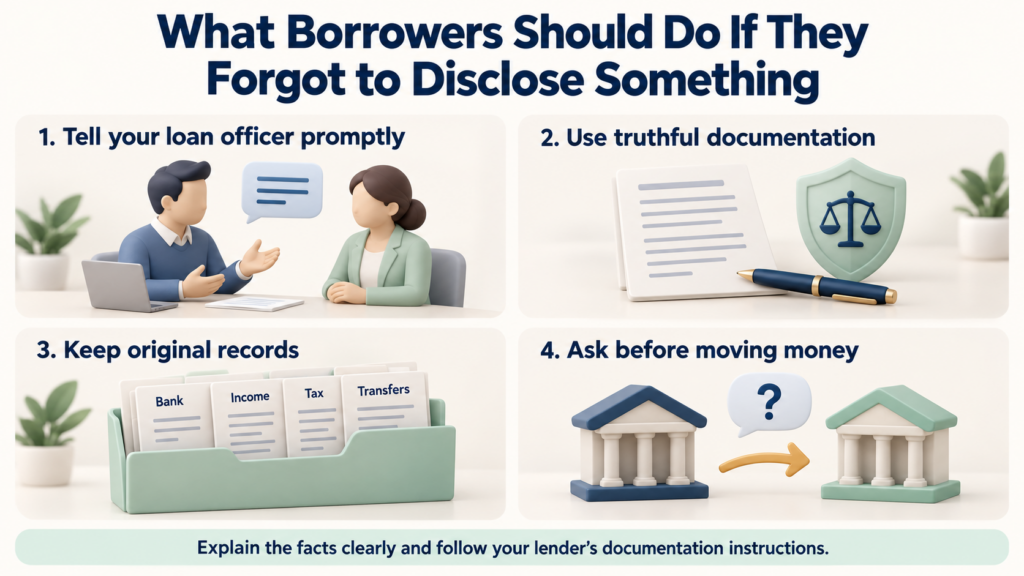
Tell your loan officer as soon as possible
Don’t wait for your lender to discover it independently. Bringing it up yourself is almost always the better path.
Do not create documents to make the story look better
Any documentation submitted for underwriting needs to genuinely reflect the actual transaction and circumstances.
Keep original records
This includes bank statements, pay stubs, tax documents, transfer records, gift documentation, and employment records. Having originals on hand makes it far easier to respond quickly if something needs clarification.
Ask before moving money
If you’re planning to transfer a significant sum, check with your loan officer first. This isn’t because every transfer is problematic. It’s because documentation requirements can vary depending on the source and timing of the funds.
Section 13
The Difference Between "Complicated" and "Untruthful"
This distinction deserves to be stated plainly.
A file involving self-employment, multiple income sources, gift funds, and a recent job change all at once can genuinely be complicated. But a complicated file can still be documented and reviewed appropriately with the right paperwork and explanations.
By contrast, a file that looks simple on the surface, a straightforward W-2 income and healthy savings, can become a serious problem if the borrower has deliberately concealed or misrepresented information. A complicated file can be documented. An inaccurate file creates uncertainty, and uncertainty is far harder for a lender to work through than complexity.
Section 14
How to Make Your Mortgage File Easier Without Hiding Anything
Keep your financial records organized
It helps to maintain separate folders for income, assets, debts, taxes, employment, and property documentation, so everything is easy to locate when it’s requested.
Ask before making major financial changes
Before taking on a new car loan, opening a new credit card, making a large transfer, changing jobs, or moving money between accounts, it’s worth checking with your loan officer first.
Tell your loan officer when something changes
There’s no need to wait until your lender specifically asks. Proactively sharing changes tends to prevent much bigger headaches later.
Do not edit or manipulate documentation
Documents submitted for underwriting need to be genuine and complete, without alterations of any kind.
Section 15
The Biggest Mortgage Mistake Is Not Having a Perfect Financial History
Lenders don’t require every borrower to have a flawless financial profile. A job change, self-employed income, gift funds, multiple bank accounts, large deposits, or past financial difficulties don’t automatically mean denial. What actually matters most is that the lender has an accurate picture of the borrower’s real financial situation, whatever that situation happens to be.
Section 16
Final Takeaway: Tell the Truth Before the File Gets Complicated
If there’s an issue somewhere in a file, it’s always better for a loan officer to know about it from the start. Knowing early leaves time to explore documentation and determine whether there’s a reasonable path forward. What creates real problems is discovering an important piece of information right before closing, when there’s little time left to address it properly.
If you’re not sure whether something needs to be disclosed, ask. Don’t assume on your own that something probably doesn’t need to be mentioned.
If you’re working through a mortgage application and aren’t sure whether a specific source of funds, income change, debt, or job change needs to be disclosed, ask your loan officer before deciding on your own. A quick question early on is almost always easier to handle than a discovery made at the last minute. If you want to discuss a specific mortgage scenario before submitting your application, you can get started with Wonder Rates and speak with a licensed mortgage professional.
Section 17
Sources
- Federal Bureau of Investigation (FBI), Mortgage Fraud
- Consumer Financial Protection Bureau (CFPB), Owning a Home
- Fannie Mae Selling Guide
- Fannie Mae Selling Guide, B3-3.5-01: Underwriting Factors and Documentation for a Self-Employed Borrower
This article is provided for general educational and informational purposes only and does not constitute legal, financial, tax, mortgage, underwriting, or lending advice, nor does it guarantee loan approval or any specific loan terms. Mortgage requirements vary by lender, loan program, applicable law, property type, transaction structure, and the borrower’s individual circumstances. The numerical examples in this article are hypothetical illustrations only and are not representations of actual qualification requirements, underwriting outcomes, interest rates, fees, or loan terms. A missing document, inconsistent information, or discrepancy does not automatically constitute mortgage fraud. Intentional misrepresentation, concealment of material information, or submission of inaccurate or altered documentation may have serious consequences and should be addressed with the appropriate licensed professionals. Borrowers should provide complete and accurate information and consult a licensed mortgage professional, attorney, tax professional, or other qualified professional when appropriate.
Duc Pham, Mortgage Broker | NMLS# 844897 | 408-600-1900 | dp@wonderrates.com Wonder Rates, Inc. | NMLS# 1518655 | DRE# 02047445 | DFPI# 60DBO-59134 Equal Housing Opportunity. Equal Housing Lender. Licensed in: AL, AZ, CA, CO, FL, GA, LA, MI, NC, OH, OK, OR, PA, SC, TX, VA, WA