
Section 01
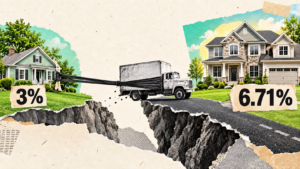
Your parents bought a house. Today’s young adults are often stuck answering a harder question: when?
That framing is a bit of an exaggeration. Not every young adult is renting, in debt, or priced out of the market, and plenty of Gen Z and millennial buyers close on homes every year. But the exaggeration points to something real. The path that used to look fairly linear, college, job, marriage, house, now looks different for a lot of people.
For many young Americans today, the path can look more like this: college, student debt, renting, a few career changes, some side income, and maybe a house somewhere down the line. That does not mean Gen Z or millennials do not want to own a home. It usually means the timing and the ability to save enough to get there have both shifted.
Financial media outlets like MarketWatch have pointed out that the traditional wealth-building path, centered on steady income, saving, and eventually buying a home, has become harder for Gen Z and younger millennials to follow, largely because of a combination of housing costs, debt, and income pressure. That framing sets up the rest of this article well: this is less a story about young Americans rejecting homeownership and more a story about the math changing underneath them.
Section 02
Is Homeownership Still Part of the American Dream?
It’s tempting to read the headlines and conclude that young Americans have simply given up on owning a home. Survey data on ownership rates cannot tell us what people want, but it does show how ownership builds with age, and that pattern points more toward timing than toward rejection.
Homeownership Rate by Age Group in 2025
According to the Federal Reserve’s 2025 Survey of Household Economics and Decisionmaking (SHED), 24% of adults ages 18 to 29 owned their home in 2025, compared with 58% of adults ages 30 to 44 and 63% of all adults overall. The same report found that 44% of adults ages 18 to 29 rented, and that 49% of adults under age 30 lived with a parent in 2025, up 12 percentage points since 2019, according to the SHED executive summary.
This data comes from the Federal Reserve’s 2025 Report on the Economic Well-Being of U.S. Households, covering U.S. adults in 2025. Homeownership rates vary significantly by age, income, and other factors, so this data should not be used to draw conclusions about any single generation or individual’s likelihood of owning a home.
Nothing in these numbers shows that homeownership has disappeared from the American Dream. For a lot of young adults, it may simply be arriving later than it did for their parents.
The National Homeownership Rate in 2026
That pattern also shows up at the national level. The U.S. Census Bureau reported a national homeownership rate of 65.0% in the second quarter of 2026, essentially unchanged from 65.0% in the second quarter of 2025. In other words, the country as a whole has not seen a sudden collapse in ownership. The change young adults are running into is more about when and how they get in.
This is the overall U.S. homeownership rate, not a rate specific to Gen Z or millennials. It comes from the Census Bureau’s Housing Vacancy Survey, which is a supplement to the Current Population Survey. It measures households, while the Federal Reserve figures above measure adults, so the two numbers are not directly comparable.
Section 03
What Stands in the Way Before You Apply for a Mortgage?
It’s easy to frame this issue as “mortgages are too expensive,” but that framing skips over everything that happens before a person even applies for one.
What Lenders Look for Before Approval
Before a mortgage application ever gets submitted, a borrower typically needs several things lined up at once:
- Stable income
- A credit history
- A down payment
- Enough cash for closing costs
- Emergency savings
- Positive monthly cash flow
- Manageable existing debt
This is where rent, student loans, car payments, and credit card balances start to intersect with the path to homeownership, often long before a lender ever enters the picture. A person can have a strong income and still be a year or two away from being ready, simply because the cash for a down payment, closing costs, and a reserve fund has not built up yet.
This is a general checklist, not an underwriting standard. Requirements vary by loan program, lender, and borrower profile.
How Rent Slows Down Saving for a Down Payment
The Federal Reserve found that 23% of renters reported falling behind on rent at some point in 2025, up from 21% in 2024.
This figure comes from the Federal Reserve’s 2025 SHED housing data, based on a national survey of renters. It is not a measure of how many people “cannot afford to buy a home,” and it does not mean every renter is in financial distress.
When a large share of monthly cash flow already goes toward rent, there is simply less room left over to build a down payment or cover closing costs. That is a cash flow issue, not proof that renting always costs more than owning. For someone with a shorter time horizon, uncertain plans, or a tight budget, renting can still be the more practical choice for now.
Section 04
How Does Student Debt Affect Buying a Home?
Student loans are one of the more direct ways debt intersects with the path to homeownership, and this is a section worth reading carefully if that description fits you.
According to the Federal Reserve, 16% of all adults had outstanding student loans in 2025. That share was higher among younger adults: 25% of adults ages 18 to 29 and 22% of adults ages 30 to 44 had outstanding student loan debt.
This is the share of adults with outstanding student loans according to the Federal Reserve’s 2025 SHED credit data. Having a student loan does not automatically mean a person cannot qualify for a mortgage.
Can You Get a Mortgage With Student Loans?
This is an important point, and it is worth stating plainly: having student debt does not mean someone cannot get a mortgage.
Student loans can affect monthly cash flow and, depending on the loan balance, the repayment status, and the payment amount, can factor into how a lender calculates affordability. But “has a student loan” and “cannot qualify for a mortgage” are two very different statements. The more useful way to think about it is as a chain: income flows into monthly debt obligations, which flow into mortgage qualification, which flow into what a person can comfortably afford.
Illustrative example: Imagine a buyer with gross monthly income of $6,000 who is considering a total monthly housing payment of $1,900. With no other debts, housing would be about 32% of gross income ($1,900 divided by $6,000). Now add a $350 monthly student loan payment. Total monthly obligations become $2,250, or about 38% of gross income ($2,250 divided by $6,000). The house and the income did not change, but the student loan moved the buyer’s debt-to-income ratio by about six percentage points.
This is a simplified, hypothetical example used only to show how a monthly debt payment changes a debt-to-income ratio. It is not an underwriting calculation. Lenders use different methods, limits, and loan programs, and how a student loan payment is counted can depend on the loan type and repayment status. Do not use these figures to estimate whether you would qualify.
Mortgage qualification and what a person can actually live with comfortably each month are also two different things. A loan program might approve a higher payment than someone is personally comfortable carrying, which is a separate question worth asking regardless of what a lender is willing to offer.
Section 05
How Much Do Mortgage Rates Change Your Monthly Payment?
Interest rates are the piece of this conversation that gets the most attention, and for good reason.
Today’s 30-Year Fixed Mortgage Rate (Freddie Mac)
According to Freddie Mac’s Primary Mortgage Market Survey (PMMS), the average rate on a 30-year fixed mortgage was 6.95% as of September 17, 2026, up from 6.76% the week before and 6.26% a year earlier.
This is a national weekly average reported by Freddie Mac’s PMMS. The survey focuses on conventional, conforming, fully amortizing home purchase loans for borrowers who put 20% down and have excellent credit, so it is not the rate any individual borrower will actually receive. Actual rates depend on credit profile, loan program, down payment, property type, lender, and timing, and can differ meaningfully from the national average. The PMMS is updated weekly on Thursdays.
It’s tempting to reduce this to a single headline: “6.95% means mortgages are too expensive.” But the same home, the same down payment, and the same buyer can end up with very different monthly payments depending on the interest rate attached to the loan.
Example: What a 1% Rate Change Costs on a $400,000 Loan
Illustrative example: Consider a borrower financing $400,000 with a 30-year fixed-rate loan. At an interest rate of 5.71%, the estimated monthly principal and interest payment would be roughly $2,324. At 6.71%, just one percentage point higher, the estimated monthly principal and interest payment rises to roughly $2,584, a difference of about $260 per month on the same loan amount. At 6.95%, the same loan would come to roughly $2,648 per month.
This is a simplified, hypothetical example used only to illustrate how interest rate changes affect the principal and interest portion of a payment. It does not include property tax, homeowners insurance, HOA dues, mortgage insurance, or other costs that are typically part of a monthly housing payment. Do not use these figures to estimate an actual mortgage payment. Actual payments depend on the specific rate, loan term, loan program, and other costs at the time of application.
Over a 30-year loan, that monthly gap adds up, which is why a small change in rate can change what a buyer feels comfortable purchasing. It is also one reason many buyers compare quotes from more than one lender.
Section 06
Is Renting Really "Throwing Money Away"?
This section matters because it’s easy for an article like this one to drift into sounding anti-renting, which would be its own kind of bias. Renting is not automatically a financial mistake.
When Renting Makes Sense
Renting tends to make the most sense for people who:
- Are not sure where they will be living long-term
- Are in the middle of a career transition
- Do not want to lock up a large amount of money in one property
- Do not yet have a strong emergency fund
- Would rather avoid maintenance responsibilities and the transaction costs of buying and selling
Flexibility has real value, especially early in a career. A renter who can relocate for a better job, or who is not forced to sell during a bad market, is buying that freedom with monthly rent.
When Renting Is Not a Financial Win Either
It’s also worth avoiding the opposite extreme. Rent payments do not build home equity, full stop.
If someone rents specifically to free up cash for investing instead, the outcome of that strategy depends on several variables working together: how much is actually invested each month, the investment returns achieved, fees, taxes, the time horizon involved, and how consistently the person actually sticks with the plan. Investments can also lose value, which is a risk that a fixed monthly mortgage payment does not carry in the same way.
There is no rent-versus-buy strategy that is automatically better for everyone. This is a discussion of trade-offs, not an investment or financial recommendation for any individual situation.
Section 07
Can Homeownership Still Build Wealth?
None of the above should be read as an argument against buying a home. Homeownership still works as a wealth-building tool for a lot of people, through a few specific mechanisms.
Equity
As a homeowner pays down the principal balance of a mortgage over time, they build equity, meaning ownership stake, in the property. A down payment creates equity on day one. Early in a 30-year loan, though, a larger share of each payment goes toward interest, so the balance shrinks slowly at first and faster in later years.
Appreciation
Property values can rise over time, which can increase a homeowner’s equity beyond what they have paid down through their mortgage. Appreciation depends heavily on the local market, the property, and how long the owner holds it.
Home prices are not guaranteed to go up, however. Values can also decline depending on market conditions, location, and the property itself.
Fixed-Rate Stability
A fixed-rate mortgage keeps the principal and interest portion of the payment the same for the life of the loan. Property taxes, homeowners insurance, and other associated costs can still change over time even when the principal and interest amount does not. The Federal Reserve’s 2025 survey found that 14% of homeowners with insurance said they struggled to afford their premiums, a reminder that the fixed part of the payment is only one piece of the monthly cost.
Forced Saving
For some people, a mortgage payment functions as a built-in savings mechanism, since a portion of every payment goes toward reducing the loan balance rather than being fully spent. That structure can help people who find it hard to save on their own, as long as the payment stays comfortably affordable.
Homeownership also comes with real costs that renting does not: maintenance, homeowners insurance, property taxes, and the closing and transaction costs involved in buying or eventually selling.
Homeownership can support long-term wealth building, but it does not guarantee returns or price appreciation. This is educational information, not investment advice.
Section 08
Is the Real Issue Timing Rather Than Homeownership?
This is really the thesis of this whole article, so it’s worth stating directly.
The more useful question is probably not “Does Gen Z still want to buy a home?” It’s closer to: “At what age, at what price point, and through what financial path can a young adult realistically get there?”
Homeownership Rate by Age: 18 to 29 vs. 60 and Older
Federal Reserve data shows homeownership rising steadily with age:
- Ages 18 to 29: 24%
- Ages 30 to 44: 58%
- Ages 45 to 59: 76%
- Ages 60 and older: 83%
These figures come from the Federal Reserve’s 2025 SHED housing data. This is cross-sectional data, meaning it reflects different age groups at one point in time, not the same group of people tracked over their entire lives. It should not be interpreted to mean that today’s 24% of 18-to-29-year-old homeowners will automatically become 58% homeowners once they reach ages 30 to 44.
That distinction matters more than it might first appear. Older generations reached higher homeownership rates partly because they had more time, and often different economic conditions, to work with. It is not a guarantee that any specific cohort will follow the exact same trajectory.
Section 09
What Does This Mean for the American Dream?
A few things seem to be true at the same time.
1. Homeownership is still valuable. Nothing in the data suggests owning a home has stopped being a meaningful financial and personal milestone. The national homeownership rate has held steady at 65.0% year over year.
2. But it is no longer the only financial milestone that matters. A lot of young adults are simultaneously paying down debt, building an emergency fund, investing, growing a career, or building a business, all before buying becomes realistic, and all of those goals have value on their own.
3. “Not yet” does not mean “never.” The American Dream, at least the homeownership piece of it, may not be disappearing. It may simply be arriving on a different timeline than it did for previous generations.
Neither version of the path is wrong. They are just built around a different set of starting conditions. The traditional sequence of education, career, marriage, home, and wealth now sits alongside others: education, debt, career building, renting, saving and investing, and a home later on. For others, it might look like career, entrepreneurship, investing, and renting long-term by choice rather than necessity. MarketWatch has also noted that a portion of younger Americans are pursuing financial security through other means, including investing, entrepreneurship, side income, and longer-term renting, rather than treating homeownership as the only milestone that counts.
Section 10
What Should You Consider Before Buying Your First Home?
This section is meant to be practical rather than theoretical, since the goal here is to help with an actual decision, not just describe a trend.
Monthly Affordability
The more useful question is not “What size home do I qualify for?” It’s “Would I actually be comfortable with this payment every month, including the months when something unexpected comes up?” A payment that a lender approves and a payment that fits your life are not always the same number.
Cash Reserves
After the down payment and closing costs are paid, how much is left over? A home purchase that empties out every available dollar leaves very little room for the inevitable surprise expense, whether that is a repair, a job change, or a jump in insurance costs.
Existing Debt
Student loans, car loans, credit cards, and other recurring monthly obligations all affect how much room is realistically left in a budget for a mortgage payment, separate from whatever a lender is willing to approve. Paying down a high-interest balance can sometimes do more for monthly flexibility than waiting for a lower rate.
How Long You Plan to Stay
Buying and selling a home both come with transaction costs. Someone planning to stay in one place for one or two years is working with a very different math problem than someone planning to stay for ten or more.
Career and Location
If a career is still likely to involve relocation or significant change, renting can offer flexibility that a mortgage simply does not provide. If your work and life are settled in one area, the case for buying gets stronger.
This is an educational checklist, not an underwriting standard or personalized financial advice. Actual mortgage qualification depends on the specific loan program, lender, and borrower profile.
Section 11
Should Young Americans Rent or Buy?
There isn’t a single right answer here, and this article is not going to pretend there is one. The table below is meant as a starting framework rather than a recommendation.
| If you prioritize… | You might consider… |
|---|---|
| Flexibility | Renting |
| Career or location that is still in flux | Renting |
| Building home equity | Buying |
| Strong cash reserves already in place | Buying |
| You do not yet have enough savings | Waiting and continuing to save |
| A long-term commitment to one location | Comparing the buy option more closely |
This is a framework for thinking through the decision, not a personalized recommendation. What fits best depends on income, savings, debt, location, home prices, mortgage terms, and personal plans, all of which vary from person to person.
Section 12
The American Dream Is Changing, Not Disappearing
Our parents may have treated homeownership as the clearest marker of adulthood. For a lot of young adults today, the road to that same milestone can simply be longer.
College can come with debt attached. Careers can involve more changes along the way. Renting can stretch on longer than it used to. Homeownership, when it happens, may simply arrive later.
But later is not the same thing as never.
Maybe the more useful question is not “Why isn’t Gen Z buying homes?” but rather: “How does someone build financial security while living in an expensive housing market?”
That is also where mortgage planning fits into the picture. Home price is only one part of the equation. Interest rate, monthly payment, existing debt, cash reserves, and how long someone plans to stay in a home all matter just as much when it comes to deciding whether, and when, to buy.
Section 13
Frequently Asked Questions
Is homeownership still part of the American Dream?
Yes, for many people it still is. Federal Reserve data shows 63% of U.S. adults owned their home in 2025, though ownership was much lower among adults ages 18 to 29 (24%) than among older groups. Affordability has made reaching homeownership harder for some groups, particularly younger adults and those with lower incomes.
Why is homeownership harder for Gen Z?
There is no single cause. Housing costs, mortgage rates, income levels, savings, student debt, and a limited supply of moderately priced homes can all play a role, often at the same time.
Is renting better than buying?
There is no universal answer. Renting offers flexibility and fewer ownership responsibilities, while buying can help build equity over time. Which one makes more sense depends on someone’s financial situation and how long they plan to stay in one place.
Does student debt prevent you from getting a mortgage?
Not automatically. Student debt can affect monthly obligations and overall affordability, but mortgage qualification also depends on income, credit, assets, reserves, the loan program, and individual lender requirements.
How much income do I need to buy a house?
There is no single income threshold that applies to everyone. Lenders typically evaluate income alongside debt, credit, assets, the property itself, and the specific loan program being used.
Section 14
Sources
- Federal Reserve, Report on the Economic Well-Being of U.S. Households in 2025, Housing
- Federal Reserve, Report on the Economic Well-Being of U.S. Households in 2025, Credit
- Federal Reserve, Report on the Economic Well-Being of U.S. Households in 2025, Executive Summary
- U.S. Census Bureau, Housing Vacancies and Homeownership (Current Population Survey/Housing Vacancy Survey)
- Freddie Mac, Primary Mortgage Market Survey (PMMS), September 17, 2026 release
- Freddie Mac, Primary Mortgage Market Survey (PMMS), current rates
Disclaimer: This article is intended for general informational and educational purposes only and does not constitute financial, mortgage, tax, legal, or investment advice. The figures cited are drawn from the sources linked throughout this article and are subject to change over time. Homeownership, rent, and mortgage affordability vary significantly by income, location, property, credit profile, loan program, and individual financial circumstances. Neither renting nor buying is automatically the right choice for everyone.
Duc Pham, Mortgage Broker | NMLS# 844897 | 408-600-1900 | dp@wonderrates.com Wonder Rates, Inc. | NMLS# 1518655 | DRE# 02047445 | DFPI# 60DBO-59134 Equal Housing Opportunity. Equal Housing Lender. Licensed in: AL, AZ, CA, CO, FL, GA, LA, MI, NC, OH, OK, OR, PA, SC, TX, VA, WA