
Section 01
You agreed on a price, you’re under contract, and then the appraisal comes back lower than what you offered. It feels like the deal just broke. It usually hasn’t, but it does mean the numbers have to move somewhere.
Here’s what actually happens when an appraisal comes in low, and the real options you have from there.
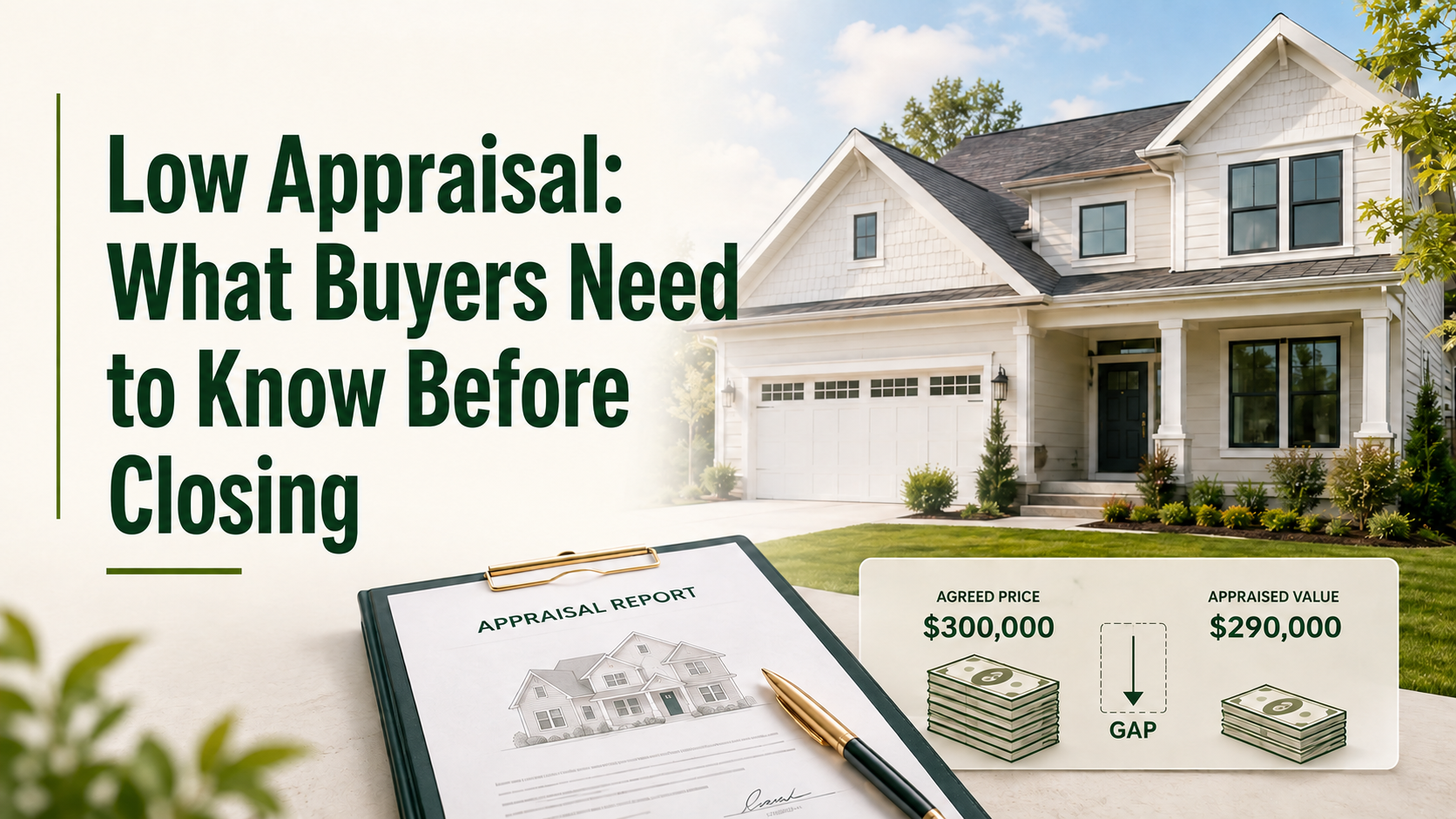
A low appraisal happens when the home’s appraised value comes in below the agreed purchase price. When that happens, your lender uses the lower value to determine your loan amount, which may require you to bring additional funds, renegotiate the price, or explore other options before closing.
Section 02
How a Low Appraisal Affects Your Mortgage Loan Amount
Lenders base your loan on the lower of two numbers: your agreed purchase price, or the appraised value. If those two numbers match or the appraisal comes in higher, nothing changes. IIf the appraisal comes in lower, the maximum loan amount may be reduced because the lender uses the lower value when calculating the loan-to-value ratio.
For illustration purposes, assume you’re under contract for $300,000 with a loan program that allows 95% financing. You may expect a $285,000 loan based on the purchase price.
| Scenario | Value Used | Example Loan Amount at 95% LTV |
|---|---|---|
| Based on contract price | $300,000 | $285,000 |
| Based on low appraisal | $290,000 | $275,500 |
That’s a $9,500 gap between what you expected to borrow and what the appraisal actually supports. Someone has to cover that gap for the deal to close as originally structured.
These figures are for illustration purposes only. Actual loan-to-value limits, loan amounts, and appraisal outcomes vary based on the lender, loan program, borrower qualifications, and property details.
Section 03
Your Practical Options When the Value Comes in Low
Once the gap exists, you generally have a handful of realistic paths forward. The right choice depends on your contract terms, financing situation, available cash, and how motivated both sides are to keep the deal moving forward.
| Option | What It Means | Best When… |
|---|---|---|
| Pay the difference in cash | Bring extra funds to closing to cover the gap | You have the cash and still want the home at the agreed price |
| Renegotiate with the seller | Ask the seller to lower the price to match the appraisal | The seller is motivated and comparable sales support a lower value |
| Split the difference | Buyer and seller each cover part of the gap | Both sides want the deal to work and neither wants to absorb it fully |
| Walk away | Cancel the contract if you have an appraisal contingency | The gap is too large or negotiations stall, and your earnest money is protected |
Which option makes sense depends heavily on how motivated each side is to keep the deal together and how much room there actually is to negotiate.
Section 04
The Option Most Buyers Don't Know They Have: Disputing the Appraisal
A low appraisal isn’t automatically the final word. The Consumer Financial Protection Bureau confirms that mortgage borrowers can challenge an appraisal they believe is inaccurate through a formal reconsideration of value process, submitted through your lender rather than directly to the appraiser.
An ROV request generally works by submitting supporting information the original appraisal may have missed or gotten wrong, such as more accurate comparable sales, corrections to the property’s condition or features, or errors in the report itself. It isn’t a request to simply raise the number. It’s a request for the appraiser to review specific, documented concerns.
Federal banking regulators, including the CFPB, finalized interagency guidance in 2024 stating that lenders should ensure borrowers have a clear, consistent way to request this review, since a lack of one can raise fair lending concerns. That guidance means most lenders should already have a defined ROV process in place, worth asking about directly if you believe your appraisal missed something material.
This reflects general guidance from the CFPB and federal banking regulators. The specific reconsideration of value process, timeline, and outcome depend on your individual lender.
Section 05
Why an Appraisal Contingency Matters More Than Ever
If you waived the appraisal contingency, you may lose the right to cancel solely because of a low appraisal. Whether you can renegotiate or exit under another contract right depends on the agreement and state law, so confirm with your agent or attorney.
This is a separate decision from your inspection contingency, and the two protect against different risks. One covers the property’s condition. The other covers whether the price you agreed to is actually supported by the numbers a lender will lend against.
Section 06
How to Reduce Your Risk of a Low Appraisal Before It Happens
Ask your agent for a comparable sales analysis before you offer. If recent, similar sales nearby don’t support your offer price, a low appraisal is more likely from the start.
Be cautious in a rapidly rising market. Appraisals rely on closed sales, which lag behind what buyers are currently willing to pay. In a fast-moving market, the gap between offer prices and appraised values tends to widen.
Provide the appraiser with useful information upfront. Your agent or lender can often supply a list of recent comparable sales and relevant property improvements directly to the appraiser before the report is finalized, which can help avoid a preventable gap in the first place.
Section 07
Frequently Asked Questions
Does a low appraisal mean the home isn’t worth the price I offered?
Not necessarily. Appraisals rely on recent comparable sales, and if the market has moved quickly or comparable homes are limited, the appraisal can lag behind what buyers are actually paying. It’s one professional opinion of value, not an absolute fact, which is part of why the reconsideration of value process exists.
How long does a reconsideration of value request typically take?
It varies by lender, since the guidance doesn’t set a fixed timeline. It’s worth asking your loan officer directly how their specific ROV process works and how it fits into your closing timeline, since delays here can affect your closing date.
Can I request my own second appraisal if I disagree with the first one?
Generally, the reconsideration of value process works through your existing lender and appraiser rather than commissioning an entirely separate appraisal, since the loan is tied to the original appraisal engagement. In some cases, a lender may order a second appraisal if the ROV process doesn’t resolve the concern, but this depends on the lender’s specific policy.
Section 08
Conclusion
A low appraisal changes the numbers, but it does not always mean you have to walk away from the home. If you are facing an appraisal gap, Duc and the Wonder Rates team can help you understand your available options and next steps based on your situation.
This article is for general educational purposes only and does not constitute an offer of credit or financial advice. Appraisal processes, contingency terms, and reconsideration of value procedures vary by lender, contract, and state. Consult your loan officer and real estate agent for guidance specific to your situation.
Duc Pham, Mortgage Broker | NMLS# 844897 | 408-600-1900 | dp@wonderrates.com
Wonder Rates, Inc. | NMLS# 1518655 | DRE# 02047445 | DFPI# 60DBO-59134
Equal Housing Opportunity. Equal Housing Lender.
Licensed in: AL, AZ, CA, CO, FL, GA, LA, MI, NC, OH, OK, OR, PA, SC, TX, VA, WA