
Section 01
Mortgage Applications Are Rising, but Home Sales Aren't – What's Really Happening?
Under normal market conditions, an increase in mortgage applications is usually followed by an increase in home sales within the next one to three months. Historically, this relationship has been fairly consistent because applying for a mortgage is often the first step toward completing a home purchase.
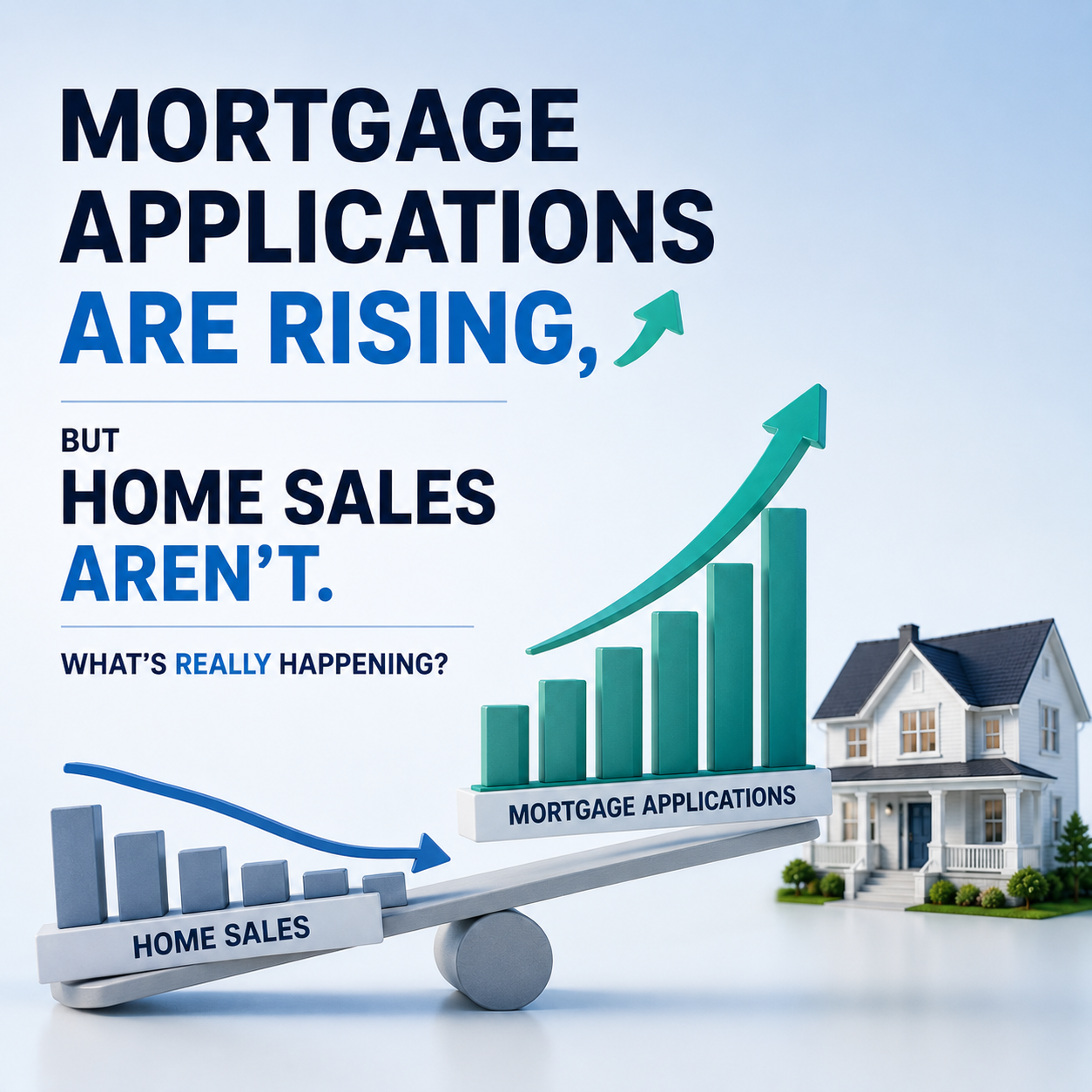
The answer is more complex than many people realize. A mortgage application represents buyer intent, while a home sale represents a completed transaction. The growing gap between these two indicators reflects deeper structural changes in today’s mortgage and housing markets.
Section 02
Why Mortgage Applications and Home Sales Used to Move Together
Mortgage applications are a leading indicator not the final outcome
For decades, economists have viewed mortgage applications as one of the strongest leading indicators for housing activity. When more consumers apply for purchase mortgages, a portion of those borrowers typically find homes, complete underwriting, and close their transactions within the following weeks or months.

As a result, rising Purchase Mortgage Applications have traditionally signaled stronger Pending Home Sales and Existing Home Sales in the near future. This relationship remained relatively stable because housing inventory was more balanced, affordability was stronger, and a higher percentage of applications ultimately became successful home purchases.
What changed after interest rates surged?
The sharp increase in mortgage rates beginning in 2022 fundamentally changed this relationship. Consumers are still interested in buying homes and continue applying for mortgage pre-approvals, but far more obstacles now exist between obtaining financing and actually purchasing a property.
Today’s market doesn’t suffer from a lack of interested buyers. Instead, it suffers from a shortage of conditions that allow buyers to successfully complete transactions.
Section 03
Mortgage Applications Are Increasing, but Demand Isn't Converting Into Sales
A pre-approval is no longer a guarantee that someone will buy a home
One of the biggest misconceptions is that receiving a mortgage pre-approval means a borrower will eventually purchase a home. In reality, a pre-approval simply confirms that, based on current financial information, the borrower appears to qualify for financing. It does not guarantee that a purchase will happen.
Consider a couple earning a combined annual income of $180,000. After reviewing their financial profile, a lender issues a pre-approval allowing them to purchase a home priced around $700,000. Over the next several weeks, they submit multiple offers, but each property attracts competing bids above the asking price. Eventually, they decide to pause their home search until more inventory becomes available.
In this example, the mortgage application appears in market statistics, but no home sale ever occurs.
The same borrower may appear multiple times in application data
Mortgage application statistics also do not necessarily represent the number of unique homebuyers.
Many borrowers shop around for the best financing before selecting a lender. A single buyer may obtain pre-approvals from a traditional bank, a credit union, and an independent mortgage broker within the same month. Although only one individual is actively searching for a home, multiple mortgage applications may be recorded.
As a result, application volume can increase without producing a proportional increase in completed transactions.
Section 04
Not Every Mortgage Application Is Intended to Purchase a Home
Refinancing activity can significantly increase total mortgage applications
One common mistake when analyzing housing data is looking only at total mortgage applications.
That figure includes both purchase mortgages and refinance applications.
Whenever mortgage rates decline, even modestly, many homeowners refinance their existing loans to lower monthly payments or complete cash-out refinances to access home equity. These applications increase overall mortgage volume without generating any new home sales.
| Mortgage Type | Does It Create a Home Sale? |
|---|---|
| Purchase Mortgage | Yes |
| Rate-and-Term Refinance | No |
| Cash-Out Refinance | No |
| HELOC | No |
For this reason, housing economists often focus on the Purchase Applications Index rather than total mortgage applications when evaluating housing demand.
Even purchase applications don’t guarantee a closing
Even when analyzing only purchase mortgage applications, there remains a significant gap between submitting a loan application and completing a real estate transaction.
Borrowers may change their minds, lose bidding wars, fail to satisfy underwriting conditions, or simply decide that current market conditions are no longer favorable.
A mortgage application marks the beginning of the homebuying journey not its conclusion.
Section 05
The Barriers Preventing Mortgage Applications From Becoming Home Sales
The lock-in effect continues to freeze housing inventory
Perhaps the most significant factor affecting today’s housing market is the lock-in effect.
Millions of homeowners refinanced during the period when mortgage rates were between 2.5% and 3%. Selling those homes today would likely require replacing that mortgage with a new loan carrying an interest rate more than twice as high.
For example, imagine a homeowner currently has a $450,000 mortgage at 2.75%. Purchasing another home with the same loan amount at 6.50% would significantly increase the monthly principal and interest payment.
| Scenario | Interest Rate | Estimated Monthly Principal & Interest* |
|---|---|---|
| Current Mortgage | 2.75% | Approximately $1,837 |
| New Mortgage | 6.50% | Approximately $2,844 |
For many households, that additional monthly cost outweighs the benefits of moving.
As a result, homeowners remain in their existing properties longer, limiting inventory and reducing the total number of transactions—even though buyer demand still exists.
Affordability has become a bigger obstacle than interest rates alone
Many people believe rising mortgage rates are the primary issue.
In reality, buyers are responding to total housing costs, not simply the interest rate.
Consider a $650,000 home with a 20% down payment, resulting in a $520,000 loan.
| Scenario | Loan Amount | Mortgage Rate | Estimated Monthly Principal & Interest* |
|---|---|---|---|
| Purchase Today | $520,000 | 3.00% | Approximately $2,192 |
| Purchase Today | $520,000 | 6.50% | Approximately $3,287 |
That increase of more than $1,000 per month doesn’t include property taxes, homeowners insurance, HOA dues, maintenance costs, or utilities.
Even borrowers who qualify for financing may conclude that the long-term monthly payment no longer aligns with their financial goals.
Section 06
Modern Underwriting Is Reducing the Conversion Rate
Underwriting standards are significantly stricter than before
Following the 2008 financial crisis, regulations such as the Ability-to-Repay (ATR) Rule substantially increased documentation requirements.
Today’s lenders must carefully verify:
- income;
- employment;
- assets;
- source of down payment funds;
- debt obligations;
- repayment capacity.
These requirements improve loan quality and reduce systemic risk, but they also mean that more applications fail to reach the closing table.
For example, a borrower may have a 760 credit score and stable income but still face delays if a recently deposited down payment cannot be properly documented. Until the lender verifies the source of those funds, underwriting may remain incomplete.
Buyer psychology is becoming increasingly important
Not every approved borrower chooses to move forward.
Many qualified buyers are intentionally waiting because they expect mortgage rates to decline, housing prices to soften, or economic conditions to become more favorable.
These buyers remain active in mortgage application data but never become completed home sales.
This growing hesitation is another reason why mortgage applications and housing transactions are no longer moving together as closely as they once did.
Housing analysts evaluate multiple indicators together
Professional market analysis extends far beyond mortgage application data.
Economists typically monitor several key housing indicators simultaneously.
| Indicator | What It Measures |
|---|---|
| Mortgage Applications | Initial borrowing demand |
| Purchase Applications | Home purchase demand |
| Pending Home Sales | Contracts awaiting closing |
| Existing Home Sales | Completed transactions |
| New Listings | New housing supply |
| Months of Inventory | Supply-demand balance |
| Days on Market | Market absorption speed |
When viewed together, these indicators provide a far more complete picture of market conditions than any single metric alone.
The market isn’t lacking buyers it’s lacking completed transactions
Perhaps the most important takeaway is that housing demand has not disappeared.
Many Americans still want to buy homes, continue applying for mortgages, and remain financially qualified to borrow.
What the market lacks today are the conditions necessary to convert that demand into completed transactions.
Limited inventory, reduced affordability, stricter underwriting standards, and greater economic uncertainty have all widened the gap between mortgage applications and home sales.
Section 07
Final Thoughts
An increase in mortgage applications should not automatically be interpreted as evidence of a strong housing market recovery. Mortgage applications measure consumer interest in financing, but numerous hurdles must still be overcome before that interest becomes a completed home purchase.
The growing disconnect between mortgage applications and home sales reveals an important truth about today’s housing market: the shortage isn’t buyer demand it is the ability to turn that demand into completed real estate transactions.
Disclaimer: This article is for educational purposes only and should not be considered financial, tax, or legal advice.
Duc Pham, Mortgage Broker | NMLS# 844897,
Wonder Rates, Inc. | NMLS# 1518655 | DRE# 02047445 | DFPI# 60DBO-59134 |
Equal Housing Opportunity. Equal Housing Lender. |
Licensed in: AL, AZ, CA, CO, FL, GA, LA, MI, NC, OH, OK, OR, PA, SC, TX, VA, WA.