
Section 01
Picture this. A lender hands you two options. Option A has a higher interest rate and lower upfront cost. Option B has a lower interest rate, but it costs more upfront. That extra upfront cost is called mortgage points.
The natural question is simple: why would you pay more money today just to get a lower rate? Here is the trade-off in one line: you pay more now, you might get a lower rate, and that lower rate might save you money over time. Whether that trade actually pays off depends on your loan amount, how much the rate drops, how much cash you have on hand, how long you plan to keep the loan, and your tax situation. This guide walks through every piece of that decision.
Disclaimer: This article is provided for general educational and informational purposes only and does not constitute financial, mortgage, tax, legal, or investment advice. Mortgage rates, discount points, lender credits, fees, loan requirements, tax treatment, and other mortgage terms vary by lender, loan program, market conditions, property, and borrower circumstances. Examples in this article are hypothetical and are provided only to explain general mortgage concepts. They are not mortgage offers, guarantees of savings, or recommendations to choose a particular loan option. Borrowers should review their specific Loan Estimate and discuss their options with a qualified mortgage professional and, when appropriate, a tax professional.
Section 02
What Are Mortgage Points?
An Upfront Cost Tied to Your Mortgage
Mortgage points, often called discount points, are an upfront fee you pay to your lender in exchange for a lower interest rate, subject to the terms of your specific loan. You will also hear them called just “points.” All three terms usually mean the same thing.
One Point Generally Equals 1% of the Loan Amount
Here is the math behind one point. Take your loan amount and multiply it by 1 percent. On a $400,000 loan, one point costs $4,000. On a $500,000 loan, one point costs $5,000. On an $800,000 loan, one point costs $8,000.
Here is the single most important thing to understand: one point does not mean your rate drops by exactly one percentage point. That is a common mix-up. A point is a cost, measured as a percentage of your loan. The rate reduction you get for that cost is a separate number set by your lender, and it is almost always much smaller than a full percentage point.
These examples are simplified for educational purposes. The actual cost and rate reduction associated with discount points depend on the lender, loan program, market conditions, and specific loan terms.
Discount Points vs. Other Mortgage Fees
Points are just one upfront cost among several you might see on a Loan Estimate. Do not confuse them with origination fees, which cover the cost of processing your loan. Do not confuse them with prepaid interest, which covers interest between closing and your first payment. And do not confuse them with lender credits, which work in the opposite direction from points, as we will cover later in this guide.
Section 03
How Do Mortgage Points Work?
Pay More Upfront to Potentially Get a Lower Rate
Here is the basic flow. You pay points at closing. In exchange, you get a lower interest rate. A lower rate usually means a lower monthly principal and interest payment. Over time, those smaller monthly payments can add up to more than what you paid for the points. The word “potentially” matters here, because the exact rate reduction depends entirely on your lender and your specific transaction.
There Is No Universal Rate Reduction Per Point
One point does not come with a fixed, guaranteed rate reduction across every lender. Lender A might knock a quarter of a percentage point off your rate for one point. Lender B might offer something different for the same cost. That is exactly why comparing the full loan terms, not just the number of points quoted, matters so much.
Points Affect the Whole Economics of the Loan
Buying points is really a trade between more money today and potentially less money paid over time. That single idea runs through everything else in this guide.
Section 04
How Much Do Mortgage Points Cost?
How to Calculate the Cost of One Point
Cost of one point = Loan amount multiplied by 1 percent
Illustrative example: On a $500,000 loan, one point costs $5,000 ($500,000 multiplied by 1 percent).
How to Calculate Multiple Points
Cost of points = Loan amount multiplied by the point percentage
Illustrative example: On a $500,000 loan, 1.5 points means 1.5 percent of the loan. That works out to $7,500.
This is a hypothetical calculation showing how points are expressed as a percentage of the loan amount. Actual mortgage pricing and available point structures vary by lender and loan program.
Points Are Based on the Loan Amount, Not the Home Price
This trips up a lot of buyers. Illustrative example: a $600,000 home with 20 percent down means a $480,000 loan. One point on that loan is $4,800, not $6,000. The point percentage applies to what you are actually borrowing, not to the sticker price of the house.
This example is hypothetical and assumes the stated loan amount. Actual loan amounts depend on the transaction and financing structure.
Section 05
How Much Can Mortgage Points Lower Your Interest Rate?
Why One Point Does Not Equal a Fixed Rate Reduction
Pricing depends on your lender, current market conditions, your specific loan program, your loan amount, your credit profile, whether you will occupy the home, the property itself, how long you lock your rate, and other pricing adjustments layered on top. There is no single, reliable answer to “how much will one point lower my rate,” since it genuinely changes from lender to lender and day to day.
How Lenders Present Points and Rate Options
You will often see a menu of options from a lender: a higher rate with zero points, a lower rate with points attached, and sometimes a middle option in between. The goal is never to pick the lowest rate on the page. The goal is to compare the total cost of each option side by side.
Why You Should Compare APR and Loan Estimate Details
APR can help you compare the broader cost of borrowing between offers, but it should not be the single number that makes your decision. Look at the interest rate, the points, any lender credits, origination charges, total closing costs, the resulting monthly payment, and your total cash needed to close, all together. If you want a closer look at how to read and compare the costs shown on these documents, see our guide to Loan Estimate vs. Closing Disclosure.
Section 06
Mortgage Points Example: $500,000 Loan
Option A, higher rate with no points: Loan amount of $500,000, a hypothetical rate of 6.75 percent, and $0 in points.
Option B, lower rate with one point: Same $500,000 loan, a hypothetical rate of 6.50 percent, and 1 point, which costs $5,000.
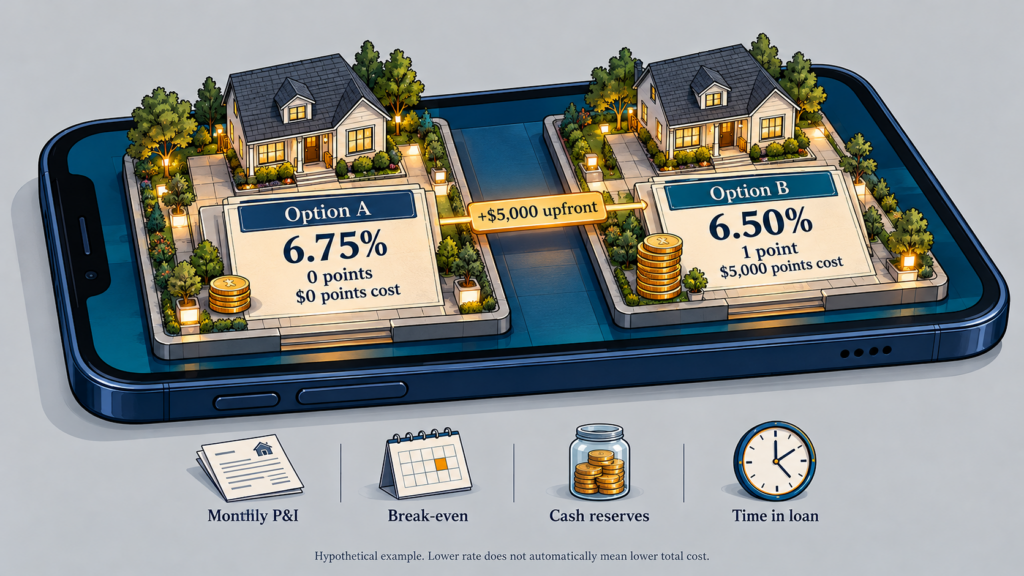
In this scenario, the borrower pays $5,000 more upfront in exchange for a lower hypothetical rate.
What should the borrower actually compare? Not just the monthly payment. Look at the upfront cost, the monthly principal and interest payment, the total interest paid over the time you expect to hold the loan, your break-even period, how much cash you will have left in reserve after closing, and how likely you are to refinance or sell before that break-even point arrives. If you want to compare the two options with your own loan amount, rate, and upfront costs, the Wonder Rates Rate Comparison Calculator can help you see the difference in monthly payment, total interest, closing costs, and break-even timing.
All rates, payments, costs, and savings in this section are hypothetical and are provided solely to explain how mortgage points work. They are not current mortgage rates, loan offers, or guarantees of savings. Actual pricing, rate reductions, payment amounts, and eligibility vary by lender, loan program, market conditions, and borrower circumstances.
Section 07
How to Calculate the Break-Even Point for Mortgage Points
What Is the Break-Even Point?
Break-even is the amount of time it takes for your monthly savings from the lower rate to add up to the upfront cost you paid for the points. Once you pass that point, you are coming out ahead.
The Basic Break-Even Formula
Break-even months = Cost of points divided by monthly payment savings
Illustrative example: Points cost $5,000. Monthly savings from the lower rate is $100. Divide $5,000 by $100, and you get 50 months, or a little more than 4 years and 2 months.
This is a simplified hypothetical calculation. Actual break-even analysis should account for the specific loan terms, payment structure, points cost, lender pricing, and any other relevant costs or savings.
Why Break-Even Is Not the Whole Decision
A borrower might technically break even in 3 years and still decide against points, maybe because they do not want to tie up that much cash upfront, or they expect to move soon, or they want to keep a bigger emergency fund. On the flip side, a borrower who plans to stay in the loan for a long time might value that lower rate more, even if the break-even period stretches a bit longer than expected.
Section 08
Are Mortgage Points Worth It?
Points may make sense when you plan to keep the loan well past your break-even point. The longer you hold onto the lower rate after that point, the more the math works in your favor.
Points may not make sense if you expect to sell or refinance soon. If your loan ends before you reach break-even, through a sale or a refinance, you likely will not recover the full upfront cost through monthly savings.
Points may not make sense if cash is tight. Every dollar spent on points is a dollar that is no longer available for your emergency fund, reserves, repairs, moving costs, other closing costs, or anything else you might need soon. A lower rate is not automatically worth more to you than liquidity.
The real question is not “are points good?” It is this: does paying this amount upfront make financial sense for how long I actually expect to keep this loan?
Section 09
Mortgage Points vs. Lender Credits
What Are Lender Credits?
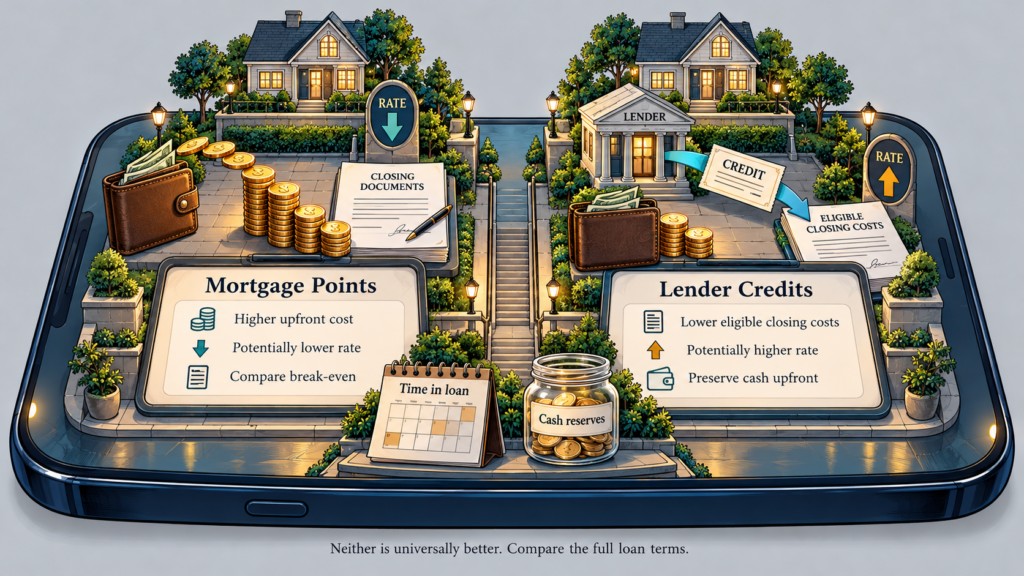
Lender credits work in the opposite direction from points. Instead of paying more upfront for a lower rate, you accept a slightly different rate in exchange for a credit toward your eligible closing costs, subject to the loan’s specific terms.
Points vs. Lender Credits, Side by Side
| Mortgage Points | Lender Credits | |
|---|---|---|
| Upfront cost | Higher | Lower |
| Interest rate | Potentially lower | Potentially higher |
| Closing costs | Higher | Lower |
| Main trade-off | Pay more now | Pay less now |
| Long-term consideration | Potential interest savings | Potentially higher monthly cost |
When Might Each Option Make Sense?
Points tend to make more sense when you have enough cash on hand, you expect to keep the loan for a long time, and the break-even period fits comfortably within your timeline. Lender credits tend to make more sense when your cash to close is tight, you place a high value on keeping liquidity, or you expect to hold the loan for a shorter period. Neither option is universally better. It depends entirely on your own situation.
Section 10
Mortgage Points vs. Origination Points
What Are Discount Points?
Discount points are the ones covered throughout this guide, paid specifically to bring your interest rate down.
What Are Origination Fees?
Origination fees cover the lender’s cost of processing, underwriting, and funding your loan. They are not the same thing as discount points, even though both can show up as upfront charges tied to your mortgage.
Why You Should Read the Loan Estimate Carefully
Do not assume every charge labeled with the word “points” serves the same purpose. Read the actual description on your Loan Estimate, and ask your loan officer to explain any charge you do not fully understand.
Section 11
Mortgage Points and Taxes
Are Mortgage Points Tax Deductible?
There is no simple yes or no answer here. According to the IRS, points paid to purchase your main home are generally fully deductible in the year you pay them, but only if you meet several specific conditions, including that the loan is secured by your main home, the points are calculated as a percentage of the loan amount, and the charge is clearly shown as points on your settlement statement. Points paid on a refinance are usually treated differently. The IRS generally requires you to deduct those points gradually over the life of the loan instead of all at once, though there are exceptions.
Tax disclaimer: Tax treatment of mortgage points depends on individual circumstances and applicable tax rules. Consult a qualified tax professional for advice about your specific situation.
Why Tax Treatment Should Not Drive the Decision by Itself
Start with the mortgage economics: the upfront cost, the rate reduction, and your break-even timeline. A potential tax benefit can be a nice bonus on top of that analysis, but it should not be the single reason points suddenly look “worth it” if the underlying math does not already make sense for your situation.
When to Talk to a Tax Professional
Because deductibility depends on your specific loan, your tax filing status, and current tax law, it is worth a conversation with a CPA or tax professional before you count on any specific tax outcome from paying points.
Section 12
Can You Negotiate Mortgage Points?
Mortgage Pricing Can Have Different Structures
Lenders often price the same loan several different ways. Asking for more than one option is a normal, reasonable part of shopping for a mortgage.
Ask Your Lender for Multiple Rate-and-Point Scenarios
For example, you might ask to see 6.75 percent with 0 points, 6.50 percent with 1 point, and 6.25 percent with 2 points, if those combinations are available from that lender.
Compare the Total Cost, Not Just the Headline Rate
Look at the points, the lender fees, any credits offered, the rate itself, your resulting monthly payment, the APR, your total cash to close, and your break-even period, all at once, for every option on the table.
Section 13
Mortgage Points on Different Loan Types
Conventional mortgages can offer points as part of their standard pricing menu, alongside the usual rate-and-fee options.
FHA mortgages carry their own separate mortgage insurance structure, so points should be evaluated alongside those FHA-specific costs, not in isolation.
VA mortgages come with their own set of closing cost rules and financing guidelines, so points need to be weighed against the full VA picture, not treated like a generic conventional purchase.
Jumbo mortgages often carry different underwriting and pricing considerations since they exceed standard conforming loan limits, which means point structures and rate reductions can look different here too.
There is no universal rule stating that a specific loan type always comes with a set point limit or a guaranteed rate reduction. Ask your loan officer what is actually available for your specific loan program.
Section 14
Mortgage Points When Buying vs. Refinancing
Buying a Home With Mortgage Points
When you are buying, the key questions are how long you expect to live in this home and how much cash you can comfortably put toward points without draining your reserves.
Paying Points During a Refinance
The same break-even concept still applies, but a refinance adds a few more things to weigh: your existing loan balance, the new closing costs you are taking on, how long you expect to keep this new loan, how much you are actually saving by refinancing in the first place, and the real possibility that you might refinance again down the road.
Why Break-Even Matters Even More When Refinancing
If you expect rates to keep shifting, or you think you might refinance again within a few years, paying a large amount upfront for points on this refinance may not make sense, since a second refinance could end the loan before the points have paid for themselves.
Section 15
Common Mistakes When Paying Mortgage Points
Assuming one point always lowers the rate by exactly 1 percent. It almost never does. The rate reduction is a separate, lender-specific number.
Choosing the lowest rate without calculating the upfront cost. A lower rate is not automatically a lower total cost once you factor in what you paid to get there.
Ignoring the break-even timeline. Without comparing break-even to how long you actually expect to keep the loan, you are guessing instead of deciding.
Using all your available cash to buy down the rate. Liquidity matters just as much as your rate, especially right after closing.
Assuming you will keep the mortgage for the full 30-year term. Most borrowers do not. A 30-year loan term does not mean you will actually hold that exact loan for 30 years.
Ignoring the possibility of refinancing. A future refinance can completely change the economics of points you paid today.
Comparing only monthly payments. You need to weigh the upfront cost and the long-term savings together, not just glance at the smaller monthly number.
Section 16
A Step-by-Step Framework for Deciding Whether to Buy Mortgage Points
Step 1, get the zero-point option. Ask your lender what your loan looks like with no discount points at all.
Step 2, get one or more point options. Ask for alternative rate-and-point combinations to compare against the zero-point baseline.
Step 3, calculate the upfront difference. Figure out exactly how much additional cash each point option requires at closing.
Step 4, calculate your monthly savings. Compare the principal and interest payment under each option.
Step 5, calculate your break-even. Divide the cost of the points by your monthly savings to get your approximate break-even in months.
Step 6, compare break-even with your expected timeline. Ask yourself honestly: will I realistically keep this loan beyond that break-even point?
Step 7, check your post-closing liquidity. Make sure paying points does not leave you without enough cash for reserves and unexpected expenses right after you close.
Step 8, compare the full Loan Estimate. Never make this decision based on the interest rate alone.
Section 17
Detailed Mortgage Points Example: When Are Points Worth It?
Borrower scenario: Loan amount of $500,000. Option A is 6.75 percent with 0 points. Option B is 6.50 percent with 1 point, costing $5,000. The hypothetical monthly principal and interest savings from choosing Option B is $80.
Calculate the break-even: Divide $5,000 by $80, and you get 62.5 months, or approximately 5.2 years.
A borrower who plans to stay for 10 years would pass that break-even point with years to spare, so the points may potentially make economic sense for this borrower.
A borrower who expects to sell after 3 years would never reach break-even, which means they likely would not recover the upfront cost through monthly savings before the loan ends.
A borrower who expects to refinance in 2 years runs into the same problem. A refinance that happens before break-even effectively ends the original loan before the points have had a chance to pay for themselves.
This entire scenario is hypothetical and simplified for educational purposes. Actual mortgage payments, rate reductions, point costs, tax treatment, break-even timing, and savings will vary based on the lender, loan program, loan terms, market conditions, and borrower circumstances. This example is not a recommendation to buy or avoid mortgage points.
Section 18
How Mortgage Points Appear in Your Loan Estimate
Look at the Interest Rate and Points Together
Never read the rate on its own. Always look at the rate and the points side by side, since one number does not tell the full story without the other.
Review the Loan Costs Section Carefully
Take the time to actually read through your Loan Estimate and understand what each individual charge represents, rather than skipping straight to the bottom-line numbers.
Compare Loan Estimates on an Apples-to-Apples Basis
If two lenders quote different rates, different points, different credits, and different fees, you cannot judge them by monthly payment alone. You have to line up every cost side by side.
Questions to Ask Before Choosing Points
How much am I actually paying for these points? How much does the rate change in exchange? What is my real monthly savings? What is my break-even period? What happens to my upfront cost if I refinance early? What happens if I end up selling? Are there lender credits available as an alternative? What other closing costs are different between these options?
Section 19
Mortgage Points Checklist
Before paying points
- [ ] Know your loan amount.
- [ ] Know the exact cost of the points.
- [ ] Know the rate with zero points.
- [ ] Know the rate with points included.
- [ ] Calculate your estimated monthly savings.
- [ ] Calculate your break-even period.
- [ ] Estimate how long you expect to keep this loan.
- [ ] Consider the possibility of a future refinance.
- [ ] Review any available lender credits as an alternative.
- [ ] Make sure you still have enough cash reserves after closing.
- [ ] Compare the full Loan Estimate, not just the rate.
- [ ] Ask about tax treatment if it is relevant to your situation.
Section 20
Final Takeaways: What to Know About Mortgage Points
Mortgage points are an upfront cost that can potentially lower your mortgage interest rate. One point generally equals 1 percent of the loan amount, not 1 percentage point of interest. The rate reduction you get per point is not the same from lender to lender. The single most important calculation is your break-even period. Points tend to make more sense when you expect to keep the mortgage well past that break-even point. They tend to make less sense when cash is tight or you expect to sell or refinance soon. Lender credits are essentially the opposite trade-off and deserve a side-by-side comparison with points. And in the end, the right choice always comes down to your specific loan terms and your own financial situation.
Mortgage points are ultimately a trade-off between paying more today and potentially paying less over time. The best option is not necessarily the mortgage with the lowest advertised rate. It is the one whose upfront cost, monthly payment, and your expected time in the loan actually line up for you. If you want to compare mortgage options based on your own situation, you can get started with a licensed mortgage professional.
Section 21
Sources
- IRS Publication 936, Home Mortgage Interest Deduction
- Consumer Financial Protection Bureau, Loan Estimate explainer
Disclaimer: This article is for general educational and informational purposes only and does not constitute financial, mortgage, tax, legal, or investment advice. Mortgage rates, discount points, lender credits, fees, loan requirements, tax treatment, and other mortgage terms vary by lender, loan program, market conditions, property, and borrower circumstances. Examples in this article are hypothetical and do not represent mortgage offers or guarantees of savings. Borrowers should review their specific Loan Estimate and consult a qualified mortgage professional and, when appropriate, a tax professional before making mortgage decisions.
Duc Pham, Mortgage Broker | NMLS# 844897, Wonder Rates, Inc. | NMLS# 1518655 | DRE# 02047445 | DFPI# 60DBO-59134 | Equal Housing Opportunity. Equal Housing Lender. | Licensed in: AL, AZ, CA, CO, FL, GA, LA, MI, NC, OH, OK, OR, PA, SC, TX, VA, WA.