
Section 01
Do not leave the alt field empty and do not use the URL slug by itself as the alt text.
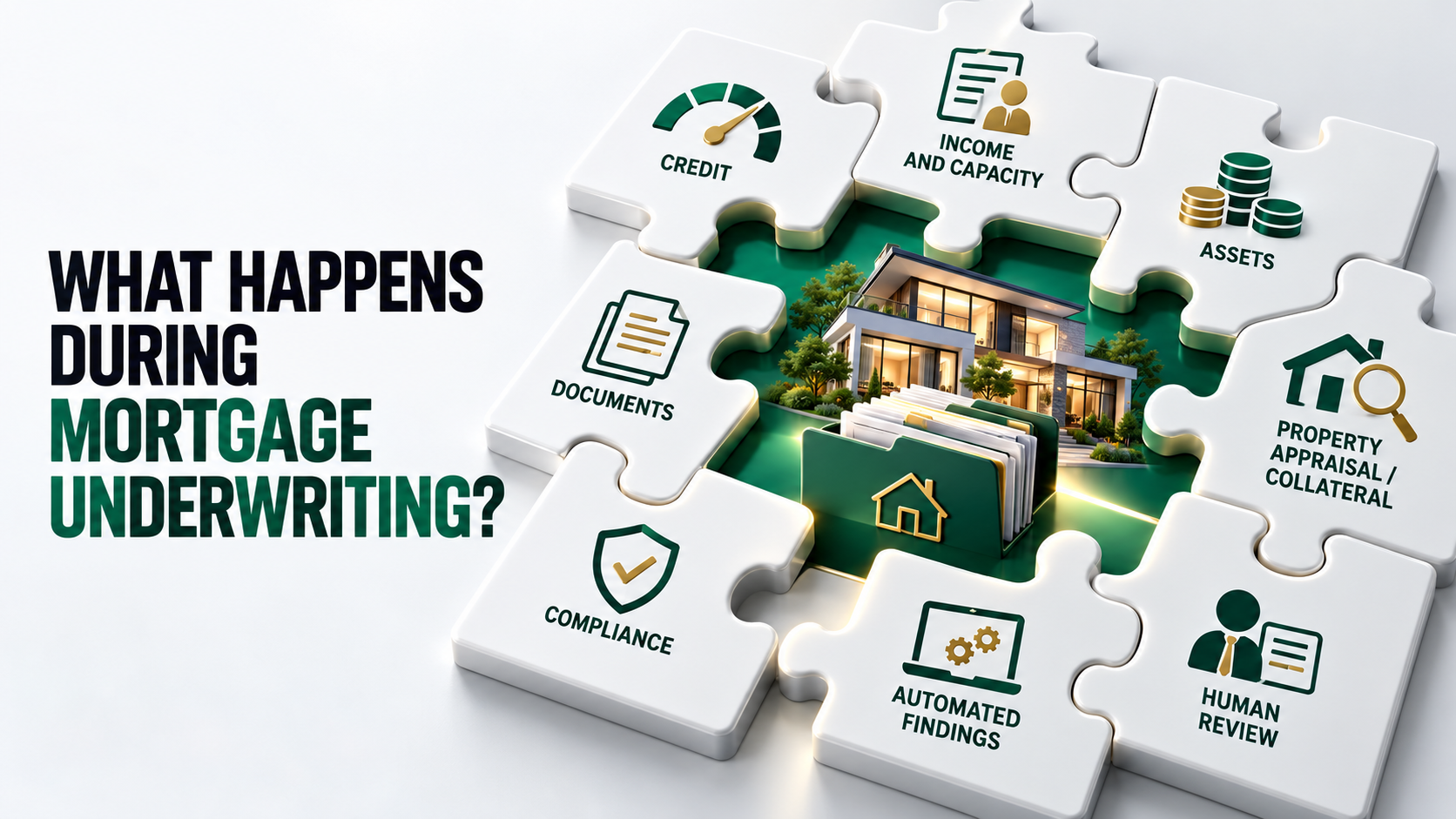
The mortgage underwriting process is the lender’s detailed review of the borrower, loan structure, and property before final approval. The lender may verify credit, income, employment, assets, debts, occupancy, insurance, title, appraisal information, and compliance with the selected loan program.
Underwriting is not one universal checklist completed in the same order by every lender. The exact documents, conditions, timing, and decision method vary by loan program, lender, property, borrower circumstances, and whether automated or manual underwriting is used.
Section 02
Where Underwriting Fits in the Mortgage Process
A mortgage application commonly moves through several broad stages:
- The borrower submits an application and supporting information
- The lender provides applicable disclosures, including a Loan Estimate
- The borrower indicates an intent to proceed
- The processor organizes documents and coordinates third-party items
- Automated and human underwriting review the file
- The lender issues conditions, requests additional information, or makes another credit decision
- Conditions are reviewed and cleared when acceptable
- Final verifications and closing requirements are completed
- The loan may proceed to closing and funding
The order can overlap. Appraisal, title, insurance, verification, and underwriting work may occur at the same time. A delay in one area can affect the overall closing timeline.
The Consumer Financial Protection Bureau’s home-closing guide identifies underwriting documents as an important part of preparing for closing, but borrowers should use their lender’s current instructions for the specific transaction.
Section 03
Who Reviews the Mortgage File?
Several professionals may participate in the process.
Loan officer
The loan officer discusses financing options, gathers initial information, communicates with the borrower, and helps identify missing items. The loan officer does not personally guarantee or control the final credit decision.
Loan processor
The processor may organize the file, review it for completeness, request documents, and coordinate items such as appraisal, title, insurance, employment verification, and other requirements.
Underwriter
The underwriter evaluates whether the verified borrower, property, and loan satisfy the requirements that apply to the transaction. The review can result in approval with conditions, suspension or request for additional information, counteroffer, or denial, depending on the lender’s process and the facts of the file.
Third parties
Appraisers, title professionals, insurance providers, employers, tax-verification vendors, credit-reporting companies, and other parties may supply information needed for the lender’s review. Delays outside the lender can therefore affect underwriting timing.
Section 04
What Mortgage Underwriters Review
Underwriting is sometimes described through the three C’s: credit, capacity, and collateral. In practice, each category can involve several separate reviews.
Credit
The lender may evaluate credit scores and the underlying credit history, including payment patterns, balances, delinquencies, public records where applicable, inquiries, recently opened accounts, disputed information, and other obligations.
Credit is not reviewed in isolation. Its effect can depend on the loan program, down payment, reserves, DTI, occupancy, property, and lender requirements.
If two lenders reach different conclusions, the Wonder Rates guide to mortgage approval differences explains how program availability, lender overlays, and verification methods may affect the result.
Capacity
Capacity concerns the borrower’s ability to repay. The lender may review qualifying income, employment, monthly debts, the proposed housing payment, and the debt-to-income ratio.
Income shown on a pay statement, tax return, or bank account is not automatically the same as qualifying income. The lender may need to evaluate stability, history, documentation, and expected continuance according to the applicable requirements.
The Wonder Rates DTI Calculator can help borrowers organize an initial estimate. Its result is educational and is not a lender’s underwriting calculation, approval, or commitment to lend.
Capital and assets
The lender may verify the funds used for the down payment, closing costs, and reserves. Bank statements can also reveal recurring obligations, transfers, account ownership, and deposits that require explanation.
When funds have moved between accounts or come from a gift, business, sale, or another source, the lender may request a paper trail. Wonder Rates explains these questions in its guide to <a href=”https://wonderrates.com/learning-hub/source-of-funds-mortgage”>documenting the source of mortgage funds</a>.
Collateral
The property secures the mortgage, so underwriting also addresses the collateral. The lender may review the appraisal or another permitted valuation method, property type, condition, marketability, title, liens, insurance, flood status, occupancy, and program-specific eligibility.
An appraisal is not a home inspection and does not guarantee the condition of the property. A low value or property issue can affect the loan amount, loan-to-value ratio, repairs, insurance, or eligibility.
Buyers facing a valuation issue can review what happens after a low appraisal before deciding how to respond.
Loan structure and compliance
The underwriter may also confirm the loan purpose, occupancy, product, term, interest-rate structure, down payment, interested-party contributions, mortgage insurance, disclosures, and other transaction details.
Section 05
Automated Underwriting and Human Review Work Together
Many conventional files are submitted through an automated underwriting system. Fannie Mae describes Desktop Underwriter as a system that helps lenders assess credit risk and determine eligibility for sale and delivery to Fannie Mae. Freddie Mac describes Loan Product Advisor as its automated underwriting system for assessing mortgage eligibility.
An automated recommendation is not the same as final approval. The quality of the output depends on the accuracy of the submitted data, and the findings may specify documentation, verification, appraisal, or other conditions. The lender must still verify the file and apply its own requirements.
Some files may use manual underwriting or another review method. Borrowers should not assume that every lender or loan program uses the same system.
Section 06
Why Underwriters Request More Documents
A request for an updated or additional document does not automatically mean the loan is in trouble. Common reasons include:
- A statement or pay stub became outdated
- A deposit or transfer needs to be sourced
- Income differs across documents
- Employment must be verified
- A debt or payment needs clarification
- A bank account is jointly owned
- Gift funds require documentation
- Tax transcripts or business records are needed
- The appraisal, title, or insurance review created a condition
- A document is incomplete, unreadable, or missing pages
- The borrower changed the loan amount, down payment, or another application detail
Send complete documents through the lender’s approved secure method. Do not alter statements, remove pages, redact information without instructions, or create explanations that do not match the records.
Section 07
What Conditional Approval Means
Conditional approval generally means the lender has reviewed the file and identified requirements that must still be satisfied before the loan can move forward. The exact terminology and legal significance can vary by lender and stage of the transaction.
Conditions may involve:
- Updated income, employment, or asset documents
- Written explanations supported by records
- Appraisal or property requirements
- Title or lien resolution
- Homeowners or flood insurance
- Verification of funds to close
- Documentation of a debt payoff
- Final loan or compliance documents
Conditional approval is not a guarantee of closing or funding. A condition may not be satisfied, a new issue may appear, or verified information may differ from what was originally submitted.
“Clear to close” also should not be treated as permission to make major financial changes. The lender may still complete final verifications and closing requirements before funding.
Section 08
What Can Delay Mortgage Underwriting?
Common causes of delay include missing documents, complex income, slow responses, appraisal scheduling, title issues, insurance difficulty, unexplained deposits, recently opened debt, credit changes, employment changes, property concerns, and inconsistent information.
Insurance can become a separate closing condition. The Wonder Rates guide to home-insurance delays before closing explains why a quote may not be enough when acceptable coverage has not been finalized.
Wonder Rates provides a broader transaction checklist in five issues that can delay mortgage closing.
There is no responsible universal promise for how many days underwriting will take. A straightforward file may move quickly, while a self-employed borrower, multiple-property owner, unusual property, manual underwrite, or file requiring third-party corrections may take longer.
Section 09
What Borrowers Should Do During Underwriting
Respond promptly and completely
Read the full request, submit every page requested, and ask questions before sending the wrong document. A partial response can create another review cycle.
Avoid new debt and credit activity
Do not finance a car, open a new account, increase balances substantially, co-sign a loan, or change the financing structure without asking how the action could affect the pending file.
Keep income and employment stable when possible
Tell the loan officer before changing jobs, compensation structure, hours, leave status, or self-employment activity. The lender may need to re-evaluate qualifying income.
Preserve the funds needed for closing
Avoid moving verified funds or making large withdrawals without keeping documentation and first asking how the transaction should be handled.
Continue monitoring the property side
Follow appraisal, repair, title, insurance, HOA, condominium, and contract deadlines. Financial approval alone does not establish property eligibility.
Ask for status without demanding a guarantee
Useful questions include which stage the file is in, whether borrower documents are outstanding, whether third-party items are pending, and whether the expected closing date remains reasonable.
Section 10
Frequently Asked Questions
How long does mortgage underwriting take?
There is no universal timeline. It depends on the lender, loan program, file complexity, property, documentation, third parties, and how quickly conditions are resolved.
Does conditional approval mean the mortgage is approved?
It means the file has reached an important stage, but specified conditions and remaining lender requirements must still be satisfied. It is not a guarantee of closing or funding.
Can a mortgage be denied after conditional approval?
Yes. A condition may remain unresolved, the verified information may differ, the property may be ineligible, or the borrower’s financial circumstances may change.
Why does the lender need documents already provided?
The document may be outdated, incomplete, inconsistent with another record, or needed for a different verification. Ask which period, account, pages, or information the updated request must include.
Does an appraisal guarantee mortgage approval?
No. The lender must still approve the borrower, loan structure, title, insurance, property eligibility, and all applicable conditions.
Can I estimate my payment while the loan is in underwriting?
The Wonder Rates Mortgage Payment Calculator can organize an estimate of principal, interest, taxes, insurance, PMI, and HOA. The official loan documents and final underwriting determine the actual approved terms and required payment.
Section 11
Prepare for Underwriting Before the File Is Submitted
The mortgage underwriting process is easier to navigate when the application, income, assets, debts, occupancy, and property information are complete and consistent from the beginning. Additional conditions are common, but borrowers can reduce avoidable delays by responding promptly and avoiding major financial changes.
Wonder Rates can help identify likely documentation needs, explain underwriting requests, and review mortgage options before a buyer enters a purchase contract.
Prepare your home-buying application with Wonder Rates
Duc Pham, Mortgage Broker | NMLS# 844897
Wonder Rates, Inc. | NMLS# 1518655
Equal Housing Lender.
AZ, CA, CO, FL, GA, LA, MI, OK, PA, SC, TX, VA, WA, OH, AL, OR, NC
This article is for educational purposes only and is not a commitment to lend. Underwriting methods, documentation, conditions, terminology, timelines, automated findings, appraisal requirements, property eligibility, loan programs, rates, and fees vary by lender, borrower, property, and transaction and may change without notice. Loan approval and funding are subject to creditworthiness, verified income and assets, property eligibility, current underwriting guidelines, and satisfaction of all applicable conditions. Review your official loan documents and lender communications.