

Section 01
You have some extra cash each month. Do you put it toward your mortgage principal, or do you invest it instead? Financial professionals genuinely disagree on this. The honest answer is that it depends on your numbers, your other debts, and how you personally feel about carrying debt. This guide lays out both sides plainly, without pretending there is one right answer for everyone.
Section 02
Why This Question Does Not Have a Universal Answer
The math side of this debate compares two things. First, the interest rate on your mortgage, which is a cost you avoid by paying down debt faster. Second, the return you might reasonably expect from investing that same money elsewhere. If your mortgage rate is relatively high, paying it down early tends to look more attractive. That is a guaranteed way to avoid future interest. If your mortgage rate is relatively low, the case for investing gets stronger. Long-term investment returns have historically outpaced low borrowing costs over long periods. This is never guaranteed, though, and past performance does not predict future results.
That comparison only covers the math. It leaves out something just as real: how you feel about debt. Some people experience genuine stress from carrying a mortgage balance, regardless of what the numbers say. Peace of mind has value too, even if it does not show up on a spreadsheet.
Section 03
How Paying Down a Mortgage Actually Works
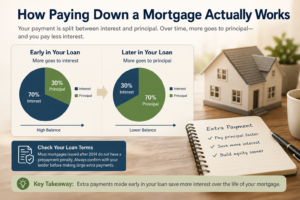
Every mortgage payment is split between interest and principal. This process is called amortization. Early in your loan, more of each payment goes toward interest, since your balance is still high. As you pay down the balance, more of each payment shifts toward principal. You owe less interest each month.
This means extra payments made early in your loan term generally save more in total interest. The same extra payment made later in the loan saves less, since more of your balance is still accumulating interest early on. Before you assume prepayment is always free of extra cost, check your loan documents. Most mortgages issued after 2014 do not carry a prepayment penalty. It is still worth confirming with your lender or servicer before making large extra payments.
Section 04
The Case for Paying Off Your Mortgage Early
A guaranteed outcome. Paying down debt gives you a certain result: you avoid future interest at your mortgage rate. Investment returns are never guaranteed, so this certainty has real value for many people.
Lower monthly obligations later in life. Entering retirement without a mortgage payment reduces the income you need each month, which can lower financial stress during a stage of life when your income may also be less flexible.
Less risk if your income changes. A paid-off home is one less monthly obligation to worry about if you lose a job, face a medical issue, or have any other unexpected drop in income.
Emotional and psychological relief. For many homeowners, being debt-free brings a sense of security that is hard to quantify, but very real in daily life.
Section 05
The Case for Investing the Extra Money Instead
Your mortgage may be relatively cheap debt. If your mortgage rate is on the lower end, it may cost less than what other forms of long-term investing have historically returned. Outcomes vary and are never guaranteed.
Liquidity. Money in a mortgage is generally locked into your home’s equity. You cannot easily access it without selling or refinancing. Money in an investment account can typically be accessed more easily if you need it.
Diversification. Putting every extra dollar into your home concentrates your wealth in a single asset. Investing elsewhere can spread that risk across different types of assets.
Potential tax considerations. Mortgage interest may be deductible in some situations. There may be other tax factors involved in either strategy. This varies by household. It is worth reviewing with a tax professional rather than assuming either path is automatically better for your taxes.
Section 06
A Middle-Ground Approach
Many homeowners do not treat this as an all-or-nothing decision. Some common middle paths include:
- Paying off higher-interest debt, such as credit cards, before directing any extra money toward a mortgage or investments. Credit card interest rates are typically far higher than mortgage rates. This debt usually costs more to carry.
- Building a full emergency fund first. A job loss or emergency should not force you to pull equity back out of a paid-down mortgage.
- Splitting extra funds between both goals, rather than committing 100% to either one.
- Revisiting the decision periodically. Your mortgage rate, your other debts, and your risk tolerance can all change over time.
Section 07
Questions to Ask Yourself
- Do I have any higher-interest debt that should be paid off first?
- Do I have an emergency fund that could cover several months of expenses?
- How many years do I have left until I want to be mortgage-free, such as before retirement?
- How would I feel, honestly, if my investments lost value in a bad year while my mortgage balance stayed the same?
- Am I confident I would actually invest the extra money consistently, rather than spending it?
Section 08
Frequently Asked Questions
Is there a prepayment penalty if I pay off my mortgage early?
Most mortgages issued after 2014 do not carry a prepayment penalty, and federal rules limit when and how much lenders can charge if one applies. Confirm your specific loan terms with your lender or servicer before making large extra payments.
Does paying extra toward my mortgage always save the same amount of interest?
No. Extra payments made earlier in your loan term typically save more total interest than the same extra payment made later, since a larger share of your balance is still accruing interest earlier in the loan.
Should I pay off my mortgage before investing for retirement?
It depends on your mortgage rate, your retirement timeline, and your other financial priorities. Many financial professionals suggest weighing your mortgage rate against your expected investment return, along with your comfort with debt. There is no single rule that fits everyone.
Is investing always better if my mortgage rate is low?
Not always. A low mortgage rate strengthens the math case for investing, but it does not account for how you personally feel about carrying debt, or how stable your income is. Both factors matter in a real decision.
Can I do both at the same time?
Yes. Many homeowners split extra funds between additional mortgage payments and investing, rather than choosing one path exclusively.
Section 09
This Is Not Financial Advice
This article is for general education and is not a recommendation to pay off your mortgage or to invest instead. Wonder Rates is not a financial advisor. The right choice depends on your full financial picture, including your other debts, your income stability, your timeline, and your personal comfort with risk. Consider speaking with a licensed financial advisor and a tax professional before making a large extra payment or investment decision.
Section 10
Next Steps
If part of your decision involves refinancing to a lower rate, freeing up cash flow, or exploring how much equity you already have, Wonder Rates can walk through your specific numbers with you.
[Talk to a loan officer about your options →]
Duc Pham, Mortgage Broker | NMLS# 844897
Wonder Rates, Inc. | NMLS# 1518655
Equal Housing Lender.
AZ, CA, CO, FL, GA, LA , MI, OK, PA, SC, TX, VA, WA, OH, AL, OR, NC
This article is for educational purposes only and is not a commitment to lend. Loan approval is subject to creditworthiness, income verification, property eligibility, and current underwriting guidelines. Loan programs, interest rates, and lender fees may change without notice. Always review your official Loan Estimate before making a financing decision.