
Section 01
Most buyers think about one loan at a time.
One application, one approval, one monthly payment. That is how most people picture the mortgage process, and for straightforward purchases it works fine.
Some buyers can use a financing method that involves two loans on the same property. This piggyback loan can be a good alternative to a single mortgage with a smaller down payment.
It is called a piggyback loan, and here is how it actually works and when it makes sense.
Section 02
What a Piggyback Loan Is
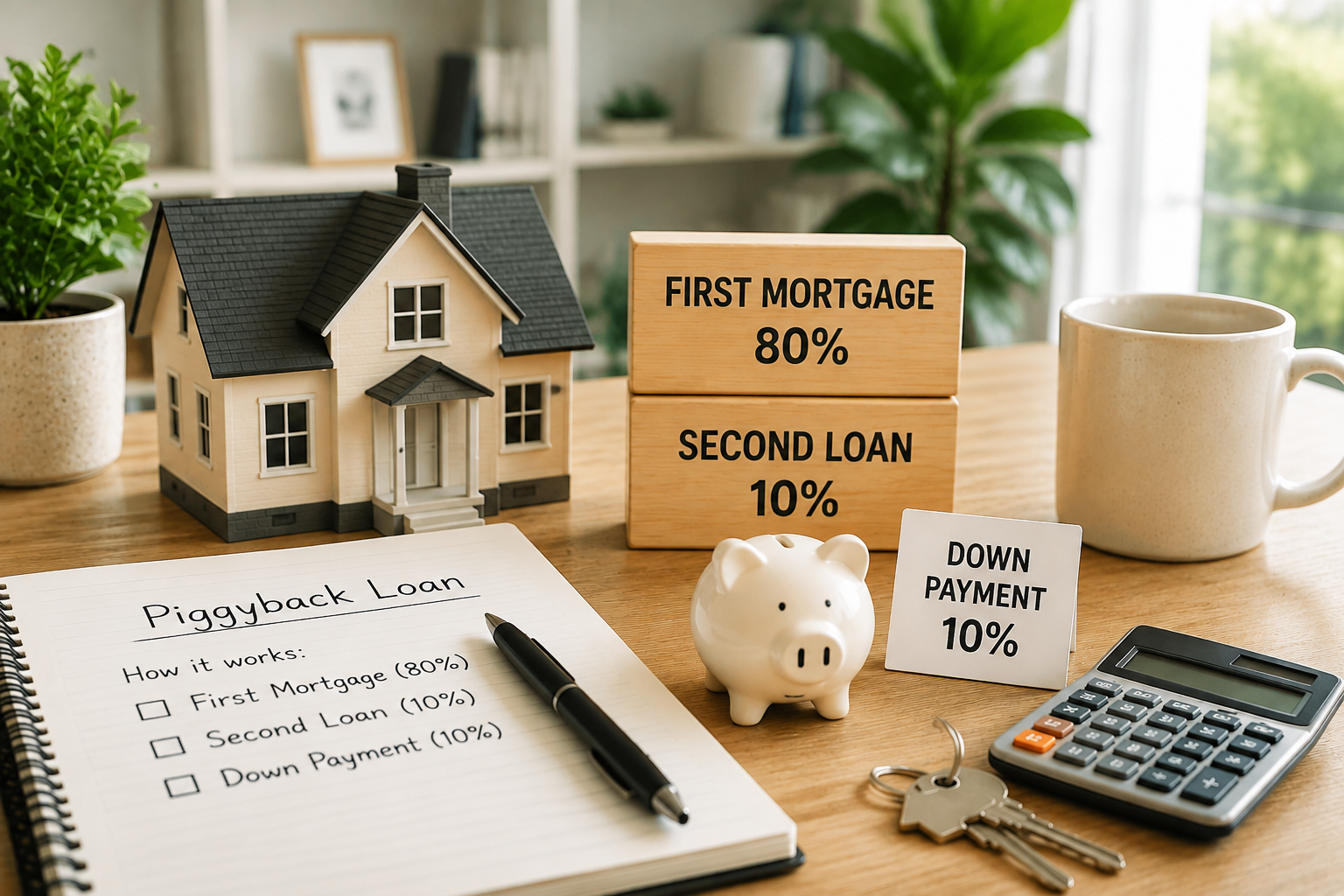
A piggyback loan is a second mortgage taken out at the same time as the first mortgage, closing simultaneously on the same property. The two loans together cover the purchase price, with the first mortgage typically covering 80% of the value, the second mortgage covering a portion of the remaining amount, and the buyer bringing the difference as a down payment. Piggyback loans are not available from every lender, and qualification depends on factors such as credit profile, income, debt-to-income ratio, and lender guidelines.
The most common structure is the 80/10/10, where the first mortgage covers 80% of the purchase price, the second mortgage covers 10%, and the buyer contributes 10% down. Other variations may use different combinations, such as 80/15/5. Higher-LTV options are less common and depend on lender-specific requirements.
The second loan is typically a home equity loan or HELOC, carries a higher interest rate than the first mortgage, and has a shorter term, usually 10 to 15 years.
Section 03
Way 1: Eliminating PMI Without 20% Down
This is the most common reason buyers use a piggyback loan, and it is where the math is most straightforward.
Private mortgage insurance (PMI) is typically required on conventional loans when the down payment is below 20%. The cost varies based on factors such as credit score, loan-to-value ratio, loan amount, and lender requirements. For some buyers, avoiding PMI through a piggyback loan may be worth comparing against the cost of a second mortgage.
A piggyback loan structured as 80/10/10 keeps the first mortgage at 80% LTV, which may allow borrowers to avoid PMI on the first mortgage depending on the loan program and lender requirements. The 10% second mortgage comes with a higher interest rate, but for some buyers, the combined payment of the first and second loans may be comparable to or lower than a single loan with PMI. The second loan also has a defined payoff period, while PMI cancellation depends on factors such as loan balance, home value, and lender requirements.
| Scenario | Loan Structure | Monthly P&I | PMI | Total Monthly |
|---|---|---|---|---|
| Single loan, 10% down | $360,000 at 6.75% | $2,335 | $216 | $2,551 |
| Piggyback 80/10/10 | $320,000 at 6.5% + $40,000 at 8.5% | $2,023 + $496 | $0 | $2,519 |
| Difference | $32/mo difference |
All figures are illustrative estimates based on a $400,000 purchase price, hypothetical rates, and a 30-year first mortgage and 10-year second mortgage. Actual rates, PMI costs, and payments vary by lender, credit score, and borrower profile. These figures do not constitute an offer of credit.
In this example, the piggyback structure results in a slightly lower estimated monthly payment under these assumptions. However, the difference is much smaller than the PMI savings alone may suggest. Over the 10-year term of the second mortgage, the estimated payment difference would be approximately $3,840 before considering factors such as closing costs, changes in PMI over time, tax considerations, or differences in loan terms.
Section 04
Way 2: Managing Jumbo Loan Requirements
The 2026 conforming loan limit for a single-family home is $832,750 in most areas, according to the Federal Housing Finance Agency (FHFA). Higher limits apply in designated high-cost counties, with a maximum ceiling of $1,249,125. Actual conforming loan limits depend on the county where the property is located.
For buyers in high-cost areas such as many counties in California, the applicable conforming limit may be higher than the baseline limit. This means a $900,000 purchase may not require a jumbo loan depending on the property location.
Loans above the applicable conforming loan limit are generally classified as jumbo loans and may have different qualification requirements, pricing, and reserve expectations compared with conforming loans.
For buyers purchasing homes near or above the conforming loan limit, a piggyback structure can be one option to compare. In standard-cost counties, a $900,000 purchase may require a jumbo loan, while buyers in high-cost counties such as many areas in California may qualify for higher conforming limits.
| Purchase Price | Single Loan Approach | Piggyback Approach | Potential Benefit |
|---|---|---|---|
| $900,000 | May require a jumbo loan in standard-cost counties | $832,750 conforming + second mortgage | May keep first mortgage within conforming limits in standard-limit areas |
| $850,000 | May require jumbo loan in standard-limit counties | $832,750 conforming + second mortgage | May avoid jumbo classification depending on location and lender guidelines |
| $750,000 | Usually within conforming limits | Not needed | Standard single loan may be sufficient |
The 2026 conforming loan limit is $832,750 in most areas. High-cost counties may qualify for higher limits up to $1,249,125. Verify applicable county limits with your loan officer.
Section 05
Way 3: Preserving Cash Reserves
Some buyers have enough funds for a larger down payment but choose a piggyback structure instead to keep more liquid reserves after closing.
A buyer purchasing a $500,000 home who puts 20% down uses $100,000 toward the purchase at closing. The same buyer using an 80/10/10 structure puts $50,000 down, takes a $50,000 second mortgage, and keeps $50,000 in liquid savings.
The trade-off is the cost of the second mortgage versus the value of the retained liquidity. For buyers who value financial flexibility or want to maintain a larger cash reserve after closing, this trade-off may be worth considering even when the monthly payment difference is limited.
Section 06
Way 4: How a Piggyback Loan Can Affect DTI
Because the second mortgage in a piggyback structure typically has a shorter term than the first, it may have a higher monthly payment per dollar borrowed. This means the structure does not always improve DTI eligibility.
During underwriting, lenders consider both mortgage payments when evaluating DTI. The way these obligations are calculated may vary depending on the lender and loan program, so borrowers should discuss how the structure would be evaluated before choosing this option.
Section 07
The Trade-Offs Worth Understanding
Piggyback loans are not universally the right choice. Here is what the structure costs you that a single loan does not.
Second mortgages generally carry higher interest rates than first mortgages because they are in a junior lien position. Depending on the loan product, the rate may be fixed, such as with many home equity loans, or variable, such as with many HELOCs. Because the second lien position carries more risk for the lender, second mortgages are generally priced higher than first mortgages.
Because second mortgages often have shorter repayment terms, their monthly payments may be higher relative to the amount borrowed. Buyers should evaluate the combined payment of both loans when comparing a piggyback structure with other financing options.
You are qualifying for two loans simultaneously, which means two sets of underwriting, two sets of closing costs, and two monthly payments to manage. The administrative complexity is higher than a single loan.
If you want to refinance later, both loans are affected. Refinancing only the first mortgage into a better rate is possible but requires the second mortgage lender to agree to resubordinate their lien, which adds a step and a cost to the process.
| Factor | Single Loan with PMI | Piggyback 80/10/10 |
|---|---|---|
| Monthly payment | Higher if PMI significant | May be higher or lower depending on rates, PMI costs, and loan terms |
| PMI | May apply below 20% down; cancellation depends on applicable rules | Typically none on the first mortgage if lender requirements are met |
| Second mortgage rate | Not applicable | Generally carries a higher rate; may be fixed or variable |
| Closing costs | One set | Two sets |
| Refinancing later | Straightforward | Requires subordination of second |
| Qualification complexity | Standard | Two separate approvals |
| Best for | Simpler transaction, lower purchase price | Avoiding PMI or jumbo pricing on right profile |
This table provides general guidance only. Actual suitability depends on the full borrower profile, purchase price, available rates, and lender-specific requirements.
Section 08
Frequently Asked Questions
Can I get a piggyback loan with less than 10% of my own money?
Some lenders may offer higher-LTV structures, such as an 80/15/5 loan, where the buyer puts 5% down, the second mortgage covers 15%, and the first mortgage covers 80%. However, these options are less common and may require stronger credit, higher qualifications, and lender approval. Availability depends on your financial profile and the lender’s guidelines.
Is the interest on the second mortgage tax deductible?
It depends on how the funds are used and current IRS rules. Interest on a home equity loan used to buy, build, or substantially improve a qualified residence may be deductible if certain requirements are met. Because tax situations vary, consult a tax professional before assuming the interest is deductible.
What happens to the second mortgage if I want to refinance the first mortgage later?
When refinancing the first mortgage, the second mortgage lender must either agree to remain in second position through a subordination agreement or the second loan may need to be paid off. The process can add time and costs, so borrowers should consider this before choosing a piggyback loan.
Section 09
Conclusion
If you are comparing a piggyback loan with a single mortgage for your home purchase, the right choice depends on your purchase price, down payment, credit profile, and financial goals.
Talk with Duc Pham or the Wonder Rates team to compare different financing scenarios and understand which mortgage structure may fit your situation.
Disclaimer: All figures, rates, payment calculations, and program details are for illustration only. They are not an offer of credit. They also do not give financial advice. Piggyback loans can vary a lot. Rates and terms depend on the lender, credit score, purchase price, and borrower profile. Availability also changes widely. PMI rates and conforming loan limits are subject to change. Tax deductibility of mortgage interest depends on individual circumstances and current IRS rules. Consult your loan officer and tax advisor for guidance specific to your situation.
Duc Pham, Mortgage Broker | NMLS# 844897 | Wonder Rates, Inc. | NMLS# 1518655 | DRE# 02047445 | DFPI# 60DBO-59134 | Equal Housing Opportunity. Equal Housing Lender. | Licensed in: AL, AZ, CA, CO, FL, GA, LA, MI, NC, OH, OK, OR, PA, SC, TX, VA, WA.