Section 01
Most credit advice online is a generic checklist. Pay your bills on time. Keep your utilization low. Do not open new accounts. All true, and not very useful without a timeline.
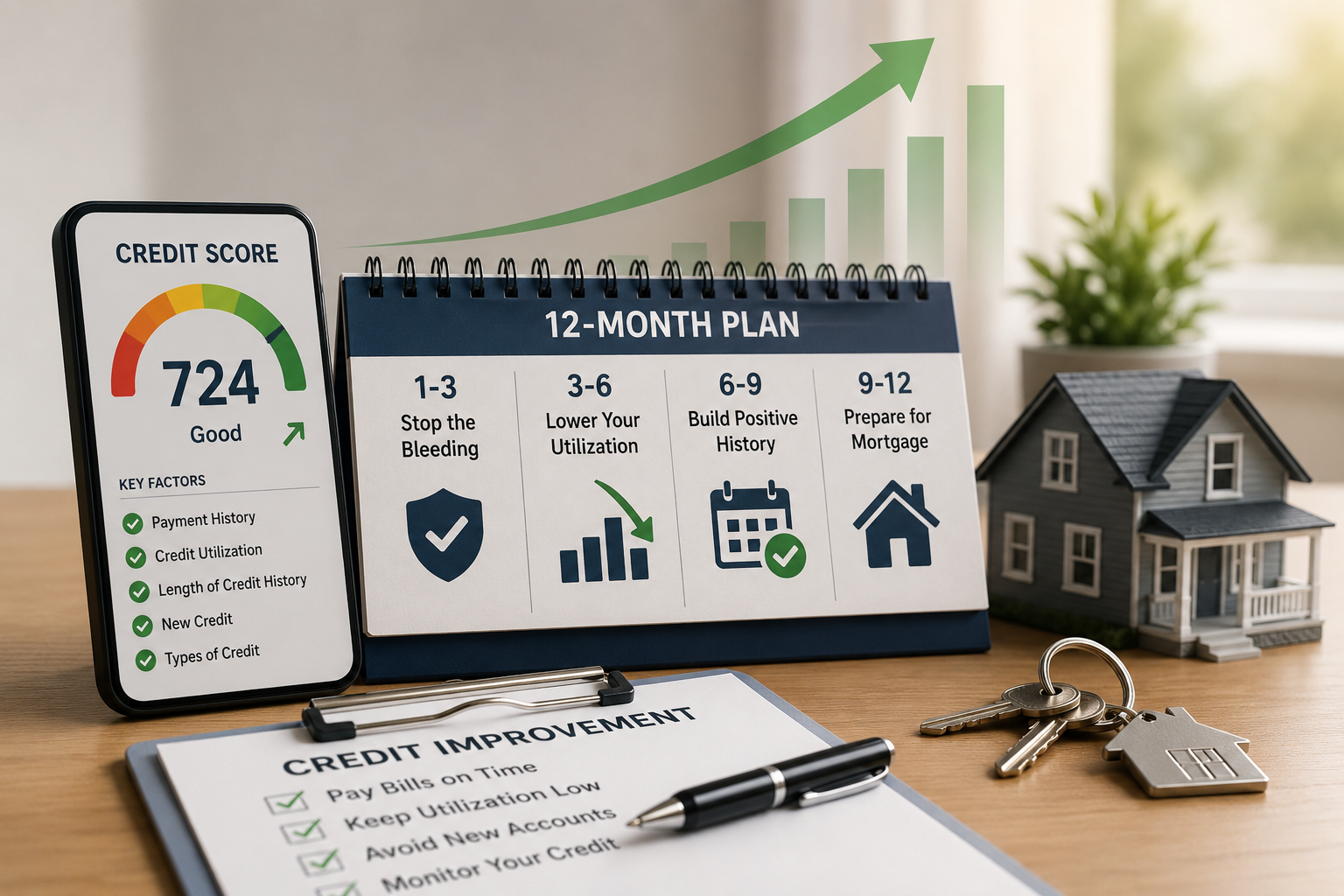
This article gives you that timeline. Twelve months, broken into specific stretches, with what to focus on during each one and roughly how it affects your score. This is especially useful for two groups we see often: buyers recovering from a financial setback, like a late payment or a period of high debt, and buyers who are newer to the U.S. credit system and have not yet built a long history.
The numbers below describe typical patterns in how FICO scoring responds to these actions. Every credit file is different, and your own results will depend on your starting point.
Section 02
Before Month One: Know Your Starting Point
Pull your credit reports from all three bureaus before you do anything else. Look for three things. Any late payments, and how recent they are. Your credit utilization, meaning how much of your available credit you are currently using. Any errors, like an account that is not yours or a balance reported incorrectly.
If you have little to no credit history yet, your starting point looks different, and the plan below still applies, just with more focus on building new accounts rather than repairing old ones.
Section 03
Months 1 to 3: Stop the Bleeding
The first three months are about removing anything actively working against you.
Get current on any past-due accounts immediately. A payment that is 30 or more days late has a real impact on your score, and the impact grows the longer it stays unpaid. Bringing an account current stops further damage, even though the late payment itself stays on your report for years.
Dispute any errors you found on your reports. If an account does not belong to you, or a balance is reported incorrectly, filing a dispute with the bureau can correct it, sometimes within 30 to 45 days.
Stop applying for new credit during this window. Each hard inquiry has a small, temporary impact on your score, and multiple inquiries in a short period compound that effect. Give your file room to stabilize before adding anything new.
Section 04
Months 3 to 6: Lower Your Utilization
Credit utilization, the percentage of your available credit you are using, is one of the fastest levers you have. Lenders generally like to see utilization under 30%, and under 10% shows even more strength.
If you are carrying balances close to your credit limits, focus this stretch on paying them down. Paying a card from 80% utilization down to 20% can move your score meaningfully within one or two billing cycles, since utilization updates as soon as your new balance is reported.
If raising your limit is realistic, requesting a credit limit increase on an existing card, without using the additional room, can also lower your utilization percentage without paying down debt as aggressively. This works best on cards you already manage responsibly.
Section 05
Months 6 to 9: Build Positive History
Once your utilization is under control, this stretch is about adding consistent, positive payment history.
If you have thin credit, meaning few accounts or a short history, becoming an authorized user on a family member’s well-managed card can add positive history to your file, as long as that account has a long track record of on-time payments and low balances.
A secured credit card is another option for building history from a low starting point. You put down a deposit that becomes your credit limit, then use the card lightly and pay it off in full each month. Reported on time, this behaves like any other credit card for scoring purposes.
Keep every payment on time during this stretch, without exception. Payment history is the single largest factor in most credit scoring models, and six straight months of on-time payments during a rebuilding period carries real weight.
Section 06
Months 9 to 12: Prepare the File a Lender Will See
The final stretch is about making sure your file looks stable and ready by the time you apply.
Avoid closing old credit cards, even ones you rarely use. Closing an account can reduce your total available credit, which raises your utilization percentage even if your spending has not changed. It can also shorten your average account age over time.
Avoid new credit applications in the 90 days before you plan to apply for a mortgage. A new inquiry or a new account resets part of your credit profile at exactly the moment a lender is about to review it.
Get pre-approved early in this window, even if you are not ready to buy yet. A loan officer can review your actual credit file and tell you which factors are still holding your score back, rather than guessing based on general advice.
Section 07
A Simple Example
This example is hypothetical and is provided for educational purposes only. It does not represent a typical borrower or guarantee any particular credit score outcome.
Imagine a borrower starting with a 580 credit score, primarily because of high credit utilization and a late payment reported the previous year.
Over the next twelve months, the borrower follows the four steps outlined in this article:
- brings all past-due accounts current,
- reduces credit utilization from about 75% to below 20%,
- avoids applying for unnecessary new credit, and
- builds additional positive payment history by making every payment on time.
In this hypothetical example, those actions could strengthen the borrower’s overall credit profile over time. The actual effect on any credit score depends on many factors, including the borrower’s complete credit history, the age of existing accounts, the severity and timing of negative items, and the credit scoring model being used. Individual results will vary, and no specific score improvement should be expected.
Section 08
Want to Know Exactly What Is Holding Your Score Back?
A Wonder Rates loan officer can review your credit file and build a plan specific to your numbers, instead of a general twelve-month timeline.
Duc Pham | NMLS #844897 | DRE #01905915
Wonder Rates, Inc. | NMLS #1518655 | DRE #02047445 | DFPI #60DBO-59134
Equal Housing Lender.
This content is for educational purposes only and is not a commitment to lend. Loan approval is subject to creditworthiness, income verification, property eligibility, and current underwriting guidelines. Programs and requirements may change without notice. Rates and terms are subject to change. Subject to credit approval.