
Section 01
Rental property financing works differently from financing a primary residence. Investment property loans often come with different qualification requirements, including larger down payments, additional documentation, and a closer review of both you and the property.
Many first-time investors assume they can use the same mortgage they used for their own home. Sometimes that works. Often it does not. Understanding your financing options before making an offer can help you avoid delays and choose a loan strategy that fits your investment goals.
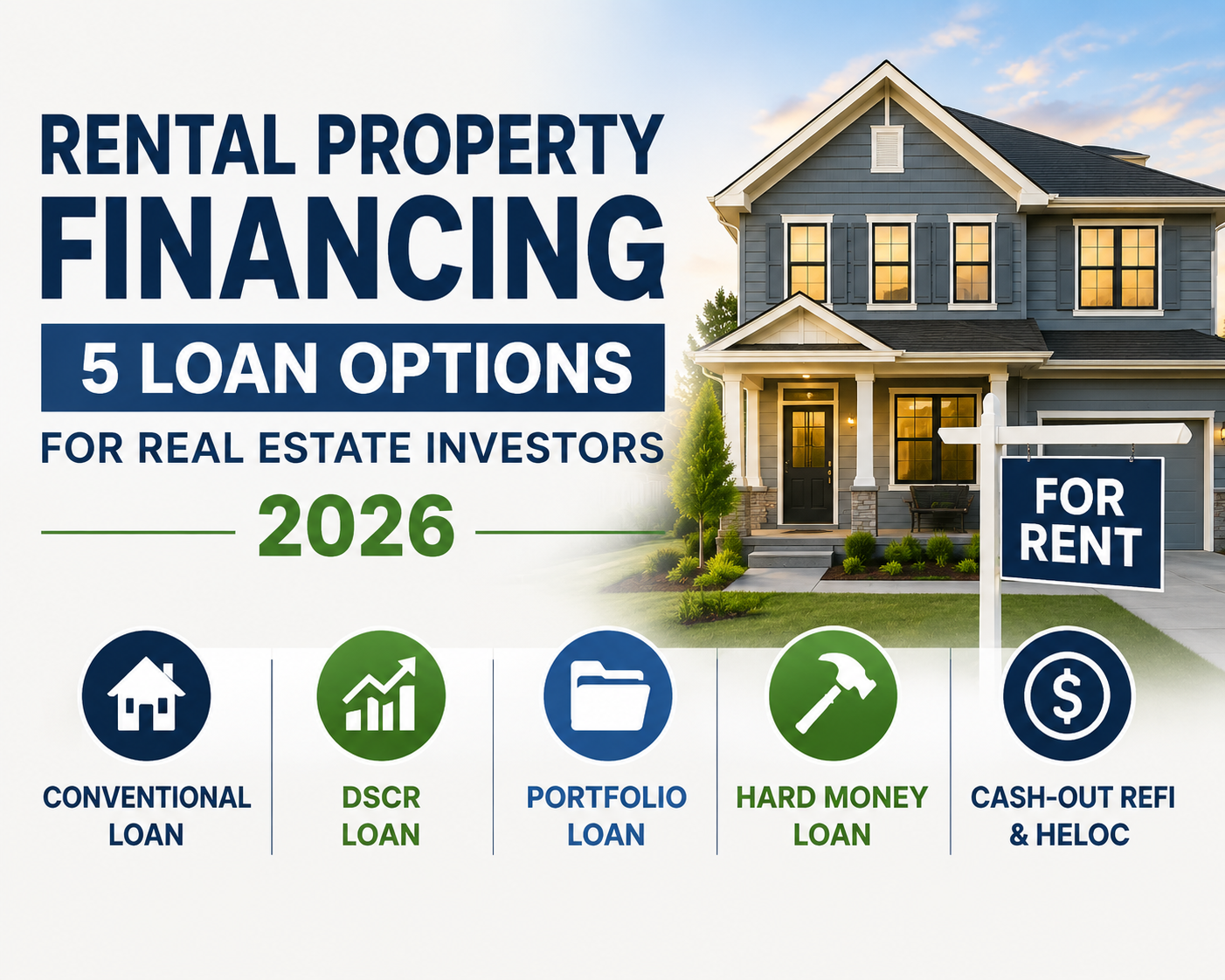
This guide explains the main rental property financing options available in 2026, including conventional investment property loans, DSCR loans, portfolio loans, hard money loans, and equity-based financing options.

Section 02
Option 1: Conventional Rental Property Financing
This is often a good starting option for investors with steady income, good credit, and one or two rental properties.
Conventional investment property loans follow guidelines from Fannie Mae and Freddie Mac. These loans are widely available and may work well for single-family homes, condos, and two to four unit properties depending on borrower qualifications and lender guidelines.
The requirements are more demanding than for a primary residence. Many lenders look for stronger credit profiles, and requirements vary based on the loan program, property type, and borrower qualifications.
Many lenders typically require larger down payments for investment properties. Down payment requirements vary by loan program and property type. Some single-family investment properties may start around 15% down. Multi-unit properties may require more.
Fannie Mae allows investors to finance up to 10 properties under its guidelines. However, additional reserve requirements may apply based on the number of financed properties, including the subject investment property and other financed properties owned by the borrower.
Rental income may be used to help qualify for a conventional investment property loan, but lenders typically require documentation. Depending on the property and borrower situation, qualifying rental income may be supported by a lease agreement or an appraiser’s rent schedule. The amount counted toward qualifying income varies based on loan guidelines and lender requirements.
| Requirement | Single-Family | 2 to 4 Unit |
|---|---|---|
| Typical credit score considerations | 680+ (higher scores may qualify for different pricing) | 680+ (higher scores may qualify for different pricing) |
| Typical down payment | Starting around 15% | May be higher depending on program |
| Max financed properties | 10 (Fannie Mae guideline) | 10 (Fannie Mae guideline) |
| Reserve for subject investment property | 6 months of PITIA | 6 months of PITIA |
| Additional reserves for other financed properties | 2% of aggregate UPB for 1–4 financed properties; 4% for 5–6 financed properties; 6% for 7–10 financed properties | 2% of aggregate UPB for 1–4 financed properties; 4% for 5–6 financed properties; 6% for 7–10 financed properties |
| Rental income counted | 75% of market or actual rent | 75% of market or actual rent |
Reserve requirements are based on current Fannie Mae guidelines and may vary by borrower profile, property type, and lender overlays. Guidelines are subject to change.
Section 03
Option 2: DSCR Loan
For investors whose personal income does not fully reflect their investment strategy, a DSCR loan focuses primarily on the property’s cash flow rather than traditional income documentation.
DSCR stands for Debt Service Coverage Ratio. It measures whether the rental income can cover the property’s monthly expenses, including the mortgage, taxes, insurance, and HOA fees. If the ratio meets lender requirements, the property’s cash flow becomes a key factor. The lender may rely less on your personal income documentation.
Many DSCR lenders set minimum DSCR requirements that may range around 1.0 to 1.25, depending on the program and lender. A property generating $2,200 per month in rent with a proposed monthly PITIA of $1,750 produces a DSCR of 1.26, which may meet certain lender guidelines depending on the full loan profile. A property generating $1,700 with the same $1,750 PITIA produces a DSCR of 0.97, which falls below 1.0 and may require adjustments, such as additional equity, different property terms, or another financing structure depending on the lender.
DSCR loans typically require 20% to 25% down, a credit score of 680 or above for standard pricing, and the property must be rent-ready at the time of closing. Most DSCR products are available as 30-year fixed or ARM structures.
One advantage of DSCR loans is flexibility for investors. The lender focuses more on the property’s cash flow instead of your personal income.
| DSCR Calculation | Monthly Rent | Monthly PITIA | DSCR | Result |
|---|---|---|---|---|
| Strong | $2,400 | $1,800 | 1.33 | Common lender range |
| Acceptable | $2,100 | $1,800 | 1.17 | May need larger down payment |
| Borderline | $1,900 | $1,800 | 1.06 | Lender dependent |
| Below threshold | $1,700 | $1,800 | 0.94 | Sub-1 product or restructure needed |
DSCR calculations are illustrative. Actual lender thresholds and qualification criteria vary.

Section 04
Option 3: Portfolio Loan
Portfolio loans are held by the lender rather than sold to Fannie Mae or Freddie Mac, which means the lender can set their own underwriting guidelines without being bound by agency rules.
Portfolio loans can help when traditional loans do not fit. They may work for investors with many properties, mixed-use properties, or complex income situations.
The trade-off is that portfolio loan rates are often higher than conventional financing because lenders take on different levels of risk and create their own underwriting guidelines, and terms vary significantly by lender. There is no standardized product in the way that conventional or FHA loans are standardized, which means shopping multiple portfolio lenders is especially important.
Section 05
Option 4: Hard Money Loan
Hard money loans are short-term loans often used by investors who need quick funding. They are common for fixer-uppers, fast purchases, and fix-and-flip projects.
Hard money lenders typically place greater emphasis on the property’s value, project details, and exit strategy, although borrower qualifications may still vary by lender.
Many hard money lenders base financing on the property’s after-repair value (ARV). Loan-to-value limits can vary a lot. These limits depend on the lender, the project type, and the borrower’s experience. Hard money loans usually carry higher costs than traditional financing because they are short-term and asset-based, and most hard money loans have short terms, often between 6 and 24 months, with repayment structures that may include a balloon payment.
Hard money loans are generally designed as short-term financing solutions rather than long-term rental property financing. Investors typically use it to acquire and renovate a property, then refinance into a DSCR or conventional loan once the property is stabilized with a tenant in place. Using hard money as permanent financing can significantly increase borrowing costs and may reduce cash flow for many rental properties.
Section 06
Option 5: Cash-Out Refinance or HELOC for Rental Property Investors
Investors who already own property may be able to use their equity to help fund another purchase. This can reduce the need to use additional savings.
A cash-out refinance replaces the existing mortgage on a property you already own with a new, larger loan and gives you the difference in cash at closing. A HELOC, home equity line of credit, sits on top of the existing mortgage and functions as a revolving line of credit secured by the property’s equity.
The right choice between the two depends on several factors, including your existing mortgage rate, the amount of cash you need, how you plan to use the funds, fees, repayment terms, and your comfort with variable-rate risk. If your current rate is below today’s market, a cash-out refinance requires replacing your existing mortgage with a new loan, which may mean giving up your lower rate on the existing balance. A HELOC allows you to keep your existing first mortgage while borrowing against available equity through a separate line of credit with its own terms and interest rate.
| Cash-Out Refinance | HELOC | |
|---|---|---|
| Existing mortgage | Replaced with new loan | Stays in place |
| Rate structure | Fixed or adjustable, depending on product | Usually variable, but terms vary by lender |
| Best when | You need a larger lump sum and prefer replacing your existing mortgage with new financing | You want flexible access to funds while keeping your existing first mortgage |
| Closing costs | May include lender fees and closing expenses | May have lower upfront costs, depending on lender and structure |
| Funds structure | Lump sum at closing | Draw as needed |
Figures are illustrative estimates. Actual rates and terms vary by lender, borrower profile, and market conditions.
Section 07
How to Choose the Right Rental Property Financing Option
The right loan depends on three factors: your finances, the property, and your investment goals.
Investors with strong W-2 income, solid credit, and a first or second rental property purchase may find conventional financing a suitable starting point if they meet agency loan requirements and prefer traditional underwriting.
Those with complex income, self-employment, or plans to build a larger portfolio may consider DSCR loans, which focus more on the property’s cash flow rather than traditional income documentation.
Properties that need significant repairs before becoming rental-ready may require short-term financing options such as hard money, followed by a refinance into a DSCR loan once the property is stabilized.
Investors who already have equity in existing properties may use a cash-out refinance or HELOC as one option to help fund a future acquisition without relying solely on additional savings.
Most investors use different products at different stages of building their portfolio. Understanding all five options means you are not locked into one path when the next deal requires a different approach.

Section 08
Frequently Asked Questions
Can I use rental income from a property I am buying to qualify for the loan?
Yes, but requirements vary by loan type. For conventional loans, lenders may use a portion of documented rental income based on lease agreements or an appraiser’s rent schedule, depending on the situation. For DSCR loans, rental income is the main qualification factor and is compared directly to the property’s debt payments.
What credit score do I need to finance a rental property?
A stronger credit profile may affect available loan terms depending on the lender, loan program, and overall borrower profile. Hard money loans may have more flexible credit requirements because lenders focus more on the property’s value. Your credit score can affect your loan pricing and overall borrowing costs.
How many rental properties can I finance at the same time?
With conventional loans, investors can typically finance up to 10 properties under Fannie Mae guidelines, though additional reserves and documentation may be required. Beyond that, many investors use DSCR loans, portfolio loans, or commercial financing. Your practical limit depends on your income, reserves, credit profile, and each property’s cash flow.
Section 09
Conclusion
If you are evaluating your first rental property or planning your next investment, understanding your financing options early can help you make a more informed decision.
Send Duc Pham or the Wonder Rates team a message to discuss your loan options and learn which programs may fit your investment goals.
All figures, requirements, rates, and program details in this article are for illustrative and educational purposes only and do not constitute an offer of credit or investment advice. Conventional loan guidelines, DSCR thresholds, hard money terms, and portfolio loan requirements vary by lender and are subject to change. Reserve requirements and financed property limits are based on current Fannie Mae guidelines and may be updated. Rental income calculation methods vary by loan program and lender. Consult your loan officer for guidance specific to your situation and investment strategy.
Duc Pham, Mortgage Broker | NMLS# 844897 | Wonder Rates, Inc. | NMLS# 1518655 | DRE# 02047445 | DFPI# 60DBO-59134 | Equal Housing Opportunity. Equal Housing Lender. | Licensed in: AL, AZ, CA, CO, FL, GA, LA, MI, NC, OH, OK, OR, PA, SC, TX, VA, WA.