
Section 01
Saving enough money for a home is a major milestone. Whether you have spent years building your savings or recently received financial help from family, one question often surprises borrowers during the mortgage process: where did the money come from?
Many people assume showing a healthy bank balance is enough. In reality, lenders may also ask for documentation that helps explain the source of the funds being used for the transaction. This does not automatically mean there is a problem with your application. Instead, it is often part of the documentation process used to verify the information supporting your mortgage.
Exactly what documentation is required depends on the lender, the loan program, and your individual financial situation.
Section 02
What does "source of funds" mean?
Source of funds refers to documentation that helps explain where the money used in a home purchase comes from. This can apply to money used for your down payment, your closing costs, cash reserves when a loan program requires them, and your earnest money deposit.
It is worth being clear about what this is and is not. Source of funds documentation is not simply a matter of showing how much money you have. It is documentation showing where those funds originated, which is a somewhat different question than the balance on a single statement.
Section 03
Why do lenders ask about source of funds?
Rather than thinking about this in terms of regulation, it helps to understand what a lender is actually trying to confirm.
A lender generally wants to understand whether funds are genuinely available, whether they belong to the borrower using them, and whether the documentation provided is consistent with the rest of the file. In some situations, a specific transaction may simply need a bit more explanation before the lender can move forward with confidence. Different loan programs have different documentation requirements here, so what is asked of one borrower may look different from what is asked of another.
Section 04
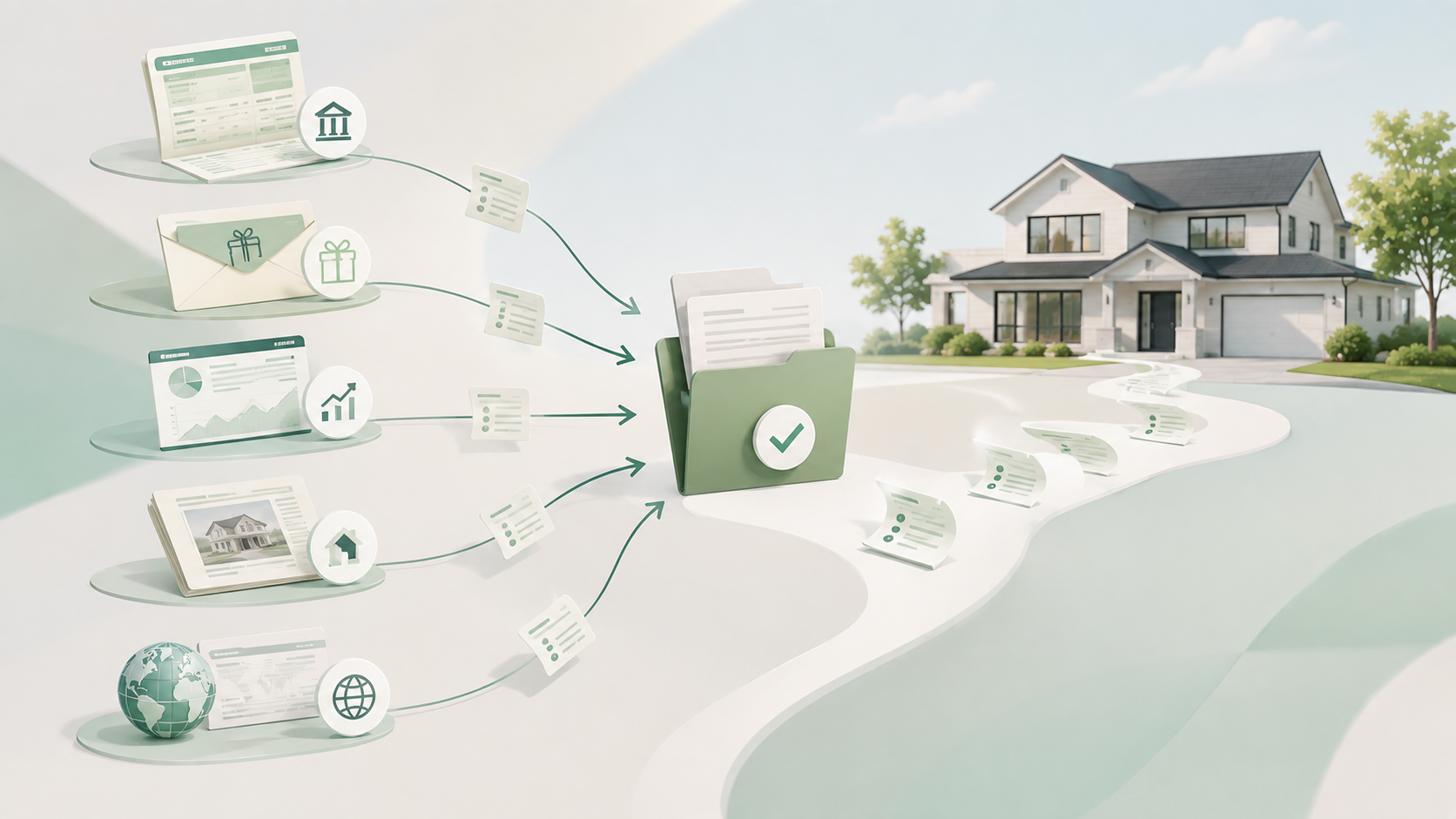
Common sources of funds
Personal savings
A borrower who has gradually saved money over several years typically has an easier documentation path. Recent bank statements generally show consistent balances building over time, and this pattern is usually straightforward for a lender to verify.
Employment income
Salary, bonus, commission, and overtime pay are all common sources of funds. Because this income is often already being reviewed as part of your overall income documentation, verifying that it also supports your savings tends to be a relatively natural part of the process.
Gift funds
Gift funds may be acceptable when the donor and documentation meet the applicable loan-program requirements. Donor eligibility, for example whether the gift can come from a parent, another relative, or in some cases a non-relative, varies by loan program, so not every donor or relationship automatically qualifies. When gift funds are involved, a lender will typically request documentation required by the applicable loan program, which often includes a signed gift letter along with evidence that the money was actually transferred.
Sale of another property
When a borrower sells a home and uses the proceeds toward a new purchase, documentation typically includes the closing disclosure from the sale, a wire confirmation showing the transfer, and a bank statement showing the funds landing in the borrower’s account.
Sale of personal assets
Selling a vehicle, boat, jewelry, or other personal property can also be a legitimate source of funds. Documentation in these cases may include a bill of sale, proof of payment, and account records showing the deposit into the borrower’s account.
Investment accounts
Funds coming from a brokerage account, stocks, or mutual funds are generally verified through account statements showing the transaction, including the sale or liquidation and the resulting transfer of cash.
Retirement accounts
401(k) and IRA funds can sometimes be used as a source of funds as well, though borrowers should be aware that withdrawals from these accounts may carry their own tax implications, which is a separate conversation worth having with a tax professional before withdrawing funds for a home purchase.
Business distributions
Self-employed borrowers sometimes use distributions from their business as part of their funds. Because these distributions are tied to business income and cash flow, lenders may review this documentation somewhat more closely alongside the borrower’s broader income picture.
Foreign assets
When funds are being transferred from an overseas account, additional documentation may be requested to confirm the transfer and the availability of the funds, depending on the lender and loan program involved.
Section 05
Large deposits: why they sometimes receive additional attention
A large, unexplained deposit is one of the more common triggers for additional documentation requests during the mortgage process.
Consider an account that has held a fairly steady balance for months, and then suddenly receives a large deposit shortly before the borrower applies for a mortgage. In a situation like this, a lender may reasonably ask for documentation explaining where that deposit came from. It is important to understand that a large deposit does not automatically create a problem with your application. It simply may require additional documentation to confirm the source before the file can move forward.
Section 06
Documents commonly used to verify source of funds
Bank statements are typically the starting point, since they show account activity over time and help establish patterns. A gift letter is used specifically to document funds received from a relative, confirming that the money is a genuine gift rather than a loan that would need to be repaid. A closing disclosure and wire confirmation are commonly used together when funds come from the sale of a prior home, showing both the transaction terms and the actual transfer of money.
A settlement statement can serve a similar purpose for other types of real estate transactions, while investment statements and a sale agreement help verify funds coming from brokerage accounts or the sale of personal property. A CPA letter is sometimes requested, particularly for self-employed borrowers, to help confirm details about business-related funds. A letter of explanation may be requested any time a lender needs additional context about a specific transaction that is not otherwise clear from the documents provided. Inheritance documentation and trust documentation serve a similar role when funds originate from an estate or a trust, helping confirm that the money is legitimately available to the borrower.
Section 07
Real-world examples
Illustrative example 1: A borrower has saved $60,000 gradually over several years, with bank statements showing consistent, steady balances the entire time. This pattern typically makes documentation relatively simple. This example is illustrative only and does not represent every saver’s experience or a guaranteed documentation outcome.
Illustrative example 2: A borrower’s parents contribute $35,000 toward a down payment. The lender requests a signed gift letter along with documentation showing the transfer, and the funds appear clearly in the borrower’s bank statements. This example is illustrative only and does not represent every gift fund transaction.
Illustrative example 3: A borrower sells an investment property and nets $210,000 in proceeds. Because this transaction has its own closing disclosure and wire confirmation, the documentation trail is generally clear, though the lender may still request bank statements showing the funds land in the borrower’s account. This example is illustrative only and does not represent every property sale scenario.
Illustrative example 4: A borrower receives an $18,500 annual bonus from their employer, deposited directly into their bank account. Because this income is already part of the borrower’s documented employment income, it is typically straightforward to verify as a source of funds. This example is illustrative only and does not represent every bonus scenario.
Illustrative example 5: A borrower transfers $95,000 from a foreign bank account to help fund their purchase. Depending on the lender and loan program, this may prompt requests for additional documentation to confirm the transfer and the funds’ origin. This example is illustrative only and does not represent every foreign transfer scenario.
Illustrative example 6: A business owner takes a $70,000 distribution from their business to help fund a home purchase. Because this ties into the borrower’s business income, a lender may review it alongside other business and income documentation already in the file. This example is illustrative only and does not represent every self-employed borrower’s situation.
These examples describe general patterns that can come up during the mortgage process. They are not a guarantee of how any individual file will be handled, since actual documentation requirements depend on the lender, loan program, and borrower’s specific circumstances.
Section 08
Common misunderstandings
Some borrowers assume that simply having enough money is all a lender needs to see, but source of funds documentation is about where the money came from, not just the balance on a statement. Others believe large deposits do not need to be explained as long as the money is legitimately theirs, but even legitimate funds may require documentation to confirm their source.
It is also a common assumption that parents or other relatives can transfer money at any point in the process without any issue. In reality, timing matters, and donor eligibility itself can vary by loan program, which is one more reason it is worth looping in your loan officer before a gift transfer happens rather than after. Some borrowers believe cash is an easier source of funds to use, but cash that has not passed through a documented account can actually be harder to verify than funds with a clear paper trail. Finally, some borrowers move money between accounts right before applying without realizing that this kind of last-minute shuffling can itself trigger additional documentation requests, since it can make a clear, established balance suddenly look like a new, unexplained deposit.
Section 09
Building a clear paper trail
A paper trail simply means that each step in how your funds moved can be traced and documented, from the moment they were saved or received all the way through to closing.
Generally, this trail runs from your original savings, through any deposit into your account, through any transfer between accounts, into the purchase itself, and finally through to closing. When each of these steps has a matching piece of documentation behind it, whether that is a bank statement, a gift letter, or a wire confirmation, verifying your funds tends to be a much smoother part of the mortgage process.
Building a paper trail before you find a home
Here is what that might look like over the course of several months. In January, a borrower’s savings account holds $45,000, built up gradually over time. In March, the borrower receives a $20,000 gift from their parents. In April, they sell a vehicle for $18,500. By June, they begin shopping for a home in earnest.
By keeping the gift letter, the bill of sale, the transfer records, and the relevant bank statements from each of these events as they happen, rather than trying to track them down later, the borrower ends up with a much clearer documentation trail if those funds need to be verified once they are ready to apply. This example is illustrative only and does not represent a specific loan file or a guaranteed documentation outcome.
Section 10
Tips to help you prepare
Keeping your bank statements organized and easy to access can save time once your loan officer starts requesting documentation. It is generally wise to avoid unnecessary movement between accounts in the months leading up to your application, since each transfer can create a new item that needs to be explained.
Saving your closing documents from any property sale, along with your investment records, means you will have what you need on hand if those funds come into play.
Beyond staying organized, timing matters just as much. It is generally worth reaching out to your loan officer before receiving gift funds, before selling investments, before transferring funds from overseas, before moving large sums of money between accounts, and before withdrawing from a retirement account. A short conversation ahead of time helps you understand what documentation will likely be needed, so you can gather it as the transaction happens rather than trying to reconstruct the story afterward.
Section 11
Conclusion
Source of funds documentation is not about making the mortgage process more complicated. It helps lenders understand how the money used for your home purchase was accumulated or transferred, and it ensures the documentation supporting your application is complete.
Preparing records early, keeping a clear paper trail, and discussing significant financial transactions with your loan officer before applying may help reduce unnecessary delays during the mortgage process.
Section 12
Sources
- Fannie Mae Selling Guide, B3-4.2-01: Verification of Deposits and Assets, and B3-4.2-02: Depository Accounts
- Freddie Mac Single-Family Seller/Servicer Guide
- Consumer Financial Protection Bureau (CFPB), Owning a Home
- U.S. Department of Housing and Urban Development (HUD), Single Family Housing Policy Handbook 4000.1
This article is provided for educational purposes only and should not be considered financial, legal, tax, or lending advice. Source of funds documentation requirements vary by lender, loan program, underwriting guidelines, and individual borrower circumstances. The examples in this article are for illustration only and do not guarantee loan approval or represent documentation requirements for every borrower. Consult your loan officer regarding the documentation applicable to your mortgage application.
Duc Pham, Mortgage Broker | NMLS# 844897 | 408-600-1900 | dp@wonderrates.com
Wonder Rates, Inc. | NMLS# 1518655 | DRE# 02047445 | DFPI# 60DBO-59134
Equal Housing Opportunity. Equal Housing Lender.
Licensed in: AL, AZ, CA, CO, FL, GA, LA, MI, NC, OH, OK, OR, PA, SC, TX, VA, WA