
Section 01
VA loan myths are common misconceptions about eligibility, down payments, borrowing limits, fees, and property requirements. While VA loans offer unique benefits for eligible borrowers, some popular beliefs are outdated or incomplete. Here are five common VA loan myths and the facts behind them.
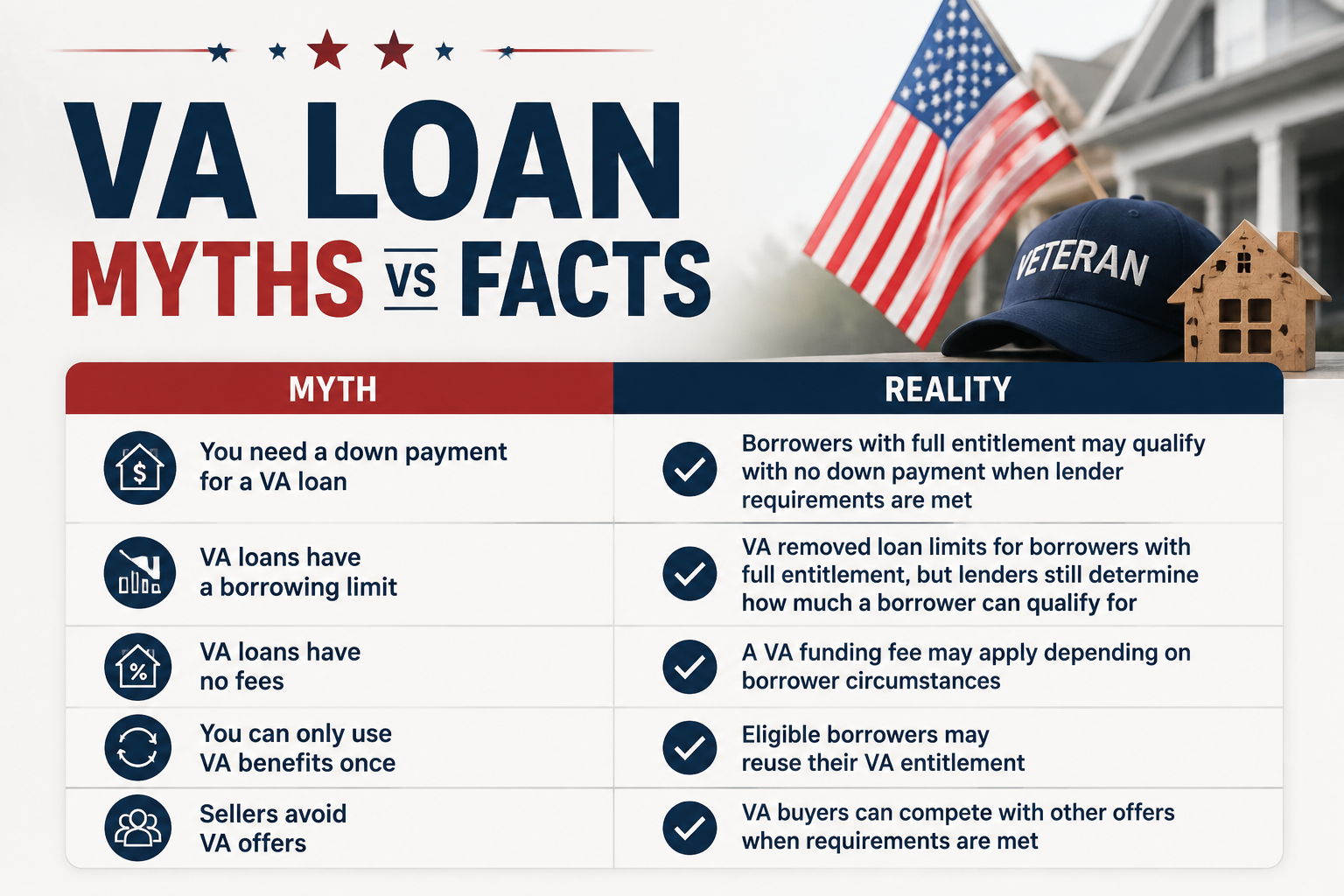
VA Loan Myths vs Facts at a Glance
| Myth | Reality |
|---|---|
| You need a down payment for a VA loan | Borrowers with full entitlement may qualify with no down payment when lender requirements are met |
| VA loans have a borrowing limit | VA removed loan limits for borrowers with full entitlement, but lenders still determine how much a borrower can qualify for |
| VA loans have no fees | A VA funding fee may apply depending on borrower circumstances |
| You can only use VA benefits once | Eligible borrowers may reuse their VA entitlement |
| Sellers avoid VA offers | VA buyers can compete with other offers when requirements are met |
Section 02
Myth 1: You Need a Down Payment to Get a VA Loan
For borrowers who qualify for zero-down financing, a down payment may not be required. However, some borrowers may still need to contribute funds depending on their entitlement, loan amount, and lender requirements. Borrowers with partial entitlement may still need a down payment depending on their remaining entitlement and loan amount.
Putting money down is still optional and can help in other ways, mainly by lowering your VA funding fee, which is covered in Myth 3. A down payment may not be required for borrowers who qualify for zero-down financing, but some borrowers may still need one depending on their entitlement, loan amount, and lender requirements.
Section 03
Myth 2: There's a Cap on How Much You Can Borrow
This one used to be true. Before 2020, VA loans followed county-level limits similar to conforming conventional loans. The Blue Water Navy Vietnam Veterans Act removed VA loan limits for borrowers with full entitlement. However, lenders still review factors such as income, credit history, assets, and debt-to-income ratio before approving a loan amount.
That doesn’t mean unlimited approval. Individual lenders can still apply their own overlays, and your income, credit, and DTI still determine what you actually qualify for. The cap that’s gone is the VA’s, not every lender’s internal comfort level.
Section 04
Myth 3: VA Loans Are Completely Free, No Fees at All
Zero down payment options and the absence of monthly mortgage insurance often lead buyers to assume VA loans have no costs attached at all. There’s still a VA funding fee, a one-time charge that helps sustain the program, and it varies based on your down payment and whether this is your first time using the benefit.
For illustration purposes, the example below shows how the VA funding fee may vary on a $300,000 purchase price for a first-time VA borrower.
| Example Down Payment | Example Loan Amount | Example Funding Fee Rate | Example Funding Fee |
|---|---|---|---|
| 0% down | $300,000 | 2.15% | $6,450 |
| 5% down | $285,000 | 1.5% | $4,275 |
| 10% down | $270,000 | 1.25% | $3,375 |
A larger down payment does double duty here: it lowers your loan amount and drops you into a lower funding fee bracket at the same time. Some borrowers, including certain veterans receiving VA disability compensation and eligible surviving spouses, may qualify for a funding fee exemption depending on VA eligibility rules.
These examples are based on a $300,000 purchase price. The VA funding fee is calculated based on the loan amount, which changes depending on the down payment. Actual fees vary based on borrower eligibility, VA guidelines, and individual loan details.
Section 05
Myth 4: You Can Only Use Your VA Loan Benefit Once
VA entitlement isn’t a one-time benefit. It can be reused, often multiple times over your life, as long as prior VA loans are paid off or your entitlement is restored. Some borrowers even carry more than one VA loan at once if enough entitlement remains.
Repeat use of a VA loan benefit may come with different funding fee requirements depending on the borrower’s circumstances. For example, a subsequent-use VA borrower with 0% down may pay a 3.3% funding fee, which equals $9,900 on a $300,000 loan amount. A first-time VA borrower with 0% down may pay a 2.15% funding fee, or $6,450 on the same loan amount.
In this example, the difference is $3,450 before considering any applicable exemptions. Some borrowers, including certain veterans receiving VA disability compensation and eligible surviving spouses, may qualify for a funding fee exemption based on VA eligibility rules.
Funding fee rates, exemptions, and entitlement rules vary based on VA guidelines and borrower circumstances. Examples are for illustration purposes only and do not constitute an offer of credit.
Section 06
Myth 5: Sellers Won't Accept VA Offers Because of Appraisals or Inspections
This myth usually comes from VA’s Minimum Property Requirements, a set of livability and safety standards the home has to meet. VA Minimum Property Requirements are separate from a buyer’s home inspection. The VA appraisal focuses on whether the property meets basic safety and condition standards required for the loan, while a home inspection helps buyers understand the home’s overall condition and identify potential issues before closing.
In many cases, VA loans can close on timelines comparable to conventional loans when the appraisal, documentation, and property requirements are handled properly. A well-maintained home may have fewer issues overall, but it still needs to meet the VA’s Minimum Property Requirements before the loan can move forward.
Section 07
Frequently Asked Questions
Who besides active-duty service members can use a VA loan?
Veterans, certain National Guard and Reserve members, and some surviving spouses of service members can qualify, depending on service history and eligibility requirements. Active duty is one path to eligibility, not the only one.
If I’m exempt from the funding fee, does that change anything else about my loan?
The exemption removes the VA funding fee. Your rate, down payment requirement, and qualification still depend on your entitlement, lender guidelines, and full borrower profile.
How much does putting 5% down actually save on the funding fee, compared to 0% down?
Based on a $300,000 purchase price for a first-time VA borrower, 0% down results in a $6,450 funding fee. With 5% down, the loan amount decreases to $285,000 and the funding fee drops to $4,275, a difference of $2,175.
This is an illustrative estimate only, based on current published VA funding fee rates. It does not constitute an offer of credit.
Section 08
Conclusion
VA loans carry real benefits, but the myths around them can either scare off eligible buyers or lead to bad assumptions about what’s actually required.
Talk with Duc Pham or the Wonder Rates team to review your VA loan options, eligibility requirements, and how your benefits may apply to your situation.
Disclaimer: All figures, calculations, and examples in this article are for illustrative and educational purposes only and do not constitute an offer of credit or financial advice. VA funding fee rates, exemptions, and eligibility rules are current as of 2026 VA guidance and are subject to change. Consult your loan officer for guidance specific to your situation.
Duc Pham, Mortgage Broker | NMLS# 844897 | Wonder Rates, Inc. | NMLS# 1518655 | DRE# 02047445 | DFPI# 60DBO-59134 | Equal Housing Opportunity. Equal Housing Lender. | Licensed in: AL, AZ, CA, CO, FL, GA, LA, MI, NC, OH, OK, OR, PA, SC, TX, VA, WA.