Section 01
When Does It Make Sense to Split a Mortgage Into a First Mortgage and a HELOC?
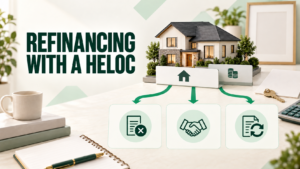
Most homebuyers assume they need just one mortgage to finance a home. In many cases, that’s true. However, some borrowers choose a different strategy by combining a first mortgage with a Home Equity Line of Credit (HELOC) instead of taking one larger loan.
This approach isn’t new, but it often goes unnoticed because it works best in specific situations. When used correctly, it may help reduce upfront cash requirements, avoid certain loan costs, or create more flexibility after closing. When used incorrectly, it can increase financial risk and monthly payment uncertainty.
The key is understanding why someone would split a loan instead of keeping everything under one mortgage.
Section 02
What Does "First Mortgage + HELOC" Mean?
A first mortgage is the primary loan used to purchase the home. A HELOC is a second loan secured by the same property that works more like a revolving line of credit than a traditional mortgage.
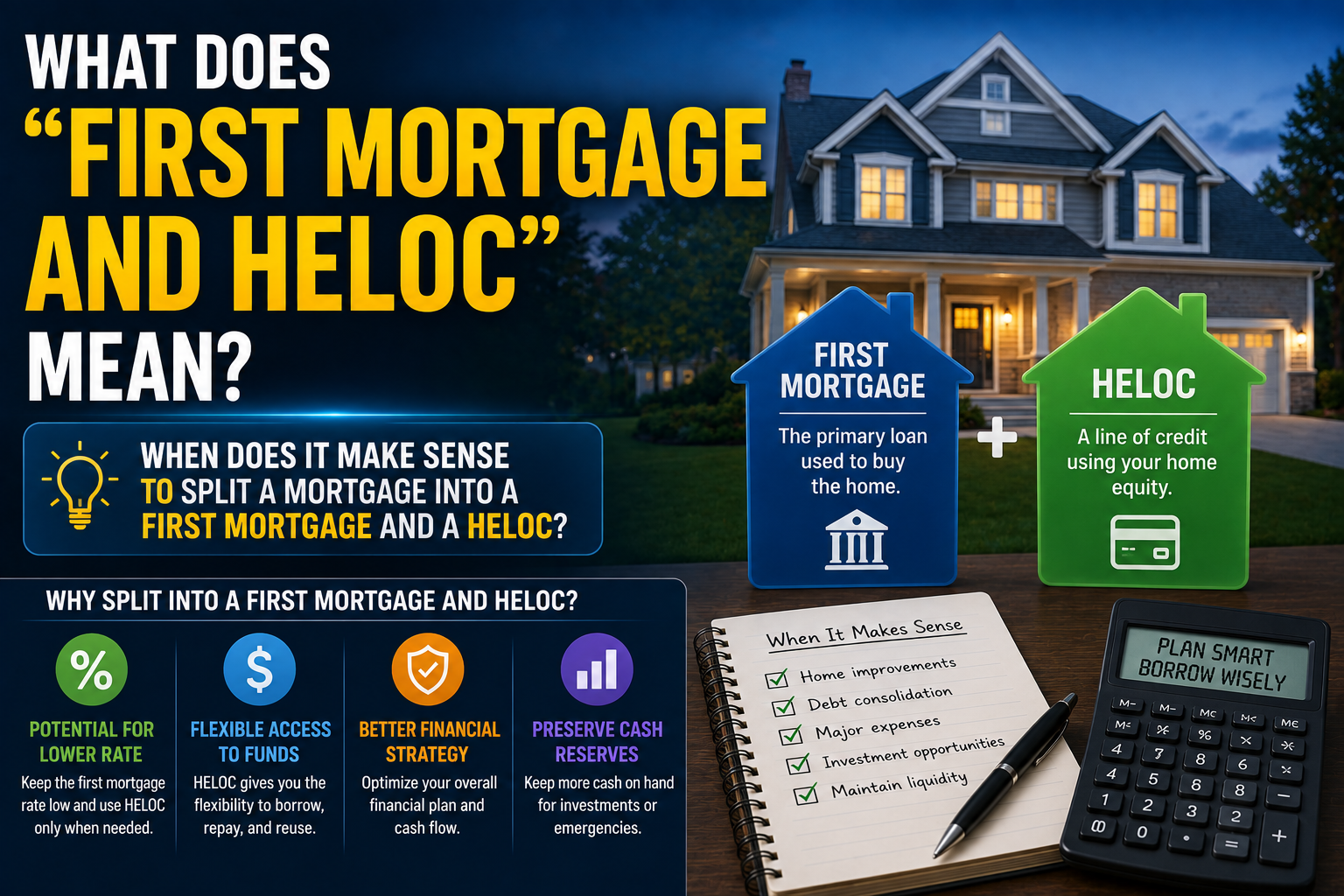
Instead of borrowing the full amount through one loan, the financing is divided into two pieces.
For example, imagine you’re buying a $800,000 home with a 10% down payment.
Instead of taking one mortgage for $720,000, your financing could look like this:
| Loan | Amount |
|---|---|
| First Mortgage | $640,000 |
| HELOC | $80,000 |
| Down Payment | $80,000 |
Together, the first mortgage and HELOC still finance the purchase, but each loan serves a different purpose.
Section 03
One Common Reason: Avoiding Jumbo Loan Limits
One of the biggest reasons borrowers split a loan is to stay below the conforming loan limit.
Suppose the conforming loan limit in your area is $806,500, but you need to borrow $860,000. Taking one mortgage could push you into jumbo financing, which may have different underwriting guidelines, reserve requirements, or documentation standards.
Instead, a lender may structure the financing like this:
- First mortgage: $806,500
- HELOC: $53,500
This allows the first mortgage to remain within conforming loan limits while the HELOC finances the remaining balance.
Whether this strategy is beneficial depends on market conditions and the lender’s available loan programs.
Note: The figures above are for illustrative purposes only and may not reflect current conforming loan limits. Loan limits change periodically and vary by location.
Section 04
Another Strategy: Reducing PMI
Some borrowers use a HELOC to lower the size of the first mortgage and avoid Private Mortgage Insurance (PMI).
Imagine you’re purchasing a $600,000 home with only 10% down.
One option is:
- Down payment: 10% ($60,000)
- First mortgage: 90% ($540,000)
Because the first mortgage exceeds 80% of the home’s value, PMI may be required.
Another option could look like this:
| Financing | Amount |
|---|---|
| Down Payment | $60,000 |
| First Mortgage | $420,000 |
| HELOC | $120,000 |
The first mortgage now represents only 70% of the home’s value, which may eliminate the PMI requirement. The trade-off is that the borrower now has a second loan with its own interest rate and payment.
Whether this saves money depends on the cost of the HELOC, current interest rates, and how long the borrower expects to keep both loans.
Section 05
A HELOC Offers Flexibility But That Comes With Risk
Unlike a traditional mortgage, a HELOC usually has a variable interest rate.
If market rates increase, the monthly payment on the HELOC can also increase.
For example, a borrower may begin with a 7% HELOC rate and a monthly payment of $500. If rates rise over the next two years, that payment could increase even if the balance stays the same.
Borrowers should understand this risk before relying on a HELOC as part of their long-term financing strategy.
Section 06
This Strategy Doesn't Work for Every Borrower
Splitting a loan isn’t automatically better than taking one larger mortgage.
It often works best for borrowers who:
- want to stay below conforming loan limits;
- are trying to reduce or avoid PMI;
- expect to repay the HELOC relatively quickly;
- have sufficient income to manage two monthly loan payments.
On the other hand, borrowers planning to keep both loans for many years should carefully compare the long-term cost of a variable-rate HELOC against the stability of one fixed-rate mortgage.
Section 07
Final Thoughts
Using a first mortgage together with a HELOC can be an effective financing strategy, but only when it matches your financial goals. It isn’t simply a way to borrow more money. In many cases, it’s a tool to improve loan structure, manage mortgage insurance costs, or stay within certain lending limits.
Before choosing this approach, compare the total cost of both loans, understand how the HELOC interest rate may change over time, and consider how long you expect to keep the financing in place. The best mortgage strategy isn’t always the one with the lowest initial payment it’s the one that fits your overall financial plan.
Disclaimer: This article is for educational purposes only and should not be considered financial, tax, or legal advice.
Duc Pham, Mortgage Broker | NMLS# 844897,
Wonder Rates, Inc. | NMLS# 1518655 | DRE# 02047445 | DFPI# 60DBO-59134 |
Equal Housing Opportunity. Equal Housing Lender. |
Licensed in: AL, AZ, CA, CO, FL, GA, LA, MI, NC, OH, OK, OR, PA, SC, TX, VA, WA.