

Section 01
Imagine submitting a 200-page tax return as part of your mortgage application. Instead of manually reviewing every page, a document processing system extracts key figures, organizes the information, and flags items that may need further attention.
This is one way artificial intelligence (AI) can support mortgage document review. Tools that use optical character recognition (OCR), machine learning, and document processing can help lenders handle large volumes of paperwork more efficiently.
But faster document processing does not automatically mean a more accurate mortgage decision. A system may identify a number on a tax return without fully understanding how that number affects qualifying income. It may flag a discrepancy without knowing whether the difference is a harmless formatting issue or something that requires further documentation.
Understanding what AI can do, what it cannot reliably determine on its own, and how lenders use the results can help homebuyers navigate the mortgage process with more realistic expectations.
Section 02
How AI Is Changing Mortgage Document Review
Mortgage applications involve more than collecting a few forms. Depending on the borrower and loan program, a lender may need to review pay stubs, W-2s, tax returns, bank statements, employment records, purchase contracts, and other financial documents.
Some lenders use AI-assisted systems to help organize and process these records. The specific capabilities vary by technology provider and lender, but common applications include document classification, data extraction, consistency checks, and workflow automation.
For example, a document processing tool may identify a W-2, extract the reported wages, and place the information into a structured record. A reviewer can then compare those figures with other documents in the mortgage file.
These tools can reduce repetitive data entry and help staff identify items that need attention. However, not every lender uses the same systems, and AI-assisted review does not eliminate the need to verify information against applicable lending requirements.
Section 03
What Happens During AI-Assisted Mortgage Document Review?
AI-assisted document review generally involves several related tasks. The exact workflow depends on the lender’s technology, document types, and internal controls.
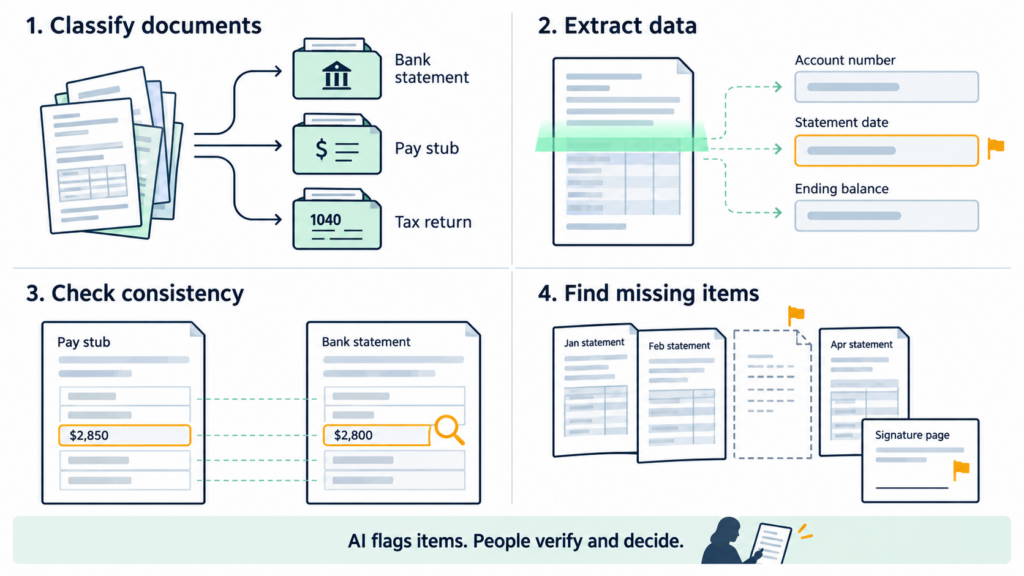
1. Document classification
The system identifies the type of document submitted. It may distinguish a bank statement from a pay stub, a W-2 from a 1099, or a tax return from a purchase contract.
Classification helps organize a file so the appropriate information can be extracted and reviewed. If the document is incomplete, poorly scanned, or difficult to interpret, the system may still need human assistance.
2. Data extraction
Optical character recognition converts text in scanned documents or images into machine-readable information. AI-assisted tools may then extract relevant fields, such as wages, account balances, dates, employer names, and reported income.
Extracted information is not automatically verified simply because it has been read by software. The system may misread a digit, overlook a handwritten note, or incorrectly associate a figure with the wrong field.
For that reason, important figures may need to be checked against the original document and other supporting records.
3. Consistency checks
Some systems can compare information across documents and flag potential discrepancies. For example, the employer listed on a pay stub may differ from the employer shown on another record, or a bank statement may not cover the full period requested.
A flagged discrepancy is a reason to investigate, not proof that the borrower made an error or submitted inaccurate information. Differences may result from name changes, document timing, account transfers, or other legitimate circumstances.
4. Missing-document detection
Document management tools may identify missing pages, incomplete statements, unsigned forms, or records that do not cover the requested period.
Catching these gaps earlier can help reduce back-and-forth requests. However, automated checks cannot guarantee that every missing or incorrect item will be detected.
The lender remains responsible for determining what documentation is required for the specific mortgage application.
Section 04
What AI Can Help Mortgage Lenders Do
AI-assisted systems are most useful when handling repetitive tasks involving large volumes of relatively structured information. Their value depends on the quality of the documents, the design of the system, and how the lender validates the results.
Organize large document packages
A borrower with multiple income sources or business interests may submit a substantial volume of records. Automated classification can help sort those files into categories, making the review process easier to manage.
This is particularly useful when a file contains different document types or requires information to be compared across multiple periods.
Extract financial information
AI tools can help identify income figures, account balances, deposits, and other relevant data. A reviewer may then use the extracted information to locate important details without manually searching every page.
The extracted figures still need to be evaluated under the applicable mortgage guidelines. A number that appears on a document does not automatically qualify as usable income or an eligible asset.
Flag potential discrepancies
Automated checks can help identify differences between documents or highlight unusual entries for additional review.
These alerts may help a lender decide where closer inspection is needed. They should not be treated as a final conclusion about a borrower’s financial situation.
Support document workflows
Some systems can route files to the appropriate team member, track outstanding documentation, or identify items that still require attention.
These workflow features can help teams manage applications more consistently. They do not guarantee a shorter closing timeline, since delays can also result from third-party verifications, appraisal issues, title work, property conditions, or unresolved underwriting requirements.
Section 05
What AI Cannot Reliably Determine From Documents Alone
The main limitation of document processing is that extracting information is not the same as interpreting it in context.
Mortgage qualification depends on more than reading a collection of numbers. The lender must determine how the information applies under the selected loan program and whether the documentation supports the required conclusions.
Understanding complex income situations
Consider a self-employed borrower whose reported income declined during one tax year. An AI tool may identify the decline and summarize the relevant tax figures.
But the figures alone may not explain whether the decline reflects a temporary business expense, a change in operations, a continuing reduction in revenue, or another circumstance.
A mortgage professional can review the supporting records, ask follow-up questions, and determine what additional documentation may be relevant. The lender must still evaluate the income according to the applicable underwriting requirements.
For a deeper look at this issue, see Wonder Rates’ guide on getting a self-employed mortgage after a bad tax year.
Distinguishing reported income from qualifying income
Taxable income, cash flow, gross receipts, and mortgage qualifying income are not interchangeable.
For example, a business owner may report depreciation on a tax return. Depending on the applicable loan program and income calculation, some depreciation expenses may be added back when determining qualifying income.
However, this does not mean every deduction can be ignored or that the lender will use the business owner’s full reported revenue. The calculation depends on the relevant income documentation and underwriting rules.
An automated summary may help locate the figures, but the final qualifying-income analysis requires the appropriate calculation and review.
Determining which loan program fits the borrower
A document processing tool may extract the same financial information that a loan officer uses to compare mortgage options. That does not mean the tool can independently determine the best loan for every borrower.
The appropriate option may depend on income type, credit profile, down payment, property eligibility, occupancy, financial reserves, and the borrower’s goals.
FHA, conventional, VA, USDA, and other mortgage programs have different eligibility requirements. A program that appears suitable based on one part of a file may not be appropriate after the full application is considered.
Resolving exceptions and unusual circumstances
Some mortgage applications require explanations or additional documentation that cannot be resolved by simply extracting more data.
A lender may need to clarify a large deposit, review a change in employment, understand a gap in income, or obtain additional records from a third party.
AI may help identify the issue, but the borrower and mortgage team may still need to gather evidence and determine the next step under the relevant requirements.
Section 06
AI Document Review Is Not the Same as Automated Underwriting
The terms AI mortgage review and automated underwriting are sometimes used as if they mean the same thing. They describe different functions.
AI-assisted document review focuses on processing and organizing information contained in documents. Depending on the tool, it may extract data, identify document types, and flag inconsistencies.
An Automated Underwriting System (AUS) evaluates information from a mortgage application under the applicable system’s risk assessment framework and program rules. For conventional loans, examples include Desktop Underwriter (DU) from Fannie Mae and Loan Product Advisor (LPA) from Freddie Mac.
These systems serve different purposes. Document processing can help prepare information for review, while an AUS generates underwriting findings based on the data submitted to it.
Neither term should be treated as a universal guarantee of approval. The lender must follow the applicable program requirements, review any required documentation, and address outstanding conditions before a loan can proceed to closing.
Section 07
Example: Reviewing a 200-Page Tax Return
Consider a hypothetical borrower who owns a restaurant and has income reported through a business tax return, a Schedule K-1, and related schedules.
The tax package is lengthy and includes revenue, expenses, depreciation, and other financial information.
An AI-assisted system may help classify the documents and extract relevant figures into a summary. That can make it easier for a reviewer to locate the information needed for the next stage of analysis.
However, the extracted summary may not establish the borrower’s qualifying income by itself. The lender may need to review business ownership, the applicable income calculation, the treatment of expenses, and whether the documentation supports the figures being used.
If the file contains a large depreciation deduction, for example, the reviewer must determine how that deduction is treated under the applicable guidelines rather than assuming that the figure should always be added back.
The practical value of AI is that it can help organize the information. The important qualification decision still depends on the correct interpretation of the documents and the rules governing the loan.
Illustrative example: This scenario is hypothetical and is provided for educational purposes only. It does not represent an actual borrower or guarantee how a lender will calculate qualifying income. The treatment of business income and deductions depends on the loan program, lender requirements, supporting documents, and underwriting review.
Section 08
What Borrowers Should Know About Privacy and Data Security
Mortgage documents contain sensitive personal and financial information. Depending on the application, these records may include Social Security numbers, account details, tax information, employment history, and other nonpublic personal information.
When a lender uses AI or a third-party document processing provider, borrowers should understand how their information is handled. The existence of an AI feature does not, by itself, establish whether a system is secure or how submitted data may be stored or used.
Before uploading mortgage documents to a public AI tool or an unfamiliar service, consider the following:
- Confirm the platform is authorized. Use the lender’s designated document portal or another approved submission method.
- Review the privacy terms. Understand what information is collected, how it is used, whether it is retained, and whether it may be shared with service providers.
- Avoid unnecessary disclosure. Do not submit sensitive documents to a tool unless there is a clear purpose and you understand the relevant privacy protections.
- Ask how errors are handled. Find out how incorrect extracted information can be reviewed and corrected.
- Use secure channels. Follow the lender’s instructions for transmitting documents rather than sending sensitive information through unapproved channels.
The Federal Trade Commission provides guidance on financial institutions’ obligations concerning consumer financial information under the Gramm-Leach-Bliley Act Privacy Rule. The specific obligations that apply depend on the organization, the information involved, and the circumstances.
Borrowers should not assume that every AI tool has the same privacy protections. When in doubt, ask the lender how the document review process works and which platform should be used.
Section 09
Can AI Make Mortgage Decisions Unfair or Inaccurate?
AI systems can produce incorrect results, and automated models may introduce or reproduce biases if they are poorly designed, trained, or used. A system can also make errors when the source documents are incomplete, inconsistent, or difficult to read.
These risks matter because mortgage decisions can have significant financial consequences.
The Consumer Financial Protection Bureau has explained that creditors using complex algorithms or artificial intelligence must still comply with applicable requirements for explaining adverse credit decisions. Technology does not remove a lender’s responsibility to provide specific and accurate reasons when required.
You can read the CFPB’s guidance on credit denials by lenders using artificial intelligence.
For borrowers, the practical takeaway is straightforward: if a lender requests additional documentation or communicates an adverse decision, ask what specific issue needs to be addressed. If information in the file is incorrect, provide supporting evidence and ask how the discrepancy can be reviewed.
AI can assist with information processing, but errors and unresolved questions still need a clear process for review and correction.
Section 10
How Borrowers Can Prepare for AI-Assisted Document Review
You generally do not need to know which AI system a lender uses to prepare a strong mortgage application. You can, however, make document review easier by submitting complete, accurate, and well-organized records.
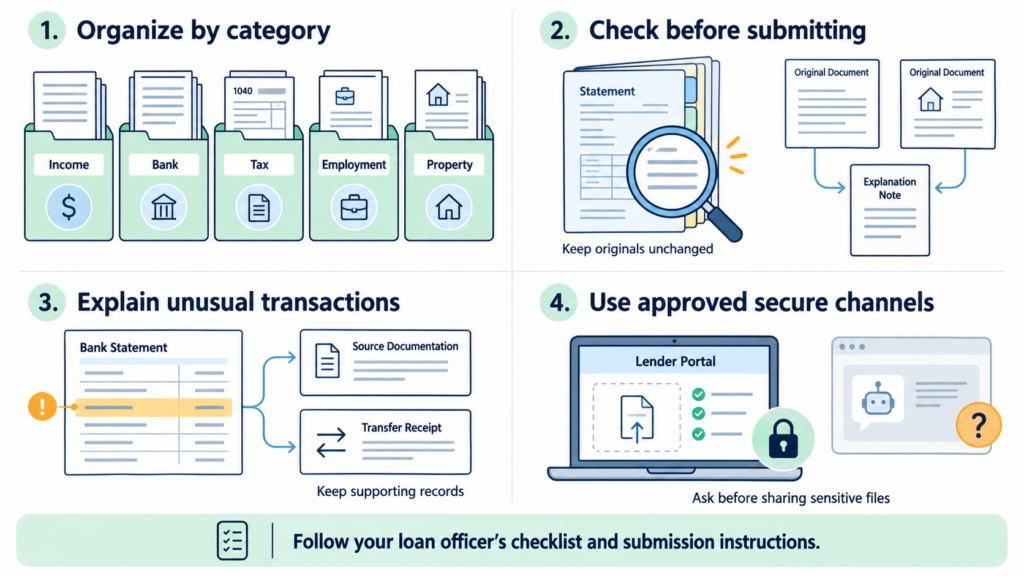
Organize documents by category
Keep income records, bank statements, tax returns, employment documents, and property-related paperwork organized in clearly labeled files.
Use the document checklist provided by your loan officer. Requirements vary depending on your income type, assets, loan program, and application.
Check for missing pages and inconsistent information
Before submitting a statement or tax return, confirm that the document includes the pages requested and is readable.
If your name, address, employer, account information, or other details differ across documents, do not alter the original records to make them match. Explain the difference and provide supporting documentation when requested.
Explain unusual transactions before they become a problem
Large deposits, transfers between accounts, business expenses, and other unusual entries may require clarification depending on the source and the loan program.
Keep relevant records available so you can explain where the funds came from and provide evidence if the lender requests it.
Ask before uploading sensitive documents to another tool
If you want to use AI to organize your own paperwork, avoid uploading unredacted tax returns, bank statements, or identification documents to an unapproved service.
Your lender should tell you which documents are needed and how to submit them securely. An external AI summary should not be treated as a substitute for the lender’s document requirements or underwriting review.
Section 11
Does AI Make the Mortgage Process Faster?
AI-assisted document processing can reduce certain manual tasks, such as sorting files and extracting information. This may help a lender identify missing records or review a file more efficiently.
However, it does not guarantee that an application will be approved faster or close on schedule. The overall timeline also depends on the completeness of the application, the responsiveness of the borrower and third parties, property-related requirements, and the time needed to resolve underwriting conditions.
A well-organized application can help regardless of whether the lender uses AI. Complete documents, timely responses, and clear explanations remain important throughout the process.
Section 12
Estimate Your Mortgage Payment While Preparing Your Documents
Document review is only one part of preparing to buy a home. You should also understand the payment range that fits your budget before moving too far into the application process.
Use the Wonder Rates Mortgage Payment Calculator to estimate your monthly principal and interest payment, along with property taxes, homeowners insurance, and other applicable costs when the necessary inputs are available.
Try different home prices, down payment amounts, and interest rate assumptions to compare possible scenarios. The result is an estimate, not a loan approval or a guarantee of the rate you will receive.
If you are preparing to purchase a home, explore the Wonder Rates homebuying page to review your next steps. You can also connect with Wonder Rates to discuss your situation with a mortgage professional.
Section 13
The Bottom Line: AI Can Process Documents, but Context Still Matters
AI-assisted mortgage document review can help lenders organize records, extract financial information, and flag potential discrepancies. These capabilities can make parts of the mortgage process more efficient.
But extracting a number is not the same as determining whether it qualifies under a mortgage program. A document summary does not automatically resolve unusual income, explain a large deposit, determine the appropriate loan program, or establish that an application meets all underwriting requirements.
For borrowers, the best approach is to prepare accurate documents, use secure submission channels, and ask questions when something is unclear. Understand what the technology is being used for, but do not assume that an automated review guarantees accuracy, approval, or a faster closing.
Technology can support the process. The quality of the documentation, the applicable lending requirements, and the review of the complete application still matter.
Section 14
Disclaimer
This article is provided for general educational and informational purposes only. It is not financial, legal, tax, cybersecurity, or mortgage lending advice. AI tools, document review procedures, privacy practices, underwriting requirements, and loan eligibility vary by lender, technology provider, loan program, and borrower circumstances. Examples are hypothetical and do not represent an actual borrower, a guaranteed underwriting outcome, or a loan approval. Consult a licensed mortgage professional about your specific situation and review the applicable privacy terms before submitting sensitive financial documents to any technology platform.
Duc Pham, Mortgage Broker | NMLS# 844897, Wonder Rates, Inc. | NMLS# 1518655 | DRE# 02047445 | DFPI# 60DBO-59134 | Equal Housing Opportunity. Equal Housing Lender. | Licensed in: AL, AZ, CA, CO, FL, GA, LA, MI, NC, OH, OK, OR, PA, SC, TX, VA, WA.