
Section 01
An adjustable-rate mortgage (ARM) can offer a lower initial rate than a fixed-rate mortgage, which may help some rental property investors manage early cash flow. However, the payment can change after the introductory period ends.
For investors, the key question is not only how much the property saves today, but whether the deal remains financially sustainable if the rate adjusts later.
Here are five things to understand before choosing an ARM for a rental property.
Section 02
1. How an ARM Loan Works for Rental Properties
An adjustable-rate mortgage has two distinct phases: a fixed period and an adjustable period.
During the initial fixed period, your interest rate stays the same. A 5/1 ARM has a fixed rate for the first five years. A 7/1 ARM fixes the rate for seven years. A 10/1 ARM fixes for ten years.
After the fixed period ends, the rate adjusts based on a benchmark index plus a margin set in your loan agreement. Many ARMs use an index such as the Secured Overnight Financing Rate (SOFR), although the specific index depends on the loan program and terms.
Two caps limit how much the rate can move: a periodic cap that limits the adjustment at each reset, and a lifetime cap that limits how far above the original rate the loan can ever go. A common cap structure is 2/2/5, meaning the rate can adjust by no more than 2% at the first reset, 2% at each subsequent reset, and no more than 5% above the original rate over the life of the loan.
These caps limit how quickly your rate can increase, but they do not prevent your payment from rising when the loan adjusts.
| ARM Type | Fixed Period | First Adjustment | Why an Investor May Consider It |
|---|---|---|---|
| 5/1 ARM | 5 years | Year 6 | Planned sale or refinance within the fixed period |
| 7/1 ARM | 7 years | Year 8 | More time before the first adjustment |
| 10/1 ARM | 10 years | Year 11 | Longer fixed-rate period before adjustment risk begins |
ARM structures vary by lender and loan program. Adjustment frequency and index used depend on specific loan terms.
Section 03
2. ARM Rental Property Loans: Lower Initial Rates Come With Risk
Depending on market conditions and lender programs, a 5/1 or 7/1 ARM may have a lower initial rate than a comparable 30-year fixed mortgage. The difference varies by borrower profile and loan terms.
For illustration purposes only, a lower initial ARM rate may reduce monthly principal and interest payments compared with a higher-rate fixed mortgage. The actual difference depends on factors such as the loan amount, interest rate, loan term, and borrower qualifications.
While this lower initial payment may improve short-term cash flow, investors should also evaluate whether the property can continue supporting the mortgage if the rate adjusts later.
When the fixed period ends, the new rate depends on the index, margin, and adjustment limits outlined in the loan terms. If market rates are higher at the time of adjustment, the borrower’s payment may increase.
For a rental property, a rate increase directly compresses cash flow. The property’s rental income does not adjust upward automatically because the mortgage payment went up.
Section 04
3. Stress-Test Rental Cash Flow Before Choosing an ARM
This is one of the most important steps when evaluating an ARM for a rental property.
A common mistake is evaluating a rental property only at the initial ARM rate and assuming the cash flow will remain the same after the adjustment period. Investors should also stress-test the property under different rate scenarios to understand how higher payments could affect overall returns.
For example, assume an investor takes out a $400,000 30-year ARM loan with an initial fixed rate of 6.0%.
During the initial period, the monthly principal and interest (P&I) payment would be approximately $2,398 per month. After five years, the remaining loan balance would be about $372,217.
Now assume the ARM reaches its first adjustment period and the rate increases by 2.0 percentage points, moving from 6.0% to 8.0% based on the loan’s adjustment cap structure.
At the new rate, the monthly principal and interest payment would increase to approximately $2,873 per month.
That is an increase of about $475 per month, or approximately $5,700 more per year in mortgage payments.
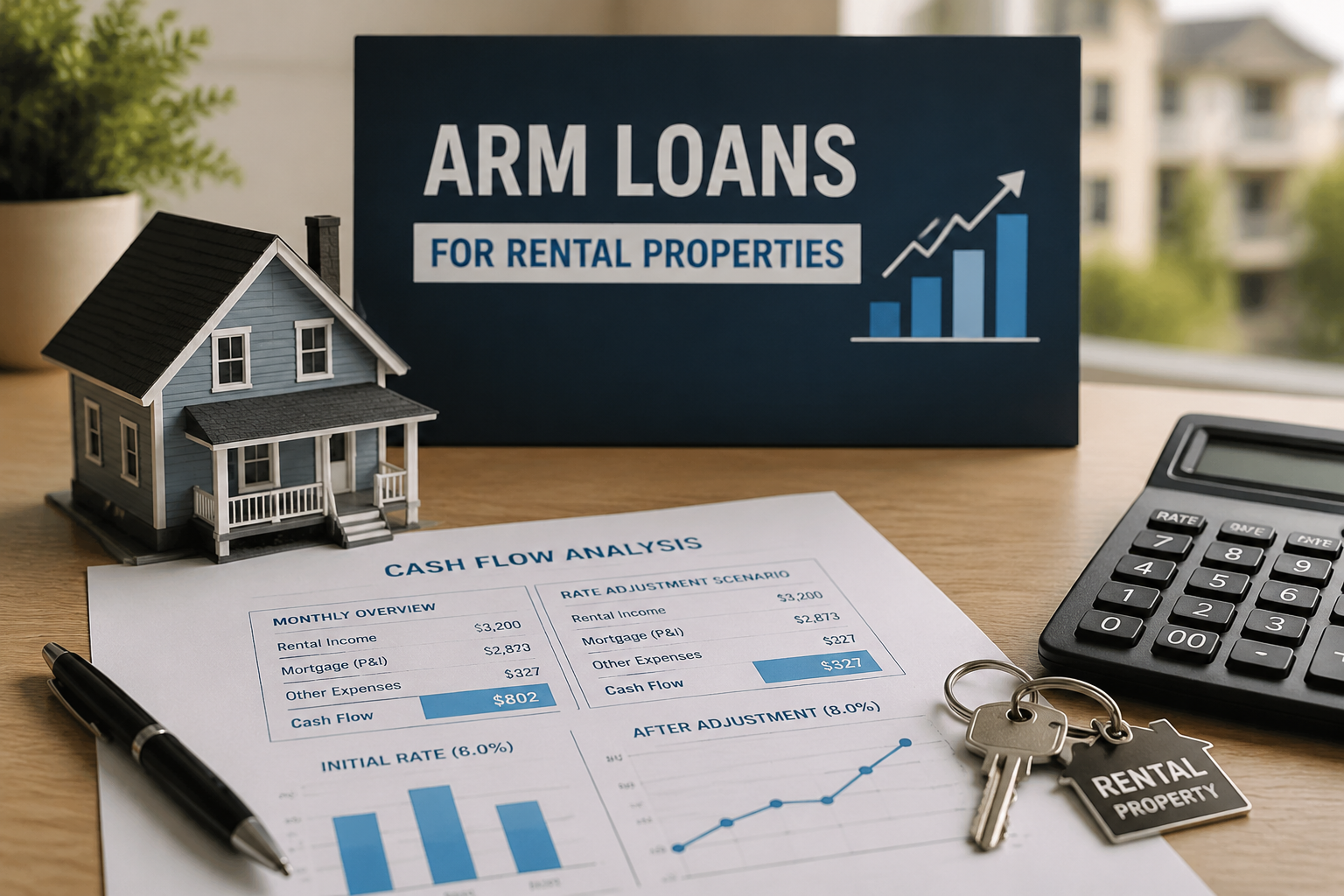
If the rental property generates $3,200 per month in rental income, the initial cash flow before other expenses may look like this:
| Scenario | Monthly Rental Income | Monthly P&I Payment | Remaining Before Other Expenses |
|---|---|---|---|
| Initial ARM rate at 6.0% | $3,200 | $2,398 | $802 |
| After adjustment to 8.0% | $3,200 | $2,873 | $327 |
This example does not include expenses such as property taxes, insurance, maintenance, vacancy, or property management. After accounting for those costs, the property’s cash flow could become significantly tighter.
A property that works at the initial ARM rate may produce weaker cash flow after an adjustment. Investors should evaluate whether the rental income can support higher mortgage payments, along with expenses such as property taxes, insurance, maintenance, vacancy, and property management.
The goal is not to predict exactly where rates will move in the future. Instead, investors should understand how different rate scenarios could affect the property’s overall financial performance.
| Scenario | What Investors Should Consider |
|---|---|
| Initial fixed period | A lower starting payment may improve short-term cash flow |
| First adjustment | Mortgage payments may increase depending on the index, margin, and loan terms |
| Higher-rate environment | Rental income may not increase at the same pace as mortgage costs |
| Long-term ownership | Investors should evaluate whether the property remains sustainable under changing conditions |
Before choosing an ARM on any rental property, run these numbers under different rate scenarios and make sure the property can still support the higher payment if the loan adjusts.
Section 05
4. ARM Loans Make More Sense in Specific Investor Scenarios
Despite the risks, ARM loans may fit certain rental property strategies, especially when investors have a clear timeline and exit plan.
For example, an investor who plans to sell or refinance before the fixed period ends may benefit from the initial fixed-rate period without reaching the adjustment phase. An investor who plans to renovate, stabilize, and refinance a property within the initial fixed period may consider an ARM depending on the financing strategy.
An ARM may also be worth considering when investors expect market conditions to change during the fixed period. Borrowers can use the initial rate structure and later evaluate whether refinancing into a fixed-rate loan makes sense based on their goals and available options.
For long-term rentals, an ARM may provide more flexibility when the property’s cash flow can support potential payment increases after adjustment.
| ARM May Fit When | ARM May Carry More Risk When |
|---|---|
| Planned hold period is shorter than the fixed period | You plan to hold indefinitely |
| Cash flow remains positive under higher-rate scenarios | The deal only works at the initial rate |
| A realistic sale or refinance strategy exists | There is no clear exit strategy |
| You have adequate cash reserves | A payment increase would create financial stress |
| You understand the adjustment terms | You are relying on rates falling later |
Section 06
5. DSCR Loans vs ARM Loans for Rental Properties
For investors financing rental properties, the conversation about ARM vs fixed rate often focuses on the monthly payment. But another option worth understanding is a DSCR loan.
While ARM loans focus on the loan structure and potential payment changes, DSCR loans focus more on the property’s rental income performance. The right choice depends on your investment strategy, cash flow, and financing goals.
| Feature | ARM Loan | DSCR Loan |
|---|---|---|
| Primary focus | Loan structure, rate adjustments, and borrower qualifications | Property cash flow and rental income |
| Payment structure | May adjust after the initial fixed period | Often available as fixed-rate options |
| Best fit | Investors comfortable with potential rate changes | Investors focused on rental income qualification |
| Main consideration | Future payment changes | Property cash flow performance |
Many DSCR loans are available as fixed-rate products. While the initial rate may be higher than an ARM, a fixed-rate DSCR loan can provide more stable payments and may allow qualification based primarily on the property’s rental income rather than personal income, depending on the program.
Whether that trade-off makes sense depends on your credit profile, the property’s projected cash flow, and how long you plan to hold.
Section 07
Frequently Asked Questions
What happens if I cannot afford the payment after the ARM adjusts?
If your ARM payment becomes unaffordable, common options include refinancing, selling the property, or requesting a loan modification in certain hardship situations. Refinancing requires you to qualify based on your credit, income, and property value at that time. The best protection is making sure your rental property has enough cash flow cushion before the adjustment period begins.
Is a 7/1 ARM significantly safer than a 5/1 ARM for a rental property?
A 7/1 ARM gives you two additional years before the first adjustment, which may help if you plan to sell or refinance during that period. However, the better choice depends on your investment timeline, expected hold period, and future market conditions.
Can I refinance out of an ARM before the fixed period ends?
Yes, you may be able to refinance before the fixed period ends, depending on your loan terms and qualifications. Keep in mind that refinancing involves closing costs and requires you to qualify again. Whether it makes sense depends on your new rate, costs, and how long you plan to keep the property.
Section 08
Final Thoughts
Next Step
If you are evaluating a rental property and trying to decide whether an ARM, a fixed-rate conventional loan, or a DSCR product fits the deal best, that is a conversation worth having before you make the offer.
Send Duc Pham or the Wonder Rates team a message before choosing a financing strategy. We can help you compare ARM, fixed-rate, and DSCR options based on your rental property goals and loan scenario.
Disclaimer: All examples, rate scenarios, and cash flow illustrations are for educational purposes only. Actual loan terms, rates, adjustment periods, and qualification requirements vary by lender, loan program, and borrower circumstances. Rental property performance depends on market conditions, expenses, vacancy, and other factors. Consult your loan officer to evaluate options based on your specific situation.
Duc Pham, Mortgage Broker | NMLS# 844897 | Wonder Rates, Inc. | NMLS# 1518655 | DRE# 02047445 | DFPI# 60DBO-59134 | Equal Housing Opportunity. Equal Housing Lender. | Licensed in: AL, AZ, CA, CO, FL, GA, LA, MI, NC, OH, OK, OR, PA, SC, TX, VA, WA.