Section 01
Can I Buy a House With Bad Credit? Most people assume bad credit means no mortgage.
That assumption stops a lot of people from even asking the question. They check their score and quickly say no. Then, they wait years to feel “ready,” even though they might have been closer than they realized.
The reality is more nuanced. Bad credit makes buying harder and more expensive, but it does not automatically make it impossible. The answer depends on how low your score actually is, what caused it, and which loan program you are looking at.
Here is what you actually need to know.
Section 02
What Is Considered Bad Credit for a Mortgage?
For mortgage purposes, “bad credit” is not a single number.
A 620 credit score and a 520 credit score are both considered “bad credit.” However, they can lead to different mortgage options and costs.
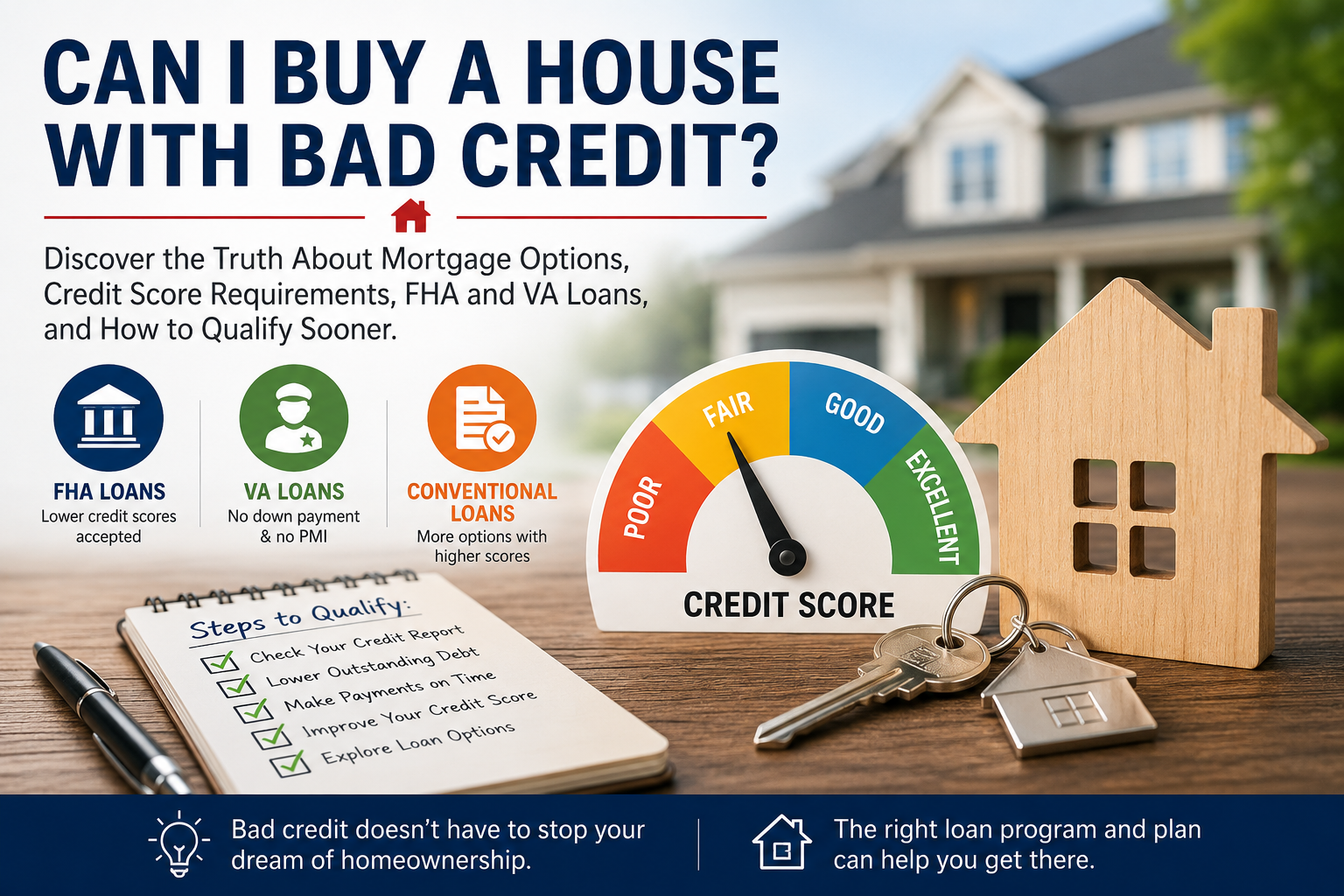
Lenders generally use FICO scores, which range from 300 to 850, to evaluate risk. Where your score falls can affect the loan programs available to you, your interest rate, and how much money you may need upfront.
Here is how lenders typically view different credit score ranges:
| Credit Score Range | How Lenders Typically View It | Potential Loan Options* |
|---|---|---|
| 740 and above | Excellent | All major loan programs, best pricing |
| 700 to 739 | Good | All major loan programs, competitive pricing |
| 660 to 699 | Fair | Conventional, FHA, VA |
| 620 to 659 | Below average | FHA, VA, limited conventional options |
| 580 to 619 | Poor | FHA with 3.5% down, VA |
| 500 to 579 | Very poor | FHA with 10% down, limited options |
| Below 500 | Very difficult | Focus on rebuilding credit first |
Loan availability varies by lender and loan program. Individual lenders may have stricter requirements, known as lender overlays, and meeting a credit score threshold does not guarantee approval.
The important thing to understand is that bad credit is a range, not a yes-or-no answer.
That is why two people who both believe they have “bad credit” can end up with very different mortgage options. Understanding where your score falls is often the first step toward building a realistic homebuying plan.
Section 03
FHA Loans: The Most Common Path for Lower Credit Scores
FHA loans are often the most common option for buyers with lower credit scores.
The minimum credit score for an FHA loan is 580 with a 3.5% down payment. Buyers with scores between 500 and 579 may still qualify, but the required down payment increases to 10%.
FHA loans need mortgage insurance. This adds to your monthly payment and raises your total borrowing cost. It is important to factor that into your budget before choosing this program.
Section 04
VA Loans: The Best Option If You Qualify
If you are a veteran, active duty service member, or eligible surviving spouse, VA loans are worth exploring before anything else.
VA loans have no official minimum credit score set by the VA itself, though many lenders prefer to see scores between 580 and 620 or higher. They also require no down payment in most cases and no private mortgage insurance.
The combination of no down payment and no PMI can make VA loans significantly more affordable than FHA for eligible buyers.
Section 05
Can You Get a Mortgage With Bad Credit and No Money Down?
Possibly, but your options are limited.
For most buyers, lower credit scores and no down payment do not usually go together. Many loan programs that accept lower credit scores still require at least some money upfront.
The biggest exception is the VA loan.
If you’re a qualified veteran, active duty member, or surviving spouse, a VA loan can help you buy a home with no down payment. This is true even if your credit isn’t perfect. The VA does not set a minimum credit score, although many lenders prefer to see scores between 580 and 620 or higher.
Another option is a USDA loan. USDA loans also offer 100% financing in eligible rural areas. However, lenders typically look for stronger credit profiles, often around a 640 credit score, and borrowers must meet income and property eligibility requirements.
If you do not qualify for VA or USDA financing, most buyers with lower credit scores will likely need some form of down payment. FHA loans, for example, require at least 3.5% down with a 580 credit score and 10% down for scores between 500 and 579.
The important takeaway is this: having bad credit does not automatically mean you need a large down payment, and having little money saved does not automatically mean homeownership is out of reach. The right answer depends on your credit profile, your income, and which loan programs you may qualify for.
That is why it can be helpful to review your full financial picture before assuming that buying a home is impossible.
Section 06
Conventional Loans: Harder to Access, But Worth Understanding
Conventional loans typically require a minimum score of 620. Below that threshold, conventional financing is generally not available.
Above 620, conventional loans become an option, but pricing is heavily influenced by credit score.
| Credit Score | Estimated Rate Impact | Monthly Payment Difference on $300K Loan |
|---|---|---|
| 740 and above | Best available pricing | Baseline |
| 700 to 739 | Slightly higher | +$30 to $60/mo |
| 660 to 699 | Moderately higher | +$80 to $130/mo |
| 620 to 659 | Noticeably higher | +$150 to $220/mo |
Rate differences are illustrative only and vary based on market conditions, lender, loan program, down payment, and other factors. These figures do not represent an offer of credit.
For many buyers, improving a credit score by even 20 to 40 points can make a meaningful difference in monthly payment and total borrowing costs.
Section 07
When Buying Now Makes Sense Despite a Lower Score
Waiting to improve your credit is not always the right call.
If your score is in the 580 to 620 range and you have found a home you can comfortably afford, the higher rate you pay now may be refinanced later if your score improves and rates cooperate. You also begin building equity immediately rather than continuing to rent.
Whether buying now makes sense depends on how quickly your score could improve, the cost of waiting, and how home prices in your market may change.
There is no universal right answer. The important thing is to run the numbers instead of assuming waiting is always better.
Section 08
When Waiting to Improve Your Credit Makes More Sense
If your score is below 580, your options narrow significantly.
FHA with a 10% down payment may still be possible, but the combination of a larger down payment, higher rates, and mortgage insurance can make the monthly payment difficult to sustain.
In that range, spending six to twelve months improving your credit could open the door to better loan options and lower costs.
The key is having a specific plan and a defined timeline rather than waiting indefinitely.
Section 09
Frequently Asked Questions
Will applying for a mortgage hurt my credit score if I get denied?
A mortgage application results in a hard inquiry that usually lowers your score by a few points temporarily. A denial itself does not create an additional negative mark beyond that inquiry.
Talking to a loan officer before formally applying can help you understand your options and avoid unnecessary applications.
Can I buy a house with a 500 credit score?
Technically, yes. FHA loans may allow scores as low as 500 with a 10% down payment.
However, many lenders set their own minimum requirements above the FHA floor, often at 580 or higher. If your score is in this range, understanding what is holding it down and how long it may take to improve can be more valuable than immediately searching for a lender.
Does paying off old collections improve my score enough to qualify?
It depends.
Some collections may help your score when paid off, while others may have little impact. Before paying old collection accounts, speak with a loan officer or credit professional who can review your specific situation.
Section 10
Final Thoughts
If bad credit is the reason you’ve put homeownership on hold, don’t assume the answer is no.
A conversation with Duc Pham and the Wonder Rates can help you understand where you stand today, what options may be available, and what steps could move you closer to buying a home.
Sometimes the answer is, “You’re ready sooner than you think.”
And sometimes the answer is, “Here’s the plan to get there.”
Either way, you’ll walk away with clarity and a path forward.
Duc Pham, Mortgage Broker | NMLS# 844897 + Wonder Rates, Inc. | NMLS# 1518655 | DRE# 02047445 | DFPI# 60DBO-59134 | Equal Housing Opportunity. Equal Housing Lender. | Licensed in: AL, AZ, CA, CO, FL, GA, LA, MI, NC, OH, OK, OR, PA, SC, TX, VA, WA.