

Section 01
Cash reserves are the liquid funds you have left over after closing, money that is not spent on your down payment or closing costs, but that remains available to cover your mortgage payment and other expenses if something unexpected happens.
Many buyers assume that once they have saved enough for a down payment, they are financially ready to buy. But lenders often look at a separate question: after this transaction closes, does the borrower still have a financial cushion?
Cash reserves matter most for certain borrowers and certain loan scenarios, such as jumbo loans, investment properties, self-employed applicants, or files with other compensating factors involved. Understanding what reserves are, how they are calculated, and which assets qualify can help you prepare more confidently before you apply.
Section 02
What Are Cash Reserves?
Cash reserves are liquid or near-liquid assets that remain available to you after your down payment and closing costs have been paid. They are not spent at closing. Instead, they are verified as available, on hand, in case they are needed later.
| What It’s For | When It’s Used | |
|---|---|---|
| Down Payment | Goes toward the home’s purchase price | Paid at closing |
| Closing Costs | Covers transaction-related fees and services | Paid at or before closing |
| Cash Reserves | Demonstrates financial cushion after closing | Not spent, simply verified as available |
Section 03
Why Do Mortgage Lenders Care About Cash Reserves?
Lenders evaluate cash reserves as part of assessing overall risk. Reserves can speak to:
- Financial stability. A borrower with reserves has a documented cushion beyond just qualifying income.
- Ability to weather job loss or income disruption. Reserves provide time to adjust if income temporarily stops or changes.
- Capacity to absorb unexpected expenses, such as a major home repair, without missing a mortgage payment.
- Lower perceived default risk. All else being equal, a borrower with more available liquidity may represent less risk to a lender or investor.
Illustrative example: Consider two borrowers applying for similar loans with similar income and credit profiles. One has no funds remaining after closing beyond the down payment and closing costs. The other has several months of their housing payment available in savings after closing. The second borrower’s reserves may be viewed as a compensating factor in underwriting, though reserves are only one part of a full financial review and do not by themselves determine approval.
Section 04
How Mortgage Cash Reserves Are Measured
Reserves are typically measured in terms of your monthly housing payment, expressed as a multiple of months.
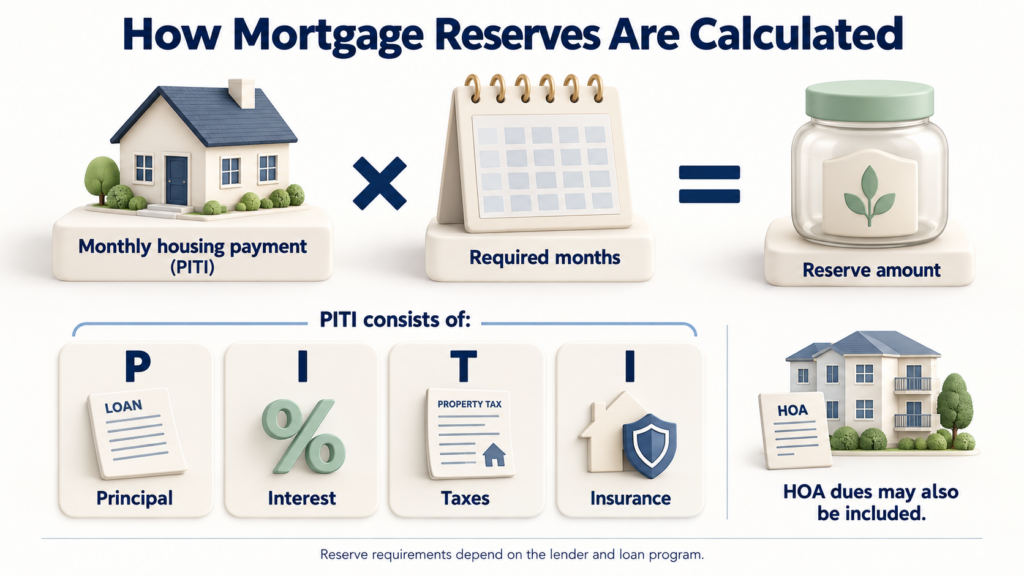
Reserve amount = Monthly housing payment (PITI) × Number of required months
PITI refers to the components of your monthly housing payment:
| Letter | Component |
|---|---|
| P | Principal |
| I | Interest |
| T | Taxes |
| I | Insurance |
If you want a more detailed breakdown of what goes into your monthly housing payment, see our guide to PITI: Principal, Interest, Taxes, and Insurance.
If the property has HOA dues, many lenders include those in the housing payment used to calculate reserves as well.
Section 05
Example: Calculating Cash Reserves
Illustrative example 1: Standard primary residence
Monthly housing payment (PITI): $2,400
Reserve requirement: 6 months
$2,400 × 6 = $14,400
If you are still estimating your monthly housing payment, the Wonder Rates Mortgage Payment Calculator can help you estimate the payment you’ll use when planning for potential reserve requirements.
Illustrative example 2: Luxury or jumbo home
Monthly housing payment (PITI): $4,500
Reserve requirement: 12 months
$4,500 × 12 = $54,000
Illustrative example 3: Investment property
Monthly housing payment (PITI): $2,900
Reserve requirement: 12 months
$2,900 × 12 = $34,800
Actual reserve requirements depend on the loan program, lender, automated underwriting findings, property type, and the borrower’s full financial profile.
Section 06
Which Assets Count as Cash Reserves?
| Asset | Generally Counts? | Notes |
|---|---|---|
| Checking accounts | Yes | Must be verified and sourced |
| Savings accounts | Yes | Must be verified and sourced |
| Money market accounts | Yes | Treated similarly to savings |
| Certificates of deposit (CDs) | Often, with conditions | Early withdrawal terms may apply |
| Stocks | Often, with a haircut | Lenders may count a percentage of value due to market volatility |
| Bonds | Often, with a haircut | Similar treatment to stocks |
| 401(k) | Often, partially | Lenders typically count only a portion of the vested balance |
| IRA | Often, partially | Similar treatment to 401(k), subject to lender guidelines |
| Brokerage accounts | Often, with a haircut | Documentation of ownership and value required |
| Trust accounts | Sometimes | Access and terms of the trust matter |
| Gift funds | Sometimes, with conditions | Often must be documented and, in many cases, cannot be counted the same as the borrower’s own seasoned funds |
| Cash value life insurance | Sometimes | Only the accessible cash value may count, subject to lender review |
| Cryptocurrency | Varies by lender | Not all lenders accept it, and requirements to convert and season funds may apply |
| Business accounts | Sometimes, with conditions | May require additional documentation to confirm funds are not needed for business operations |
Exact treatment of each asset type depends on the specific lender, loan program, and investor guidelines, so confirming with a licensed mortgage professional is recommended.
Section 07
What Does NOT Count?
The following are generally not accepted as cash reserves:
- Furniture
- Vehicles
- Jewelry
- Home equity in a property you currently own
- Cash borrowed from a credit card
- Undocumented or unsourced cash
Section 08
How Many Months of Cash Reserves Do You Need?
Reserve requirements vary widely. Some borrowers are approved with no formal reserve requirement at all, while others, particularly on larger or higher-risk loans, may be asked to document a year or more of reserves.
| Loan Type / Scenario | General Reserve Tendency | Why It May Matter |
|---|---|---|
| Conventional (primary residence) | Often two months or fewer, and sometimes none, depending on credit, down payment, and automated underwriting findings | Strong credit and stable income may reduce reserve needs |
| FHA | Generally no mandatory reserve requirement for 1 to 2 unit properties; 3 to 4 unit properties often require reserves | — |
| VA | Generally no mandatory reserve requirement for 1 to 2 unit properties; multi-unit or rental-income scenarios often require reserves | — |
| USDA | Reserve expectations vary by lender and file; USDA does not publish a single universal reserve rule for all borrowers | — |
| First-time homebuyer with W-2 income | Often none to a few months, depending on the loan and underwriting findings | Strong credit and stable income may reduce reserve needs |
| Self-employed borrower | Often higher than a comparable W-2 file | Income may fluctuate from month to month or season to season |
| Jumbo | Often six to twelve months or more, depending on loan size and lender overlays | Larger loan amounts generally carry stricter underwriting |
| Investment property | Often six months or more per financed property, and sometimes more depending on the lender | Rental properties increase overall financial risk |
| Multiple financed homes | Higher reserve requirements may apply | More properties can increase a lender’s risk exposure |
| Second home | Often at least a couple of months, with specifics varying by lender | — |
| Non-QM | Often higher than conventional financing | Reflects the nature of these programs |
If you’re considering a jumbo loan, our guide to Mortgage Requirements for Jumbo Loans explains how assets, reserves, income, credit, and other factors can affect qualification.
These figures describe general tendencies in the industry, not fixed rules. Reserve requirements are ultimately based on automated underwriting system findings and specific investor or lender guidelines, so not every borrower needs the same amount. Your actual requirement will be disclosed as part of your specific loan file.
Section 09
When Are Cash Reserves Usually Required?
Reserves are more likely to come up as a specific requirement in scenarios such as:
- Jumbo loans
- Investment property financing
- Owning multiple financed properties
- Lower credit scores
- Higher debt-to-income ratios
- Self-employment income
- Non-QM loan programs
- Larger loan amounts generally
Section 10
Cash Reserves vs. Emergency Fund
These two concepts are related but not identical.
| Cash Reserves | Emergency Fund | |
|---|---|---|
| Purpose | Demonstrate post-closing financial cushion to a lender | Personal safety net for unexpected life expenses |
| Who requires it | Set or reviewed by the lender or loan program | Set by you, based on your own financial planning |
| When it’s used | Verified during underwriting, may or may not be required to remain untouched | Used as needed for real-life emergencies |
Many financial professionals recommend maintaining an emergency fund regardless of what a specific loan program requires in reserves, since your own financial security needs may extend beyond a lender’s minimum guidelines.
Section 11
Can Retirement Accounts Count as Cash Reserves?
In many cases, yes, though typically only in part.
Lenders generally look at the vested balance of a 401(k) or IRA, meaning the portion that is actually yours to access, rather than the full account balance. Because withdrawing from these accounts before retirement age can trigger taxes and penalties, lenders commonly apply a discount, often counting a percentage of the vested balance rather than its full face value.
Illustrative example: A borrower has a vested 401(k) balance of $40,000. If a lender counts a portion of that balance toward reserves to account for potential taxes and early withdrawal penalties, the amount actually credited toward reserves would be lower than $40,000. The specific percentage a lender applies, if any, depends on that lender’s guidelines and the specific loan program, and should be confirmed directly with your mortgage professional.
Section 12
Can Stocks and Investments Count?
Brokerage accounts, mutual funds, and ETFs can often count toward reserves, but usually with adjustments to account for market fluctuation.
Because the value of these assets can change day to day, lenders may apply a percentage reduction rather than counting full market value. Documentation requirements typically apply, and large, recent, or unexplained deposits into these accounts may require additional documentation to source the funds.
Section 13
Cash Reserves for Self-Employed Borrowers
Underwriters often pay closer attention to reserves for self-employed applicants because:
- Income can vary from month to month or season to season
- Business cycles can affect short-term cash flow
- Liquidity outside the business matters, since business funds may not always be readily available for personal use
- Certain programs, such as bank statement loans, are specifically designed around self-employed income documentation and may carry their own reserve expectations
Illustrative example: A self-employed borrower with seasonal income may be asked to document more reserves than a W-2 borrower with a similar loan amount, to help demonstrate the ability to manage the mortgage payment during slower income periods. Actual requirements depend on the specific lender, loan program, and the borrower’s documented financial profile.
Section 14
Cash Reserves for Investment Properties
Reserve requirements are often higher for investment properties because rental properties carry additional financial risk. If a tenant moves out, a property needs repairs, or rental income is temporarily disrupted, the borrower still needs to be able to cover that property’s payment.
Illustrative example: A borrower who already owns two financed rental properties and is purchasing a third may be required to show reserves not only for the new property, but potentially for their other financed properties as well, depending on the lender and loan program.
Section 15
What If You Don't Have Enough Cash Reserves?
If reserves are a challenge for your specific file, some borrowers explore options such as:
- Delaying the purchase to build additional savings
- Reducing the loan amount
- Choosing a different loan program with different reserve expectations
- Working to improve credit
- Working to reduce debt-to-income ratio
- Reviewing which of your existing liquid assets may qualify as reserves
- Working with a mortgage broker who has access to multiple lenders and loan programs
These are general options to discuss with a licensed mortgage professional, not a guarantee that any specific option will result in approval.
Section 16
Tips to Build Cash Reserves Before Applying
- Automate regular savings contributions
- Reduce discretionary spending where possible
- Avoid unnecessary large purchases in the months before applying
- Keep funds seasoned, meaning held in your account for a documented period of time
- Avoid large, unexplained deposits that may require additional documentation
- Maintain a separate emergency savings cushion alongside any reserves earmarked for your mortgage application
Section 17
Frequently Asked Questions
Do all mortgages require reserves? No. Many loans, particularly certain conventional and government-backed loans on primary residences, may require little to no formal reserves, depending on the borrower’s profile and underwriting findings.
Can gift funds count? Sometimes, though gift funds are often treated differently than a borrower’s own seasoned funds, and specific documentation requirements typically apply.
Do retirement accounts count? Often, yes, though usually only a portion of the vested balance, since lenders commonly apply a discount to account for taxes and potential early withdrawal penalties.
How are reserves calculated? Reserves are generally calculated by multiplying your monthly housing payment (PITI) by the number of months required for your specific loan program and lender.
Can reserves replace a down payment? No. Reserves and a down payment serve different purposes. A down payment goes toward the purchase of the home, while reserves must remain available after closing.
Section 18
Final Thoughts
Cash reserves don’t necessarily determine whether you qualify for a mortgage, but they can strengthen your application, especially for certain loan programs or borrowers with more complex financial profiles.
Understanding how reserves are calculated and which assets qualify can help you prepare more confidently before applying.
If you want to understand how reserve requirements may apply to your specific loan scenario, you can talk with a licensed mortgage professional.
Section 19
Sources
- Federal Housing Finance Agency (FHFA), conforming loan guidance
- Fannie Mae Selling Guide, reserve requirements and eligible assets
- Freddie Mac Seller/Servicer Guide, reserve calculations
- Consumer Financial Protection Bureau (CFPB), mortgage application guidance
- U.S. Department of Housing and Urban Development (HUD), FHA program guidance
- U.S. Department of Veterans Affairs (VA), VA loan underwriting guidance
- U.S. Department of Agriculture (USDA), Single Family Housing Guaranteed Loan Program
This article is provided for educational purposes only. Mortgage reserve requirements vary by loan program, lender, investor guidelines, automated underwriting results, and individual borrower circumstances. The examples shown throughout this article are illustrative and hypothetical, and should not be interpreted as minimum qualification standards, guaranteed outcomes, or approval requirements.
Wonder Rates, Inc. (NMLS #1518655) is an Equal Housing Lender. Loan approval is subject to credit review, underwriting, property eligibility, and applicable lending guidelines. Mortgage programs, reserve requirements, interest rates, fees, and eligibility criteria may change without notice. This content does not constitute financial, tax, or legal advice. Borrowers should consult with a licensed mortgage professional regarding their specific situation.
Duc Pham, Mortgage Broker | NMLS# 844897, Wonder Rates, Inc. | NMLS# 1518655 | DRE# 02047445 | DFPI# 60DBO-59134 | Equal Housing Opportunity. Equal Housing Lender. | Licensed in: AL, AZ, CA, CO, FL, GA, LA, MI, NC, OH, OK, OR, PA, SC, TX, VA, WA.