Section 01
Buying a home involves more than just the purchase price and your down payment.
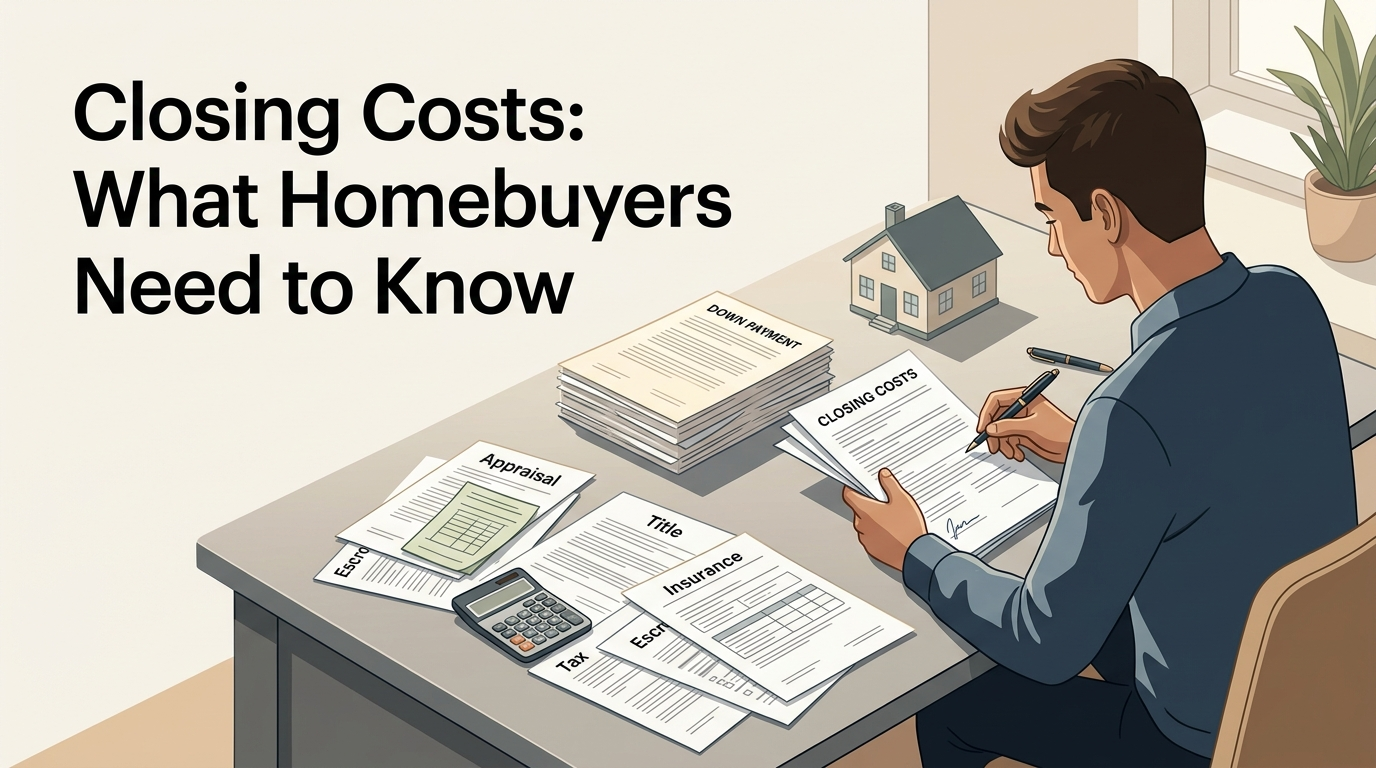
One expense that often surprises first-time homebuyers is closing costs. Many buyers spend months saving for a down payment, only to realize there are additional costs due before they can receive the keys.
The good news is that closing costs aren’t “hidden fees.” They are simply a collection of legitimate expenses associated with finalizing a real estate transaction.
Understanding what they are, and planning for them early, can help you avoid surprises as you move toward closing day.
Section 02
What Are Closing Costs?
Definition
Closing costs are the fees and expenses associated with completing a real estate transaction. They are typically paid at or before closing and are separate from your down payment.
Why Do Closing Costs Exist?
Several professionals and organizations are involved in getting a home purchase across the finish line, and each provides a service that supports a safe, legally sound transaction. This commonly includes:
- The lender, who underwrites and funds the loan
- The title company, which verifies ownership and issues title insurance
- The escrow company, which manages funds and documents through closing
- The county recording office, which formally records the transaction
- The appraiser, who provides an independent valuation of the property
- An attorney, where applicable by state or transaction type
Closing costs represent payment for these services, not random or arbitrary charges.
Section 03
Closing Costs vs. Down Payment
| Down Payment | Closing Costs |
|---|---|
| Builds home equity | Pays transaction expenses |
| Goes toward the home’s purchase price | Covers services and legal processing |
| Usually expressed as a percentage of purchase price | Varies depending on the transaction |
| Part of your financing strategy | Part of your transaction costs |
Many first-time buyers focus only on saving for the down payment and forget that closing costs are a separate expense that also needs to be planned for.
Section 04
What's Typically Included in Closing Costs?
Loan Origination Fees
Fees charged by the lender for processing and underwriting your loan application.
Home Appraisal
An appraisal provides an independent estimate of the home’s value. Lenders generally require one to confirm the property supports the loan amount.
Credit Report
Lenders pull a credit report as part of evaluating your application, and this pull is typically billed as part of your closing costs.
Title Search
A title search reviews public records to confirm the seller has clear ownership and to identify any liens or claims against the property.
Title Insurance
Title insurance protects against certain title defects that were not discovered during the title search. There are generally two types: a lender’s policy, which protects the lender’s financial interest in the loan, and an owner’s policy, which protects the buyer’s ownership interest. Requirements and availability of each can vary by state and transaction.
Escrow Fees
Fees charged by the escrow or settlement company for managing funds and documents through the closing process.
Recording Fees
Fees charged by the county or local government to officially record the transfer of ownership and the new mortgage.
Prepaid Property Taxes
These are not an extra tax. In many transactions, a portion of property taxes is collected in advance at closing to fund the escrow account that will be used to pay future tax bills.
Homeowners Insurance Premium
Lenders typically require the first year’s homeowners insurance premium to be paid at or before closing, since the home needs to be insured from day one of ownership.
Prepaid Interest
This is a common point of confusion. Prepaid interest covers the interest that accrues on your loan between your closing date and the start of your first full mortgage payment cycle, since mortgage payments are typically paid in arrears.
Section 05
Example: What Closing Costs Might Look Like
Sample closing cost breakdown
Purchase price: $600,000
| Item | Example Amount |
|---|---|
| Loan Origination | $1,200 |
| Appraisal | $600 |
| Credit Report | $75 |
| Title Services | $1,800 |
| Escrow | $1,000 |
| Recording | $350 |
| Total of fixed items above | $5,025 |
| Prepaid Property Taxes | Varies |
| Homeowners Insurance | Varies |
| Prepaid Interest | Varies |
Total closing costs in many transactions often range from approximately 2% to 5% of the home’s purchase price, although the actual amount depends on factors such as the property location, loan program, lender, taxes, insurance, and other transaction-specific details.
This example is for illustration only and does not represent a quote, an estimate, or a guarantee for any actual transaction. Actual closing costs vary based on the state, lender, purchase price, loan program, insurance provider, and property tax rate involved, among other factors. Your Loan Estimate and Closing Disclosure will reflect your actual, transaction-specific costs.
Section 06
Who Pays Closing Costs?
Buyers typically pay the majority of closing costs, but sellers may also have their own closing costs, which can include items such as agent commissions, transfer taxes, and title-related fees, depending on local custom and the terms of the contract.
In some transactions, certain closing costs may be negotiated between buyer and seller as part of the purchase agreement. The specific division of costs depends on local practice, the loan program involved, and what is negotiated in the contract, so no single outcome applies to every transaction.
Section 07
When Are Closing Costs Paid?
Closing costs generally become clearer as a transaction moves through these stages:
- Offer accepted
- Loan processing and underwriting
- Closing Disclosure issued
- Closing day
The Closing Disclosure is a standardized document your lender is required to provide before closing. It outlines your final loan terms, projected monthly payment, and itemized closing costs, giving you a clear picture of what you will owe before you sign.
Section 08
Can Closing Costs Be Financed?
In most purchase transactions, closing costs are paid out of pocket at closing or offset through seller concessions or lender credits. They are not simply added to your loan amount at your discretion.
A limited number of loan programs allow certain fees to be rolled into the loan amount, such as some refinance transactions or specific program structures, but this is governed by program-specific rules rather than a general option available on every loan.
Whether any financing option applies to your situation depends on your loan program and lender guidelines, so it is best discussed directly with a licensed mortgage professional rather than assumed.
Section 09
Can the Seller Help Pay Closing Costs?
In many transactions, sellers can agree to contribute toward a buyer’s closing costs, often referred to as seller concessions. This is a negotiable part of the purchase agreement rather than a guaranteed benefit.
Loan programs may set limits on how much a seller can contribute, and these limits can vary by program and by the buyer’s down payment or loan-to-value ratio. A licensed mortgage professional can explain the specific limits that apply to your loan program.
Section 10
What Is "Cash to Close"?
Cash to close is not the same thing as your down payment. It is a broader figure that generally includes:
- Down payment
- Closing costs
- Prepaid items, such as taxes and insurance
- Any applicable credits
- Earnest money adjustments already applied to the transaction
Your Closing Disclosure will show your specific cash-to-close figure, calculated for your actual transaction.
Section 11
Common Closing Cost Myths
Myth: Closing Costs Are Hidden Fees
Reality: Most closing costs pay for specific, required services involved in completing the transaction, such as appraisal, title work, and recording. They are itemized in your Loan Estimate and Closing Disclosure.
Myth: Closing Costs Are the Same as the Down Payment
Reality: These are separate expenses. Your down payment goes toward the purchase price of the home, while closing costs pay for transaction-related services and prepaid items.
Myth: Every Buyer Pays the Exact Same Closing Costs
Reality: Many factors influence the final amount, including location, lender, loan program, purchase price, and insurance and tax rates.
Myth: Closing Costs Always Come as a Surprise
Reality: Reviewing your Loan Estimate early and asking questions throughout the process can help you plan for closing costs well before closing day.
Section 12
How to Prepare for Closing Costs
- Understand your loan and its associated fees
- Start budgeting for closing costs early, alongside your down payment
- Review your Loan Estimate carefully when you receive it
- Read your Closing Disclosure closely before closing day
- Ask your loan officer questions about anything that is unclear
- Avoid large financial changes, such as new debt or large deposits, in the period before closing
Section 13
Questions to Ask Your Loan Officer About Closing Costs
- Which fees are charged by the lender?
- Which fees are charged by third parties?
- Which costs may still change before closing?
- What is included in my Cash to Close figure?
- Are there any seller credits included in this transaction?
- What prepaid items are included in my closing costs?
Section 14
Why Understanding Closing Costs Matters
Buying a home is not just about qualifying for a mortgage. It is about understanding the complete financial picture before closing day.
Knowing what closing costs are, and planning for them early, can help make the homebuying process feel more predictable and less stressful.
Section 15
Conclusion
Closing costs are a normal part of buying a home. They cover many of the services required to complete your transaction safely and legally.
By understanding what these costs include, reviewing your loan documents carefully, and asking questions throughout the process, you will be better prepared when it is time to close on your new home.
Buying a home involves many moving pieces, and closing costs are just one part of the process. If you’re planning to purchase a home, speaking with a mortgage professional early can help you better understand the costs involved, review your financing options, and prepare for closing with greater confidence.
This article is provided for educational purposes only and should not be considered financial, tax, legal, or mortgage advice. Closing costs, lender fees, prepaid items, taxes, insurance premiums, loan programs, and eligibility requirements vary based on the property, transaction, lender, location, and individual financial circumstances. The example amounts shown are for illustration only and should not be interpreted as quotes or guarantees. Always review your Loan Estimate and Closing Disclosure and consult with your mortgage professional regarding your specific transaction.
Duc Pham, Mortgage Broker | NMLS# 844897 | 408-600-1900 | dp@wonderrates.com Wonder Rates, Inc. | NMLS# 1518655 | DRE# 02047445 | DFPI# 60DBO-59134 Equal Housing Opportunity. Equal Housing Lender. Licensed in: AL, AZ, CA, CO, FL, GA, LA, MI, NC, OH, OK, OR, PA, SC, TX, VA, WA