

Section 01
You may think your credit card balance only affects your credit score. But when you apply for a mortgage, lenders also look closely at the monthly debt payments tied to that balance, not just the balance itself.
This isn’t an abstract concern. According to the Federal Reserve Bank of New York’s Quarterly Report on Household Debt and Credit, total U.S. credit card balances reached $1.263 trillion in the second quarter of 2026, up $21 billion from the previous quarter. That figure represents the total credit card balances held by U.S. households nationwide, not the debt of any individual borrower, but it does illustrate just how common carrying a balance has become heading into a mortgage application.
Section 02
Why Credit Card Debt Matters When You Apply for a Mortgage
The logic here follows a fairly direct chain. A credit card balance creates a monthly debt obligation. That monthly obligation factors into your debt-to-income ratio. And a higher debt-to-income ratio leaves less room for a new mortgage payment on top of everything you’re already paying.
Fannie Mae’s Selling Guide treats revolving debts like credit cards as recurring monthly debt obligations when calculating a borrower’s debt-to-income ratio. This gets at the core idea running through this entire article: the lender is not only looking at how much you owe in total. The lender also has to look at the monthly obligation that debt creates, since that’s what actually competes with your future mortgage payment for room in your budget.
Section 03
What Is DTI and Why Does It Matter?
Debt-to-Income Ratio
Your debt-to-income ratio, or DTI, is calculated by dividing your total monthly debt obligations by your gross monthly income. If your monthly debt obligations increase while your income stays the same, your DTI goes up. If your income increases while your debt stays flat, your DTI goes down. It’s a fairly simple relationship, but it drives a lot of what happens during underwriting. If you want a deeper explanation of how DTI is calculated and how different debt payments can affect your mortgage qualification, see our guide to Debt-to-Income Ratio (DTI).
Example: Consider a borrower whose monthly debt obligations increase because of new or growing revolving balances, while their gross monthly income stays the same. Their DTI would rise as a direct result, simply because the same income now has to cover more monthly debt. This example is meant only to illustrate how the DTI relationship works mechanically. It does not represent an actual underwriting decision, a specific borrower’s loan terms, or a guaranteed outcome for any application.
Fannie Mae maintains different DTI thresholds depending on how a loan is underwritten. For manually underwritten loans, the maximum total DTI ratio is generally 36% of the borrower’s stable monthly income, though this can be exceeded up to 45% if the borrower meets specific credit score and reserve requirements outlined in Fannie Mae’s Eligibility Matrix. For loans processed through Desktop Underwriter, Fannie Mae’s automated underwriting system, the maximum allowable DTI ratio is 50%.
These figures, 36%, 45%, and 50%, are Fannie Mae guideline thresholds that apply in specific underwriting scenarios. They are not a single universal DTI limit that applies to every mortgage. FHA, VA, USDA loans, individual lender overlays, and the specifics of your own file can all involve different requirements entirely.
Section 04
How a Credit Card Balance Can Affect Your Mortgage
This is really the core of the entire article, so it’s worth slowing down here.
It Is Not Simply “$10,000 Debt Equals $10,000 Less Mortgage”
It would be a mistake to think of this as some kind of direct dollar-for-dollar subtraction. A lender does not simply take your credit card balance and subtract it straight from your potential mortgage amount. Instead, they look at the monthly payment obligation that balance creates and factor that into your overall DTI calculation.
Fannie Mae’s guidelines specifically require that revolving debts like credit cards be treated as recurring monthly debt obligations, meaning they get counted month by month rather than as one lump sum working against your total borrowing power.
The Minimum Payment Matters
Here’s where things get more specific, and more useful to understand. If your credit report does not show a required minimum payment amount, and there’s no supplemental documentation to support a lower figure, Fannie Mae’s guidelines require the lender to use 5% of the outstanding balance as your recurring monthly debt obligation for that account. For loans processed through Desktop Underwriter specifically, if a revolving debt appears on the loan application without a monthly payment amount, the system will use whichever is greater between $10 or 5% of the outstanding balance.
This is a specific Fannie Mae underwriting rule, not a formula that applies to every mortgage program or every lender universally. But it’s a genuinely useful detail to understand, since it directly affects how a balance on your credit report translates into a number your lender actually uses.
Section 05
Example: Why a $10,000 Credit Card Balance Matters
Example: Suppose a borrower has a $10,000 revolving credit card balance. Under the Fannie Mae guideline scenario described above, if no required minimum payment is provided or documented, 5% of $10,000 works out to $500 per month, which would be used in the DTI calculation for that account. This is an illustrative example based on one specific scenario within Fannie Mae’s guidelines. It does not mean every lender will use exactly $500 per month for every borrower with a $10,000 balance, and it does not mean $10,000 in credit card debt reduces mortgage borrowing power by a fixed, universal amount. Actual treatment depends on what’s shown on the credit report, any supplemental documentation provided, and the specific loan program involved.
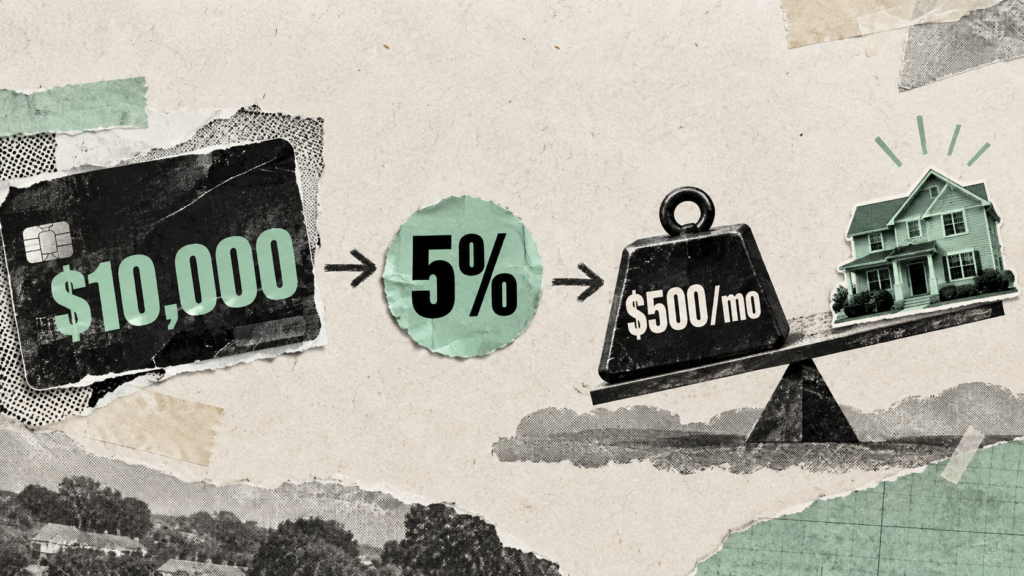
This is exactly why the balance you see on your credit card statement and the number your lender ultimately uses to qualify you can look quite different from what you might calculate on your own.
Section 06
Does Credit Card Debt Automatically Mean Mortgage Rejection?
No, and this is worth stating plainly. A lender does not make a decision based on any single factor in isolation.
Fannie Mae’s comprehensive risk assessment framework directs underwriters to consider income, credit history, assets, reserves, liabilities, DTI, and overall repayment capacity together, as a complete picture, rather than any one piece on its own. Having credit card debt does not automatically mean you cannot get a mortgage. What actually matters is the debt level relative to your income, the resulting monthly obligations, your broader credit profile, and how your entire financial picture holds together as a whole.
Section 07
Credit Card Debt Can Affect More Than Your DTI
It would be a mistake to treat this entire topic as purely a DTI conversation, since credit card debt can influence your mortgage file in a few other ways too.
Credit Utilization
A high balance relative to your available credit limit can affect your broader credit profile, depending on how you’re using revolving credit generally, separate from the specific DTI calculation described above.
Payment History
A history of late payments on credit card accounts can affect your credit history and, by extension, your credit score, which factors into underwriting in its own right.
New Credit Activity
Opening new credit accounts, or taking on additional debt close to when you submit your mortgage application, can require your file to be looked at again more closely. Fannie Mae requires lenders to evaluate a borrower’s credit report and liabilities carefully, and lenders may need to re-underwrite a loan if new debt shows up between initial underwriting and closing, which is exactly why timing matters here.
Section 08
Should You Pay Off Credit Cards Before Applying for a Mortgage?
There isn’t a simple yes answer here, and it’s worth resisting the urge to give one.
It Can Help in Some Cases
Paying down revolving debt can reduce your monthly debt obligation and, in turn, improve your DTI. For some borrowers, this genuinely opens up more room in their qualifying numbers.
But You Shouldn’t Automatically Drain Your Cash
At the same time, you likely still need funds available for your down payment, closing costs, reserves, and your own emergency savings. The CFPB specifically emphasizes that being qualified to borrow a certain amount is not the same thing as being comfortable affording it month to month.
Paying down debt before a mortgage application needs to be weighed against your cash reserves, closing costs, and your complete financial profile together. This isn’t a blanket recommendation to pay off every credit card before buying a home. For some borrowers, keeping cash available for reserves and closing may matter more than shaving a few points off DTI.
Section 09
What Homebuyers Should Check Before Applying
A few practical steps can make a real difference in how prepared you feel walking into this process.
Start by checking your actual credit card balances, so you know precisely how much you’re carrying rather than a rough guess. From there, check the minimum payments specifically, not just the balances, since as covered above, the payment figure is what actually drives the DTI calculation. It’s worth calculating your own DTI as best you can, to get a sense of how much of your income is already committed to existing monthly debts before you add a mortgage payment on top. The Wonder Rates DTI Calculator can help you estimate that ratio using your income, proposed housing payment, and monthly debts.
During this period, it’s generally wise to avoid taking on unnecessary new debt, especially while your mortgage application is actively being processed, since new debt discovered before closing can trigger a re-underwrite. If you want to understand why new debt can create problems late in the mortgage process, see our guide to common issues that can delay closing. Keep your documentation organized as well, since your lender may need to verify your liabilities and payment information directly. And finally, it’s worth simply asking your lender how they’ll calculate your specific debts, since guidelines genuinely differ between loan programs, and getting a clear answer early can save you surprises later.
Section 10
The Bigger Lesson: Mortgage Approval Is About Monthly Cash Flow
A mortgage lender is not only asking how much debt you have in total. The bigger question underneath that is whether your income can support a new mortgage payment alongside your existing monthly obligations, all at the same time, every month, for years to come.
The chain runs from credit card debt, to the monthly obligation that debt creates, to your DTI, to your overall borrowing capacity. It would be an overstatement to say credit card debt kills your mortgage outright. It’s more accurate, and more useful, to say that credit card debt can reduce the room you have available for a new mortgage payment, which is a meaningfully different and more precise way to think about it.
Section 11
Final Takeaway
Credit card debt does not automatically stop you from buying a home. But the monthly obligation tied to that debt can affect your DTI, and therefore your mortgage qualification, in ways that are worth understanding well before you apply.
Before applying, it’s worth asking more than just how much you owe. Ask how this debt specifically affects your monthly qualification, since that’s the number your lender will actually be working with.
If you want to understand how your specific debt profile may affect your mortgage options, you can talk with a licensed mortgage professional.
Section 12
Frequently Asked Questions
Does credit card debt affect mortgage approval?
Yes. Credit card debt can be counted as part of your monthly debt obligations and can affect your DTI, depending on the specific loan program and underwriting method involved.
Can I get a mortgage with credit card debt?
Possibly, yes. Having credit card debt does not automatically mean you’ll be rejected. Lenders consider your entire financial profile together, not any single factor in isolation.
Does paying off credit cards help mortgage approval?
It can help by reducing your monthly debt obligation and improving your DTI, but this needs to be weighed against your cash reserves and other requirements, not treated as an automatic step everyone should take.
How much credit card debt is too much for a mortgage?
There is no single dollar amount that applies universally to every borrower. The actual impact depends on your income, your monthly payments, your other debts, the loan program you’re using, and the specific underwriting rules that apply to your file.
Should I stop using credit cards before applying for a mortgage?
There’s no absolute rule here that fits everyone. What generally matters more is keeping your existing debt under control and avoiding unnecessary financial changes while your mortgage application is being processed.
Section 13
Sources
- Federal Reserve Bank of New York, Household Debt Balances Decreased Slightly; Credit Card Delinquency Transition Rates Remained Steady (Q2 2026)
- Fannie Mae Selling Guide, B3-6-02: Debt-to-Income Ratios
- Fannie Mae Selling Guide, B3-6-05: Monthly Debt Obligations
- Fannie Mae Selling Guide, B3-1-01: Comprehensive Risk Assessment
- Consumer Financial Protection Bureau (CFPB), How can I figure out if I can afford to buy a home and take out a mortgage?
This content is provided for general informational and educational purposes only. It is not financial, mortgage, tax, legal, or investment advice. Mortgage qualification depends on income, credit history, assets, liabilities, DTI, loan program, lender guidelines, the property involved, and many other factors. The examples and figures in this article are for illustration only and are not a mortgage quote, an approval guarantee, or an underwriting result. Guidelines can change over time. Borrowers should work directly with a mortgage professional and review their specific loan terms before making any decisions.
Duc Pham, Mortgage Broker | NMLS# 844897 | 408-600-1900 | dp@wonderrates.com Wonder Rates, Inc. | NMLS# 1518655 | DRE# 02047445 | DFPI# 60DBO-59134 Equal Housing Opportunity. Equal Housing Lender. Licensed in: AL, AZ, CA, CO, FL, GA, LA, MI, NC, OH, OK, OR, PA, SC, TX, VA, WA