

Section 01
If you’re planning to buy a home, you’ve probably heard that your credit score matters. But there is an important distinction between asking whether your score is “good enough” and understanding how that score fits into the mortgage you are actually applying for.
A credit score can affect your mortgage options, pricing, and underwriting process, but it is not the only number a lender reviews. Your income, monthly debts, employment, assets, down payment, credit history, property, and loan program all contribute to the overall application.
That is why there is no single credit score that guarantees mortgage approval for every borrower. A 620 score may be treated differently depending on the loan program and underwriting method, while a lower score may still leave some FHA options available. Even a high score does not guarantee approval if the rest of the application does not support the loan.
This guide explains what a credit score measures, how mortgage lenders use it, what current requirements look like across major loan programs, and what you can do to strengthen your credit before applying.
Section 02
What Is a Credit Score?
A credit score is a numerical representation of information in your credit history. It is designed to help lenders estimate credit risk based on how you have handled borrowed money and other credit obligations.
FICO scores generally range from 300 to 850. FICO currently describes scores below 580 as Poor, 580 to 669 as Fair, 670 to 739 as Good, 740 to 799 as Very Good, and 800 or above as Exceptional. These categories are useful for understanding the general range of a score, but they are not mortgage approval thresholds.
A credit score also does not measure your income or net worth. Someone can earn a high income and have a relatively low credit score, while another borrower with a more modest income can have an excellent score. Mortgage lenders review those factors separately when evaluating the complete application.
Section 03
Why Mortgage Lenders Care About Your Credit Score
Mortgage lending involves a long repayment period and a large loan balance, so lenders need to evaluate the likelihood that a borrower will make payments as agreed. Your credit score gives them one standardized way to assess that risk.
According to the Consumer Financial Protection Bureau, credit scores and credit reports can affect both whether you qualify for a mortgage and the interest rate you pay. The CFPB also notes that lenders consider other information, including your debt, savings, assets, and current income.
Your credit profile can therefore influence several parts of a mortgage application:
- Whether a particular loan program is available to you
- How your application is evaluated by automated or manual underwriting
- Interest rate and loan pricing
- Mortgage insurance costs
- Down payment requirements in some loan programs
- The amount of documentation or review required
- Your overall borrowing cost
The important point is that credit score is one part of the risk assessment, not a substitute for the rest of the application.
Section 04
What Credit Score Do You Need to Buy a House?
There is no single minimum credit score that applies to every mortgage.
The answer depends on the loan program, the lender, how the loan is underwritten, and the rest of your financial profile. Government-backed programs can have their own agency guidelines, while lenders may apply additional requirements of their own.
The distinction between program guidelines and lender requirements matters. A loan program may technically permit a particular credit profile, while an individual lender may choose to impose stricter standards.
That is why seeing a number online should not be treated as a guaranteed approval threshold.
Conventional Loans
Conventional mortgage requirements changed in an important way for Fannie Mae loans evaluated through Desktop Underwriter (DU).
Fannie Mae removed the previous 620 minimum credit score requirement for new DU loan casefiles created on or after November 16, 2025. Instead, DU evaluates credit risk using its broader automated underwriting framework. This does not mean that credit score no longer matters. It means that a single hard minimum score is no longer the same screening rule for DU casefiles.
Manual underwriting is different. Fannie Mae’s April 2026 Selling Guide states that manually underwritten fixed-rate loans generally have a 620 minimum credit score, while manually underwritten ARMs generally have a 640 minimum.
This is an important reason to be careful with the common statement that “you need a 620 credit score for a conventional mortgage.” It is still a useful benchmark in the market, and many lenders may use 620 or higher as an internal requirement, but it is not an accurate description of every conventional loan evaluated through DU.
FHA Loans
FHA loans are designed to provide mortgage financing for qualified borrowers who may not fit conventional lending as easily.
Under FHA’s established credit and down payment framework, borrowers with a qualifying credit score of 580 or higher can generally use the 3.5% minimum required investment, while borrowers with scores from 500 through 579 generally need a 10% minimum required investment. Lenders can impose their own requirements on top of FHA’s baseline guidelines. HUD’s current Single Family Housing Policy Handbook 4000.1 remains the central source for FHA underwriting policy.
The 580 number should therefore be understood as an FHA program threshold tied to the minimum investment structure, not as a universal “minimum credit score to get any mortgage.”
FHA credit scoring is also changing. HUD announced in 2026 that VantageScore 4.0 and FICO Score 10T will be added as acceptable credit score models alongside Classic FICO for FHA-insured mortgages with case numbers assigned on or after January 1, 2027.
For borrowers applying in late 2026, that distinction matters because the applicable credit scoring methodology can depend on when the FHA case number is assigned.
VA Loans
VA does not impose a minimum credit score requirement of its own.
Instead, the lender evaluates the borrower’s creditworthiness under VA requirements and may establish its own credit standards. The VA explicitly states that lenders can have their own minimum credit score requirements, which is why two VA lenders may evaluate the same borrower differently.
Credit is still important for a VA mortgage. VA eligibility does not mean that every borrower with any credit score will automatically qualify. The lender still reviews credit history, income, debts, assets, and other factors before approving the loan.
USDA Loans
USDA’s Single Family Housing Guaranteed Loan Program also does not operate around one universal published minimum credit score in the same way some other programs do. USDA underwriting considers the borrower’s credit history and the overall application, while lenders may have their own requirements.
Credit is only one part of USDA eligibility. The property must meet the program’s geographic requirements, and household income eligibility also applies.
Because USDA requirements can depend on the loan file and lender, a borrower should not assume that a particular score automatically qualifies or disqualifies them.
Section 05
FICO Score Ranges: What Does Your Number Mean?
FICO’s general score ranges can help put your number into context:
| FICO Score | General FICO Category | What It Generally Indicates |
|---|---|---|
| 300 to 579 | Poor | Higher perceived credit risk |
| 580 to 669 | Fair | Below average, but credit may still be usable |
| 670 to 739 | Good | Generally considered a good credit profile |
| 740 to 799 | Very Good | Strong credit profile |
| 800 to 850 | Exceptional | Very strong credit profile |
These are FICO’s general categories, not mortgage approval categories. A lender does not simply look at this table and decide that everyone above 740 qualifies or everyone below 580 is rejected. Mortgage underwriting uses the applicable credit model, credit history, loan program, and the rest of the borrower’s financial information.
Section 06
Your Credit Report Matters as Much as the Score
Two borrowers can have the same credit score but present very different credit profiles.
For example, suppose two borrowers both have a 640 score. One may have an older isolated late payment but a clean payment history for the past several years. The other may have several recent late payments, a collection account, and recently opened several new credit accounts.
The score alone does not tell the whole story.
Mortgage lenders can review the information behind the score, including payment history, outstanding debts, collections, bankruptcies or foreclosures where applicable, and recent credit activity. The CFPB specifically advises borrowers to review their credit reports and correct errors before applying because inaccurate information can affect both eligibility and pricing.
This is also why improving a credit profile is not always as simple as chasing a particular score number.
Section 07
What Factors Influence Your Credit Score?
Credit scoring models are proprietary, so the exact calculation depends on the scoring model being used. However, FICO identifies several major categories of information that influence its scores.
Payment History
Payment history is one of the most important parts of a credit profile. A pattern of paying obligations on time generally supports a stronger score, while missed or late payments can negatively affect it.
For a future homebuyer, this means that making payments consistently on time is generally more useful than trying to make a last-minute credit repair move immediately before applying.
Credit Utilization
Credit utilization describes how much revolving credit you are using relative to your available credit limits.
For example, if a credit card has a $10,000 limit and a $3,000 balance, the utilization on that card is 30%.
A high reported balance relative to the available limit can affect your credit score. Paying down revolving balances may therefore help your credit profile, although the exact effect depends on the rest of your credit file and when the balances are reported.
Length of Credit History
The age of your credit accounts can also influence your score.
This matters for borrowers who are newer to the U.S. credit system. Someone who has only recently opened several accounts may have a thinner or shorter credit history than someone who has managed credit responsibly for many years.
Credit Mix
Different types of credit can contribute to the overall credit profile. Credit cards, installment loans, and other accounts may be treated differently by scoring models.
You should not open a new loan simply to create a particular “credit mix” before applying for a mortgage. The potential benefit is generally not worth creating unnecessary new debt or inquiries.
New Credit
Opening several new accounts or applying for multiple new forms of credit can affect your score and may also create additional debt obligations.
That is especially relevant before a mortgage because new debt can affect both your credit profile and the debt-to-income calculation used during underwriting.
Section 08
Does Checking Your Own Credit Score Hurt It?
No. Checking your own credit report or score is generally considered a soft inquiry and does not hurt your credit score.
A hard inquiry is different. A lender may make a hard inquiry when you apply for credit, and hard inquiries can have a small negative effect on your score.
Mortgage shopping receives special treatment in many scoring models. The CFPB notes that multiple mortgage credit checks within a shopping period are generally treated as a single inquiry for scoring purposes, although the exact treatment can vary by scoring model and timing.
So checking your own credit before talking to a lender is not something you need to avoid.
Section 09
How Credit Score Can Affect Your Mortgage Rate and Costs
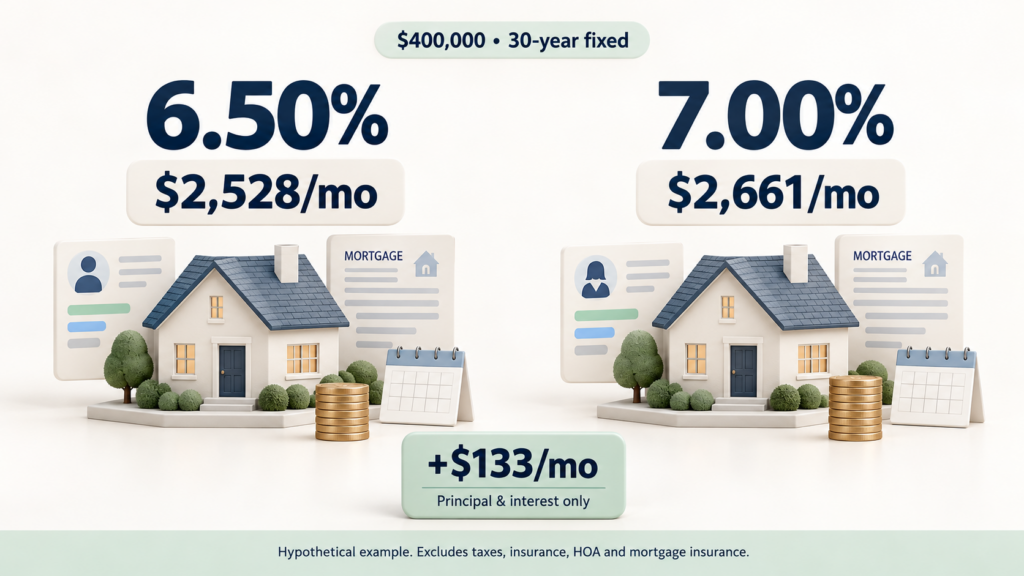
Credit score can affect more than approval. It can also affect how expensive the mortgage becomes.
Mortgage pricing reflects many variables, including loan program, loan amount, property type, occupancy, loan-to-value ratio, market conditions, and borrower credit characteristics. A stronger credit profile may qualify for better pricing in situations where credit-based pricing adjustments apply.
Consider a simplified example.
Suppose two borrowers each take a $400,000 30-year fixed mortgage. One receives a hypothetical 6.50% rate and another receives a hypothetical 7.00% rate because of differences in the pricing available to their respective profiles.
At 6.50%, principal and interest would be approximately $2,528 per month. At 7.00%, it would be approximately $2,661 per month. That is a difference of about $133 per month before property taxes, homeowners insurance, HOA dues, or mortgage insurance.
The example is hypothetical and does not represent a current rate quote. Actual pricing depends on the complete loan scenario and market conditions.
If you want to test how different rates or loan amounts change the payment, you can use the Wonder Rates Mortgage Payment Calculator before comparing actual loan options.
Section 10
A Higher Credit Score Does Not Guarantee the Lowest Rate
It is tempting to think of mortgage pricing as a simple ladder where a higher score always means a lower rate. In reality, mortgage pricing is more complicated.
A borrower with excellent credit can still receive a different rate from another borrower with the same score if the loan amount, down payment, property type, occupancy, loan purpose, or other pricing factors are different.
The same principle applies when comparing lenders. A lender’s internal pricing and underwriting requirements can affect the available options. In other words, your credit score is important, but it does not determine your mortgage rate by itself.
Section 11
How to Improve Your Credit Before Buying a Home
If buying a home is several months away, you have more room to improve your financial profile before applying.
Make Every Payment on Time
Payment history is fundamental to a healthy credit profile. Set up automatic payments or reminders for accounts where appropriate so that an otherwise avoidable late payment does not damage your credit.
Reduce High Credit Card Balances
If your revolving balances are high relative to your credit limits, paying them down may improve your utilization and potentially your score.
However, do not assume that every dollar of debt should be paid off immediately. You still need sufficient funds for your down payment, closing costs, reserves, and other homebuying expenses.
Avoid Unnecessary New Credit
Opening a credit card or taking out an auto loan shortly before a mortgage application can create new inquiries and additional monthly debt.
If you are already preparing to buy, discuss major financial changes with your mortgage professional before making them.
Review All Three Credit Reports
Review your credit reports well before applying for a mortgage rather than waiting until the lender pulls them.
Look for incorrect balances, accounts that do not belong to you, inaccurate payment history, or other information that may need to be disputed.
The CFPB recommends checking your credit reports and correcting errors before applying because inaccurate information can affect your mortgage application.
Give Credit Changes Time to Appear
Credit improvement is rarely instantaneous.
Paying down a balance today does not necessarily mean your mortgage lender will see the lower balance tomorrow. Creditors report information on their own schedules, and scoring models respond to the information that appears in the credit report.
If you are planning to buy in the next few months, start reviewing your credit as early as possible.
For a longer-term plan, see How to Rebuild Your Credit Score Before Applying for a Mortgage.
Section 12
What If Your Credit Score Is Below 620?
A score below 620 does not automatically mean you cannot buy a home.
It may limit some conventional options depending on the lender and underwriting method, but other programs may still be available. FHA, for example, has historically allowed qualifying borrowers with scores from 500 to 579 to use the program with a higher minimum required investment, while borrowers at 580 or above may qualify for the lower 3.5% minimum investment under the applicable FHA rules. Lender overlays can make the practical options narrower.
The more useful question is what is causing the score to be low and what the rest of the application looks like.
A borrower with a 600 score, stable income, manageable debt, strong savings, and clean recent payment history may present a different risk profile from another borrower with the same score but several recent late payments and high revolving debt.
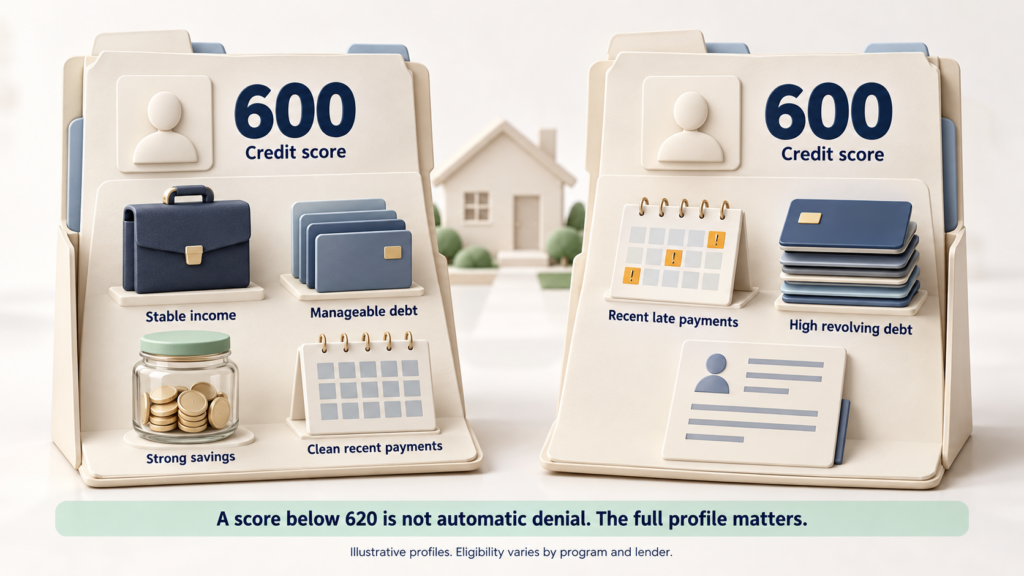
There is no guarantee that strengthening one part of the application will overcome a weakness elsewhere, but looking at the complete profile is more useful than assuming a single score determines the outcome.
If your credit is the main concern, you can also read Mortgage Requirements With a Low Credit Score: What You Need to Qualify.
Section 13
What Else Do Mortgage Lenders Look At?
Credit is only one part of mortgage underwriting.
Lenders may also evaluate:
| Factor | Why It Matters |
|---|---|
| Credit score | Helps evaluate credit risk and may affect pricing |
| Credit history | Shows how you have managed debt over time |
| Income | Supports your ability to make the proposed payment |
| Employment | Helps establish income stability and continuity |
| DTI | Measures monthly debt obligations relative to qualifying income |
| Down payment | Affects LTV, equity, and potentially pricing or mortgage insurance |
| Assets | Helps verify funds for closing and, when required, reserves |
| Property | Serves as collateral and must meet applicable requirements |
| Loan program | Determines which program-specific rules apply |
| Documentation | Supports the information used in underwriting |
This is why a mortgage application should be viewed as a complete financial profile rather than a credit score test.
If you want to understand the broader underwriting process, read What Do Mortgage Lenders Look For? The 3 C’s Explained.
Section 14
Should You Wait Until Your Credit Score Is Higher?
Not necessarily.
Waiting can make sense if your score is actively improving and a few months of lower balances or cleaner payment history could materially strengthen your application. But waiting solely because you have not reached an arbitrary number may not be necessary.
The right decision depends on your complete financial situation, your target loan program, available cash, debt, income, home price, and timeline.
For example, a borrower with a 680 score, stable income, manageable DTI, and sufficient savings may already have a workable profile, while another borrower with a 740 score but a very high debt load and insufficient funds for closing may have a more complicated application.
If you are trying to determine how much home fits your budget, start with the Wonder Rates Buy a Home page and use the affordability tools available there.
Section 15
Common Credit Score Myths Before Buying a Home
Myth: You Need an 800 Credit Score to Buy a House
You do not need an 800 score to qualify for a mortgage. FICO’s score ranges describe general credit quality, not mortgage approval requirements. Loan programs and lenders evaluate borrowers using their applicable underwriting standards.
Myth: A 620 Score Is the Universal Minimum for Every Conventional Loan
620 remains an important benchmark, particularly for certain manually underwritten conventional loans and lender overlays. But Fannie Mae removed the minimum credit score requirement from new DU loan casefiles beginning November 16, 2025, replacing the previous hard cutoff with its broader DU risk assessment.
Myth: A Low Score Automatically Means Mortgage Denial
Not necessarily. Loan programs differ, lender requirements differ, and the rest of the borrower’s financial profile matters.
Myth: Paying Off a Credit Card Automatically Fixes Your Credit Score
Not always. The effect depends on the overall credit file, the balance being reported, the scoring model, and other factors.
Myth: Your Income Determines Your Credit Score
Income and credit score measure different things. Your income is important to mortgage underwriting, but it is not what creates your FICO score. Credit scores are calculated from information in your credit reports.
Section 16
Frequently Asked Questions
What credit score do I need to buy a house?
There is no universal minimum credit score for every mortgage. FHA, conventional, VA, and USDA loans have different rules, and individual lenders may add their own requirements. The applicable credit score also depends on how the loan is underwritten.
Is 620 a good credit score for a mortgage?
A 620 score can be workable for some mortgage scenarios, but it is not a guarantee of approval or a universal minimum. For example, Fannie Mae’s current guidelines no longer impose a minimum credit score on DU loan casefiles, while manually underwritten fixed-rate loans generally have a 620 minimum.
Can I get an FHA loan with a 580 credit score?
A 580 score generally falls within the FHA threshold associated with the 3.5% minimum required investment under current FHA rules. The lender still evaluates the entire application and may have stricter requirements.
Can I get a mortgage with a credit score below 580?
Potentially, depending on the loan program and lender. FHA guidelines have historically allowed qualifying borrowers with scores from 500 to 579 with a 10% minimum required investment, although lenders may impose stricter standards. Other mortgage programs have different rules.
Does checking my own credit lower my score?
No. Checking your own credit report is generally a soft inquiry and does not hurt your score. A lender’s hard inquiry is different and can have a small impact.
How far in advance should I work on my credit before buying a house?
Earlier is better. Credit improvements can take time to appear in your reports and may not happen immediately after you pay down a balance or correct an account. Starting several months before applying gives you more time to identify errors, reduce balances, and establish consistent payment history.
Should I pay off all my credit cards before applying for a mortgage?
Not automatically. Reducing revolving balances can help your credit utilization and monthly debt obligations, but you also need cash for the down payment, closing costs, and any required reserves. The right balance depends on your complete financial situation.
Does a higher credit score always mean a lower mortgage rate?
No. Credit score can influence mortgage pricing, but the final rate also depends on the loan program, loan amount, LTV, property, occupancy, market conditions, and other factors.
Can I shop multiple mortgage lenders without damaging my credit?
Mortgage credit inquiries made within the applicable shopping period are generally treated as a single inquiry by many scoring models. The CFPB notes that the window can range from 14 to 45 days depending on the scoring model.
Section 17
What to Do Before You Apply for a Mortgage
If buying a home is on your timeline, do not focus only on getting your score above a particular number. Instead, review the entire financial profile that a lender is likely to see.
Start by checking your credit reports for errors. Review your revolving balances and monthly debts. Avoid taking on unnecessary new credit. Gather your income and asset documentation. Then determine which loan programs may fit your situation.
If you want to estimate your payment before speaking with a lender, use the Wonder Rates Mortgage Payment Calculator.
When you are ready to discuss your actual options, you can get started with Wonder Rates. A licensed mortgage professional can review your complete scenario and help you understand which loan programs and pricing options may be available based on your current profile.
Section 18
Key Takeaways
Your credit score matters when you apply for a mortgage, but it is not the entire application.
The most important points to remember are:
- There is no single credit score that guarantees mortgage approval.
- Conventional, FHA, VA, and USDA loans use different credit requirements and underwriting frameworks.
- Fannie Mae removed the previous 620 minimum score requirement from new DU loan casefiles beginning November 16, 2025, although manually underwritten loans and individual lender requirements can still have minimums.
- FHA generally uses a 580 threshold for the 3.5% minimum required investment, with a higher minimum investment for qualifying borrowers in the 500 to 579 range.
- VA does not impose its own minimum credit score, although individual VA lenders may.
- Your credit history matters alongside your score.
- Income, DTI, assets, employment, down payment, property, and loan program all contribute to the mortgage decision.
- Checking your own credit does not hurt your score.
- Improving credit can take time, so preparing before you apply gives you more options.
A stronger credit profile can help, but the goal is not to chase a perfect number. The goal is to understand how your credit fits into the complete mortgage application and prepare the parts of your financial profile that you can realistically improve.
Section 19
Sources
- Consumer Financial Protection Bureau: Does my credit score affect my ability to get a mortgage loan or the mortgage rate I pay?
- Consumer Financial Protection Bureau: What happens when a mortgage lender checks my credit?
- FICO: What Is a Credit Score?
- Fannie Mae: Desktop Underwriter credit score changes
- Fannie Mae Selling Guide: Minimum Credit Score Requirements
- HUD: FHA Single Family Housing Policy Handbook 4000.1
- HUD: FHA TOTAL Scorecard and Alternative Credit Scores
- U.S. Department of Veterans Affairs: VA Home Loan Entitlement and Limits
- FHFA: 2026 Conforming Loan Limits
This article is provided for educational and informational purposes only and should not be considered financial, tax, legal, or mortgage advice. Mortgage qualification requirements, loan programs, credit guidelines, and interest rates vary by lender and may change over time. Credit score ranges and program guidelines referenced in this article are general information based on sources available at the time of writing and are subject to change. Every borrower’s financial situation is unique, and no specific outcome, approval, rate, or loan term is guaranteed. Please consult with a qualified mortgage professional, financial advisor, tax professional, or legal advisor regarding your specific circumstances before making financial decisions.
Duc Pham, Mortgage Broker | NMLS# 844897, Wonder Rates, Inc. | NMLS# 1518655 | DRE# 02047445 | DFPI# 60DBO-59134 | Equal Housing Opportunity. Equal Housing Lender. | Licensed in: AL, AZ, CA, CO, FL, GA, LA, MI, NC, OH, OK, OR, PA, SC, TX, VA, WA.