
Section 01
Most people know their credit score matters for a mortgage. Fewer know exactly how easy it is to damage it right when it counts the most. Understanding common credit score mistakes before mortgage approval can help you avoid delays and unexpected questions during underwriting.
The time between deciding to buy a home and closing is critical. It’s when credit scores face close scrutiny, and common mistakes often occur. Some of these mistakes may lower your score slightly. Others may require additional review during underwriting or affect your mortgage options.
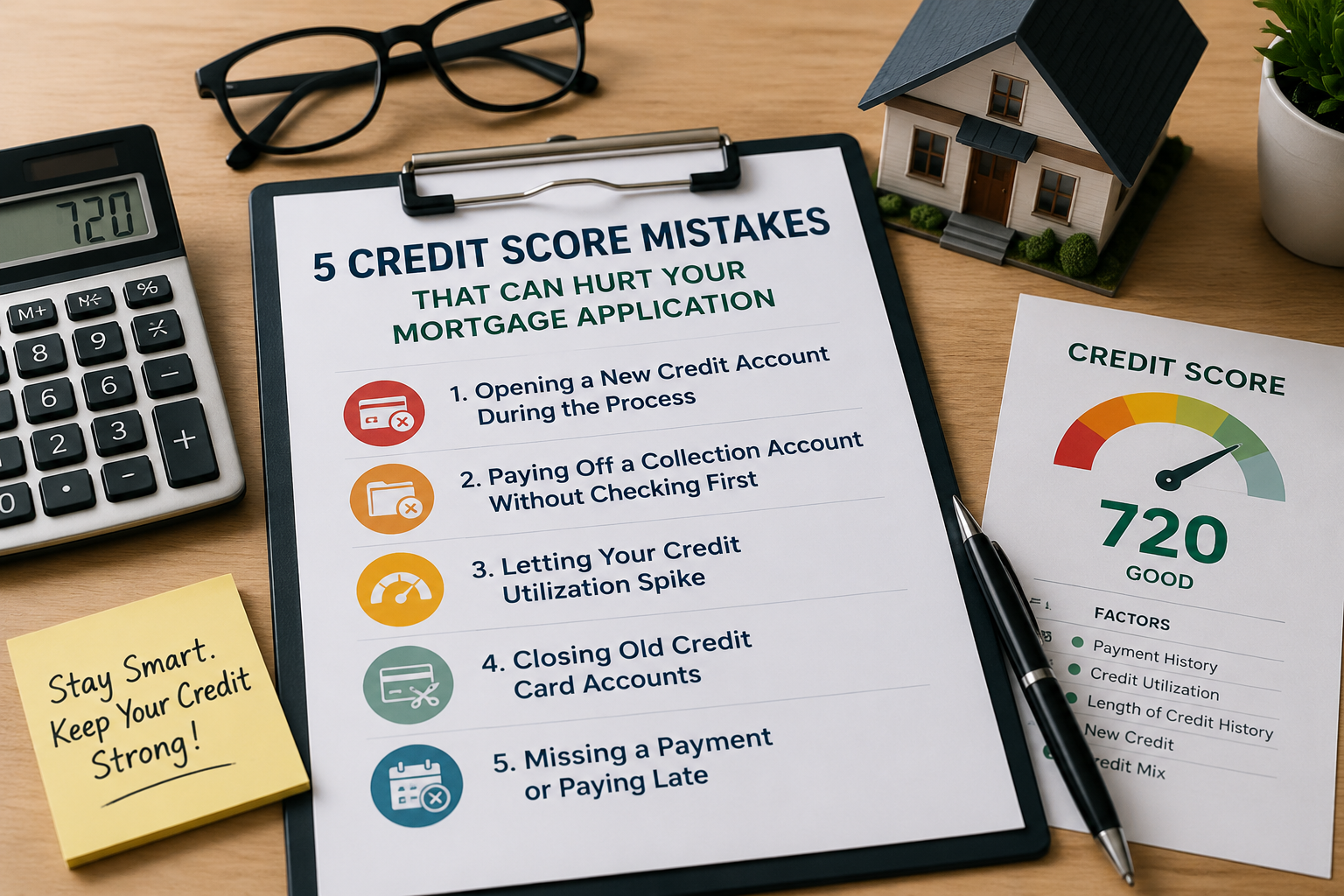
Here are the five that come up most often, and what to do about each one.
Section 02
Mistake 1: Opening a New Credit Account During the Process
This is the one that catches people most off guard, usually because the timing feels completely unrelated to the mortgage.
You find a furniture store offering 0% financing for 18 months. You sign up for a new credit card because the rewards look good. You co-sign a car loan for a family member. These actions have something in common. They create a new account, make a hard inquiry, and change your credit profile. The underwriter will notice these changes.
Some lenders may review your credit again before closing or funding to confirm there have been no major changes. A new account that did not exist at pre-approval triggers questions about additional debt obligations. Even if you have not charged anything on the new card, the available credit line exists and lenders factor it into their assessment.
The rule is simple: the safest approach is to avoid opening new credit accounts during the mortgage process unless you discuss it with your loan officer first.
| New Account Type | Impact on Mortgage Application |
|---|---|
| New credit card | Hard inquiry + new account, may affect DTI if balance is carried |
| Store financing | Same as new credit card, plus often high utilization if used |
| Auto loan | Adds monthly payment to DTI and may affect qualification |
| Co-signed loan | May affect your DTI because lenders may consider the payment obligation when reviewing your application. |
| New personal loan | Monthly payment added to DTI, triggers re-review of file |
Impacts are general guidelines. Actual underwriting decisions depend on the full borrower profile and the specific loan program.
Section 03
Mistake 2: Paying Off a Collection Account Without Checking First
Paying off a collection account sounds like the right thing to do before applying for a mortgage. In many cases, it can be helpful. However, the right approach depends on the type of account, your loan program, and your overall credit profile.
The impact depends on the age of the collection, the type of debt, the amount, and the scoring model your lender uses.
Some medical collections may be treated differently under certain credit scoring models. Paying off a collection account does not always create the credit benefit borrowers expect.
Older collections close to aging off your report may also require a conversation with your loan officer before taking action.
In some situations, paying a collection account may not create the credit improvement you expect. Talk with your loan officer before making changes so you understand how it may affect your mortgage process.
Section 04
Mistake 3: Letting Your Credit Utilization Spike
Credit utilization is the ratio of your current credit card balances to your total available credit limits. Credit utilization is an important factor in many FICO scoring models and can significantly influence your score.
Utilization can vary each month as your balances change. This can significantly affect your score, either up or down, within a single billing cycle.
Common situations that can cause a spike in utilization before a mortgage application include:
- Charging a big expense to a card, even if you plan to pay it off next month.
- Paying down one card while increasing the balance on another.
- Having a card issuer lower your credit limit, which raises your utilization, even if your balance stays the same.
Lower credit utilization is generally viewed more favorably by scoring models. Many consumers try to keep balances low before applying for a mortgage, but the impact varies based on the overall credit profile.
Check the utilization on all your cards, not just the ones with high balances. Each card’s utilization matters for your score, along with your overall utilization rate.
| Utilization Rate | Approximate Score Impact |
|---|---|
| Under 10% | Generally viewed favorably |
| 10% to 29% | Often considered a lower utilization range |
| 30% to 49% | Moderate negative impact begins |
| 50% to 74% | Meaningful negative impact |
| 75% and above | Significant negative impact |
| 90% and above | Severe negative impact |
Utilization impact is illustrative based on general FICO scoring principles. Actual score impact depends on the full credit profile and specific scoring model used.
Section 05
Mistake 4: Closing Old Credit Card Accounts
The logic seems reasonable. You are simplifying your finances, getting rid of cards you do not use, cleaning things up before the mortgage process. But closing old accounts may affect your credit score in two ways.
First, it reduces your total available credit, which immediately raises your utilization ratio on remaining cards if you carry any balances. For example, closing a card with a $4,000 limit while keeping the same balance can increase your utilization because your total available credit decreases.
Second, it shortens your average account age. Length of credit history is one factor in your FICO score. Closing an old account may eventually affect your credit history, depending on how the account is reported.
The rule is simple: don’t close any credit card during the mortgage process. Also, be careful not to close your oldest accounts, even if you’re not applying right now.
Section 06
Mistake 5: Missing a Payment or Paying Late
Payment history is one of the most important factors in many FICO scoring models. According to FICO official website, payment history is one of the key factors used in determining credit scores. A missed or late payment can hurt your score a lot. The exact effect depends on your score before the missed payment, how late it was, and when it happened.
A payment that is 30 or more days late appears on your credit report as a delinquency. Recent delinquencies generally have a stronger impact than older negative information. A missed payment can significantly affect your score, especially if you previously had a strong credit profile.
In the mortgage process, this damage is hard to fix quickly. Improving payment history takes time. A lender who approved your file and sees a new delinquency during a credit refresh may need to reevaluate your application.
Set up autopay for the minimum on every account during the mortgage process. You can pay more manually, but autopay helps you avoid missed payments. It keeps everything on track, even during busy times.
| Payment Status | Impact on Credit Report | Score Impact |
|---|---|---|
| Paid on time | Positive payment history builds over time | Positive |
| 1 to 29 days late | Not yet reported as delinquency | Minimal |
| 30 days late | Reported as delinquency | Can cause a significant score decrease depending on the borrower’s credit profile. |
| 60 days late | More severe delinquency | Higher drop than 30 days |
| 90 days late | Major delinquency | Severe impact and may lead to additional account actions. |
Score impact estimates are based on general FICO principles. Actual impact varies significantly based on starting score, overall credit profile, and other factors.
Important note on score drop ranges: A single 30-day late payment can cause a significant score drop. The impact varies depending on your starting score, credit history, and scoring model. FICO research shows that higher-scoring profiles often see bigger drops. This happens because they have more to lose from a negative mark. Lower-scoring profiles may see smaller absolute drops.
Section 07
Avoid These Credit Score Mistakes Before Mortgage Closing
The common theme is simple: keep your credit profile stable throughout the mortgage process. Changes that happen after application may require additional review from your lender.
The mortgage process asks you to keep your financial life as stable as possible from application through closing. That means no new accounts, no closed accounts, no large balance changes, no missed payments, and no unplanned interactions with your credit report. Everything that needs to happen with your credit should happen before you apply, not during.
The earlier you know about these rules, the less likely you are to run into them at the worst possible moment.
Section 08
Frequently Asked Questions
How much can one mistake actually lower my credit score during the mortgage process?
It depends on the type of mistake and your overall credit profile. A new credit card may cause a small temporary drop from the hard inquiry, while a late payment can have a much larger impact. High credit utilization or closing old accounts may also lower your score. Multiple changes at once can create a bigger impact than a single mistake.
If I damage my credit during the mortgage process, is there anything I can do to fix it quickly?
Some issues can improve faster than others. Lowering high credit card balances may help once the updated information is reported to the credit bureaus. Late payments are harder to fix because they can remain on your credit report for years. In some cases, your loan officer may help request a rapid rescore for corrected or updated information.
Should I check my credit score regularly during the mortgage process?
Yes. Checking your own credit does not hurt your score because it is a soft inquiry. Check your credit often. It helps you find unexpected changes, mistakes, or fraud. This way, you can fix problems before they hurt your mortgage application.
Section 09
Conclusion
Your credit profile plays an important role in your mortgage journey. Before you submit your application, take the time to understand what lenders may look for.
Contact the Wonder Rates team to review your credit profile and understand what steps may help you prepare for the mortgage process.
All figures, score impact estimates, and examples in this article are for illustrative and educational purposes only and do not constitute an offer of credit or financial advice. Credit score impacts vary significantly based on individual credit profiles, scoring models used, and specific circumstances. FICO scoring factors and weights referenced are based on publicly available FICO documentation and are subject to change. Consult your loan officer for guidance specific to your situation.
Duc Pham, Mortgage Broker | NMLS# 844897 | Wonder Rates, Inc. | NMLS# 1518655 | DRE# 02047445 | DFPI# 60DBO-59134 | Equal Housing Opportunity. Equal Housing Lender. | Licensed in: AL, AZ, CA, CO, FL, GA, LA, MI, NC, OH, OK, OR, PA, SC, TX, VA, WA.