

Section 01
If you have started researching mortgages, you have probably come across the term debt-to-income ratio, often shortened to DTI.
For many first-time homebuyers, DTI can be confusing. Some buyers assume it is another version of a credit score. Others believe that earning a high salary automatically makes it easier to qualify for a mortgage.
Neither assumption tells the full story.
Your debt-to-income ratio measures how your required monthly debt payments compare with your gross monthly income. Mortgage lenders use this ratio, along with your credit history, qualifying income, assets, and other factors, to evaluate your mortgage application.
Understanding DTI before you apply can help you estimate your borrowing capacity, identify financial pressure points, and prepare for questions that may arise during underwriting.
However, qualifying for a mortgage and comfortably affording a home are not exactly the same thing. A borrower may meet a lender’s DTI requirements and still have limited money left for savings, household expenses, or unexpected costs.
This guide explains how mortgage DTI works, how to calculate it, which obligations may count, how different loan programs evaluate the ratio, and what you can do to strengthen your financial position before buying a home.
Section 02
What Is Debt-to-Income Ratio (DTI)?
Debt-to-income ratio is the percentage of your gross monthly income that goes toward required monthly debt payments.
Mortgage lenders use DTI to evaluate how your existing obligations compare with the payment associated with a potential new loan. It helps them assess whether the proposed mortgage fits within the financial information documented in your application.
According to the Consumer Financial Protection Bureau’s explanation of debt-to-income ratio, lenders calculate DTI by dividing monthly debt payments by gross monthly income.
For example, consider two borrowers who each earn $8,000 per month before taxes.
The first borrower has $500 in existing monthly debt payments. The second has $2,000 in monthly debt payments. Even though their incomes are identical, their financial obligations are different before either borrower adds a mortgage payment.
Once a proposed housing payment is included, the difference becomes even more important.
DTI does not measure every aspect of a person’s financial health. It does not directly show how much money someone spends on groceries, how much they contribute to retirement accounts, or how much they want to save each month. It is one measure used within a broader mortgage qualification process.
Section 03
How Is Debt-to-Income Ratio Calculated?
The Basic DTI Formula
The basic formula is:
DTI = Total qualifying monthly debt payments ÷ Gross monthly income × 100%
Gross monthly income generally means income before taxes and other payroll deductions. However, the income used by a mortgage lender must also meet the applicable documentation and qualifying requirements.
To calculate a preliminary DTI, identify your qualifying monthly income, add the relevant monthly debt obligations, and divide the debt total by the income figure.
A Simple Mortgage DTI Example
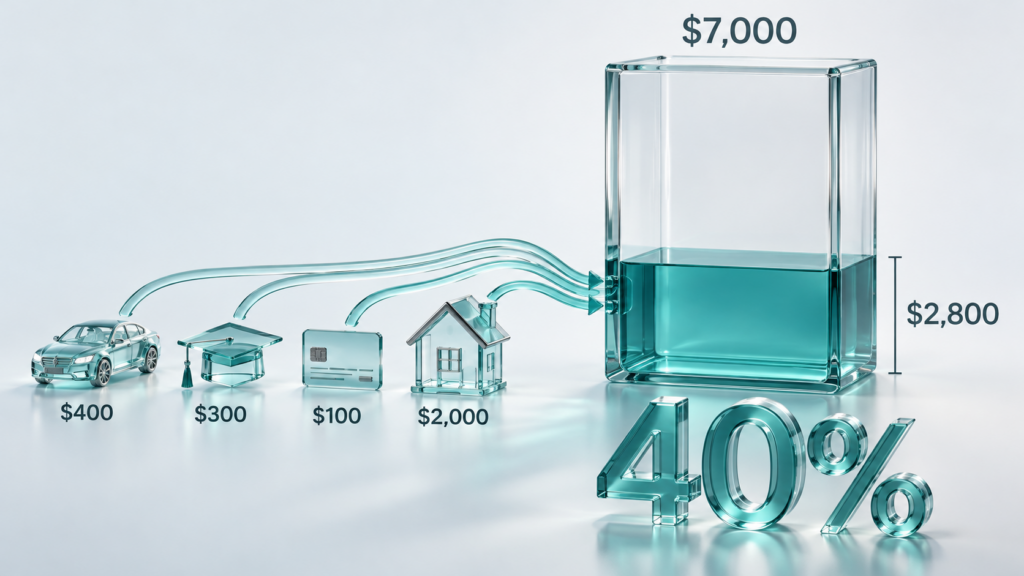
Consider a hypothetical borrower with the following financial information:
Gross monthly income: $7,000
Monthly obligations:
- Car loan: $400
- Student loan: $300
- Credit card minimum payments: $100
- Proposed monthly housing payment: $2,000
Total monthly obligations: $2,800.
The calculation is:
$2,800 ÷ $7,000 × 100% = 40%.
The borrower’s illustrative DTI is 40%.
This calculation assumes that all listed payments are included under the applicable underwriting rules and that the $2,000 housing payment represents the complete qualifying housing expense. Actual calculations can differ based on the loan program, the documentation provided, and the treatment of individual obligations.
The example is for educational purposes only. It does not represent an actual loan application, an approval outcome, or a guaranteed qualifying ratio.
Why the Housing Payment Must Be Included
When evaluating a mortgage application, lenders generally consider the proposed housing payment rather than looking only at debts the borrower already pays.
This distinction matters because someone who currently rents an apartment may have relatively few existing debt obligations. Adding a mortgage creates a new recurring financial commitment.
The qualifying housing payment may include principal, interest, property taxes, homeowners insurance, mortgage insurance where applicable, and homeowners association dues or other applicable housing obligations.
For a more complete estimate of the payment associated with a property, use the Wonder Rates Mortgage Payment Calculator. It can help you estimate principal, interest, taxes, insurance, and other relevant payment components before evaluating how the expense fits into your budget.
Calculator results are estimates. The actual qualifying payment depends on the property, loan terms, applicable expenses, and underwriting requirements.
Section 04
Gross Income vs. Net Income
One of the most common DTI mistakes is using take-home pay instead of gross income.
Gross income is income before taxes and other deductions are withheld. Net income is the amount remaining after those deductions.
For example, a borrower might earn $9,000 per month before deductions but receive only $6,700 in take-home pay. If the borrower’s qualifying monthly obligations total $3,000, dividing by gross income produces a DTI of approximately 33.3%.
Dividing the same obligations by take-home pay produces approximately 44.8%.
The two calculations look substantially different because they use different income figures. Mortgage DTI generally uses qualifying gross monthly income, not take-home pay.
However, using gross income does not mean a borrower should ignore the difference between gross and net pay when planning a household budget. Taxes, retirement contributions, health insurance premiums, childcare, groceries, utilities, and other living costs can affect how comfortably someone can manage a mortgage payment.
A useful approach is to use gross income when estimating mortgage qualification and net income when assessing personal affordability.
Section 05
What Counts as Monthly Debt for Mortgage DTI?
Not every payment leaving your bank account is considered debt for mortgage underwriting purposes.
Lenders generally evaluate recurring obligations according to the applicable loan program and underwriting guidelines. They may review credit reports, loan statements, court orders, and other documentation to determine which payments must be included.

Credit Card Minimum Payments
Credit card obligations are generally evaluated using the required monthly payment rather than the entire outstanding balance.
For example, if a borrower has several credit cards with minimum payments totaling $250 per month, those payments may contribute $250 to the monthly debt calculation.
Paying down a credit card balance may improve the DTI calculation if the required monthly payment decreases. The actual impact depends on how the account is reported, the timing of the payment, and the applicable underwriting rules.
Paying off a card can also affect credit utilization, which is a separate consideration from DTI.
Auto Loans and Vehicle Financing
Monthly car loan payments are commonly included in DTI.
A borrower with a $650 monthly auto loan payment has $650 less in monthly cash flow before considering other obligations. When the proposed mortgage payment is added, the car payment can meaningfully affect the overall ratio.
Vehicle leases and other recurring vehicle financing obligations may also be considered according to the applicable guidelines.
This is one reason large financed purchases before or during the mortgage process deserve careful consideration. A new monthly payment can change the numbers used to evaluate a mortgage application.
Student Loans
Student loans can require more detailed analysis than some other debts.
The payment used for qualification may depend on the documented repayment amount, repayment plan, deferment status, and specific loan program requirements. A payment shown on a credit report is not necessarily the only figure that may be relevant in every situation.
For some loan programs, special rules apply when a student loan has a very low payment, an income-driven payment, or no currently required payment.
Borrowers should not assume that a deferred student loan or a payment of zero will automatically be excluded from DTI. The lender may need additional documentation and may calculate a qualifying payment under the applicable guidelines.
If student loans represent a substantial portion of your monthly obligations, review how they will be treated before making decisions about your homebuying budget.
Personal Loans and Installment Debt
Personal loans, certain installment accounts, and other recurring debt payments may count toward DTI.
Examples include unsecured personal loans, debt consolidation loans, and some financed purchases.
The relevant factor is not simply whether the obligation appears on a particular credit report. The lender must determine how the obligation should be treated under the applicable underwriting rules.
Do not assume a debt can be ignored because it is paid through a different account or is not immediately visible on one document.
Child Support and Alimony
Court-ordered or legally documented support obligations may affect mortgage qualification.
The treatment of child support and alimony can depend on the specific underwriting rules and the nature of the obligation. Documentation may be needed to establish the required payment and any relevant terms.
Some obligations can also affect qualifying income or the calculation of available monthly funds differently from ordinary installment debt.
Borrowers should disclose applicable obligations accurately so the lender can determine the correct treatment.
Existing Mortgages and Other Properties
An existing mortgage may need to be included when a borrower purchases another home, particularly if the borrower plans to retain the current property.
The calculation can become more involved when rental income is involved. Depending on the loan program, lenders may use documented rental income, apply an allowable adjustment, and evaluate the existing property’s mortgage and related expenses according to specific rules.
Do not assume that the entire rental income amount can be used to offset the existing mortgage payment. The amount that qualifies may differ from the amount deposited into your bank account.
If you own another property, provide the lender with the relevant mortgage statements, rental documentation, and other requested records early in the process.
Co-Signed Loans and Other Obligations
Co-signing a loan for a family member or another borrower can affect your mortgage application, even when the other person makes the payments.
The lender may need to evaluate the obligation and determine whether documented payment history or other evidence allows different treatment under the applicable rules.
Similarly, debts that are paid by another person or business should not automatically be assumed to be excluded from DTI. Eligibility for an exclusion depends on the program’s requirements and the documentation available.
The safest approach is to disclose the obligation and allow the lender to determine how it should be handled.
Section 06
What Usually Does Not Count Toward DTI?
Many ordinary household expenses affect your budget but are generally not classified as monthly debt obligations in the standard mortgage DTI calculation.
These can include:
- Groceries and household supplies
- Electricity, water, and other utilities
- Gas and routine transportation costs
- Phone and internet bills
- Entertainment and streaming subscriptions
- Gym memberships
- General childcare expenses
- Ordinary living expenses that are not qualifying debt obligations
The treatment of a specific expense can vary, so this list should not be used to conclude that every payment outside the examples above can be ignored.
For instance, a recurring phone bill is generally treated differently from an installment loan used to purchase a phone. Similarly, ordinary living expenses are different from a court-ordered obligation or a payment secured by a loan.
The fact that an expense is excluded from DTI does not make it financially unimportant.
A borrower with a low DTI can still struggle with a mortgage if a large portion of take-home pay goes toward childcare, healthcare, transportation, or other household expenses. DTI is a qualification measure, not a complete monthly budget.
Section 07
Front-End DTI vs. Back-End DTI
DTI can be discussed in terms of a housing ratio and a total debt ratio. These are often called the front-end and back-end ratios.
What Is Front-End DTI?
The front-end ratio measures the qualifying housing payment relative to gross monthly income.
A simplified formula is:
Front-end DTI = Qualifying monthly housing expense ÷ Gross monthly income × 100%
Depending on the applicable calculation, the housing expense may include principal, interest, property taxes, homeowners insurance, mortgage insurance, and applicable HOA dues.
For example, if the qualifying monthly housing expense is $2,100 and gross monthly income is $7,000, the front-end ratio is 30%.
This figure focuses on the housing expense rather than all of the borrower’s other debts.
What Is Back-End DTI?
The back-end ratio includes the qualifying housing expense and other required monthly debt obligations.
Back-end DTI = Total qualifying monthly obligations ÷ Gross monthly income × 100%
Suppose the same borrower has a $2,100 housing expense, a $400 car payment, a $200 student loan payment, and $100 in required credit card payments.
Total monthly obligations equal $2,800. Dividing that amount by $7,000 produces a back-end DTI of 40%.
This is why a borrower can have a relatively manageable housing ratio but a substantially higher total DTI.
Which Ratio Matters for Mortgage Approval?
The answer depends on the loan program and underwriting method. Some programs or underwriting frameworks use both ratios, while others emphasize different qualification measures.
Do not assume that meeting a particular front-end ratio guarantees approval or that exceeding a general back-end guideline automatically means a borrower cannot qualify.
The lender evaluates the complete application under the applicable program requirements.
Section 08
What Is Considered a Good DTI Ratio for a Mortgage?
A lower DTI generally means that a smaller share of qualifying gross income is committed to monthly debt obligations. This can provide more flexibility when evaluating a potential mortgage payment.
However, there is no single DTI percentage that guarantees approval across every mortgage program and borrower.
For example, Fannie Mae’s conventional mortgage guidelines distinguish between manually underwritten loans and loan casefiles evaluated through Desktop Underwriter. Under the published guidelines, the maximum DTI for a Desktop Underwriter casefile is generally 50%, while manually underwritten loans are subject to different requirements and limits. Exceptions and additional restrictions may apply to particular transactions.
These are program-specific underwriting rules, not a universal promise that every borrower with a DTI below 50% can qualify.
You can review the current requirements in the official Fannie Mae Selling Guide section on debt-to-income ratios.
Other loan programs can use different standards. The treatment of DTI may also depend on credit history, assets, reserves, the property, the loan structure, and the findings produced by the applicable underwriting process.
A useful distinction is between a DTI that may meet a program’s eligibility requirements and a DTI that leaves enough room in your actual budget.
Even if a lender can approve a loan at a particular ratio, you should still consider whether the payment allows you to cover normal expenses, maintain emergency savings, and meet other financial priorities.
Section 09
How DTI Affects Your Mortgage Approval and Buying Budget
DTI can affect the size of the mortgage payment that fits within a lender’s qualification framework.
Consider a hypothetical borrower earning $8,000 per month with $700 in existing monthly debt payments. If an illustrative underwriting scenario allows total qualifying obligations of $3,600 per month, the remaining amount available for the qualifying housing payment would be $2,900.
This is a mathematical illustration, not a statement of an actual lender’s DTI limit or an approval decision. Real underwriting requirements depend on the loan program, borrower profile, and other applicable conditions.
The example shows why existing debt matters. The more qualifying debt payments a borrower has, the less room remains for the proposed housing payment under a fixed total obligation limit.
A borrower may respond by paying down certain debts, considering a less expensive property, increasing the down payment, or exploring a different loan structure. Whether any of these options improves eligibility depends on the complete circumstances.
A down payment may reduce the mortgage amount and therefore the principal and interest payment. However, it also affects the amount of cash remaining after closing. It should not be evaluated only as a way to reduce DTI.
To understand how existing obligations may affect your homebuying range, use the Wonder Rates DTI Calculator. You can estimate front-end and back-end DTI using your income, proposed housing payment, and monthly debts.
The calculator is a planning tool, not an underwriting decision. Actual qualifying income, debt treatment, payment requirements, and loan eligibility must be determined using the relevant documentation and loan guidelines.
Section 10
DTI vs. Credit Score: What Is the Difference?
DTI and credit score are separate measures, and lenders may consider both when evaluating a mortgage application.
A credit score is based on information in a credit report and a scoring model. Depending on the model, relevant information can include payment history, credit utilization, the age of credit accounts, and other aspects of credit behavior.
DTI compares qualifying monthly debt obligations with qualifying gross monthly income.
A borrower could have a strong credit score but a high DTI because of substantial car payments, student loans, or other monthly obligations. Another borrower could have a lower DTI but still face credit-related challenges that affect loan eligibility or pricing.
Neither measure replaces the other. Lenders evaluate the broader financial profile according to the requirements of the loan program.
For a mortgage application, it is helpful to understand both your credit profile and your qualifying monthly obligations rather than focusing on only one number.
Section 11
Common Reasons Your DTI May Be Higher Than Expected
Large Monthly Auto Payments
A vehicle payment can consume a meaningful share of gross monthly income, especially when the borrower is also carrying student loans or credit card payments.
The impact is not limited to the amount borrowed to purchase the vehicle. The required monthly payment is what directly enters many DTI calculations.
Multiple Credit Card Minimums
Several credit cards can create a combined monthly obligation that is larger than expected.
Even when each minimum payment looks small, the total can increase the back-end ratio and reduce the room available for a proposed mortgage payment.
Student Loan Repayment Rules
Borrowers sometimes estimate DTI using the amount they expect to pay rather than the amount the lender is required to use for qualification.
The applicable treatment may depend on the loan program and the documentation available. This can make the final calculation different from a personal estimate.
Recently Financed Purchases
A new installment loan or other financing arrangement can increase required monthly payments before the mortgage closes.
This is one reason borrowers should avoid making major financed purchases without first discussing the potential effect with their mortgage professional.
Income That Cannot Be Fully Counted
A borrower may earn money from overtime, bonuses, commissions, self-employment, or rental property. However, the amount used for qualification depends on documentation and the applicable rules.
Income deposited into a bank account is not automatically qualifying income in the same amount. Lenders may need to verify its source, consistency, and eligibility.
Section 12
How to Improve Your DTI Before Applying for a Mortgage
Improving DTI generally involves reducing qualifying monthly debt, increasing qualifying income, or changing the proposed housing payment. The most suitable option depends on your circumstances and the time available before applying.
Pay Down Debt Strategically
Reducing a required monthly debt payment may improve DTI, but the effect depends on the account and the amount of the payment that changes.
For example, paying off a loan with a $350 required monthly payment could have a different impact from paying down a credit card balance that only reduces the minimum payment slightly.
Compare the potential monthly DTI benefit with the cash needed to pay off the debt. Using a large portion of your savings to eliminate a payment may leave you with less money for the down payment, closing costs, or emergency reserves.
Before using savings to pay off debt, consider the full financial picture and discuss any material changes with your mortgage professional.
Avoid New Debt Before Closing
A new car loan, personal loan, or financed purchase may change the obligations used to evaluate your mortgage application.
Even if you initially qualify based on one set of financial figures, a material change before closing may require additional review or updated underwriting.
Avoid assuming that a preapproval means you can take on new debt without affecting the transaction. Ask your mortgage professional before making significant financing decisions while the application is in progress.
Review Credit Card Balances and Required Payments
Review each account’s balance, minimum payment, and payment history. If your credit report contains errors, follow the appropriate process to dispute inaccurate information with the relevant reporting agency.
Reducing credit card debt may help your DTI if it lowers the required monthly payment. It may also affect credit utilization, but the impact on credit scoring and the timing of reported changes can vary.
Do not assume that paying a balance today will immediately change the figures available to the lender. Confirm how updated information will be documented and evaluated.
Document Qualifying Income Correctly
If your income includes bonuses, commissions, overtime, self-employment earnings, or rental income, gather the relevant records early.
The lender may need to verify the source and consistency of the income and determine how much can be used under the applicable guidelines. A higher amount shown on a recent paystub or bank statement does not automatically mean that the full amount will qualify.
Organized documentation helps the lender evaluate your financial profile more accurately and identify any additional records needed.
Review the Proposed Housing Payment
The home price is not the only factor affecting DTI. Interest rate, down payment, property taxes, homeowners insurance, mortgage insurance, and HOA dues can influence the qualifying housing expense.
A lower-priced property or a different loan structure may produce a payment that fits better within the applicable qualification framework.
At the same time, avoid choosing a property based only on the maximum payment a lender may allow. Consider your take-home pay, normal household costs, savings goals, and potential changes in expenses.
Start Preparing Before You Apply
Waiting until the week you want to make an offer can leave little time to address financial issues.
Review your income, monthly debt payments, credit profile, available assets, and expected housing costs well in advance. This can help you identify whether a debt payment, documentation issue, or unrealistic housing estimate needs attention.
You do not need to eliminate every debt before applying for a mortgage. The objective is to understand how the full financial picture fits the relevant loan requirements and your personal budget.
Section 13
DTI and Personal Affordability Are Not the Same
Mortgage qualification and personal affordability answer different questions.
DTI helps a lender evaluate qualifying debt obligations relative to qualifying gross income. Your personal budget considers the money you actually have available after taxes and deductions, together with all the expenses that affect your life.
For example, two borrowers with the same income and DTI can have very different financial circumstances. One may have substantial savings, low childcare costs, and stable household expenses. The other may support family members, pay for childcare, or have significant healthcare costs.
Their calculated DTI could be identical, but the amount of financial flexibility they experience each month may be very different.
Before deciding how much home to buy, consider expenses that do not necessarily appear in DTI, including utilities, groceries, transportation, maintenance, childcare, insurance, and savings contributions.
Also account for expenses that can change after moving into a home. Property taxes, insurance premiums, HOA dues, repairs, and maintenance may create costs beyond the mortgage principal and interest payment.
A lender’s qualification decision is important, but your own budget should help determine whether the payment is sustainable for your household.
Section 14
Prepare Your DTI Before You Start House Hunting
Your debt-to-income ratio is an important part of mortgage preparation, but it should not be treated as a standalone verdict on your financial situation.
Start by estimating your qualifying gross monthly income and identifying the monthly obligations that may count toward DTI. Then estimate the complete housing payment for the price range you are considering.
You can use the Wonder Rates DTI Calculator to create an initial estimate. If you want to understand how your DTI could affect a purchase, review the numbers with a mortgage professional who can explain the relevant program requirements and documentation.
You can also read Mortgage Requirements With a High DTI: What You Need to Know for a closer look at possible options when your ratio is higher than expected.
If you are beginning to explore homeownership, visit Wonder Rates’ home purchase page to learn more about purchase mortgage options.
When you are ready to discuss your own numbers, get started with Wonder Rates. A mortgage professional can help you understand how your income, debts, assets, and intended home purchase may fit together. The review can help clarify potential options, but it does not guarantee approval or a specific loan amount.
Section 15
Conclusion
Debt-to-income ratio measures the relationship between qualifying monthly debt payments and gross monthly income. It helps mortgage lenders evaluate a borrower’s existing obligations alongside a proposed housing payment.
Understanding DTI can help you prepare for a mortgage application, but the calculation requires more than adding up the bills that leave your bank account. Different obligations may receive different treatment, and qualifying income must meet the applicable documentation and underwriting requirements.
A lower DTI may provide more flexibility, but no single ratio guarantees approval across every loan program. Credit history, assets, income stability, the property, and other factors also matter.
Before buying a home, review both your estimated mortgage qualification and your personal budget. The goal is not simply to reach a particular DTI percentage. It is to understand the numbers, evaluate your available options, and make an informed decision about a mortgage that fits your financial circumstances.
Section 16
Disclaimer
This article is for educational and informational purposes only and should not be considered financial, tax, legal, or mortgage advice, an offer to lend, or a guarantee of mortgage approval. DTI calculations, qualifying income, debt treatment, underwriting requirements, and loan program guidelines vary by lender, loan type, borrower circumstances, and applicable requirements. Examples are hypothetical and for illustration only. Calculator results are estimates and do not represent an approval, guaranteed qualifying ratio, or commitment to lend. Consult a qualified mortgage professional regarding your individual circumstances before making borrowing decisions.
Duc Pham, Mortgage Broker | NMLS# 844897, Wonder Rates, Inc. | NMLS# 1518655 | DRE# 02047445 | DFPI# 60DBO-59134 | Equal Housing Opportunity. Equal Housing Lender. | Licensed in: AL, AZ, CA, CO, FL, GA, LA, MI, NC, OH, OK, OR, PA, SC, TX, VA, WA.