
Section 01
What Is an Earnest Money Deposit?
You’ve found the home. Purchase price: $600,000. The seller accepts your offer, and your Realtor lets you know you’ll need to submit an earnest money deposit, often shortened to EMD. It’s a fair question to wonder whether this is some extra cost on top of your down payment.
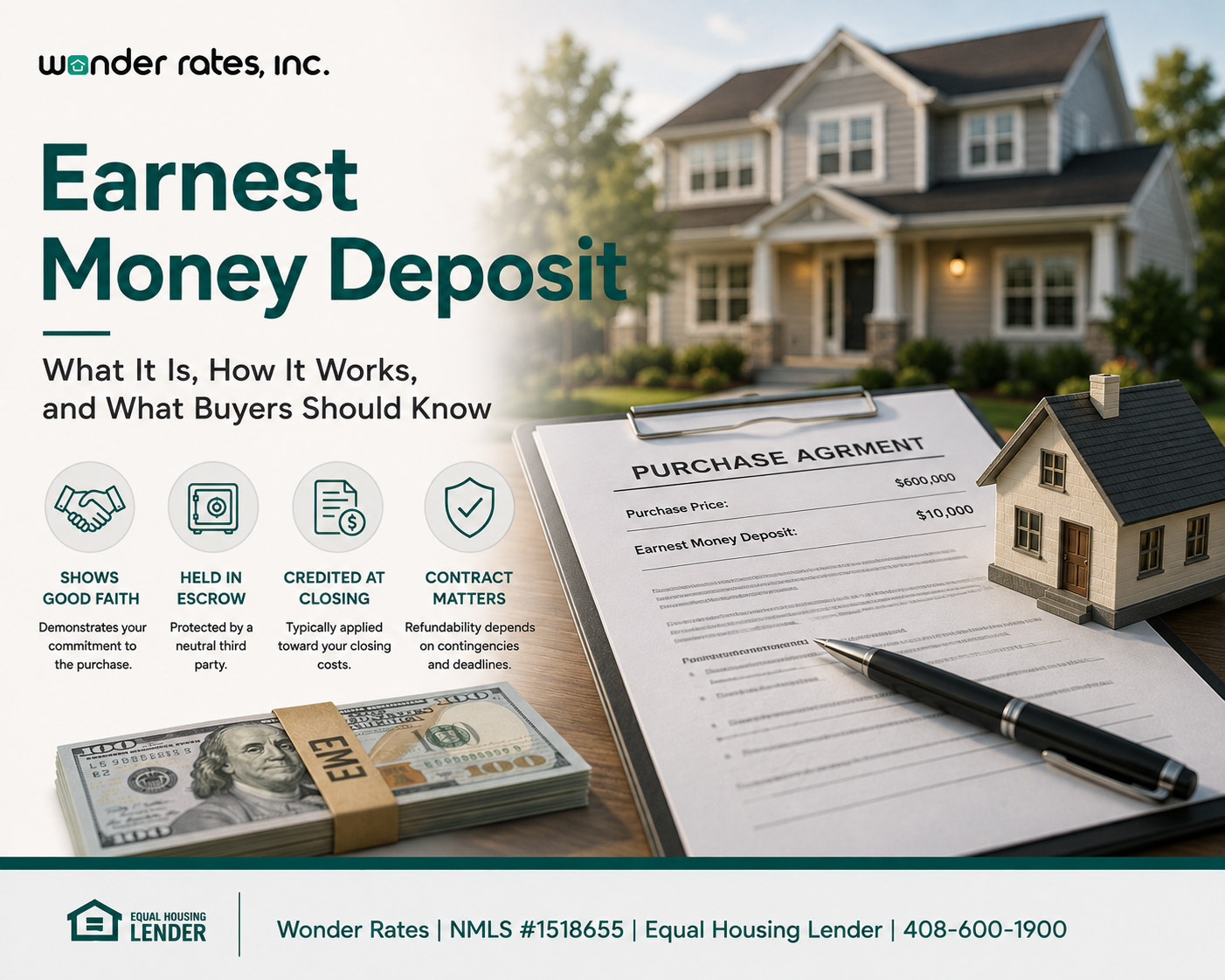
Here’s the short version. An earnest money deposit is money a buyer puts into a transaction after an offer has been accepted, as a way of demonstrating good faith and commitment to following through on the purchase contract. It is not simply a fee the buyer automatically loses. In a transaction that closes successfully, EMD is typically credited toward the funds the buyer needs to bring to closing, according to the purchase contract and closing documents.
It’s worth being careful here: earnest money isn’t legally required in every single transaction, and it would be inaccurate to describe it as mandatory across the board. Whether EMD is included, how much it is, and how it’s handled all depend on the purchase contract and the laws that apply in your state and locality. That said, in most markets, including some form of earnest money is standard practice, and an offer without it can look less serious to a seller.
Section 02
How Does Earnest Money Work?
It helps to walk through this as a sequence of steps rather than a single event.
Step 1: The buyer submits an offer
Say the purchase price is $600,000, and the offer specifies an EMD of $12,000.
Step 2: The seller accepts the offer
Once the contract is signed and accepted according to the proper process, the buyer generally has an obligation to submit the EMD within the timeframe specified in the contract, often within one to three business days of acceptance.
Step 3: EMD is held by an escrow holder or other authorized party
This is an important detail that surprises some first-time buyers. The money doesn’t go directly to the seller to use however they’d like. Instead, it’s typically held by a neutral third party specified in the transaction, such as a title company, escrow company, real estate brokerage, or attorney, depending on the requirements of that particular transaction and state.
Step 4: The transaction moves toward closing
While the deal is in progress, the buyer generally works through inspection, appraisal, financing, title work, and any other contractual requirements outlined in the purchase agreement.
Step 5: EMD is applied according to the transaction outcome
If closing is completed, EMD is typically credited toward the buyer’s closing funds, as reflected on the closing statement. If the contract is terminated in a way that’s valid under its terms, how the EMD is handled from there depends on the specific contract language and applicable law.
Section 03
How Much Is an Earnest Money Deposit?
This is an area where it’s tempting to give a simple percentage, but doing so would be misleading. There isn’t one fixed amount that applies to every transaction. EMD amounts are shaped by a mix of factors, including the local market, the purchase price, what the seller is expecting, how much competition exists for the property, the specific terms of the contract, the type of property, and how negotiations unfold. Industry sources generally place typical EMD in the range of about 1% to 3% of the purchase price, though this can run higher in especially competitive markets.
Illustrative example 1: A buyer and seller agree on an EMD of $5,000 for a $500,000 home. That works out to roughly 1% of the purchase price.
Illustrative example 2: For a $750,000 home, the contract specifies an EMD of $15,000, which comes out to roughly 2% of the purchase price.
These two examples are illustrative only and are meant to show how the percentage calculation works. They do not represent a standard or required EMD amount for any specific market or transaction. Actual amounts vary by negotiation, local custom, and the terms of the individual contract.
Why buyers should not focus only on the percentage
A larger EMD can sometimes make an offer look more appealing in a competitive situation, since it signals a stronger level of commitment. But before offering a larger amount, it’s worth asking a more important question: if this transaction doesn’t end up closing, how exactly will this money be handled?
Section 04
Is Earnest Money the Same as a Down Payment?
This is one of the most common points of confusion for first-time buyers, and the short answer is no, they are not the same thing.
Earnest money deposit
EMD is submitted earlier in the transaction, generally shortly after your offer is accepted, as a way of demonstrating your commitment to the purchase.
Down payment
Your down payment is the portion of the purchase price you’re paying with your own funds rather than financing, and it’s typically due at closing, not at the time your offer is accepted.
But EMD can become part of the buyer’s funds at closing
Here’s where it’s worth connecting the two. Say the purchase price is $500,000, with a 20% down payment of $100,000. The buyer already submitted an EMD of $10,000 earlier in the process. If the transaction closes as expected and the EMD is credited according to the closing statement, the buyer generally doesn’t need to think of this as bringing $100,000 plus a separate $10,000 to the table. The EMD can be credited toward the funds due at closing, reducing the additional cash the buyer needs to bring.
This example is illustrative only. The exact treatment of your EMD, including how and whether it’s credited toward your down payment or closing costs, will be reflected on your specific closing documents and depends on your transaction.
Section 05
Earnest Money vs. Closing Costs
This comparison trips up a lot of first-time buyers, so it’s worth spelling out clearly.
Earnest money
Submitted early in the transaction, generally shortly after the offer is accepted, primarily to demonstrate commitment under the purchase contract.
Closing costs
These are the various costs associated with closing and the mortgage transaction itself, and they vary depending on the loan type and the specifics of the transaction. Common categories include loan-related fees, title-related fees, recording fees, prepaid items, escrow-related amounts, and other applicable charges.
Why the distinction matters
Imagine a buyer with $100,000 in down payment funds, $10,000 already submitted as EMD, and an estimated $15,000 in closing costs. It would be a mistake to simply add these together and assume $125,000 in total cash is needed without reviewing the actual closing statement. Since EMD can be credited toward the funds due at closing, the true cash-to-close figure is often lower than a simple addition would suggest.
Section 06
Is Earnest Money Refundable?
This is one of the most important questions a buyer can ask, and the honest answer is: sometimes.
It would be inaccurate to say EMD is always refundable, and equally inaccurate to say it’s never refundable. Whether you can get your EMD back generally depends on the purchase contract, the contingencies included in it, the relevant deadlines, the reason for terminating the contract, applicable state or local law, and whether you complied with the contractual requirements along the way.
When EMD may be returned
Illustrative example: A buyer includes a financing contingency in their offer. Despite a good-faith effort, the buyer is unable to obtain financing under the conditions the contract allows, and follows the required procedure for terminating under that contingency before the applicable deadline. If the contract permits termination under those circumstances, the EMD may be returned to the buyer according to the contract’s terms.
This example is illustrative only and does not represent a guaranteed outcome. Whether EMD is actually returned depends on the exact language of your contract, applicable law, and whether all contractual requirements and deadlines were properly met.
When EMD may be at risk
If a buyer simply changes their mind after the contractual protections built into the contract no longer apply, that buyer may be at risk of losing their EMD. It’s worth being direct about this: “I changed my mind” does not automatically entitle a buyer to a refund. Once contingencies have expired or been waived, backing out for a reason the contract doesn’t cover can put the deposit at risk.
Section 07
How Contingencies Can Protect Your Earnest Money
Contingencies and earnest money are closely connected, which is why this deserves a closer look.
Financing contingency
This gives the buyer a window of time to secure financing under the terms specified in the contract.
Illustrative example: A buyer plans to finance $480,000 toward a $600,000 purchase. If financing isn’t approved under the conditions the contract allows, and the buyer follows the contingency requirements correctly, the EMD may be protected according to the contract.
This example is illustrative only and does not represent a guaranteed outcome for any specific loan or transaction. Financing approval, contingency terms, and how EMD is handled all vary by lender, loan program, and contract.
Inspection contingency
This gives the buyer the right to inspect the property according to the terms of the contract. If the inspection turns up a significant issue, such as a problem with the roof or foundation, the buyer’s options are defined by the contract itself. These can include requesting repairs, negotiating with the seller, or terminating under the applicable contingency, depending on what the contract allows.
Appraisal contingency
Illustrative example: A buyer offers $600,000, but the appraisal comes back at $570,000. At that point, the buyer generally needs to review the contract carefully to understand their available options, which can include renegotiating the price, bringing additional funds to cover the gap, proceeding under the originally agreed terms, or terminating if the contract permits it under those circumstances.
This example is illustrative only. A low appraisal does not automatically entitle a buyer to a refund of their EMD. The available options and outcome depend entirely on the specific contract language and how the parties choose to proceed.
Section 08
When Can You Lose Your Earnest Money?
This section deserves a clear, honest explanation, without trying to alarm buyers unnecessarily.
You back out without contractual protection
Illustrative example: A buyer decides, “I found a different house I like better,” after their contingency deadlines have already passed. If the buyer doesn’t have a contractual right to terminate at that point, and the seller has a right to claim the EMD under the contract or applicable law, the deposit can be at risk.
This example is illustrative only. Whether a buyer actually loses their EMD in a given situation depends on the specific contract terms, timing, and applicable law, not on the buyer’s reason alone.
You miss an important deadline
If a contract includes a deadline tied to a specific contingency, and the buyer doesn’t act within that window, it can affect the buyer’s rights going forward. Not every missed deadline automatically results in a lost deposit. The actual consequences depend entirely on what the specific contract says.
You fail to perform under the contract
If a buyer doesn’t fulfill a material obligation spelled out in the contract, the resulting treatment of the EMD depends on the contract terms and the law that applies in that jurisdiction.
Section 09
A $10,000 EMD Example From Offer to Closing
Following a single scenario through the full process can make these mechanics easier to understand.
The offer: Purchase price of $600,000, with a 20% down payment of $120,000, and an EMD of $10,000.
During escrow: The buyer completes inspection, secures financing, goes through the appraisal process, and completes title review.
At closing: The closing documents show the funds the buyer needs to bring to complete the down payment and applicable closing costs. The $10,000 EMD is credited according to the closing statement.
This example helps illustrate an important point: EMD isn’t necessarily an extra amount of money that disappears from the buyer’s total cost. It can become part of the funds applied toward the purchase itself.
This example is illustrative only and does not represent an actual transaction. The exact figures, credits, and cash needed at closing for any real transaction will be reflected on that specific buyer’s closing documents.
Section 10
What Happens to Your Earnest Money If the Deal Falls Apart?
Rather than a single answer, this depends on which of a few different scenarios applies.
The buyer terminates under a valid contingency
If the contract allows the buyer to terminate under a specific contingency, and the buyer follows the required process correctly, the EMD can typically be returned.
The buyer and seller disagree about who gets the EMD
This is where things can get complicated. The escrow holder generally isn’t in a position to unilaterally decide who’s right when there’s a dispute. Resolving a disagreement like this can require written instructions from both parties, a mutual release agreement, assistance from the brokers or Realtors involved, or in some cases, a legal process, depending on the circumstances and the jurisdiction.
The seller claims the buyer defaulted
If a seller asserts a right to the EMD based on an alleged default, this is a situation where the buyer generally benefits from professional or legal guidance rather than guessing at the outcome on their own.
Section 11
Does a Larger Earnest Money Deposit Make Your Offer Stronger?
This is where buyer psychology comes into play. A larger EMD can sometimes help in competitive situations, but it doesn’t automatically make an offer the winning one.
Illustrative example: Buyer A offers $600,000 with a $5,000 EMD. Buyer B offers $600,000 with a $15,000 EMD. It would be a mistake to assume Buyer B automatically wins. Sellers often weigh the full picture of an offer, including purchase price, financing terms, down payment, contingencies included, closing timeline, and the EMD amount together, not any single factor in isolation.
This example is illustrative only and does not represent a guaranteed outcome in any actual bidding situation. How a seller evaluates competing offers depends on their own priorities and the full terms of each offer.
Section 12
Should You Put More Earnest Money Down to Win a Bidding War?
This is a genuinely practical question many buyers face in a competitive market.
Scenario: A seller is fielding multiple offers, and your Realtor suggests that raising your EMD to $20,000 could make your offer stronger. Before agreeing, it’s worth asking yourself how much of your available funds you’d actually be putting at risk if the transaction doesn’t close. If your total liquid assets are around $30,000 and your proposed EMD is $20,000, a significant share of your cash reserves would be tied up in that single transaction. That can create real financial pressure, even if the transaction ultimately closes without issue.
A strong offer does not mean putting all your cash at risk
Before increasing your EMD, it’s worth thinking through your emergency reserves, your closing costs, your down payment, moving expenses, potential repairs, and other costs that come with homeownership right after closing. A stronger offer on paper isn’t worth much if it leaves you financially stretched the moment you move in.
Section 13
Earnest Money for First-Time Homebuyers
A few points tend to trip up buyers who haven’t been through this process before.
Don’t confuse EMD with money you automatically lose
As covered earlier, EMD is generally credited toward your funds due at closing in a successful transaction. It isn’t simply gone the moment you submit it.
Know your deadlines
It helps to keep a clear calendar of your EMD deposit deadline, your inspection deadline, your financing deadline, your appraisal deadline, and your closing date, so nothing catches you by surprise.
Ask where the money is being held
Before sending funds, it’s worth knowing who’s actually receiving the EMD, when it’s due, what documentation will confirm receipt, and what happens to it if the transaction terminates.
Section 14
What Buyers Should Ask Before Sending Earnest Money
How much is the EMD?
Ask for the actual dollar figure rather than just a percentage, so you know exactly what you’re committing.
When is it due?
Get a clear deadline in writing.
Who holds it?
Know exactly which party is holding your funds during the transaction.
Under what circumstances can I get it back?
This is arguably the single most important question to have answered before you send any money.
What deadlines affect my protection?
Understand your contingency deadlines clearly, since missing one can change your rights.
How will the EMD appear at closing?
Ask how the deposit will be credited on your closing documents, so there are no surprises about your final cash-to-close figure.
Section 15
Common Earnest Money Mistakes to Avoid
Thinking EMD is the same as a down payment
As covered earlier, these are two distinct concepts, even though EMD can ultimately be applied toward your down payment.
Assuming EMD is always refundable
It isn’t. Refundability depends entirely on your contract, your contingencies, and whether you met the required deadlines.
Ignoring contingency deadlines
A contingency only protects you if you understand it and follow the contract’s requirements exactly.
Putting down more EMD than you can comfortably afford
A competitive offer shouldn’t come at the cost of your financial flexibility or your safety net.
Moving money without documentation
If your EMD is coming from a different account or an unusual source of funds, it’s worth talking to your loan officer early to understand what documentation your lender might need.
Section 16
Earnest Money Deposit: The Bottom Line
What is EMD? A sum of money that demonstrates a buyer’s commitment under the purchase contract.
Is it the same as a down payment? No, but in a successful transaction, EMD is typically credited toward the buyer’s funds due at closing.
Can you get it back? Possibly, but this depends on your contract, your contingencies, your deadlines, and applicable law.
Should you offer a very large EMD? Not simply because it makes your offer look stronger on paper. Buyers need to balance competitiveness with their own financial safety.
Before submitting an earnest money deposit, it’s worth understanding not just how much you’re being asked to pay, but exactly how that money is protected under your specific contract.
Section 17
Sources
- Consumer Financial Protection Bureau (CFPB), Owning a Home
- National Association of Realtors (NAR), Earnest Money in Real Estate: Refunds, Returns and Regulations
- Fannie Mae Selling Guide
This article is provided for general educational and informational purposes only and does not constitute legal, financial, real estate, tax, mortgage, or investment advice. It does not constitute a commitment to lend. Earnest money requirements, amounts, deadlines, escrow procedures, refund rights, contingency protections, and remedies for contract breaches vary by purchase contract, state and local law, transaction structure, and the parties involved. An earnest money deposit may be refundable in certain circumstances, but it is not automatically refundable in every transaction. Examples and dollar amounts in this article are for illustration only and do not represent required or typical terms for every market or transaction. Buyers should review their purchase contract carefully and consult their Realtor, licensed mortgage professional, and qualified legal professional when appropriate before making decisions regarding earnest money.
Duc Pham, Mortgage Broker | NMLS# 844897 | 408-600-1900 | dp@wonderrates.com Wonder Rates, Inc. | NMLS# 1518655 | DRE# 02047445 | DFPI# 60DBO-59134 Equal Housing Opportunity. Equal Housing Lender. Licensed in: AL, AZ, CA, CO, FL, GA, LA, MI, NC, OH, OK, OR, PA, SC, TX, VA, WA