
Section 01
A blanket loan for multiple properties looks efficient on paper: one closing, one payment, one set of documents, and often better leverage than you could get financing each property on its own. For investors scaling past the limits of conventional financing, it can be the fastest way to grow. But the same feature that makes a blanket loan efficient, a single debt secured by many assets, is also what makes it dangerous.

Short answer: a blanket loan is cross-collateralized, meaning every property in the pool secures the entire loan balance, and it is almost always paired with cross-default, meaning a problem at one property can trigger a default on all of them. In a worst case, the lender can pursue every property in the pool, not just the one that failed. The key protections are the release clause, which sets how much you must pay down to free an individual property (commonly 110% to 125% of its allocated loan amount), and the covenants and cure rights that determine how much room you have when one asset underperforms. Understanding and negotiating these terms is the difference between a scalable financing tool and a single point of failure for your entire portfolio.
Section 02
How a Blanket Loan for Multiple Properties Is Structured
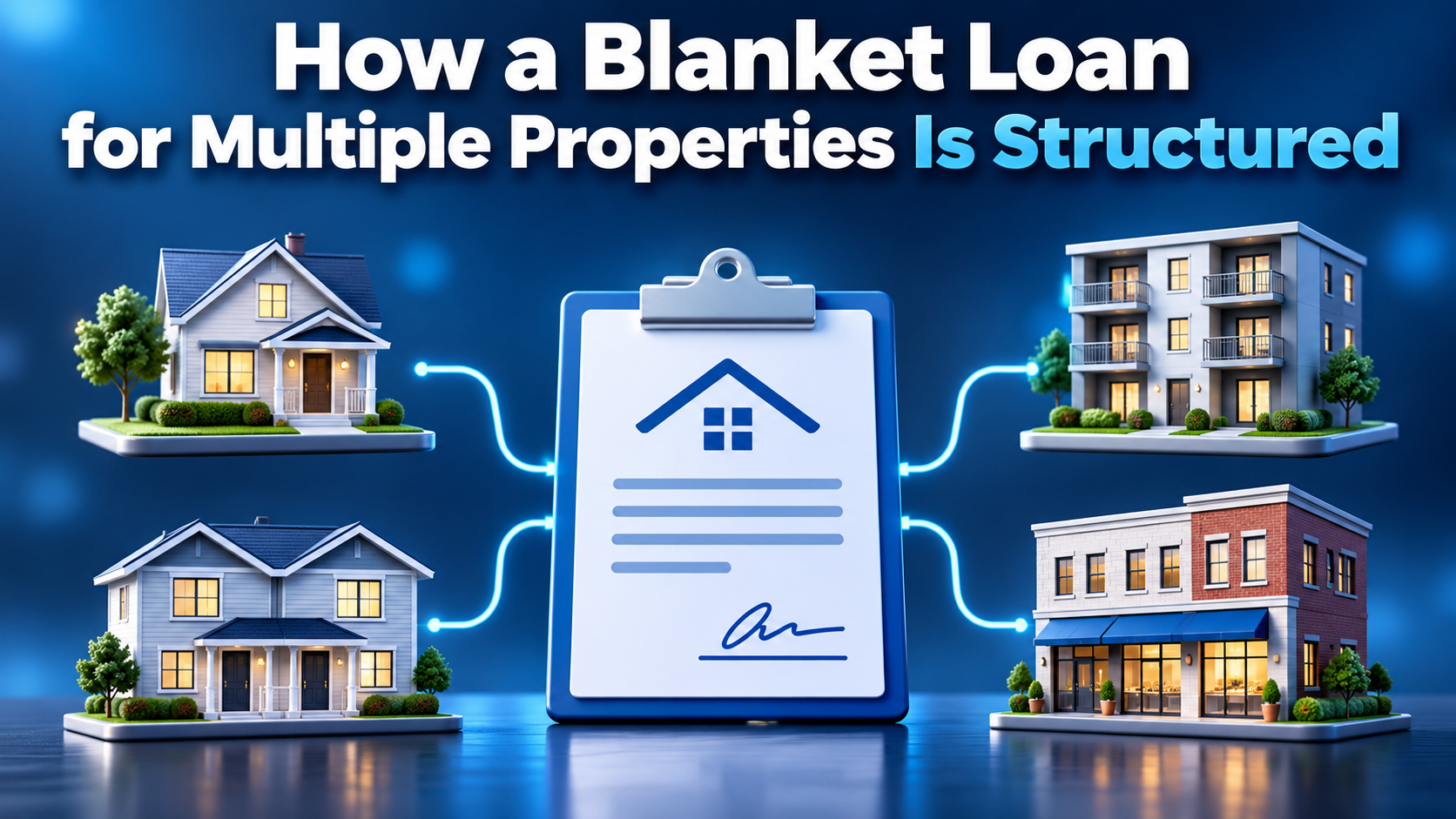
A blanket loan is a single promissory note secured by separate mortgages or deeds of trust recorded against each property in the pool. The lender underwrites the portfolio as a whole: aggregate value, aggregate net operating income and the borrower’s experience and liquidity. Rate, leverage and covenants are set at the portfolio level, not property by property.
Because Fannie Mae and Freddie Mac single-family programs finance one property per loan, blanket loans for residential investors come almost entirely from portfolio lenders, banks, debt funds and DSCR lenders. Investors often turn to them after running into the agencies’ cap on financed properties, explained in our guide to Fannie Mae’s financed property limit.
The allocated loan amount
Even though there is one loan, the documents usually assign each property an allocated loan amount (ALA). The ALA is typically based on each property’s share of total appraised value or net operating income. It does not limit what the lender can recover from that property; it is a bookkeeping figure used to calculate release prices, insurance requirements and certain covenant tests.
This distinction matters more than most borrowers realize. A property with a $250,000 ALA is still exposed to the full loan balance if the portfolio defaults. The ALA tells you what it costs to get a property out of the pool in good times, not how much risk it carries in bad times.
Typical terms
Terms vary widely by lender and market, but residential and small commercial blanket loans share some common features. Most are shorter than a 30-year residential mortgage, carry a balloon payment and include prepayment protection that limits how cheaply you can exit.
The table below summarizes terms you will commonly see. Treat it as a map of what to negotiate rather than a quote.
| Term | Common range or structure (reference) | Why it matters |
|---|---|---|
| Loan-to-value | Often up to about 70% to 75% of aggregate value | Lower leverage than single-property loans, but measured across the pool |
| Amortization and term | 20 to 30 year amortization, 5 to 10 year term with balloon | Creates a single refinance date for the whole portfolio |
| Rate | Fixed for an initial period or adjustable | Rate reset hits every property at once |
| Prepayment | Step-down penalties, yield maintenance or defeasance on larger loans | Raises the cost of selling or refinancing early |
| Covenants | Minimum DSCR, maximum LTV, reporting requirements | Breach can trigger cash sweeps or default even if payments are current |
| Recourse | Full recourse, partial recourse or non-recourse with carve-outs | Determines whether personal assets beyond the pool are exposed |
Section 03
Cross-Collateralization and Cross-Default: How One Property Puts the Pool at Risk
Cross-collateralization means each property secures not just its own allocated share but the entire debt. If the loan defaults, the lender is not limited to the property that caused the problem. It can enforce against any or all of the mortgaged properties until the full balance, interest, default interest and costs are recovered.
Cross-default is the trigger that turns a local problem into a portfolio problem. Under a typical cross-default and cross-collateralization clause, a default under the documents for one property, or under a related loan, is treated as a default under the whole facility. Together, the two provisions create a chain: one weak link can pull on every asset.
Defaults that are not about missed payments
Many investors think of default as failing to make the monthly payment. In a blanket loan, the more common triggers are covenant and technical defaults that can occur while every payment is current. Lenders draft these broadly because they are underwriting the pool’s combined cash flow and value.
Common non-monetary triggers include:
- Debt service coverage ratio falling below the required minimum on a trailing basis.
- Failure to maintain required insurance on any one property, including flood coverage where required.
- An unpaid property tax bill, HOA lien or mechanic’s lien on a single property.
- Unapproved transfer of a property or a change in ownership of the borrowing entity.
- Code violations, environmental issues or casualty losses that are not repaired on schedule.
- Late or missing financial reporting.
Remedies the lender can use
Once an event of default occurs and any cure period expires, the lender typically has a menu of remedies. These may include accelerating the entire balance, charging default interest, sweeping all rental income into a lender-controlled account, appointing a receiver and foreclosing on some or all of the properties.
Lenders often choose the path that recovers value fastest, which may mean foreclosing on your strongest, most liquid properties rather than the one that caused the problem. Blanket loan documents also commonly ask the borrower to waive the doctrine of marshaling, an equitable principle that can otherwise require a lender to look first to collateral that other creditors cannot reach. Ask counsel how marshaling, one-action rules and anti-deficiency laws apply in each state where your properties are located.
Section 04
Release Clauses and Partial Releases: Your Exit Valve
The partial release clause is the provision that lets you sell or refinance one property without paying off the entire loan. Without it, every sale would require refinancing the whole portfolio. With a poorly drafted one, you can technically sell, but the cost of releasing the property can consume most or all of your equity.
Not every blanket loan includes a meaningful release clause. Some buy-and-hold portfolio loans offer limited or no partial releases, on the assumption that the borrower will keep the pool intact until maturity. If you expect to sell individual properties during the term, this is the first clause to confirm.
How the release price works
The release price is usually set as a multiple of the property’s allocated loan amount. Industry practice commonly falls between 110% and 125% of the ALA, and some residential portfolio lenders ask for more. The premium above 100% is not a fee; it is applied to principal, which deliberately leaves the remaining pool more over-secured than before.
Many clauses add a second test: the release price is the greater of the ALA multiple and a percentage of the net sale proceeds, or the release must leave the remaining pool at or below a maximum LTV and at or above a minimum DSCR. These post-release tests can be stricter than the multiple itself, especially if you are selling your best-performing property.
Other release conditions to watch
Beyond the price, release clauses often include procedural and timing conditions. Each one adds cost, delay or a possibility that the lender can refuse the release even when you are ready to pay.
The table below lists the conditions that most often catch investors by surprise.
| Condition | What it means | Risk for the borrower |
|---|---|---|
| Release price multiple | Paydown of 110% to 125% or more of the ALA | Traps equity, especially on lower-value properties |
| Post-release LTV and DSCR tests | Remaining pool must still meet leverage and coverage minimums | Selling a strong asset can be blocked or require extra paydown |
| Prepayment consideration | Penalty, yield maintenance or partial defeasance on the released amount | Adds a cost on top of the release price |
| Lockout period | No releases allowed for an initial period | Prevents early sales even at a profit |
| No default condition | Releases allowed only if the loan is not in default | Removes the exit valve exactly when you need it most |
| Lender fees and documentation | Legal fees, title endorsements and release processing | Increases friction and closing timelines |
Section 05
Worked Example: How One Weak Asset Drags the Portfolio
Abstract clauses are easier to evaluate with numbers. This example follows a six-property single family rental portfolio financed with one blanket loan, then tests two common events: selling one property and losing income at another.
All figures are hypothetical and rounded. Rates, terms and covenant levels are assumptions chosen to illustrate the mechanics.
The portfolio
The investor owns six rentals with a combined value of $2.4 million. The blanket loan is $1.68 million, or 70% loan-to-value, at an assumed 7.5% rate with 30-year amortization, which works out to roughly $11,750 a month, or about $141,000 a year in debt service. Each property’s ALA is 70% of its value.
The portfolio produces about $190,000 a year in net operating income, for a debt service coverage ratio of about 1.35x. The loan requires a minimum DSCR of 1.25x, tested on a trailing 12-month basis.
Event 1: selling one property
The investor sells Property A, valued at $420,000, with an ALA of $294,000. Selling costs are about 7%, leaving net proceeds of roughly $390,600. The table compares the cash the investor keeps under different release prices, and against a standalone loan with the same 70% leverage.
The higher the release multiple, the more of the property’s equity is redirected to paying down the remaining pool.
| Structure | Required payoff for Property A | Cash to investor after sale |
|---|---|---|
| Standalone loan (100% of balance) | $294,000 | About $96,600 |
| Blanket loan, 110% release price | $323,400 | About $67,200 |
| Blanket loan, 125% release price | $367,500 | About $23,100 |
With a 125% release price, the remaining loan drops to $1,312,500 against $1.98 million of remaining value, about 66% LTV. The lender is now more protected than at closing, while the investor walked away with less than a quarter of the equity a standalone loan would have released.
Event 2: one property goes dark
Now suppose Property B loses its tenant, needs a $60,000 repair and produces no income for a year. Its roughly $31,700 share of NOI disappears, dropping portfolio NOI to about $158,300 and DSCR to about 1.12x, below the 1.25x covenant, even though the investor has never missed a payment.
Depending on the documents, that breach can trigger a cash sweep that redirects all rent from all six properties to the lender, a requirement to pay down principal to restore coverage, or an event of default. Under cross-collateralization, the five healthy properties are now exposed to a problem that started at one house. With six separate loans, the same vacancy would have affected only Property B’s financing. Run your own numbers with the Wonder Rates mortgage calculator before comparing structures.
Figures are illustrative only. Actual release prices, covenants and remedies depend on the specific loan documents and lender.
Section 06
Blanket Loan vs Individual Loans: The Real Trade-Off
The choice is not simply one loan versus several. It is a trade between operational efficiency and risk isolation. A blanket loan concentrates refinancing, rate and default risk into a single instrument, while individual loans keep each property’s problems contained.
For some portfolios, the efficiency is worth it: properties with similar quality and cash flow, a long hold horizon and a borrower with strong liquidity. For others, especially mixed-quality portfolios or investors who expect to sell assets one at a time, separate financing can be cheaper in the long run despite more paperwork.
Side-by-side comparison
The table below compares the two approaches across the factors that matter most for portfolio risk. Neither column is always better; the right answer depends on your strategy and the specific terms offered.
Pay special attention to the rows on default contagion and refinancing concentration, which are where blanket loans most often surprise investors.
| Factor | Blanket loan | Individual loans |
|---|---|---|
| Closings and administration | One closing, one payment, one servicer | Separate closings, payments and servicers |
| Access to financing beyond agency limits | Strong, a key reason investors use it | Limited by agency caps on financed properties |
| Default contagion | One property’s problem can trigger default on all | Problems usually stay with the affected loan |
| Selling one property | Release price, often 110% to 125% of ALA plus conditions | Pay off that loan only |
| Refinancing | Whole pool refinances at once at maturity | Staggered maturities spread rate and market risk |
| Rate risk | One reset affects every property | Mix of fixed and adjustable possible |
| Use of strong assets | Strong assets support weak ones | Each property must qualify on its own |
| Cost | Can be lower all-in, but rates often above agency loans | Agency rates possible for eligible properties |
When a blanket loan makes the most sense
Blanket financing tends to work best when the borrower has outgrown agency financing, the properties are similar in quality and location, cash flow is stable and the plan is to hold the pool together for most of the term. It can also be useful for quickly acquiring a package of properties from one seller.
It makes less sense when one or two properties carry most of the risk, when you plan to sell assets piecemeal, or when your liquidity would not cover a cash sweep or principal paydown if coverage dropped. In those cases, consider splitting the portfolio into smaller pools or keeping the riskiest assets on separate loans.
Section 07
Negotiating Blanket Loan Terms to Limit Portfolio Risk
Most of the risk in a blanket loan lives in the documents, not the rate sheet. Investors who negotiate only the interest rate often accept release, covenant and default terms that cost far more over the life of the loan. Experienced borrowers spend as much time on the term sheet’s back pages as on pricing.
Lenders will not concede everything, but many terms are negotiable, particularly for well-capitalized borrowers with strong portfolios. The goal is to keep the efficiency of a single loan while building in circuit breakers that stop one bad property from becoming a portfolio-wide crisis.
Terms worth fighting for
The items below address the specific failure points discussed earlier. Each one either lowers the cost of exiting a property or gives you more time and options when performance slips.
Prioritize them based on your strategy. An investor planning to sell assets should focus on release terms, while a long-term holder should focus on covenants and cure rights.
- Lower release multiple: push toward 110% of ALA, and ask for a step-down once the loan has amortized or the pool LTV falls below a set level.
- Fixed ALAs: lock allocated amounts at closing so the lender cannot reallocate them against your strongest properties later.
- Substitution rights: the ability to swap a property out and replace it with one of equal or better value and income, without paying down principal.
- Covenant cushion: set DSCR and LTV triggers with realistic headroom, test on trailing periods and allow equity cures such as a principal paydown or cash deposit.
- Cash management tiers: require a soft cash sweep first, with a hard sweep or default only after a longer breach.
- Notice and cure periods: written notice and meaningful time to cure non-monetary defaults before any remedy applies.
- Limited or carve-out recourse: where possible, limit personal liability to standard bad-act carve-outs rather than full recourse.
- Prepayment flexibility: step-down penalties instead of yield maintenance, and no lockout on partial releases.
Structuring around the loan
Terms are only one lever. How you structure ownership and the pool itself can also limit contagion. Some investors split a larger portfolio into two or three smaller blanket loans grouped by quality or market, so a problem in one pool cannot reach the others.
Others hold properties in separate single-purpose entities, keep the riskiest or most value-add assets on standalone financing such as bridge or hard money loans until they stabilize, and maintain a dedicated reserve sized to cover a cash sweep or covenant paydown. These choices cost some efficiency but buy resilience.
Section 08
Blanket Loan Due Diligence Checklist
Before signing a term sheet, stress test the loan against the scenarios that actually hurt portfolios: a sale, a vacancy, a rate reset and a maturity in a weak market. The checklist below turns the concepts in this guide into questions you can put to your lender and your attorney.
Work through it with real numbers from your portfolio. If you cannot answer an item, that is usually the clause to negotiate or the risk to price in.
- List each property’s ALA and confirm how it was calculated and whether it can change.
- Calculate the release payment for every property at the stated multiple, and the cash you would keep after selling costs.
- Identify any post-release LTV or DSCR tests and run them for selling your strongest asset.
- Map every event of default, separating payment defaults from covenant and technical defaults.
- Confirm notice and cure periods for each type of default.
- Model the DSCR impact if your weakest property goes vacant for 12 months.
- Understand the cash management structure and what triggers a sweep.
- Review recourse, guaranty and carve-out language with counsel.
- Check prepayment terms, lockout periods and whether they apply to partial releases.
- Note the maturity date and plan how you would refinance the entire pool in a higher-rate or lower-value market.
- Confirm how marshaling, one-action rules and anti-deficiency laws apply in each state where you own collateral.
- Size a liquidity reserve that could cover a covenant paydown or several months of a cash sweep.
Section 09
Blanket Loan FAQs
Investors considering a blanket loan tend to ask the same questions about risk, release terms and alternatives. The answers below summarize the key points in plain terms.
Because blanket loans are negotiated contracts, the specific documents always control. Use these answers to frame your questions for lenders and counsel.
What is cross-collateralization in a blanket loan?
Cross-collateralization means every property in the pool secures the entire loan balance, not just its own share. If the loan defaults, the lender can pursue any or all of the properties to recover what it is owed.
It is usually paired with cross-default, so a problem at one property can be treated as a default on the whole loan.
Can I lose all my properties if one goes into default?
It is possible. With cross-collateralization and cross-default, a default triggered by one property can allow the lender to enforce against the entire pool, depending on the documents and state law.
Cure rights, covenant cushions and your liquidity largely determine whether a single problem stays manageable or escalates.
What is a typical release price?
Release prices commonly range from 110% to 125% of the property’s allocated loan amount, and some lenders ask for more. Many clauses add post-release LTV or DSCR tests.
The premium above 100% goes to principal, so the remaining pool becomes more over-secured after each release.
Are blanket loans available from Fannie Mae or Freddie Mac?
Not for typical residential investors. Agency single-family programs finance one property per loan and cap the number of financed properties a borrower can have.
Blanket loans for residential portfolios usually come from banks, portfolio lenders, debt funds and DSCR lenders.
Is a blanket loan cheaper than separate mortgages?
Sometimes on closing costs and administration, but not always on rate. Blanket loans often price above agency loans and add prepayment and release costs.
The true comparison should include the cost of releasing properties you plan to sell and the risk of default contagion.
Can I add or swap properties later?
Only if the loan allows it. Some lenders offer substitution rights or accordion features to add collateral, while others treat the pool as fixed.
If you expect your portfolio to change, negotiate these rights before closing rather than after.
Section 10
Bottom Line
A blanket loan for multiple properties can unlock growth beyond agency limits and simplify a scaling portfolio, but it replaces many small, isolated risks with one large, connected risk. Cross-collateralization and cross-default mean a single vacant, damaged or mismanaged property can expose every asset in the pool, and release clauses priced at 110% to 125% of allocated loan amounts can trap equity when you try to sell. The investors who use blanket loans well treat the documents as the real price: they negotiate release terms, covenant cushions, cure rights and substitution rights, and they keep enough liquidity to absorb a bad year at one property.
Weighing a blanket loan against individual financing? Use the Wonder Rates mortgage calculator to model payments, then connect with Duc Pham and the Wonder Rates team to compare portfolio, DSCR and individual loan structures for your properties.
Disclaimer: This article is for general information only and is not legal, tax or financial advice. All figures are illustrative examples based on assumptions. Blanket loan terms, remedies and enforcement rules vary by lender, loan documents and state law. Review any loan agreement with a qualified attorney and confirm terms with a licensed lender before making decisions.




