Section 01
A buy now pay later mortgage review may be affected by BNPL obligations even when a pay-in-four account does not appear on a traditional credit report. A lender may learn about the payment through credit data, bank statements, asset-verification records, borrower disclosures, or another underwriting review.
One small payment may not change a file materially. Several overlapping purchases can increase monthly obligations, reduce available cash, and create questions during underwriting.
Section 02
Myth: BNPL Does Not Matter Because It Is Not on My Credit Report
The CFPB states that most pay-in-four providers historically have not reported repayment activity to the nationwide credit-reporting companies in the same way as many traditional loans. That does not make the obligation invisible or irrelevant.
BNPL can enter a mortgage file through:
- A credit report, when the provider or product reports data.
- Bank statements showing recurring withdrawals.
- Digital asset-verification data.
- A borrower application or explanation.
- A collection account after nonpayment.
- A longer-term installment product with traditional reporting.
Different BNPL products work differently. A four-payment purchase is not the same as a larger installment loan paid over many months.

Section 03
Reality: Credit Reporting and Credit Scoring Are Changing
FICO announced BNPL-specific versions of FICO Score 10 and FICO Score 10 T in 2025. These models are designed to incorporate BNPL data when that data is available.
That announcement does not mean every mortgage lender now uses a BNPL-enhanced score. Actual impact depends on:
- Whether the provider reports the account
- Whether the credit bureau receives and displays the data
- Which credit-scoring model the lender uses
- Which mortgage program and underwriting system apply
- Whether the account appears elsewhere in the file
Avoid two absolute statements: “BNPL never affects credit” and “every BNPL purchase now lowers mortgage scores.” Neither accurately describes all products and lenders.

Section 04
Myth: Four Small Payments Cannot Change DTI
DTI compares qualifying monthly debt with qualifying gross monthly income:
DTI = total qualifying monthly debt ÷ qualifying gross monthly income
Underwriting treatment depends on the program, remaining term, payment structure, documentation, and lender policy. There is no single BNPL category that produces one result for every mortgage.
Example: Small payments stack up
Educational example only. It does not state that every listed BNPL payment must be included under every mortgage program.
Assume a borrower has:
- Gross qualifying monthly income: $7,000
- Proposed housing expense: $2,400
- Auto payment: $450
- Credit-card minimum payments: $150
Before any BNPL obligation is included:
$2,400 + $450 + $150 = $3,000 monthly debt
$3,000 ÷ $7,000 = 42.86% DTI
Now assume the borrower has four active BNPL payments:
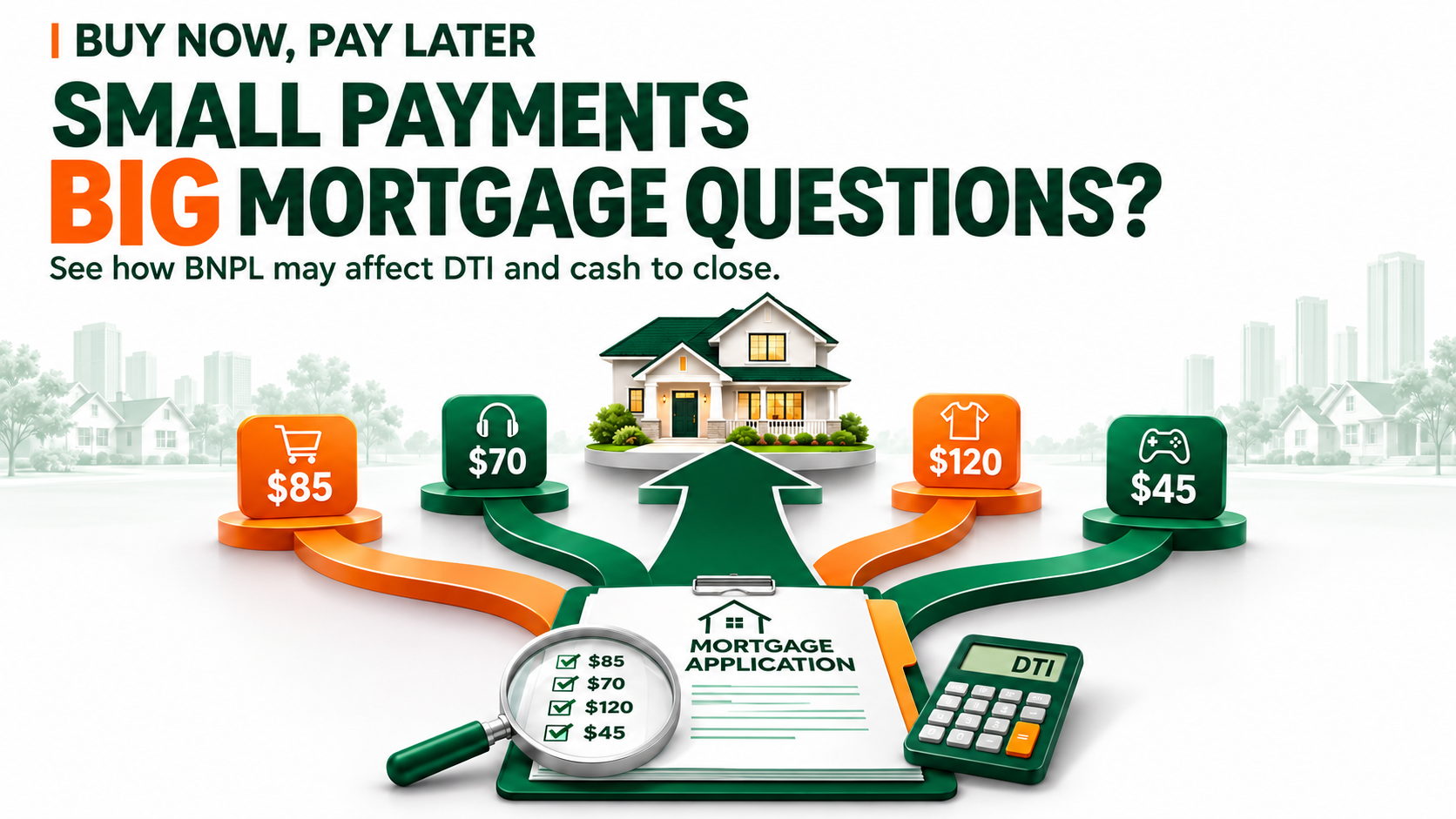
- Furniture: $85 per month
- Electronics: $70 per month
- Travel purchase: $120 per month
- Clothing purchase: $45 per month
Total BNPL payments = $320 per month
If the applicable underwriting treatment includes all four:
$3,000 + $320 = $3,320 monthly debt
$3,320 ÷ $7,000 = 47.43% DTI
The increase is approximately 4.57 percentage points. None of the payments looked large by itself. Together, they changed the calculation materially.
Use the Wonder Rates debt-to-income calculator to test the difference between including and excluding current payments. A calculator does not determine program treatment.

Section 05
Reality: Underwriters May Ask About Bank-Statement Withdrawals
Mortgage lenders review asset documents for reasons such as verifying funds to close, reserves, large deposits, and account ownership. Recurring payments to Affirm, Klarna, Afterpay, Zip, PayPal Pay in 4, or another provider may lead to questions.
An underwriter may request:
- Current BNPL statements
- Outstanding balances
- Required payment amounts
- Remaining installment dates
- Evidence that an account is paid off
- An explanation of recurring withdrawals
This does not mean every bank transaction is automatically treated as debt. It means the lender may need to understand a recurring obligation before completing the file.
The Wonder Rates Vietnamese guide Buy Now Pay Later là gì? explains how BNPL may appear during mortgage review.
Section 06
Myth: Paying BNPL on Time Means It Cannot Affect Approval
On-time payment and DTI are different issues.
Paying as agreed may prevent late fees, collections, or negative reporting. But if an active obligation must be included in monthly debt, it can still affect DTI.
BNPL can also affect liquidity. Frequent purchases may reduce the bank balance needed for:
- Down payment
- Closing costs
- Earnest money
- Required reserves
- Repairs and moving expenses
A borrower can have perfect payment history and still create a cash-to-close problem by stacking too many short-term purchases.
Section 07
Six Buy Now Pay Later Mortgage Checks Before Applying
1. Make a complete BNPL list
Record the provider, purchase, balance, monthly or scheduled payment, final payment date, and funding account.
. Stop opening new BNPL plans
Avoid creating new obligations before and during underwriting unless the loan officer has reviewed the effect. A new purchase may require updated documentation or another underwriting analysis.
3. Do not hide the accounts
Answer application and lender questions accurately. Omitting an obligation can cause more difficulty than the payment itself.
4. Ask before paying everything off
Payoff may reduce obligations, but it also uses cash. The money may be more important for closing costs or reserves. Ask the loan officer to model both scenarios.
5. Save payoff evidence
If an account is paid, retain the final statement, confirmation number, and bank record. A zero balance on an app screen may not be sufficient documentation.
6. Review credit and bank records
Obtain credit reports and examine the bank accounts that will be used for the transaction. Identify recurring payments before underwriting asks.
The CFPB recommends avoiding unnecessary new credit before or during the mortgage process. Wonder Rates also explains what happens during mortgage underwriting and common issues that delay closing.
Section 08
How Loan Officers Should Handle BNPL
Loan officers should not assume all BNPL is excluded or included. A careful workflow is:
- Ask whether the borrower has active pay-in-four or installment plans.
- Identify which accounts appear on credit.
- Review recurring payments in documents already required for the file.
- Obtain current balances and remaining terms when needed.
- Apply the current program and lender requirements.
- Document the decision instead of relying on a verbal assumption.
- Recheck before closing if new debt or payments appear.
For a broader liability review, see how debt-to-income ratio affects mortgage qualification and buying a home while paying off debt.
Section 09
Frequently Asked Questions
Does Klarna or Affirm affect mortgage approval?
It can. The effect depends on the product, reporting, outstanding payment, remaining term, loan program, and lender requirements.
Does BNPL appear on a credit report?
Some products or providers may report, while many pay-in-four transactions historically have not appeared like traditional loans. Reporting practices and credit models continue to change.
Can a lender see BNPL on bank statements?
Potentially. Recurring withdrawals may appear in statements or asset-verification data reviewed for the mortgage.
Should I pay off BNPL before applying?
Not automatically. Compare the DTI benefit with the loss of available cash. Ask the loan officer what documentation and treatment apply.
Can several small BNPL payments hurt DTI?
If the applicable underwriting method includes them, several small payments can add up and materially change the ratio.
Section 10
Review Small Debts Before They Become a Closing Surprise
Wonder Rates can review active BNPL obligations, calculate alternative DTI scenarios, and explain which documents may be needed under the proposed mortgage program. Request a mortgage readiness review.
Duc Pham, Mortgage Broker | NMLS# 844897
Wonder Rates, Inc. | NMLS# 1518655
Equal Housing Lender.
AZ, CA, CO, FL, GA, LA, MI, OK, PA, SC, TX, VA, WA, OH, AL, OR, NC
This article is for educational purposes only and is not a commitment to lend or credit advice. BNPL reporting, credit scoring, DTI treatment, documentation, and underwriting vary by provider, bureau, scoring model, mortgage program, investor, and lender and may change. Loan approval remains subject to current underwriting guidelines.