Section 01
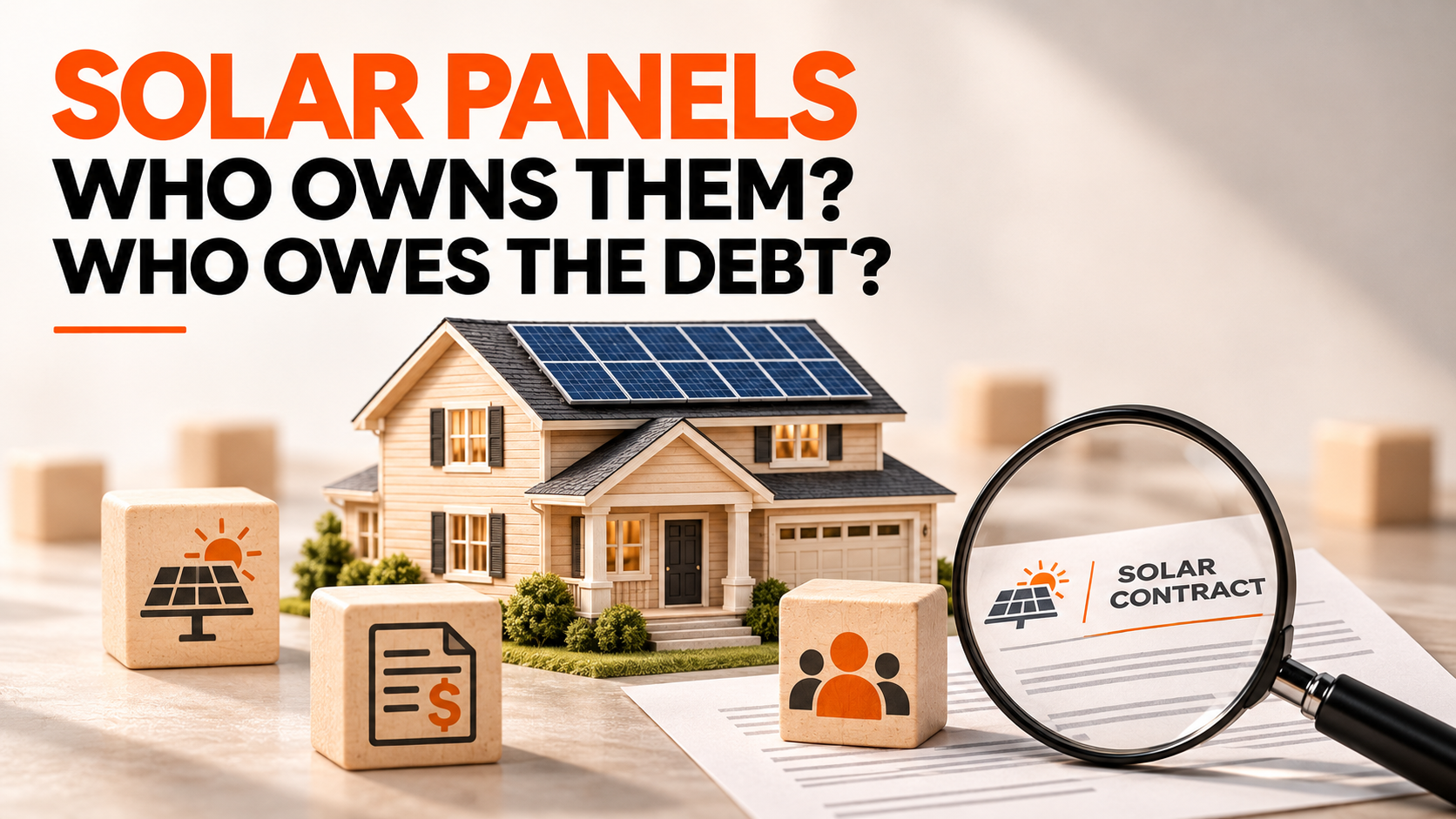
Buying a house with solar panels starts with one question: Who owns the system? Panels that are fully owned, financed through a separate solar loan, leased from a third party, covered by a power purchase agreement, or financed through a PACE assessment can receive different mortgage, title, appraisal, and DTI treatment.
Do not assume that a low electric bill means the solar arrangement will transfer easily. Obtain the complete contract and have the lender, title company, solar provider, insurance professional, and real estate agent review the parts relevant to their roles before important contingency deadlines.
Section 02
Start With This Solar Decision Tree
Ask the seller for the original purchase, financing, lease, or PPA documents. Then identify the structure.
| Solar structure | Who generally owns the panels? | Main mortgage question |
|---|---|---|
| Purchased and paid in full | Homeowner | Are the panels treated as part of the real estate and supported by title and appraisal documentation? |
| Included in the existing first mortgage | Homeowner | Is the existing mortgage being paid off through the sale? |
| Separate solar loan | Usually homeowner, subject to security documents | Will the debt be paid off, assumed, subordinated, or included in DTI and lien analysis? |
| Solar lease | Solar company or third party | Can the buyer qualify for and assume the lease, and how is the payment treated? |
| Power purchase agreement | Solar provider owns the equipment | Can the agreement transfer, and how is the energy payment structured? |
| PACE assessment | Depends on project documents | Must the assessment be paid off before or at closing? |
The label used in the listing may be wrong. “Solar included” does not prove the panels are owned free and clear.
Section 03
Scenario 1: The Solar Panels Are Fully Owned
This is often the simplest structure. The seller purchased the panels with cash, paid off the financing, or financed them through the existing mortgage that will be satisfied at closing.
The buyer’s team should still verify:
- Proof of ownership
- Evidence that any prior solar loan was paid
- Release of any related lien or UCC filing
- Transferable warranties
- Equipment condition and age
- Appraisal treatment
- Homeowners insurance requirements
- Permission or interconnection records when applicable
Owned panels may be considered in the appraisal when supported by market data and the applicable appraisal requirements. They do not receive a guaranteed dollar-for-dollar value merely because the seller paid a certain amount for installation.
The appraiser evaluates the property and market evidence. The loan officer should not promise that solar will increase value by a specific amount.

Section 04
Scenario 2: The Seller Has a Separate Solar Loan
A solar loan can be secured by the panels, reflected through a UCC filing, reported as personal debt, or structured another way. The lender and title company need the actual note and security documents.
Possible outcomes include:
- Seller pays off the solar loan at closing.
- Buyer assumes the solar financing if the provider and mortgage lender permit it.
- The payment is included in the buyer’s DTI.
- A lien or fixture filing must be subordinated or released.
- The appraiser cannot attribute contributory value to the panels under the applicable guideline.
Fannie Mae’s current guide distinguishes between panels treated as fixtures securing separate debt and panels treated as personal-property collateral. That distinction can affect DTI, LTV, CLTV, title priority, and appraisal treatment. 
Section 05
DTI example
Educational example only. Actual treatment depends on the program and documents.
Assume a buyer has:
- Gross qualifying monthly income: $10,000
- Proposed housing expense before solar obligation: $4,000
- Other qualifying monthly debt: $700
- Solar-loan payment the buyer must assume: $250
Without the solar payment:
($4,000 + $700) ÷ $10,000 = 47% DTI
If the program requires the $250 solar payment to be included:
($4,000 + $700 + $250) ÷ $10,000 = 49.5% DTI
The panels did not change, but the assumed debt changed the qualifying calculation.
Use the Wonder Rates DTI Calculator to test possible payment treatment. The lender must determine the final qualifying amount.
Section 06
Scenario 3: The Panels Are Leased
With a solar lease, a third party generally owns the system and the homeowner pays according to a lease contract. The buyer may need to qualify with the solar company and assume the remaining agreement.
Review:
- Monthly payment and escalation schedule
- Remaining term
- Transfer fee
- Credit or qualification requirements
- Buyout options
- Removal and roof-repair responsibilities
- Production guarantees
- Insurance provisions
- Default remedies
- UCC filings
- Requirements after foreclosure
Fannie Mae generally requires a lender to obtain and review the lease. The monthly lease payment may need to be included in DTI unless the agreement meets specific structural conditions described in the applicable guide.
Leased panels are not owned by the buyer, so their value generally cannot be included in the appraised value under that framework.

Section 07
Scenario 4: The Home Has a Power Purchase Agreement
Under a PPA, the provider generally owns the panels and sells the generated electricity to the homeowner under contract. The bill may change with energy production rather than remain a fixed lease payment.
The mortgage treatment can depend on how the payment is calculated. Fannie Mae, for example, distinguishes certain payments based solely on energy produced from fixed lease obligations.
The buyer should not rely on the seller’s recent electricity bill alone. Review the complete PPA for:
- Energy price per unit
- Annual price escalation
- Minimum purchase commitments
- Transfer requirements
- Contract term
- Buyout schedule
- System removal rights
- Roof and damage responsibility
- Provider remedies
The buyer should compare the long-term agreement with expected electricity use, not only with the seller’s usage.
Section 08
Scenario 5: The Solar Was Financed Through PACE
PACE financing is repaid through a property-tax assessment. It can have lien priority that conflicts with mortgage requirements.
Fannie Mae does not permit delivery of a loan on a property with a PACE obligation that is not paid in full before or at closing under its current rules. Other programs and lenders apply their own requirements.
The CFPB warns that PACE assessments increase property-tax obligations and may make selling or refinancing more difficult.
Read What Is PACE Financing? before assuming the assessment can remain with the home.
Section 09
What the Title Company Needs to Check
Solar financing can appear through a lien, fixture filing, precautionary UCC filing, tax assessment, or contract right.
The title company may need to determine:
- Whether a filing affects the real estate
- Whether it has priority over the new mortgage
- Whether payoff, release, or subordination is required
- Whether the title policy contains a solar-related exception
- Whether the seller has authority to transfer the system
A UCC filing is not automatically fatal to the transaction. Its content, collateral description, priority, and relationship to the property matter.
Review how title insurance and title searches work for broader context.
Section 10
What the Appraiser Can and Cannot Do
The appraisal is not a solar contract audit. The appraiser reports observable information and analyzes value under the assignment and program requirements.
Panels owned by a third party generally should not be valued as though the buyer owns them. Separately financed panels may also receive different treatment depending on whether they are collateral for another debt.
The buyer should provide ownership and financing documents early so the lender can give the appraiser accurate instructions.
Section 11
A Solar Review Checklist Before Removing Contingencies
- Ask whether the system is owned, financed, leased, under a PPA, or tied to PACE.
- Obtain every agreement and amendment.
- Request the current payoff or transfer package.
- Check the title report and property-tax bill.
- Confirm whether the buyer must qualify with the solar provider.
- Send the documents to the mortgage lender early.
- Ask how any payment will be treated in DTI.
- Confirm appraisal treatment.
- Review insurance and roof obligations.
- Identify fees, escalators, buyout terms, and remaining contract length.
- Verify warranties and maintenance responsibilities.
- Do not remove relevant contingencies until the appropriate professionals have reviewed the arrangement.
Solar documents can become a prior-to-docs condition. Wonder Rates explains why unresolved title, appraisal, and insurance items may delay closing in prior-to-docs and prior-to-funding conditions.
Section 12
Frequently Asked Questions
Is it harder to buy a house with solar panels?
Not necessarily. Fully owned panels with clear documentation may be straightforward. Separate financing, leases, PPAs, PACE assessments, liens, and transfer requirements can add review.
Does a solar payment count in DTI?
It may. Treatment depends on whether the system is owned, financed, leased, or covered by a PPA and on the applicable mortgage guideline.
Can the buyer assume the seller’s solar loan or lease?
Possibly, but the solar provider and mortgage lender must permit the arrangement. The buyer may need to qualify separately.
Do solar panels always increase appraisal value?
No. Ownership, financing, market evidence, property characteristics, and appraisal guidelines matter. Third-party-owned panels generally are not valued as buyer-owned improvements.
Can a PACE assessment remain after closing?
Some transactions may require it to be paid in full. Confirm the proposed mortgage program and lien structure before relying on a transfer.
Section 13
Buying a Solar Home?
Wonder Rates can review the proposed solar payment, identify lender documentation questions, and compare the mortgage file with and without an assumed obligation. Request a solar-home mortgage review.
Duc Pham, Mortgage Broker | NMLS# 844897
Wonder Rates, Inc. | NMLS# 1518655
Equal Housing Lender.
AZ, CA, CO, FL, GA, LA, MI, OK, PA, SC, TX, VA, WA, OH, AL, OR, NC
This article is for educational purposes only and is not a commitment to lend, legal advice, tax advice, appraisal advice, or solar-contract advice. Solar ownership, financing, title, appraisal, insurance, transfer, and underwriting requirements vary by transaction and may change. Review the complete agreements with qualified professionals.