Section 01
Your loan officer tells you the file came back “Refer with Caution” from one system but “Accept” from the other. Same income, same credit report, same house. To a borrower, it sounds like two judges reading the same case and reaching opposite verdicts. In conventional lending, that is exactly what can happen, and it is the reason most lenders run every eligible file through both systems.
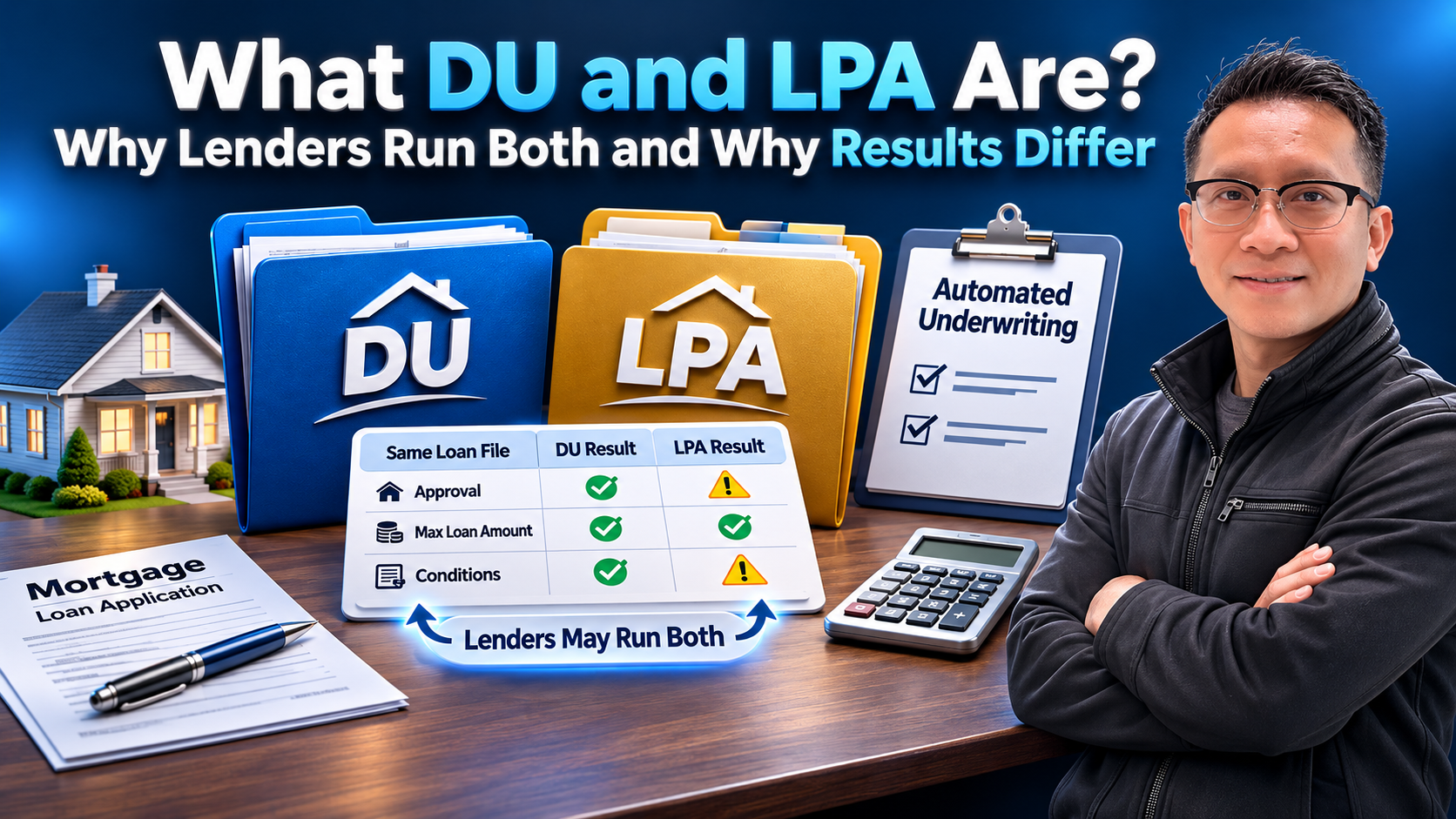
DU vs LPA is the comparison between Fannie Mae’s Desktop Underwriter and Freddie Mac’s Loan Product Advisor, the two automated underwriting systems (AUS) that decide whether a conventional loan is eligible for sale to each agency. They use different risk models and different guidelines, so the same borrower can get an approval from one and a caution from the other. Differences in how they treat student loans, 1099 income, rental income, reserves and appraisal waivers can change the DTI, the documentation required or the final verdict. Lenders that sell to both agencies run both to find the path with the best eligibility, documentation and pricing, as long as the data entered is the same and accurate.
Section 02
What DU and LPA Are and What Their Findings Mean
Desktop Underwriter (DU) is Fannie Mae’s automated underwriting system, and Loan Product Advisor (LPA) is Freddie Mac’s. Each one takes the loan application, credit report and property data, scores the overall risk, checks the file against that agency’s guidelines and returns a set of findings: a verdict plus a list of conditions the lender must satisfy.
The findings matter beyond approval. They tell the lender which documents are required, how much in reserves to verify, whether an appraisal can be waived and whether the loan can be sold to that agency. A lender that wants to deliver the loan to Fannie Mae generally needs a DU approval; one that wants to deliver to Freddie Mac generally needs an LPA accept.

How the findings are labeled
The two systems use different names for similar outcomes. Approve/Eligible in DU and Accept in LPA both mean the file meets the risk standard and, if the conditions are met, the loan is eligible for sale to that agency.
The weaker outcomes differ more in practice. A Refer with Caution in DU or a Caution in LPA usually means the system did not find the overall risk acceptable, and the file cannot be approved through that system as submitted. Some lenders may manually underwrite under specific programs, but many conventional lenders treat these results as a stop.
| Outcome | DU (Fannie Mae) | LPA (Freddie Mac) | What it generally means |
|---|---|---|---|
| Approved and eligible | Approve/Eligible | Accept | Meets risk standard and agency eligibility, subject to conditions |
| Risk approved, guideline issue | Approve/Ineligible | Accept with an ineligible message | Risk is acceptable, but a specific guideline is not met |
| Risk not accepted | Refer with Caution | Caution | Not approvable through the system as submitted |
| Cannot evaluate | Out of Scope or error messages | Incomplete or error messages | Data missing or loan outside what the system can assess |
Same score, different credit standards
Both agencies have moved away from a hard 620 credit score floor for AUS approvals. Fannie Mae removed the 620 minimum for DU loan casefiles created on or after November 16, 2025, following a similar approach Freddie Mac had already taken in LPA. Approval now depends on each system’s full risk assessment.
That makes the models themselves more important. Two systems weighing the same credit score, DTI, reserves and payment history differently can reasonably reach different verdicts, especially for files near the edge. Individual lenders can still apply their own minimum score as an overlay.
Section 03
Why DU and LPA Give Different Results
It is tempting to think one system is “easier” than the other. In reality, they disagree for three structural reasons: each uses its own risk model, each applies its own agency’s guidelines, and each connects to different data and verification tools. A file can land on the right side of one line and the wrong side of another.
Understanding which of the three is driving the difference tells the loan officer whether changing the submission, adding documentation or simply choosing the other system is the right move.
1. Different risk models
DU and LPA are built and trained separately by two different companies. Each weighs credit history, DTI, loan-to-value, reserves, property type and loan purpose in its own way. A borrower with a high DTI but large reserves might clear one model, while a borrower with a thin credit file but low DTI might clear the other.
This is why the results often split on borderline files and agree on clearly strong or clearly weak ones. Neither agency publishes its full model, so loan officers learn the patterns through experience rather than a formula.
2. Different guidelines
Even when the risk score is fine, the two agencies’ selling guides treat certain items differently. How a student loan with a $0 payment is counted, whether 1099 income must be treated as self-employment, and how some rental income is used are common examples, covered in the next section.
These guideline differences can change the inputs before any risk scoring happens. A different qualifying DTI or a different income figure can flip a borderline file from caution to approval, or the reverse.
3. Different data and verification tools
Each system connects to its own verification services. Fannie Mae’s DU validation service and Freddie Mac’s asset and income tools can verify income, employment and assets electronically, and when they succeed they can reduce the documents a lender must collect. One system may validate a borrower’s data while the other cannot, which changes the conditions rather than the verdict.
Credit inputs are also evolving. As of July 2025, the agencies began permitting lenders to use VantageScore 4.0 alongside traditional scores, adding another variable to how each system reads the same credit history over time.
| Source of difference | What changes | Typical effect |
|---|---|---|
| Risk model | How the overall file is weighed | Approve in one, caution in the other on borderline files |
| Guidelines | How specific debts, income and assets are counted | Different DTI, income or eligibility |
| Verification tools | Which data is validated electronically | Different documentation conditions |
| Credit inputs | Score models and how credit data is read | Small shifts that matter near thresholds |
Section 04
Key Guideline Differences That Flip Results
Most real-world DU vs LPA splits trace back to a handful of guideline differences. Each one changes a number that feeds the risk model, usually income or monthly debt, or changes what documentation is required.
The items below are the ones loan officers check first when a file is close. Guidelines change, so treat the table at the end as a starting point to confirm against the current selling guides.
Student loans with a $0 or low payment
Student loans are the most common reason for a split. Under Fannie Mae’s monthly debt guidance, a documented $0 payment under an income-driven repayment plan can generally be used as the qualifying payment. Under Freddie Mac’s guidance, when the reported payment is $0, the lender generally uses 0.5% of the outstanding balance instead.
For a borrower with a large balance on a $0 IDR plan, that single rule can move DTI by several percentage points. The example in the next section shows how much.
1099 income
Income reported on Form 1099 for services is generally analyzed as self-employment income under Fannie Mae rules. Freddie Mac permits a non-self-employed treatment only when its specific requirements are met. That path still deducts applicable Schedule C expenses; it is not a way to ignore large business deductions. Ask the lender which treatment and documentation apply to the file.
Appraisal waivers and property data
Fannie Mae’s value acceptance and Freddie Mac’s ACE program each decide, using their own models and data, whether a traditional appraisal can be waived. One system may offer a waiver while the other requires a full appraisal on the same property.
A waiver can save time and cost, and it removes the risk of an appraisal coming in low. When both systems approve, a lender may prefer the one that offers the waiver, as long as the borrower is otherwise well served.
Other items worth checking
Several smaller differences show up regularly: how rental income from an accessory dwelling unit can be used, documentation for business assets, and reserve requirements for certain properties.
None of these alone guarantees a different result, but in a borderline file any one of them can be decisive. That is why experienced loan officers compare both findings line by line, not just the headline verdict.
| Item | Fannie Mae (DU), general approach | Freddie Mac (LPA), general approach |
|---|---|---|
| Student loan with $0 IDR payment | Documented $0 payment can be used | 0.5% of balance used when reported payment is $0 |
| 1099 income | Treated as self-employment income | May qualify for non-self-employed treatment under specific conditions; applicable Schedule C expenses still reduce income. |
| Appraisal waiver | Value acceptance, based on Fannie Mae’s model | ACE, based on Freddie Mac’s model |
| ADU rental income | More limited, depends on program | Allowed in more situations under conditions |
This table is a simplified reference. Requirements depend on current guidelines, AUS findings and lender overlays.
Section 05
Example: Same Borrower, Two Different Outcomes
The example below isolates the student loan rule to show how one guideline difference can change the numbers each system sees. All figures are hypothetical and rounded, and other factors in a real file could change the results.
The borrower earns $6,000 a month. The proposed housing payment, including taxes and insurance, is $2,100, and there is a $400 car payment. The borrower is on an income-driven repayment plan with a documented $0 monthly payment.
Scenario A: $60,000 student loan balance
With DU, the documented $0 payment is used, so total monthly debt is $2,100 + $400 = $2,500 and DTI is about 41.7%. With LPA, 0.5% of $60,000, or $300, is counted, so total debt is $2,800 and DTI is about 46.7%.
Both figures are under a 50% ceiling, so both systems may approve. But the five-point difference can push LPA toward a caution if the borrower also has modest reserves or a thinner credit file.
Scenario B: $150,000 student loan balance
With a larger balance, the gap widens. DU still counts $0, keeping DTI at about 41.7%. LPA counts 0.5% of $150,000, or $750, bringing total debt to $3,250 and DTI to about 54.2%, above the 50% ceiling that typically applies.
In this case, the same borrower is likely approvable through DU and not through LPA. This is exactly the kind of file where running both systems changes the outcome. Use the Wonder Rates mortgage calculator to see how the housing payment moves with price and rate.
| Measure | Scenario A: DU | Scenario A: LPA | Scenario B: DU | Scenario B: LPA |
|---|---|---|---|---|
| Student loan balance | $60,000 | $60,000 | $150,000 | $150,000 |
| Student loan payment counted | $0 | $300 | $0 | $750 |
| Total monthly debt | $2,500 | $2,800 | $2,500 | $3,250 |
| DTI on $6,000 income | About 41.7% | About 46.7% | About 41.7% | About 54.2% |
Figures are illustrative, rounded and based on the assumptions above. Actual findings depend on the full file, current guidelines and lender overlays.
Section 06
Why Lenders Run Both and How They Choose
A lender approved to sell loans to both Fannie Mae and Freddie Mac can deliver a conventional loan to either agency, as long as it has that agency’s approval. Running both systems costs little and gives the lender two chances to find an eligible path, plus a way to compare the conditions each one sets.
Not every lender runs both. Some sell mostly to one agency or through an investor that prefers one system. How a lender sells its loans, whether directly or through a correspondent or wholesale channel, shapes which system it uses by default.
What lenders compare
When both systems approve, the decision is about the best path rather than any path. The lender looks at which findings require fewer documents, whether either offers an appraisal waiver, which reserve requirement is lower, and how the loan will price and sell.
When only one system approves, the choice is usually made for them. That is the scenario where running both turns a likely denial into an approval.
| Factor | What the lender checks | Why it matters to the borrower |
|---|---|---|
| Eligibility | Approve/Eligible or Accept | Whether the loan can close as a standard conventional loan |
| Conditions | Number and type of documents required | Speed and stress of the process |
| Appraisal | Waiver offered or full appraisal | Time, cost and low-appraisal risk |
| Reserves | Months of payments to verify | How much cash must stay in the bank after closing |
| Pricing and delivery | Agency execution and investor preference | Rate and fees offered |
Running both has limits
Running both systems is legitimate only when both are evaluating the same, accurate information. Changing income figures, omitting debts or adjusting data just to get a better result is not “shopping” the AUS; it is a misrepresentation that can create serious problems for the borrower and the lender.
Resubmitting is normal when real information changes, such as a corrected credit report after a rapid rescore, a paid-off debt or updated income documentation. The final findings must match what is actually in the file at closing.
Section 07
What Borrowers Can Do When the Results Differ
Borrowers do not run DU or LPA themselves, but they influence the result more than they think. Most of the levers are about giving the lender complete, accurate information early, so both systems evaluate the strongest true version of the file.
The steps below help whether you are pre-approved and waiting, or have just heard that one system came back with a caution.
Ask the right questions
Ask your loan officer whether they ran both systems and, if not, whether they can. If they did, ask which items made the difference: DTI, reserves, credit, a specific debt or the property. Knowing the driver tells you whether a fix exists.
If a student loan is the issue, ask how each system is counting the payment and whether better documentation of your repayment plan would change it. If income is the issue, ask how each agency is treating your income type.
Improve the inputs, not the story
Legitimate changes can move a file: paying down a revolving balance to lower the payment and utilization, adding documented reserves, correcting a credit report error, or choosing a slightly lower price or larger down payment to bring DTI down.
What does not work, and should never be tried, is leaving out a debt or overstating income. Both systems rely on the information being accurate, and loans approved on false data can be repurchased or worse. Lenders must also make a good faith determination of ability to repay, independent of the AUS verdict.
| Situation | Common legitimate fix | Who acts |
|---|---|---|
| DTI slightly too high | Pay down a debt, adjust price or down payment | Borrower and loan officer |
| $0 IDR student loan | Document the repayment plan; compare DU and LPA treatment | Borrower provides documents; lender compares |
| Thin reserves | Document additional eligible assets | Borrower |
| Credit report error | Dispute and rescore through the lender | Lender with borrower |
| One system cautions, the other approves | Deliver through the approving agency if the lender can | Lender |
DU vs LPA Checklist for Borrowers
A few early steps help your loan officer get the most from both systems. Most of them are about documentation, since both DU and LPA can only evaluate what is in the file.
Use the list below before or during pre-approval.
- Ask whether your lender can deliver loans to both Fannie Mae and Freddie Mac, and whether they run both DU and LPA.
- List every debt accurately, including student loans, and gather documents showing your current repayment plan and payment.
- If you earn 1099 or self-employment income, ask how each agency will treat it and which documents each requires.
- Document all eligible assets, since reserves can change the risk assessment.
- Review your credit report for errors before applying and ask about a rescore if needed.
- If one system cautions, ask which factor drove it and whether the other system approved.
- Compare conditions, appraisal requirements and pricing when both systems approve.
- Keep all information consistent and accurate across every submission.
Section 08
DU vs LPA FAQs
Borrowers tend to ask the same questions when they hear about two underwriting systems. The answers below summarize how lenders generally use them.
Guidelines and lender practices change, so confirm details with your loan officer.
What is the difference between DU and LPA?
DU is Fannie Mae’s automated underwriting system and LPA is Freddie Mac’s. Each assesses risk with its own model and applies its own agency’s guidelines.
A conventional loan generally needs an approval from the system of the agency it will be sold to.
Why would DU approve and LPA not, or the reverse?
Because the risk models are different and some guidelines differ, such as how a $0 student loan payment or 1099 income is counted.
Borderline files are the most likely to get split results.
Is one system easier than the other?
Not overall. Each is more favorable for certain profiles and less for others, which is why lenders that can use both often run both.
The better system depends on the specific file.
Is it allowed to run both systems?
Yes, when the lender can sell to both agencies and the same accurate information is submitted to each. Changing data to get a better result is not acceptable.
Resubmitting after real changes, such as a corrected credit report, is normal.
Does a Refer with Caution or Caution mean I am denied?
It means that system did not approve the file as submitted. The other system may approve, the file may improve with real changes, or another loan program may fit.
Ask your loan officer what drove the result.
Do FHA and VA loans use DU or LPA?
FHA loans are evaluated with FHA’s TOTAL Mortgage Scorecard, which lenders often access through DU or LPA. VA loans have their own underwriting standards, also commonly run through these systems.
The guideline differences in this article apply mainly to conventional loans.
Section 09
Bottom Line on DU vs LPA
DU and LPA are the gatekeepers for conventional loans sold to Fannie Mae and Freddie Mac. Because each uses its own risk model, its own guidelines and its own verification tools, the same borrower can receive an approval from one and a caution from the other. Student loan payments, 1099 income, appraisal waivers and reserves are common reasons. Lenders that can sell to both agencies run both systems to find the strongest eligible path, compare conditions and pricing, and avoid unnecessary denials, always using the same accurate data. For borrowers, the best strategy is complete documentation and a loan officer who checks both.
Got a caution from one system or want a second look before you apply? Connect with Duc Pham and the Wonder Rates team to review how DU and LPA see your file and choose the best path to approval.
Disclaimer: This article is for general information only and is not financial or legal advice. All figures are illustrative examples based on assumptions. DU and LPA findings depend on the complete loan file, current agency guidelines and lender overlays, and guidelines change. Confirm with a licensed loan officer before making decisions.
Duc Pham, Mortgage Broker | NMLS# 844897,
Wonder Rates, Inc. | NMLS# 1518655 | DRE# 02047445 | DFPI# 60DBO-59134 |
Equal Housing Opportunity. Equal Housing Lender. |
Licensed in: AL, AZ, CA, CO, FL, GA, LA, MI, NC, OH, OK, OR, PA, SC, TX, VA, WA.