
Section 01
Yes, retirees can qualify for a conventional mortgage. Being retired does not stop you from getting a home loan. You also do not need a paycheck from a job to be approved. Social Security, a pension, and some retirement account payments may count. They just need to meet the lender’s rules for proof and for how long they will last.
For most retirees, the challenge is not being retired. It is proving your income and assets the way the lender needs. You also need to show the new payment fits your budget. Retirement changes your paperwork, not your eligibility.
This guide walks through the conventional mortgage requirements for retirees step by step. You will learn how lenders look at Social Security, pensions, and retirement accounts. You will also see how savings, debt, credit, and down payment fit in. Then we cover the papers you may need and what can make a loan harder to get.
Section 02
Can Retirees Qualify for a Conventional Mortgage?
Does Being Retired Disqualify You From a Conventional Mortgage?
No. Retirement status is not a requirement or a roadblock by itself. Instead, the lender looks at your income, assets, debts, and credit. It also looks at the home and your overall ability to repay.
It also helps to know that federal fair lending law protects older borrowers. Under the Equal Credit Opportunity Act, lenders generally cannot turn you down because of your age. You just need to be able to legally sign a contract. What matters is your financial picture, not your birthday.
What Changes After Retirement?
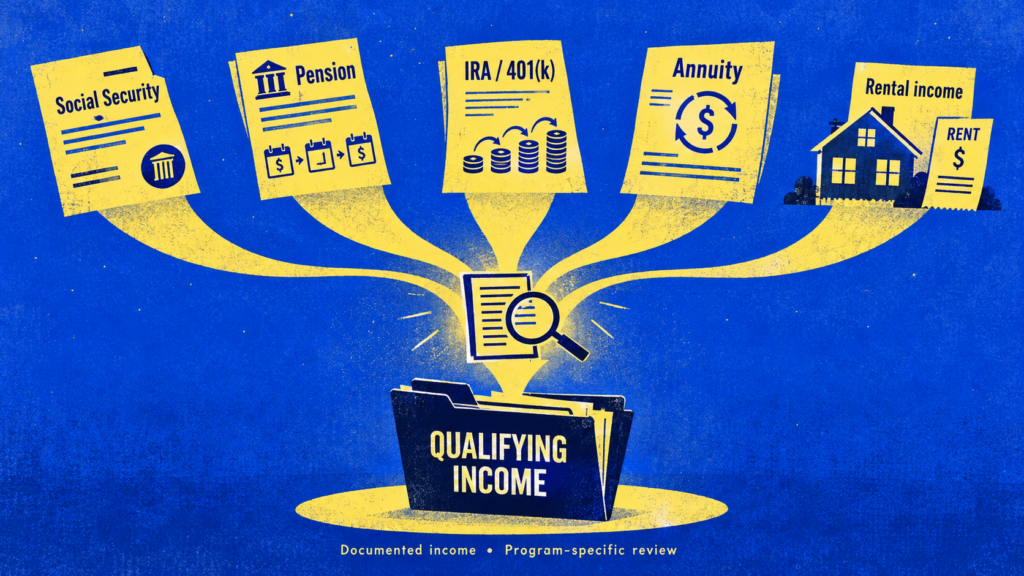
The biggest change is that your regular paycheck may stop. In its place, your qualifying income may come from several other sources:
- Social Security benefits
- A pension
- Payments from a retirement account, such as an IRA or 401(k)
- Annuity payments
- Interest or dividend income, where allowed
- Rental income from a property you own
- Other income that comes in on a regular schedule and can be documented
Not all of these will count. Each source has its own rules, which we cover below.
Why Retirement Income Requires Different Documentation
When you worked, a lender could look at recent pay stubs, a W-2, and a call to your employer. Once you retire, those records may not exist anymore.
So the lender may ask for different proof instead. This can include an award letter, bank statements, and account statements. Tax papers and pension letters may help too. In some cases, you may also need proof that the money will keep coming.
Section 03
What Are the Main Conventional Mortgage Requirements for Retirees?
Here is a quick look at what lenders may review.
| Requirement | What Lenders May Review |
|---|---|
| Qualifying income | Social Security, pension, retirement distributions, other eligible income |
| Assets | Retirement accounts, liquid assets, reserves |
| Credit | Credit history and score |
| DTI | Monthly debt relative to qualifying income |
| Down payment | Funds required for the selected loan structure |
| Reserves | Remaining assets after closing, when required |
| Property | Appraisal, condition, occupancy and eligibility |
| Documentation | Evidence supporting income, assets and liabilities |
There is no single checklist that applies the same way to every retired borrower. The exact rules depend on the loan type and the results from the lender’s approval software. Extra lender rules, the home, how you use it, and your loan-to-value ratio matter too.
Section 04
Income Requirements for Retirees
Income is the heart of any mortgage application, and it is where retirees have the most questions. Many conventional loans follow rules from Fannie Mae or Freddie Mac. So this guide uses Fannie Mae’s current Selling Guide as the main example. Other programs and lenders may have their own rules.
Social Security Income
Social Security can be used as qualifying income when it is properly documented. Fannie Mae’s rules for Social Security income allow several ways to prove it. The right one depends on the type of benefit. We dig deeper into Social Security in the next section.
Pension Income
A pension can also count. Fannie Mae has rules for annuity, pension, or retirement income. Under them, the lender must confirm the amount you get now. A statement from the pension plan or a benefit letter can do this. So can a bank statement, a signed tax return, a W-2, or a 1099.
For a fixed pension payment, Fannie Mae requires no minimum history of receipt. The monthly amount you document may be used as qualifying income.
Retirement Account Distributions
Many retirees take regular payments from an IRA, 401(k), or 403(b). These distributions may count as income, but the rules are stricter than for a pension. Fannie Mae’s guide adds a rule here. The lender must show these payments should last at least three years from when you apply.
Here is the key idea. Having $1 million in a retirement account does not mean you have $1 million of qualifying income. The lender looks at the payments you actually get. In some cases, it uses a set formula, which we explain later.
If your payment changes each month, Fannie Mae needs a 12-month history. It then uses the average. If the payment is fixed, no minimum history is required.
Annuity Income
Regular annuity payments may also count, under the same Fannie Mae section that covers pensions and retirement income. For a personal or insurance annuity, the lender must show the payments should last at least three years.
Rental Income
If you own a rental property, that rent may help you qualify. Still, lenders do not simply add the full rent to your income. They follow set rules, and the amount they use can be lower than what you collect. To learn more, read our guide on how lenders evaluate multiple income sources.
Section 05
Can Social Security Income Be Used to Qualify for a Conventional Mortgage?
Yes, Social Security is one of the most common income sources for retired borrowers. Here is how it generally works under Fannie Mae’s current rules.
What Documentation May Be Required?
Say you draw Social Security based on your own work record. The lender may check it with an SSA award letter or a Form SSA-1099. Your latest signed tax return works too, as does proof of current receipt, such as a bank statement. A new award letter may also work if your benefits start by your first mortgage payment.
If you receive benefits based on someone else’s record, such as a spouse, the rules are tighter. In that case, Fannie Mae asks for an award letter and proof you get the money now. You also need proof it will last at least three years.
Grossing Up Social Security Income
Some income is not fully taxed. Because of that, lenders may “gross up” the untaxed part. That means they raise it a little when they figure your income. This reflects that a dollar of untaxed income goes further than a dollar of taxed income.
Under Fannie Mae’s rules, the lender may treat 15% of the benefit as untaxed with no extra proof. It can then increase that 15% portion by 25%. To gross up more than 15%, the lender needs extra proof that more of the income is untaxed. This is an option under one agency’s rules. So do not assume every lender will use it.
Here is how the math works on $3,000 a month in Social Security:
- Nontaxable portion: $3,000 × 15% = $450
- Gross-up amount: $450 × 25% = about $113
- Qualifying Social Security income: about $3,113 a month
Disclaimer: This is a hypothetical example for educational purposes only. It follows the structure of Fannie Mae’s published Social Security example, but actual gross-up treatment depends on current agency guidelines, lender requirements, documentation, and the borrower’s tax situation. It is not a statement of qualifying income or loan approval.
Does Social Security Need to Continue?
That depends on whose record the benefits come from. Take retirement benefits based on your own work record. Fannie Mae says lenders do not need to prove these will last. The exception is when they have reason to think the money may stop.
Other cases are different. For benefits drawn on another person’s record, the lender must show the income should last at least three years. This matters because the lender is judging whether you can keep making payments over time.
Section 06
Can Retirement Accounts Be Used to Qualify for a Conventional Mortgage?
Retirement accounts can help in more than one way. It is important to keep these roles separate, because each one has its own rules.
Using Retirement Account Distributions
The first role is regular income. If you already take set payments from an IRA or 401(k), those payments may count as income. As noted above, the lender must show they can continue for at least three years.
To check this, a lender may see if your balance can keep paying at your current rate for three years. Fannie Mae lets eligible 401(k), IRA, and Keogh balances be added together for this check. You must have full access to them without a penalty.
For example, if you take $2,000 a month, three years of payments adds up to $72,000. A lender might look at whether your eligible balances support that amount.
Disclaimer: This simplified example is for illustration only. It ignores taxes, investment gains or losses, and other factors. How a lender documents three-year continuance depends on current guidelines, account details, and lender requirements.
Using Retirement Assets as a Source of Funds
The second role is cash for the purchase. Retirement accounts may help pay for the down payment, closing costs, or reserves. It depends on your access to the money, who owns the account, and the rules. Fannie Mae has separate rules for how retirement accounts are counted as assets.
Before you pull money from a retirement account, it is wise to talk with a tax professional. Withdrawals can have tax costs. And money you take out will not be there for future income.
Using Assets to Help Calculate Qualifying Income
The third role is the most technical. In some cases, eligible assets may be used to figure income. This can work even if you take no regular payments. This is often called asset depletion.
Fannie Mae calls this employment-related assets as qualifying income. Under this rule, the lender takes your “net documented assets.” Then it divides them by the loan term in months. Net documented assets means your eligible assets minus any early withdrawal penalty. You also subtract the money used for the down payment, closing costs, and required reserves.
This option has limits. Under Fannie Mae’s rules, it only applies to a main home or second home. The loan must be a purchase or certain refinances. The highest loan-to-value ratio allowed is 70%. It rises to 80% if the owner of the assets is at least 62 at closing. The assets must come from eligible sources. These include a 401(k), IRA, SEP, or Keogh, or a lump-sum retirement or severance payout. You also need full access to the account. It also works only if no regular payments are set up yet. If payments are set up but too small to qualify, it may still work.
Here is a simple example. Say a 65-year-old borrower has $600,000 in an eligible IRA. They have full access and no early withdrawal penalty. They use $150,000 of it for the down payment, closing costs, and reserves. On a 30-year loan, the math looks like this:
- Net documented assets: $600,000 − $150,000 = $450,000
- Monthly qualifying income: $450,000 ÷ 360 months = $1,250 a month
Disclaimer: This is a hypothetical illustration based on the structure of Fannie Mae’s published formula. It does not represent an approval, a loan offer, or a prediction of qualifying income. Actual eligibility depends on current guidelines, asset type, ownership, access, penalties, loan-to-value limits, loan purpose, occupancy, and lender requirements.
Why Asset Depletion Is Different From Simply Having Savings
Notice how much smaller $1,250 a month is than $600,000. That is because the formula spreads your remaining assets across the full loan term. A big balance is not the same as a big income. Owning assets does not turn into income on its own. The formula, the rules, and loan limits all shape the final number.
Section 07
Asset Requirements and Reserves for Retirees
What Counts as an Asset?
Assets can include checking and savings accounts, brokerage accounts, retirement accounts, and other eligible financial accounts. The lender will confirm who owns each account and how much is in it. It will also ask where large deposits came from.
Why Reserves Can Matter
Reserves are the money you have left after closing. They act as a cushion if something goes wrong. Retirees often have no paycheck coming in. So cash left over after closing can matter a lot in the lender’s review.
Still, there is no single reserve rule for all retirees. Whether you need reserves depends on the loan, the home, and your credit. The lender’s review also plays a role. Fannie Mae’s guide on minimum reserve requirements shows how these rules are set.
Retirement Accounts and Reserve Calculations
Retirement assets may count toward reserves, but they are subject to eligibility, access, and the rules for how they are valued. A lender may not count the full balance the way it counts cash in savings. So ask how your accounts will be treated.
Assets vs. Income
Here is an easy way to keep these two ideas straight. Assets tell the lender what you have. Qualifying income helps show what payment you can support. Both matter, but they answer different questions.
Section 08
Credit Score and Credit History Requirements for Retirees
Does Retirement Change Credit Requirements?
No. There is no separate credit score rule just for retirees. The same credit rules apply to you, whether you work or are retired.
What Matters Beyond the Credit Score?
Lenders look past the three-digit score. They also review your payment history and any recent late payments. Then they look at how much credit you use and the debts you already have.
Why Credit Still Matters Even With Significant Assets
Even a retiree with large savings still goes through a credit review. If you have high debt or weak credit, strong assets may help. But they do not erase those concerns on their own.
Section 09
Debt-to-Income Ratio Requirements for Retirees
How DTI Is Calculated
Your debt-to-income ratio, or DTI, compares your monthly debt payments to your gross monthly income. The lender adds your new housing payment to your other monthly debts, like car loans and card minimums. Then it divides by your qualifying income. Our guide on how debt-to-income ratio affects mortgage qualification explains the full formula and what counts.
Why Retirement Income Can Affect DTI
Your qualifying income may not match the cash that actually hits your bank account. For example, a gross-up can raise your Social Security income on paper. Meanwhile, some retirement income may not count at all. Both can change your DTI, even if your real monthly cash flow stays the same.
Do Retirees Have a Different DTI Limit?
No. Conventional loans do not have a special DTI limit for retirees. The lender uses the DTI rules that apply to the loan and the findings from its underwriting system. Fannie Mae’s guide on debt-to-income ratios sets these limits. They depend on the loan and your full profile, not on whether you are retired.
Section 10
Down Payment Requirements for Retirees
Do Retirees Need a Larger Down Payment?
Not automatically. The down payment rules come from the loan, the home, how you will use it, and your finances. Being retired does not, by itself, raise the minimum.
Can Retirement Assets Be Used for the Down Payment?
Possibly. Retirement funds may be used for a down payment. You need access to them, and the lender must be able to trace where the money came from. Keep in mind that withdrawals may have tax costs, so talk with a tax professional first.
Why a Larger Down Payment May Still Matter
A larger down payment is not required just because you are retired, but it can still help. It lowers your loan-to-value ratio, which may lower or remove mortgage insurance and reduce your monthly payment. It can also make your overall file stronger. Even so, a bigger down payment does not promise approval. It also leaves you with less cash on hand.
Section 11
Mortgage Insurance and Retirees
When Conventional PMI May Apply
On a conventional loan, private mortgage insurance, or PMI, usually applies when you put down less than 20%. PMI protects the lender, not you, and it adds to your monthly cost.
How PMI Can Affect Monthly Affordability
For a retiree on a fixed income, every monthly cost matters. PMI can raise your payment and your DTI. So it is worth including PMI when you estimate whether a home fits your retirement budget.
Can a Larger Down Payment Reduce PMI?
Generally, yes. If a larger down payment lowers your loan-to-value ratio enough, it can cut or remove PMI. It depends on the loan setup. The CFPB’s guide to PMI also explains when PMI can be canceled later on many conventional loans.
Section 12
Documentation Retirees May Need for a Conventional Mortgage
The exact list depends on which income and assets you use to qualify. Here are the most common types.
Social Security Documentation
This may include your SSA award letter, a Form SSA-1099, recent tax returns, or bank statements that show the deposits.
Pension Documentation
This may include a pension statement or award letter, a benefit statement, bank statements showing receipt, or tax forms such as a 1099.
Retirement Account Statements
Expect to provide recent statements for each IRA, 401(k), or similar account you plan to use. The lender may also check what is in the account and whether you can access it without penalty.
Bank and Brokerage Statements
Lenders usually review recent statements to confirm your balances and trace any large or unusual deposits.
Tax Returns and Other Income Records
You may need signed tax returns or tax transcripts. This is common if you have rental income, investment income, or several types of retirement income.
Documentation for Existing Debts
Your credit report shows most debts. But the lender may ask about others, like a loan on another home or alimony.
The key point is that your documents depend on which income and assets you are using. Your loan officer can tell you exactly what you need.
Section 13
How Conventional Mortgage Underwriting Works for Retirees
Underwriting is the lender’s full review of your loan file. Our guide on the mortgage underwriting process walks through what underwriters review before final approval. For retirees, a few areas get extra attention. You can also read about the 3 C’s of mortgage underwriting. They frame how lenders size up a borrower.
Credit
The underwriter reviews your credit report and payment history to see how you have handled debt over time.
Capacity
Capacity means your ability to repay. For a retiree, this is where Social Security, pension, retirement distributions, and any asset-based income come in. The underwriter checks whether your income is documented, stable, and likely to continue.
Assets and Reserves
The underwriter confirms you have enough for the down payment and closing costs, plus any reserves required for the loan.
Collateral
The home itself also matters. The lender reviews the appraisal and property details to make sure the home supports the loan.
Section 14
Common Conventional Mortgage Scenarios for Retirees
Every retiree’s finances look different. Here are a few common situations and the questions they raise.
Retiree With Social Security and Pension Income
This borrower has no job income but receives Social Security and a pension. The question is whether those two sources can support the new payment. The answer depends on the paperwork and whether the income will last. Other debts, the home, and the lender’s review matter too.
Retiree With Large Retirement Assets but Limited Monthly Income
This borrower has a large IRA or 401(k) but takes little or no monthly income from it. Here, large assets do not automatically mean high qualifying income. An asset-based approach may be possible, based on the rules and the lender. But as the earlier example shows, the income can be much smaller than the balance.
Retiree With Investment and Rental Income
This borrower has interest, dividends, or rental income on top of Social Security. Each source may be reviewed separately, with its own rules for history, paperwork, and how much counts.
Retiree Buying a Home With a Spouse Who Still Works
If one spouse is retired and the other still works, both may apply together. In that case, the household’s qualifying income may include each borrower’s eligible income, subject to underwriting.
Section 15
Example: How a Retired Borrower Could Qualify for a Conventional Mortgage
Let’s put the pieces together. Imagine a retired borrower who gets $3,000 a month in Social Security on their own work record. They also get $2,000 a month from a fixed pension. They also have retirement savings, and the proposed mortgage payment seems to fit their budget.
A lender would not simply see $5,000 and approve the loan. It would review many things, including:
- Whether each income source qualifies under the rules
- The paperwork for each source
- Whether the income is expected to continue
- Existing debts and the resulting DTI
- Credit history
- Assets and any required reserves
- The property and appraisal
- The loan amount and the underwriting system’s findings
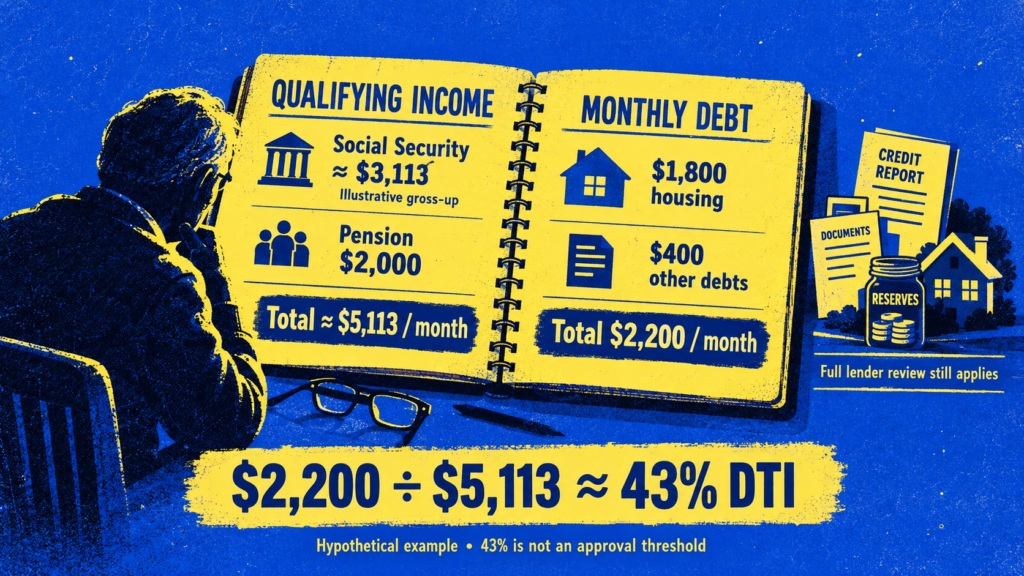
Here is how the numbers might shift. Say the lender uses the Social Security gross-up from earlier. Qualifying Social Security income could then be about $3,113 a month. With the $2,000 pension, total qualifying income would be about $5,113. Now say the new housing payment is $1,800 and other debts are $400. That is $2,200 a month in total. The DTI would be about 43%, compared with 44% without the gross-up.
Disclaimer: This hypothetical scenario is for educational purposes only and does not represent an approval, loan offer, or prediction of qualifying income. Actual treatment of Social Security, pension, retirement assets, debt, reserves, and other income depends on current agency guidelines, lender requirements, documentation, loan characteristics, property, and the borrower’s complete financial profile. The DTI shown is not a maximum or a guaranteed qualifying limit.
Section 16
What Can Make a Conventional Mortgage More Difficult for Retirees?
Retirement itself is not the problem. The issues usually come from how the finances are set up and documented.
Income Is Difficult to Document
If you cannot show clear proof of your income, the lender may not be able to count it. An award letter or regular bank deposits can help.
Too Much Debt Relative to Qualifying Income
If your debts are high compared with your qualifying income, your DTI may be too high. That can happen even if your real cash flow feels fine.
Retirement Assets Are Not Easily Accessible
If your retirement funds come with penalties, restrictions, or limited access, they may count for less, or not at all, in the lender’s review.
Recent Retirement or Major Income Change
If you just retired, your new income may not be fully set up yet. A new award letter can help in some cases. Still, timing matters, so talk with your loan officer early.
Insufficient Reserves
If the purchase would leave you with little or no cash after closing, that may weaken the file, especially if the loan requires reserves.
Property or Loan Characteristics
The type of property, how you plan to use it, and the loan structure can all add rules. A second home or a condo, for example, may come with its own requirements.
Section 17
How Retirees Can Prepare Before Applying for a Conventional Mortgage
Gather Income Documentation Early
Collect your Social Security award letter, pension statements, account statements, and recent tax returns before you apply. Having them ready can speed things up.
Review Your Credit
Check your credit reports for errors and late payments. Fixing mistakes before you apply can help your application.
Calculate Your Current Debt Obligations
List your monthly debts, such as car loans and credit card minimums, so you have a clear sense of your likely DTI.
Organize Retirement and Investment Account Statements
Gather recent statements for every account you might use. Note which accounts you can access without a penalty.
Estimate Your Cash-to-Close
Your cash to close includes your down payment, closing costs, and prepaid items. You can use the Wonder Rates Down Payment Calculator to estimate this total. Keep in mind that actual cash to close varies by transaction.
Compare the Estimated Monthly Payment With Your Retirement Budget
Before you commit, make sure the full monthly payment fits your retirement budget. The Wonder Rates Mortgage Payment Calculator can estimate principal, interest, taxes, insurance, PMI, and HOA dues. That full picture matters for retirees. A payment can look fine as principal and interest alone. Once every cost is added, it can feel very different.
Section 18
Conventional Mortgage for Retirees vs. Other Loan Options
Conventional Loans
Conventional loans can work well for retirees with proven income, solid credit, and enough savings. Under certain Fannie Mae rules, they also allow asset-based income for eligible borrowers.
FHA Loans
FHA loans are insured by the Federal Housing Administration. According to HUD, FHA loans can allow a down payment as low as 3.5%. They also come with their own mortgage insurance costs, so compare the full picture.
VA Loans for Eligible Borrowers
Eligible veterans and certain surviving spouses may want to compare a VA loan. VA loans have their own eligibility rules and costs, such as a funding fee for many borrowers.
Other Mortgage Options
Some retirees may also look at portfolio loans held by a single lender, Non-QM loans, or other asset-based programs. These can have different rules, rates, and costs, so review them carefully.
Why the Right Loan Depends on the Whole Financial Profile
Do not choose a loan just because you are retired. Choose it based on your income, assets, credit, and DTI. Your down payment, the home, your goals, and your monthly cash flow count too.
Section 19
What Retirees Should Know Before Applying for a Conventional Mortgage
Retirement does not automatically stop you from getting a conventional mortgage. The main question is whether you can show enough qualifying income. An eligible asset-based method may also work under the rules that apply.
Social Security, pensions, and retirement payments may count. But each source has its own rules for proof and for how long it must last. Retirement assets can help too. They can supply cash for the purchase or, in some cases, count toward your income.
In the end, the strongest application is not always the one with the biggest retirement account. The strongest file is the one that can be documented. Its income, assets, debts, credit, and reserves all hold up under the lender’s review.
Section 20
Explore Your Mortgage Options
Are you retired or close to it? Start by checking your estimated monthly payment with the Mortgage Payment Calculator. Then discuss your income, assets, and loan scenario with a licensed mortgage professional.
When you are ready, get started with Wonder Rates to review your options. If you are shopping for a home, you can also explore buying a home with Wonder Rates. A loan officer can help you weigh your options based on your budget.
Section 21
Disclaimer
This article is provided for general educational and informational purposes only and is not financial, legal, tax, or mortgage advice. Conventional mortgage requirements vary based on applicable agency guidelines, lender requirements, automated underwriting findings, loan amount, loan-to-value ratio, property type, occupancy, credit profile, income, assets, reserves, and other factors. Retirement status alone does not determine whether a borrower qualifies for a mortgage, and no example in this article should be interpreted as a guarantee of approval. Actual qualifying income, loan amount, interest rate, fees, and loan terms can only be determined after the applicable lender reviews the borrower’s complete application and supporting documentation.
Examples and calculations in this article are hypothetical and are intended only to explain general mortgage concepts. Treatment of Social Security, pension income, retirement account distributions, investment income, rental income, and assets can vary depending on the source, history, documentation, accessibility, continuance, loan program, and applicable underwriting requirements. Agency guidelines referenced in this article may change over time. Withdrawals from retirement accounts may have tax consequences, so consult a qualified tax professional before using retirement funds. Calculator results are estimates and are not a rate quote, loan offer, or commitment to lend. Borrowers should review their Loan Estimate and other official disclosures and speak with a licensed mortgage professional about their individual circumstances.
Duc Pham, Mortgage Broker | NMLS# 844897, Wonder Rates, Inc. | NMLS# 1518655 | DRE# 02047445 | DFPI# 60DBO-59134 | Equal Housing Opportunity. Equal Housing Lender. | Licensed in: AL, AZ, CA, CO, FL, GA, LA, MI, NC, OH, OK, OR, PA, SC, TX, VA, WA.



