
Section 01
Easement or Encroachment Found on a Survey
The file looks clean. Credit is approved. Appraisal is in. Then the survey comes back a few days before closing and shows a fence, a driveway, or a garage sitting over the property line. The lender pumps the brakes. Closing slips, or the deal dies.
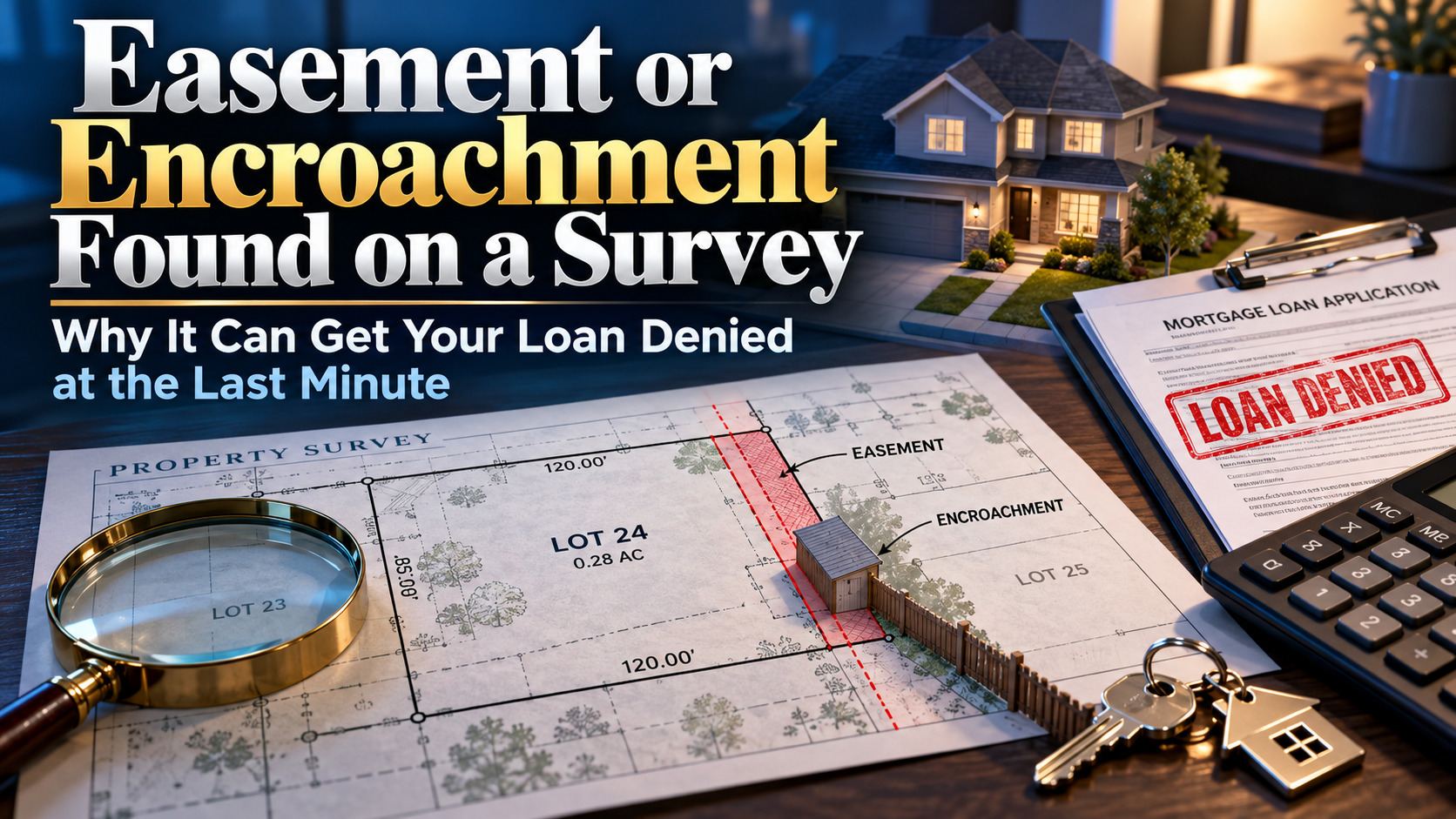
This happens more often than people expect, because a survey is usually one of the last documents ordered in a transaction. By the time it arrives, everyone has already mentally closed the deal. This article explains why a survey finding can stop funding, how Fannie Mae, FHA, and title insurers actually treat encroachments, and what fixes a loan officer can push for before the clock runs out.
Section 02
What a Survey Actually Checks
A survey measures where the legal property lines sit on the ground, then compares that to what is actually built or placed on the lot. Lenders and title companies rely on a few different survey types:
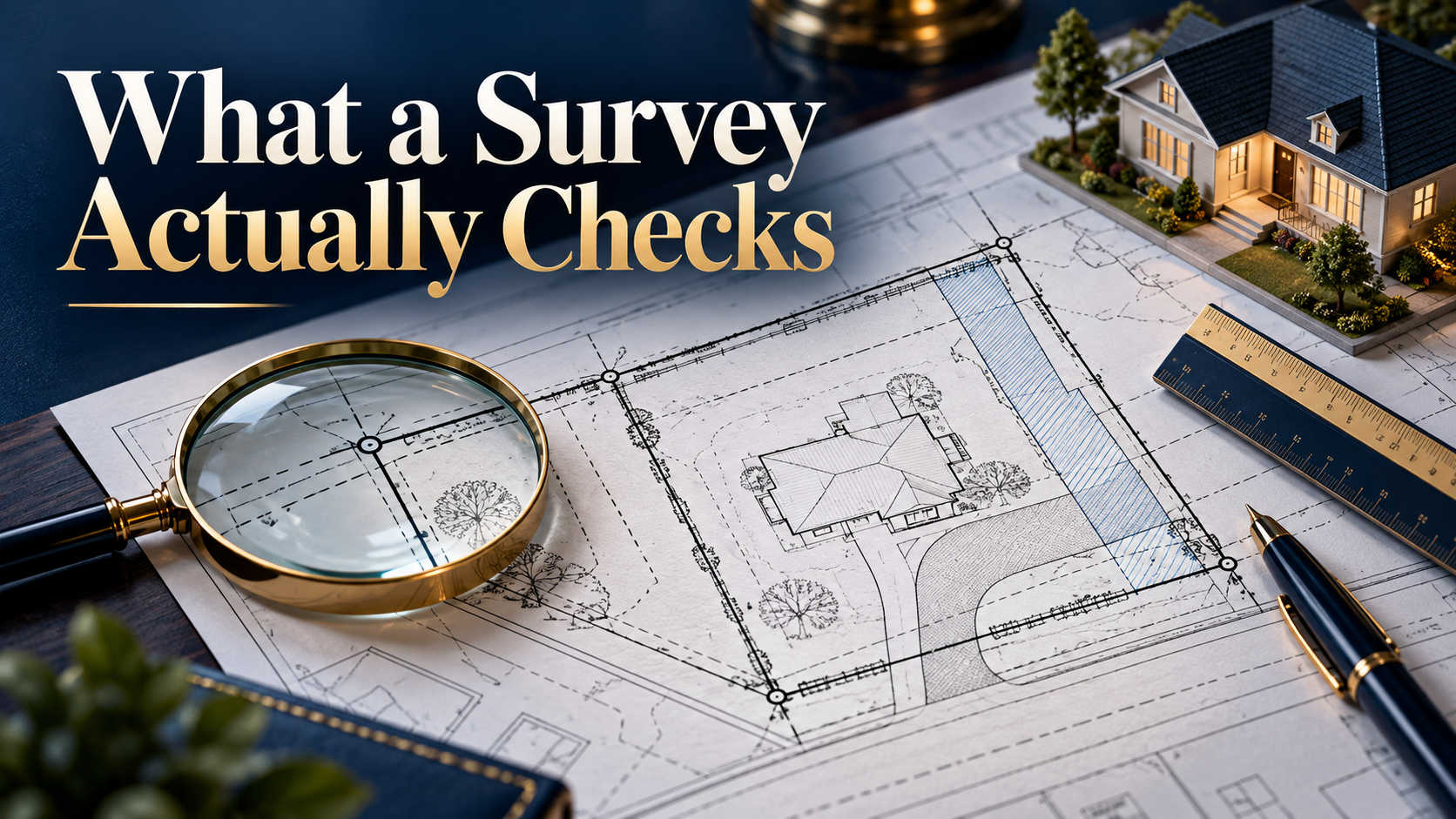
- A boundary survey, which just marks the property lines.
- A mortgage location survey (sometimes called a mortgage inspection), a lighter, cheaper version used mainly to confirm a structure sits roughly inside the lot. It is not built for precision and is not a substitute for a full survey.
- An ALTA/NSPS Land Title Survey, the detailed standard used for commercial deals and higher-risk residential files. It combines physical measurements with the title records, so it catches things a boundary survey alone will miss.
The survey is frequently ordered late because many lenders only require it once the loan is close to final underwriting. That timing is exactly why problems surface so close to closing.
Section 03
Easement vs. Encroachment: Not the Same Problem
These two terms get used interchangeably, but they describe different legal situations.
| Term | What it means | Typical example |
|---|---|---|
| Easement | A legal right for someone else to use part of your land for a specific purpose. It is usually recorded and known in advance. | A utility company’s right to access a power line across the backyard |
| Encroachment | A physical structure or improvement that crosses a property line without legal permission. It is often discovered, not disclosed. | A neighbor’s fence, shed, or driveway sitting a few feet onto the subject property |
An easement is expected and usually priced into the deal from day one. An encroachment is the surprise. It shows up because nobody checked the actual boundary until the survey did.
Section 04
Why This Can Stop Funding at the Last Minute
Two separate mechanics are at work here, and both can independently delay or kill a closing.
The title insurance mechanism
A standard title insurance policy excludes matters that an accurate survey would reveal. This is called the standard survey exception. If no current survey exists, the title company simply writes around the risk by excepting it from coverage.
Once a survey is delivered and it shows an encroachment, the title company has to specifically list that encroachment as an exception on Schedule B. From that point, the title policy does not insure against any loss tied to that specific boundary problem. Many lenders, especially on jumbo loans, will not fund without that exception removed or addressed through an endorsement.
The appraisal mechanism
Separately, Fannie Mae’s Selling Guide (B4-1.3-04) requires the appraiser to factor in easements and encroachments because they can affect a property’s marketability. If the appraiser flags the encroachment as a marketability issue, the lender has an independent reason to pause the file, apart from anything the title company is doing.
Section 05
How Fannie Mae Actually Draws the Line
Fannie Mae does not treat every encroachment the same way. Its Selling Guide sets a specific, numeric threshold for what counts as a minor, acceptable impediment on a conventional loan:
| Situation | Fannie Mae’s treatment |
|---|---|
| Eave, overhang, or driveway encroaching one foot or less onto adjoining property, with at least ten feet of clearance between the building on the subject property and the affected property line | Acceptable as a minor title impediment. No cure required. |
| Encroachment beyond that threshold (a structure, garage, or addition crossing the line by more than a foot, or clearance under ten feet) | Not automatically acceptable. Lender must address it, often through title company action or a cure. |
| No survey customary in the jurisdiction, and no ALTA 9 endorsement obtained | Not acceptable. The title policy must not carry a survey exception in that case. |
That one-foot, ten-foot standard is precise for a reason. It lets a lender approve small, cosmetic boundary quirks without a fight, while still forcing a real conversation when a structure is actually sitting on someone else’s land.
How FHA and VA Treat the Same Problem
Government-backed loans run on a different standard, tied to HUD’s Minimum Property Requirements rather than Fannie Mae’s title impediment rules.
| Loan type | Standard |
|---|---|
| FHA | A fence encroachment by the subject or an adjacent property is acceptable as long as it does not affect the marketability of the property. An encroachment involving a dwelling, garage, or other structure is treated far more seriously and, as a general rule, makes the property ineligible unless resolved, for example through a recorded encroachment easement from the adjoining landowner. |
| VA | VA appraisers follow a similar marketability-first test under the VA’s Minimum Property Requirements, evaluating whether the encroachment affects safety, access, or the ability to sell the home in the future. |
The common thread across FHA, VA, and conventional loans is the same question: does this encroachment hurt marketability or create legal risk. A two-inch fence overlap rarely does. A garage sitting on the neighbor’s lot almost always does.
Section 06
Fixing It Before Closing: The Realistic Options
Once an encroachment surfaces, these are the paths a loan officer, title company, and real estate attorney typically work through, roughly in order of speed:
| Fix | What it does | Typical timeline impact |
|---|---|---|
| ALTA 9 endorsement (Restrictions, Encroachments, Minerals) | Forces the title company to insure over specific survey matters unless expressly excepted, giving the lender comfort on minor encroachments | Can often be issued quickly if the title company is comfortable with the risk |
| Boundary line agreement between neighbors | The two property owners formally agree on where the line sits, resolving ambiguity | Days to a few weeks, depending on neighbor cooperation |
| Recorded encroachment or airspace easement from the adjoining owner | The neighbor grants a legal right for the encroaching structure to remain, converting an unauthorized encroachment into an authorized easement | Days to weeks; requires a cooperative neighbor and proper recording |
| Removal or modification of the encroaching structure | Physically fixes the problem by moving or removing what crosses the line | Can take the longest, especially if it requires a contractor |
| Municipal variance or approval | Needed when the fix requires local zoning sign-off, such as a legally shortened setback | Often the slowest option; can take weeks to months |
| Survey affidavit confirming a minor, cosmetic encroachment | Used when the issue clearly falls within a lender’s acceptable minor-impediment threshold (like Fannie Mae’s one-foot rule) | Fast, since it is largely a documentation step |
Several of these can run in parallel. A loan officer should not wait to see if one fix works before starting the next, especially once a rate lock or closing date is at risk.
Why This Keeps Happening So Close to Closing
The root cause is sequencing, not surprise defects in the property. Many purchase contracts do not require a new survey. Many lenders only order one late in the process, sometimes simultaneously with the title commitment or even after it. By the time the survey lands, everything else in the file is already finished, so any issue it raises reads as a last-minute problem even though the underlying condition has existed on the ground for years.
Checklist for Loan Officers
- Confirm early in the file whether a survey will be required for this loan type, lender, and jurisdiction.
- If a survey is required, push to order it as early as possible, not after every other condition is cleared.
- As soon as a survey comes back, check it against Fannie Mae’s one-foot, ten-foot minor impediment standard before assuming it is a problem.
- For FHA and VA files, separate fence encroachments (usually fine if marketability is not affected) from structural encroachments (usually a real issue).
- Loop in the title company immediately to find out whether an ALTA 9 endorsement is realistic for this specific encroachment.
- If a neighbor’s cooperation is needed for an easement or boundary agreement, start that conversation the same day the survey is received, not after other options are exhausted.
- Track the rate lock and closing date against the realistic timeline for whichever fix is in progress.
Section 07
Frequently Asked Questions
Does every encroachment kill a loan?
No. Fannie Mae explicitly treats small encroachments, such as an eave or driveway crossing one foot or less onto adjoining land with ten feet of clearance, as a minor and acceptable impediment. The real risk is with structural encroachments like a garage or addition.
Can title insurance just cover the encroachment and let the deal close anyway?
Sometimes. An ALTA 9 endorsement can let the title company insure over certain survey-related issues. But the title company will usually want to review the actual survey first, and it is not guaranteed for every type of encroachment.
Is a fence encroachment treated the same as a building encroachment?
No, especially on FHA loans. A fence encroachment is generally acceptable if it does not affect marketability. A dwelling, garage, or other structure crossing the line is a much bigger problem and often makes the property ineligible until it is resolved.
Why wasn’t this caught earlier in the transaction?
Because many files do not require a survey until late in processing, sometimes around the same time as the title commitment. The boundary issue itself likely existed long before the file was opened; the survey is simply the first document that actually measures it.
Section 08
Bottom Line
An easement or encroachment found on a survey is not automatically a dead deal. Fannie Mae has a specific, numeric threshold for what counts as acceptable. FHA and VA both use a marketability test rather than a flat ban. Title companies have tools, like the ALTA 9 endorsement, to insure around smaller issues. The real danger is timing: surveys tend to land late, which turns a fixable boundary issue into a closing-week crisis. Ordering the survey early, and knowing the exact thresholds each loan type uses, is what keeps a late survey from becoming a dead file.
This article is for general educational purposes and does not replace guidance from a licensed lender, title company, surveyor, or real estate attorney. Specific requirements vary by lender, loan program, and jurisdiction, and can change over time. Readers should confirm current requirements directly with their lender and title company before relying on any specific threshold or remedy described here.
Sources: Fannie Mae Selling Guide B4-1.3-04 (Site Section of the Appraisal Report) and B7-2 (Title Insurance), including the Minor Impediments to Title provisions for conventional mortgages; HUD Single Family Housing Policy Handbook 4000.1, Property Acceptability Criteria; ALTA Restrictions, Encroachments, Minerals Endorsement 9 (ALTA 9) and related ALTA 25/25.1 and 28/28.3 endorsement forms.
Duc Pham, Mortgage Broker | NMLS# 844897,
Wonder Rates, Inc. | NMLS# 1518655 | DRE# 02047445 | DFPI# 60DBO-59134 |
Equal Housing Opportunity. Equal Housing Lender. |
Licensed in: AL, AZ, CA, CO, FL, GA, LA, MI, NC, OH, OK, OR, PA, SC, TX, VA, WA.




