
Section 01
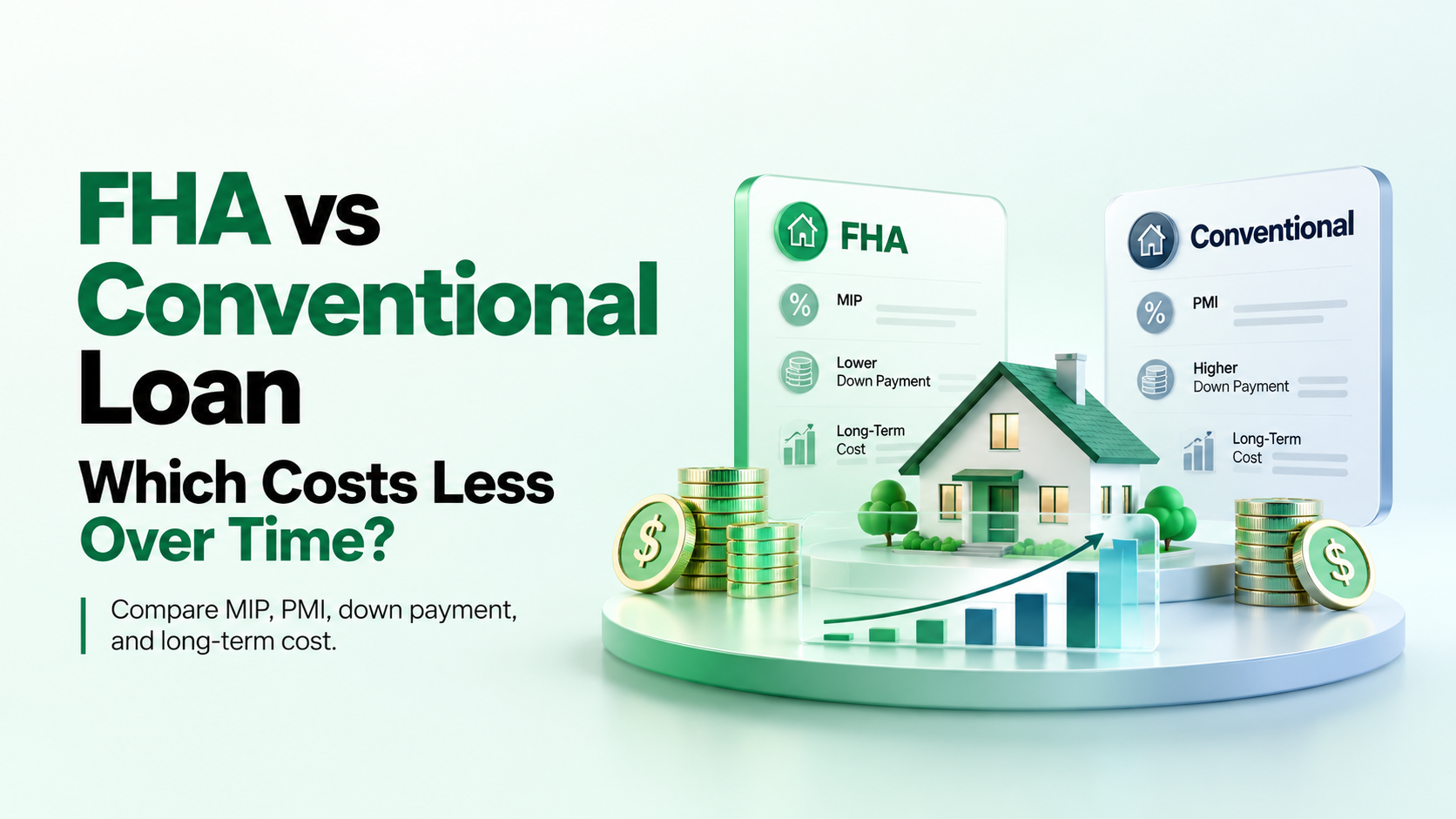
An FHA loan is not automatically cheaper than a conventional loan, and a conventional loan is not always the better long-term choice. The answer depends on the borrower’s credit profile, down payment, mortgage insurance, loan pricing, property and expected time in the loan.
The most reliable way to compare an FHA vs conventional loan is to request both options for the same property and review the Loan Estimates side by side. A lower interest rate alone does not prove that one loan costs less.
Section 02
FHA vs Conventional Loan: The Main Differences
FHA loans are insured by the Federal Housing Administration and offered through FHA-approved lenders. Conventional loans are not insured by a federal housing agency. Many conventional mortgages follow requirements established by Fannie Mae or Freddie Mac.
Both options may allow a qualified borrower to buy with a relatively small down payment, but their mortgage insurance and underwriting structures are different.
| Comparison | FHA loan | Conventional loan |
|---|---|---|
| Program structure | Federally insured mortgage | Mortgage without federal agency insurance |
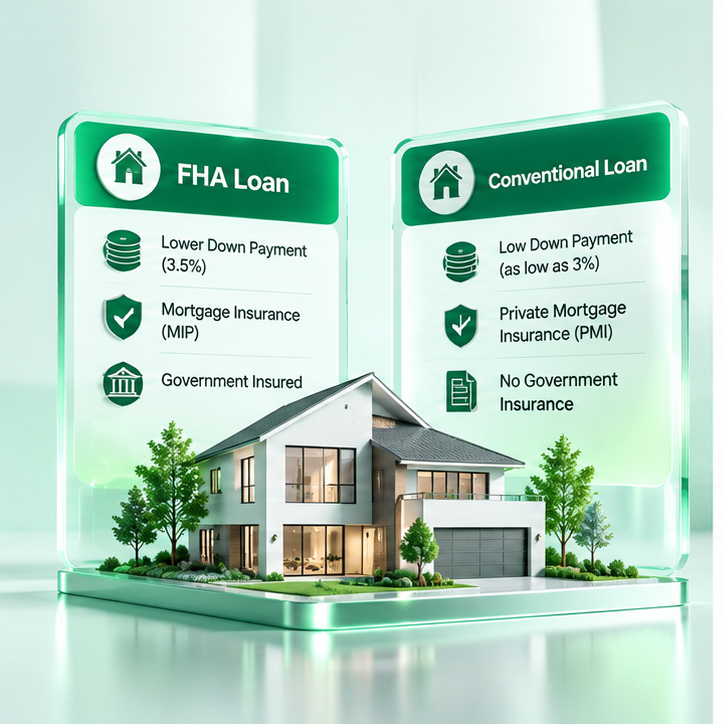
| Low-down-payment option | May permit a minimum required investment as low as 3.5%, subject to eligibility | Certain programs may permit down payments as low as 3%, subject to eligibility |
| Mortgage insurance | Upfront and annual FHA MIP may apply | PMI may apply when required by the loan structure |
| Credit treatment | FHA guidelines establish national requirements, but lender requirements may also apply | Eligibility and pricing depend on the program and complete borrower profile |
| Removing mortgage insurance | FHA MIP follows FHA duration rules | Borrower-paid PMI may be canceled or terminated when applicable requirements are met |
| Property review | FHA appraisal includes value and property acceptability considerations | Conventional appraisal and property requirements depend on the program and transaction |
HUD explains that FHA financing may offer a low-down-payment path for eligible borrowers, but approval still depends on the complete application and lender requirements. Review HUD’s official FHA loan overview for the program basics.
Section 03
Mortgage Insurance: MIP vs PMI
Mortgage insurance protects the lender, not the borrower, if the loan defaults. FHA and conventional loans handle this cost differently.
FHA mortgage insurance
An FHA mortgage generally includes an upfront mortgage insurance premium and an annual mortgage insurance premium. The upfront amount may be financed into the loan, which increases the starting balance, or handled in another permitted manner.
Annual MIP is usually collected as part of the monthly mortgage payment. The applicable premium and duration depend on factors that include the loan term, original loan-to-value ratio and FHA case-number assignment date.
For many FHA mortgages with case numbers assigned on or after June 3, 2013, annual MIP may remain for 11 years or for the mortgage term, depending on the original LTV and loan term. Reaching a particular amount of equity later does not create the same cancellation rights that may apply to conventional PMI.
Conventional private mortgage insurance
Conventional PMI may be required when the loan exceeds an applicable LTV threshold. Its cost can depend on the borrower’s credit profile, down payment, loan characteristics, occupancy and mortgage insurance provider.
Borrower-paid PMI may be canceled or automatically terminated when legal, investor and servicer requirements are met. The route may use the property’s original value or, in certain investor-approved situations, its current value.
Our guide to how to remove PMI explains the cancellation routes and the questions to ask a servicer. The CFPB also provides an official explanation of how mortgage insurance works.

Section 04
Factor 1: Credit Profile and Loan Pricing
Credit can affect FHA and conventional financing in different ways.
FHA’s annual MIP is not priced by credit-score tier in the same way as conventional PMI. However, credit can still affect eligibility, lender pricing and available terms. A published FHA credit-score guideline should not be treated as a guarantee that every borrower at that score will be approved.
With conventional financing, the borrower’s credit profile can affect interest-rate pricing, loan-level adjustments and PMI. A borrower with stronger credit may receive a different conventional offer from someone making the same down payment on the same type of property.
This does not mean that FHA is always better for a borrower with lower credit or that conventional is always better for someone with stronger credit. The full application still matters. Borrowers working on their credit can review a 12-month plan to rebuild a credit score before applying for a mortgage.
Section 05
Factor 2: Down Payment and Cash After Closing
FHA guidelines may permit a minimum required investment as low as 3.5% for an eligible borrower. Certain conventional programs may permit financing up to 97% LTV, but the requirements are not identical across programs.
For example, Fannie Mae’s standard 97% LTV option generally requires at least one borrower to be a first-time homebuyer. HomeReady has separate income eligibility requirements and does not always require first-time buyer status. Fannie Mae summarizes these differences in its 97% LTV options.
The smallest down payment is not automatically the best choice. A buyer should also consider:
- Total cash needed at closing
- Mortgage insurance structure
- Emergency savings remaining after closing
- Planned repairs and moving expenses
- Available seller, lender or assistance-program credits
- How a larger down payment changes the available loan options
California buyers may also review first-time homebuyer programs that may assist with down payment or closing costs. Program eligibility and assistance terms must be evaluated separately from the FHA or conventional loan comparison.
Section 06
Factor 3: How Long You Expect to Keep the Loan
The expected holding period can change the result.
A borrower who expects to sell or refinance after a shorter period may care more about upfront costs, cash to close and the remaining balance at the expected exit date. Someone expecting to keep the same mortgage much longer may place greater weight on mortgage insurance duration and total borrowing costs.
Do not compare only the sum of scheduled payments. A fair comparison should also include:
- Initial loan amount
- Upfront mortgage insurance
- Points and lender credits
- Origination and third-party charges
- Mortgage insurance during the expected holding period
- Principal balance at the comparison date
- Cost of any future refinance being considered
A plan to refinance from FHA to conventional later may be reasonable to evaluate, but it should not be treated as guaranteed. Future qualification, property value, rates, closing costs and market conditions are unknown.
Section 07
Factor 4: Qualification and Property Requirements
Cost matters only after confirming that the borrower and property meet the program requirements.
Debt-to-income ratio
FHA and conventional loans use different underwriting frameworks. Neither should be reduced to one universal DTI limit. The result can depend on automated or manual underwriting, income, reserves, credit, compensating factors, property and lender requirements.
Borrowers concerned about their obligations can read how mortgage programs may evaluate a higher DTI without assuming that one limit applies to every file.
Previous credit events
FHA and conventional programs may use different waiting periods after bankruptcy, foreclosure or another major credit event. The applicable requirement can depend on the event type, discharge or dismissal date, documented circumstances, underwriting method and lender overlays.
Property condition
An FHA appraisal addresses value and FHA property acceptability considerations. A condition affecting safety, security or soundness may require further evaluation or correction. Conventional loans also have appraisal and property requirements, but they are not identical to FHA’s.
Condominiums, multi-unit properties, manufactured homes and properties with unusual characteristics may require additional review under either program.
Section 08
How to Compare Two Loan Estimates Fairly
Ask the lender to prepare FHA and conventional scenarios using consistent assumptions whenever possible:
- Same property and purchase price
- Same down payment or same cash-to-close target
- Same loan term
- Quotes prepared at the same time
- Comparable lock periods
- Clear treatment of points and lender credits
Then compare these sections:
- Loan amount: FHA upfront MIP may affect the opening balance.
- Interest rate and APR: Do not evaluate the note rate alone.
- Projected payments: Identify principal, interest and mortgage insurance separately.
- Loan costs: Compare origination charges, points, credits and third-party services.
- Cash to close: Confirm how much the buyer must bring after deposits and credits.
- Comparisons page: Review the disclosed five-year cost and principal reduction figures.
- Mortgage insurance duration: Ask when the charge may end and what conditions apply.
The CFPB recommends requesting multiple Loan Estimates and comparing the loan amount, rate, payment, mortgage insurance and loan costs. Its Loan Estimate comparison guide can help buyers review the forms consistently.

Section 09
Which Loan May Fit Which Situation?
The following are discussion points, not approval rules.
| Situation | Question to explore |
|---|---|
| Limited cash available | Which option preserves enough reserves after closing? |
| Credit needs improvement | How do actual conventional pricing and PMI compare with the available FHA terms? |
| Strong credit profile | Does conventional pricing offset its PMI and other costs? |
| Planning to keep the loan long term | How long does mortgage insurance remain under each option? |
| Planning to move sooner | Which option has the better cost and remaining balance at the expected sale date? |
| Property needs work | Will the property meet the appraisal and eligibility requirements for each program? |
For a broader view of qualification, see how to get a mortgage and prepare the application.
Section 10
Frequently Asked Questions
Is FHA or conventional cheaper?
Neither is automatically cheaper. Compare actual Loan Estimates using consistent property, timing, term and down-payment assumptions. Include mortgage insurance, upfront costs, cash to close and the projected balance for the period you expect to keep the loan.
Can a conventional loan require only 3% down?
Certain conventional programs may permit a 3% down payment for eligible borrowers. First-time buyer, income, occupancy and other requirements depend on the specific program.
Does FHA always work better with lower credit?
No. FHA may be worth comparing because its mortgage insurance works differently, but eligibility, lender pricing and the overall application still matter.
Can FHA mortgage insurance be removed at 20% equity?
FHA MIP does not follow the conventional PMI cancellation process. Its duration depends on the applicable FHA rules, including the FHA case-number assignment date, original LTV and loan term.
Can I refinance from FHA to conventional later?
Potentially, if the borrower, property and new loan meet the requirements at that time. A refinance creates a new mortgage and may include new closing costs, so it must be evaluated using current information.
Section 11
Compare the Offers, Not Just the Program Names
An FHA vs conventional loan decision should be based on two comparable offers, not a general belief that one program always has the lower rate or easier approval.
A Wonder Rates loan officer can prepare both scenarios using the borrower’s actual credit profile, down payment and property, then explain the cash to close, mortgage insurance and longer-term tradeoffs. Loan approval and final terms remain subject to the applicable program, lender and underwriting requirements.
Duc Pham, Mortgage Broker | NMLS# 844897
****Wonder Rates, Inc. | NMLS# 1518655
Equal Housing Lender.
AZ, CA, CO, FL, GA, LA, MI, OK, PA, SC, TX, VA, WA, OH, AL, OR, NC
This article is for educational purposes only and is not a commitment to lend. Loan approval is subject to creditworthiness, income verification, property eligibility and current underwriting guidelines. Loan programs, mortgage insurance requirements, interest rates and lender fees may change without notice. Always review your official Loan Estimate before making a financing decision.



