

Section 01
“I don’t have a paycheck from a job, but I get a benefit payment every month. Can that be used to buy a house?”
That question comes up often, and the honest answer sits between two wrong assumptions. The first wrong assumption is that no paycheck means no mortgage. The second is that any government payment automatically counts, dollar for dollar, toward qualifying for a home loan. Neither is accurate.
Mortgage underwriting looks at the source of income, how it is documented, how much is received, and whether it is expected to continue. That framework applies whether the income comes from an employer or from a government program. Not having a W-2 does not disqualify a borrower. But receiving a benefit does not automatically mean the full amount is usable either.
This article focuses specifically on one question: can government assistance income help a borrower qualify for a mortgage? That is a narrower and more accurate question than asking whether government assistance can pay a mortgage, because in nearly every case a benefit does not go directly to a lender or a loan servicer. Instead, a lender may count a documented, continuing benefit as part of a borrower’s qualifying income, the same way it would count wages, retirement income, or investment income, subject to the requirements for that specific income type.
This article discusses general underwriting concepts using guidance published by Fannie Mae and the Federal Housing Administration (FHA). It is for general educational purposes and is not mortgage, financial, legal, or tax advice. Guidelines vary by loan program and lender, and agencies update their guidance over time. Confirm current requirements with a licensed mortgage professional before making a decision based on this article.
Section 02
What Counts as Government Assistance Income?
“Government assistance” is not one single category in mortgage underwriting. Fannie Mae’s Selling Guide treats several kinds of benefit income as separate topics, each with its own documentation, continuance, and calculation rules. Grouping them together as one thing is the first mistake many borrowers make.

Public Assistance
Public assistance income, which can include adoption assistance, is a defined category in Fannie Mae’s Selling Guide (Section B3-3.4-12). It covers benefit payments from a paying agency that are not tied to Social Security, VA, or Section 8 specifically.
Social Security Income
Social Security benefits are their own category (Section B3-3.4-15), and the requirements differ depending on the type of benefit, retirement, disability, survivor, or Supplemental Security Income (SSI), and whether the borrower is drawing on their own work record or someone else’s.
SSI and SSDI
Supplemental Security Income (SSI) and Social Security Disability Insurance (SSDI) are both Social Security Administration programs, but they are treated differently under the guideline, so a lender needs to know precisely which benefit a borrower receives rather than treating “disability income” as a single bucket.
VA Benefits
VA benefits income is a separate category (Section B3-3.4-18) covering payments from the U.S. Department of Veterans Affairs, such as VA disability compensation or VA pension. Education benefits, such as GI Bill payments, are specifically excluded because they are offset by education expenses.
Section 8 Homeownership Assistance
The Housing Choice Voucher Homeownership Program, commonly known as the Section 8 homeownership option, is different from all the categories above because the payment is tied directly to housing costs rather than being general income. It has its own section in the Selling Guide (B3-3.4-14) and its own qualifying income treatment, covered later in this article.
The categories above summarize how Fannie Mae’s conventional loan guidelines are organized. Government-backed loan programs such as FHA, VA, and USDA have their own guidance, which can differ in documentation and calculation details. A borrower’s actual benefit type and loan program determine which specific rule applies.
Section 03
What Do Mortgage Lenders Look At When Using Benefit Income?
Whatever the benefit type, underwriters generally work through the same four questions before counting it as qualifying income.
Source
The lender needs to identify exactly which agency or program issues the payment. “I get a check from the state” is not specific enough; the file needs to show which program it is and which agency administers it.
Amount and Frequency
The dollar amount and how often it is paid need to be documented, typically through an official letter, statement, or exhibit from the paying agency rather than a borrower’s own estimate.
Duration (Continuance)
This is where many borrowers get surprised. For public assistance income, Fannie Mae requires the lender to document that the income is expected to continue for at least three years from the note date. Social Security retirement and long-term disability income based on the borrower’s own work record generally does not require continuance verification unless the lender has reason to believe it will not continue, but Social Security income drawn on another person’s account or work record does require documented three-year continuance. VA benefits generally require three-year continuance documentation as well, except for VA retirement or long-term disability benefits, which do not require this verification. Section 8 Housing Choice Voucher Homeownership Program payments do not require continuance verification unless the lender has reason to believe the payments will not continue.
Verifiability
A bank statement alone shows that money arrived in an account, but it does not, by itself, establish the source, the program, or how long the payment is expected to last. That is why an award letter, benefit statement, or agency-issued documentation typically carries more weight than deposit history alone.
This is a general summary of underwriting focus areas and not an exhaustive checklist. Exact documentation requirements differ by benefit type, loan program, and whether the loan is processed through automated underwriting.
Section 04
Why Documentation Matters More Than Your Bank Balance
It is common for a borrower to describe their finances in terms of what lands in their checking account: “I get about three thousand dollars a month.” A lender cannot use that statement on its own, because a deposit of $3,000 could be a government benefit, child support, a gift from a family member, a reimbursement, a temporary program payment, or a withdrawal from savings. Each of those has different documentation requirements, and several of them (gifts, most reimbursements, one-time transfers) are not usable as ongoing qualifying income at all.
Illustrative example: A borrower shows bank deposits of $2,800 per month and describes it as “my assistance payment.” Before that amount can be used to qualify for a mortgage, the lender typically needs a letter or exhibit from the paying agency confirming the benefit type, the monthly amount, and the payment frequency, consistent with the documentation standard for public assistance income. A bank statement showing the deposit is supporting evidence, but it does not replace the agency documentation.
This example is simplified to illustrate a documentation concept. It does not represent every lender’s exact process, and requirements can vary by loan program and by whether the loan uses automated underwriting.
Section 05
Does the Entire Benefit Amount Count as Mortgage Income?
There is no single formula, such as “benefit amount times a fixed percentage,” that applies across every program. Under Fannie Mae’s public assistance income guideline, the documented monthly amount may generally be used in full as qualifying income once the documentation and continuance requirements are met. Social Security income is also generally used at its full documented monthly amount. Section 8 Housing Choice Voucher Homeownership Program payments are also used at the full documented monthly amount from the public agency.
Illustrative example: A borrower’s public assistance award letter documents a benefit of $2,000 per month, and the lender confirms the income is expected to continue for at least three years from the note date. Once that documentation is in the file, the $2,000 may generally be used as qualifying income for that specific benefit type, subject to the applicable guideline and the lender’s own underwriting review.
This example describes a general treatment under one specific income category and is not a guarantee that any particular benefit amount will be approved as qualifying income. Loan programs and individual lender overlays can apply additional conditions.
Section 06
Can Tax-Free Benefit Income Be Grossed Up for a Mortgage?
Some government benefits are nontaxable. “Gross-up” is the underwriting practice of adjusting a nontaxable income figure upward to reflect the fact that a borrower would have needed to earn more in taxable income to net the same amount after taxes. Gross-up does not add money to a borrower’s monthly deposit; it is strictly a calculation used to size the qualifying income figure for underwriting purposes.
For Social Security income specifically, Fannie Mae’s guideline provides a defined method: the lender does not need separate documentation to treat 15 percent of the Social Security benefit as the nontaxable portion, and that nontaxable portion can then be grossed up at a 25 percent rate.
Illustrative example (Social Security gross-up, using Fannie Mae’s published method): A borrower’s Social Security benefit is $1,500 per month. Fifteen percent of that amount is treated as the nontaxable portion: $1,500 multiplied by 15 percent equals $225. That $225 is then grossed up by 25 percent: $225 multiplied by 25 percent equals about $56, rounded to the nearest dollar. The resulting qualifying income figure is $1,500 plus $56, or about $1,556 per month, without needing extra documentation for that specific adjustment. If a lender wants to gross up more than 15 percent of the Social Security income, additional documentation supporting the higher nontaxable amount is required.
For public assistance income, Fannie Mae’s guideline also allows gross-up of any documented amount that is nontaxable, following the same general nontaxable income rules. For Section 8 Housing Choice Voucher Homeownership Program payments, Fannie Mae’s guideline states that the full documented amount is nontaxable and may be grossed up.
The Social Security example above uses Fannie Mae’s own published calculation method and is accurate to that specific program as of the guideline in effect when this article was written. Gross-up treatment for other benefit types, and the exact percentage used, can differ, and lenders may apply guideline updates that change these figures over time. This is not a substitute for the lender’s own income calculation on an actual file.
Section 07
Can Temporary Government Assistance Be Used to Qualify?
A benefit a borrower is currently receiving is not automatically the same thing as income a lender can rely on for a 30-year loan. This is what “continuance” is checking for.
Fannie Mae’s public assistance income guideline requires the lender to document that the income is expected to continue for at least three years from the note date. For Social Security income drawn on another person’s work record, and for most VA benefits other than VA retirement or long-term disability, the same three-year continuance standard generally applies. On the government-backed side, FHA’s Single Family Housing Policy Handbook similarly directs lenders to verify and document public assistance income and generally requires it to be expected to continue, though the exact continuance period and documentation steps are set out in FHA’s own handbook and can differ in detail from Fannie Mae’s conventional guideline.
Illustrative example: A borrower receives $2,500 per month in public assistance, but the agency’s documentation shows the benefit is scheduled to end in eight months with no indication of renewal. Because that falls well short of the three-year continuance standard for public assistance income, a lender would generally not be able to treat the full $2,500 as long-term qualifying income for that loan, even though the borrower is receiving the full amount today.
This is a simplified illustration of a continuance concept, not a specific loan decision. Whether a particular benefit meets a continuance requirement depends on the benefit type, the applicable guideline, and the specific facts documented in the loan file.
Section 08
Can Benefit Income Actually Cover Your Mortgage Payment?
Even when a benefit is fully documented, continuing, and usable as qualifying income, “my benefit is bigger than my proposed mortgage payment” is not, by itself, an approval. Mortgage qualification is a debt-to-income calculation, not a simple comparison between one income source and one expense. If you want a closer look at how lenders calculate debt-to-income ratio and which monthly obligations may count toward DTI, see our guide to Debt-to-Income Ratio (DTI).
Illustrative example: A borrower receives $3,500 per month in qualifying benefit income, and the proposed monthly housing payment (principal, interest, taxes, insurance, and any HOA dues) is $2,200. On the surface, $3,500 comfortably covers $2,200. But the same borrower also has a $600 monthly car payment and $300 in combined minimum payments on credit cards and other debt. When the $2,200 housing payment is added to the $600 and $300 in other debt, total monthly obligations reach $3,100 against $3,500 in income, a debt-to-income ratio of about 89 percent ($3,100 divided by $3,500). That ratio is far above what most loan programs allow, so this borrower would likely not qualify for that specific loan amount even though the raw benefit total exceeds the housing payment alone. If you want to estimate how your own income and monthly debts affect your DTI, you can use the Wonder Rates DTI Calculator as a starting point.
This is a simplified, hypothetical debt-to-income illustration, not an actual underwriting calculation, approval prediction, or representation of any specific lender’s allowable ratios. Maximum debt-to-income ratios vary by loan program, credit profile, and lender.
Section 09
Housing Assistance Is Different From General Benefit Income
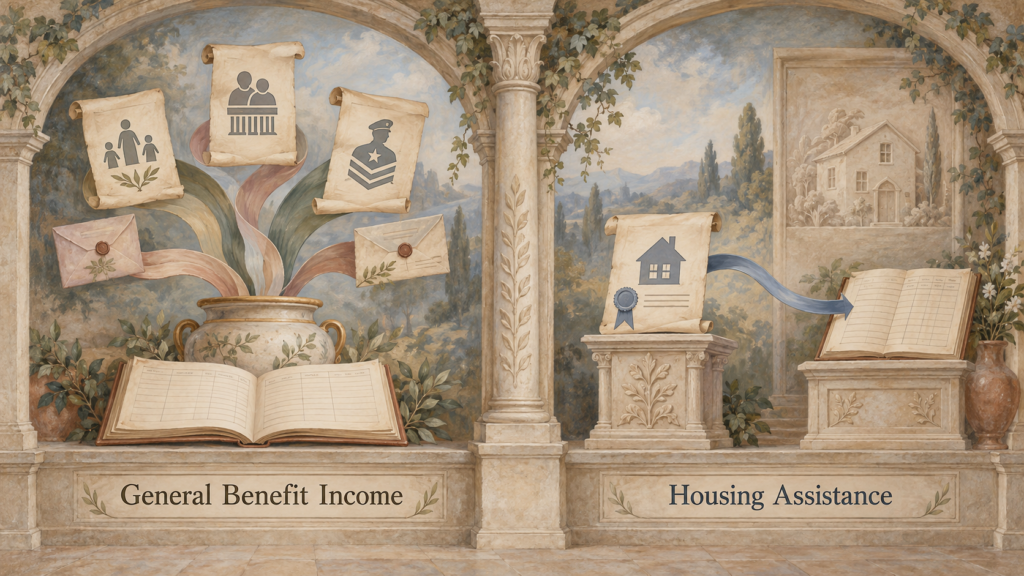
Everything discussed so far treats a government benefit as general qualifying income, similar in concept to wages or Social Security. That is different from a program that ties assistance directly to a housing payment.
The clearest example is the Housing Choice Voucher Homeownership Program, sometimes called the Section 8 homeownership option, which is distinct from standard Section 8 rental vouchers. Under Fannie Mae’s guideline, this is an acceptable source of qualifying income. The lender must obtain evidence of the payment amount from the public housing agency that issues the voucher and confirm the borrower will receive at least one payment on or before the first payment due date. The full documented amount is treated as nontaxable and may be grossed up, and continuance generally does not need to be separately verified unless the lender has reason to believe the payments will not continue.
The key distinction is this: general benefit income (public assistance, Social Security, VA benefits) is evaluated as part of a borrower’s overall income picture, the same way wages would be. A housing-specific program like the Section 8 homeownership voucher is evaluated on its own, program-specific terms, because it was designed from the start to support a housing payment. Neither of these is the same as a government agency paying a mortgage servicer directly, which is not how either program works.
Program availability and administration for Section 8 homeownership vouchers vary by local public housing agency. Not every housing authority offers the homeownership option, and eligibility rules for the voucher itself are separate from a lender’s mortgage qualifying income treatment.
Section 10
What Documents May You Need to Use Benefit Income for a Mortgage?
Exact requirements vary by benefit type and lender, but the general categories of documentation a lender may request include:
- Award or benefit letter. A letter from the paying agency showing the benefit type, monthly amount, frequency, and, where required, an expected duration.
- Bank statements. Used to help confirm current and ongoing receipt of the deposit, alongside the agency documentation rather than in place of it.
- Agency statement or exhibit. Direct documentation from the government body or administering agency, which for public assistance income must show the amount, frequency, and duration of the benefit.
- Tax documents. For Social Security income, acceptable documentation can include the SSA Award letter, an SSA-1099, or the most recent signed federal tax return or tax transcript. For VA benefits, acceptable documentation can include a statement from the VA, an award letter or benefit statement, a bank or financial account statement, a signed federal tax return, or an IRS 1099 form.
- Proof of continuance. Where a three-year continuance standard applies, documentation showing the benefit is expected to continue for that period, which for some benefits (such as certain Social Security benefits tied to the recipient’s age) can be satisfied by confirming the recipient’s age rather than requiring a document with a defined expiration date.
This is a general checklist, not a complete or universal list of required mortgage documents. The lender’s automated underwriting findings, the specific loan program, and the specific benefit type all affect which documents are actually required for a given file.
Section 11
Example: A Borrower Who Receives $3,000 in Monthly Benefits
Putting the pieces together with one walk-through example helps show how these pieces fit together in practice.
Borrower profile (hypothetical):
- Monthly public assistance benefit: $3,000
- Employment income: $0
- Other monthly debt payments: $500
- Proposed monthly housing payment: $1,900
- The benefit is documented by the paying agency
- The agency’s documentation shows the benefit is expected to continue for more than three years from the anticipated note date
Step 1: Identify the benefit. The lender first confirms exactly which program the $3,000 comes from, since the specific program (public assistance versus Social Security versus VA benefits) determines which set of rules applies.
Step 2: Verify the income. The lender obtains the agency letter or exhibit showing the amount, frequency, and, where applicable, the expected duration of the benefit, consistent with the documentation standard for that income type.
Step 3: Check continuance. Because this is public assistance income, the lender confirms the documentation supports at least three years of continued receipt from the note date.
Step 4: Determine qualifying income. Once documentation and continuance are confirmed, the $3,000 monthly amount may generally be used as qualifying income for this borrower, subject to the lender’s full underwriting review.
Step 5: Analyze debts. The lender adds the $1,900 proposed housing payment to the $500 in other monthly debt, for $2,400 in total monthly obligations against $3,000 in qualifying income, a debt-to-income ratio of 80 percent ($2,400 divided by $3,000).
Step 6: Determine whether the borrower qualifies. An 80 percent debt-to-income ratio is well above what most loan programs allow (many conventional and government-backed programs generally look for a ratio well under 50 percent, with the exact maximum depending on the loan program, credit profile, and compensating factors). In this hypothetical, the borrower’s income is fully documented and continuing, but the debt-to-income ratio alone would likely prevent approval at this housing payment level without a lower housing payment, additional qualifying income, or reduced other debt.
The point of this walk-through is not the specific numbers. It is the sequence: identify, verify, check continuance, determine the qualifying amount, then run the full debt-to-income analysis. Skipping straight from “benefit amount” to “approved” skips the steps that actually decide the outcome.
All figures in this example are hypothetical and used only to illustrate the underwriting process described above. They are not a loan estimate, a debt-to-income calculation for any real borrower, an approval prediction, or a representation of any specific lender’s guidelines or maximum ratios.
Section 12
Common Mistakes Borrowers Make When Using Benefit Income for a Mortgage
Assuming every benefit counts the same way. Public assistance, Social Security, VA benefits, and Section 8 homeownership payments each have their own documentation and continuance rules. Treating them as interchangeable can lead to inaccurate expectations.
Relying only on bank statements. Deposit history helps confirm current receipt, but it does not establish the benefit type, the paying agency, or expected duration on its own.
Forgetting about expiration dates. A benefit that is scheduled to end soon may not meet a program’s continuance standard, even if the current monthly amount looks strong on paper.
Assuming the full payment is always usable. Treatment differs by benefit type and by whether the income is taxable or nontaxable, which affects whether and how it can be grossed up.
Thinking a larger benefit than the mortgage payment guarantees approval. Qualification is based on total debt-to-income ratio, not a simple comparison between one income source and one expense.
Waiting until underwriting to explain the income. Bringing agency documentation to a loan officer early, before shopping for a home, gives more time to resolve documentation gaps or continuance questions before they become a closing delay. If you’re preparing to buy a home and want to understand what lenders review before you start shopping, see our guide to mortgage pre-approval.
Section 13
Questions to Ask a Mortgage Loan Officer About Benefit Income
- Will my specific benefit be treated as qualifying income under this loan program?
- What documentation will you need from the paying agency?
- Does my income need to show three-year continuance, and how would that be confirmed for my benefit type?
- Is any part of this income nontaxable, and would it be grossed up?
- How will this benefit be factored into my debt-to-income ratio?
- Are there lender-specific requirements beyond what the loan program’s guideline requires?
- What happens to my file if the benefit amount changes or ends before closing?
Asking these questions before making an offer on a home, rather than after, is the most reliable way to avoid a surprise midway through underwriting.
Section 14
The Bottom Line: Benefits Can Be Part of a Mortgage Qualification Strategy
Not having a traditional paycheck does not automatically rule out mortgage qualification. Government benefit income, when it is properly documented and expected to continue, can be used as part of a borrower’s qualifying income under published guidelines from Fannie Mae and government-backed loan programs.
At the same time, simply receiving a benefit does not automatically mean it qualifies, or that the full amount will be used, or that a larger benefit than the mortgage payment guarantees approval.
The more useful question is not “how much do I receive every month?” It is: “how can this income be documented, and how will my lender actually use it in the qualification math?”. If you receive government benefit income and want to understand how it may fit into your mortgage qualification, you can get started with Wonder Rates and speak with a licensed mortgage professional.
Section 15
Related Reading
Section 16
Sources
- Fannie Mae Selling Guide, B3-3.4-12, Public Assistance Income
- Fannie Mae Selling Guide, B3-3.4-15, Social Security Income
- Fannie Mae Selling Guide, B3-3.4-18, VA Benefits Income
- Fannie Mae Selling Guide, B3-3.4-14, Section 8 Housing Choice Voucher Homeownership Program Payments
- Fannie Mae Selling Guide, B3-3.1-01, General Income Information
- HUD FHA Single Family Housing Policy Handbook 4000.1
Disclaimer: This article is for general educational and informational purposes only and does not constitute mortgage, financial, legal, or tax advice. Whether government assistance, public assistance, Social Security, disability benefits, VA benefits, housing assistance, or other benefit income can be used to qualify for a mortgage depends on the specific income source, loan program, documentation, continuance requirements, and lender underwriting guidelines in effect at the time of application. Agency guidelines and lender requirements may change over time and may not be identical across loan programs or lenders. All examples and calculations in this article are hypothetical and are provided solely to explain general mortgage underwriting concepts. They are not guarantees of loan approval, qualifying income, loan amount, interest rate, or eligibility. Borrowers should consult a qualified, licensed mortgage professional and verify current program requirements before making any financial decision.
Duc Pham, Mortgage Broker | NMLS# 844897 | 408-600-1900 | dp@wonderrates.com
Wonder Rates, Inc. | NMLS# 1518655 | DRE# 02047445 | DFPI# 60DBO-59134
Equal Housing Opportunity. Equal Housing Lender. Licensed in: AL, AZ, CA, CO, FL, GA, LA, MI, NC, OH, OK, OR, PA, SC, TX, VA, WA



