
Section 01
If you own 20% or more of a business with an SBA loan, you almost certainly signed an unlimited personal guarantee. When you later apply for a mortgage, two questions follow: will the underwriter even see that guarantee, and if so, will the business’s loan payment be added to your debt-to-income ratio? The answer depends less on the guarantee itself than on how the debt is reported, who actually pays it and how your business cash flow is analyzed.
SBA personal guarantee is a contingent liability, and when the business is the borrower and makes the payments, it usually does not count in your DTI. But if the SBA loan or other business debt appears on your personal credit report, Fannie Mae lets the lender exclude it only when the business has paid it from company funds with no delinquency, typically documented with 12 months of business payments, and the lender’s cash flow analysis of the business accounts for the obligation. If those conditions are not met, the full payment goes into your DTI. Separately, an SBA lien on your home can surface in the title search and complicate a refinance, even when the debt itself is excluded from your ratios.
Section 02
Guarantee vs Direct Obligation: The Distinction Underwriters Care About
Under the SBA’s lending rules in SOP 50 10, every individual who owns 20% or more of a 7(a) borrower must provide an unlimited personal guarantee, and lenders cannot waive it. Many conventional business loans, equipment financing and commercial leases carry similar guarantees. Legally, the guarantor promises to pay if the business does not.
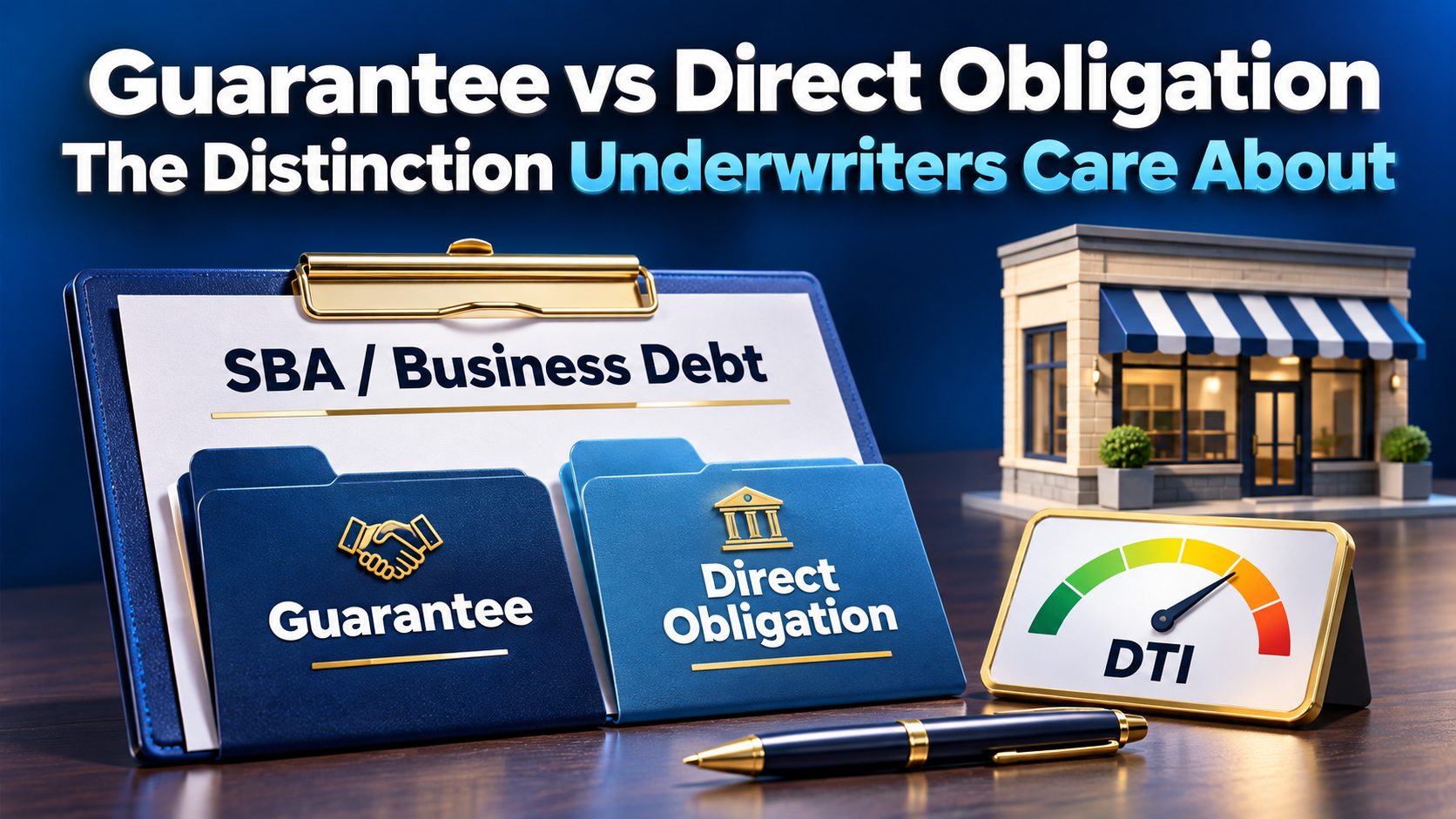
For mortgage underwriting, the key question is whether you are a guarantor or a direct obligor. A guarantee is a contingent liability: it becomes a real payment only if the primary borrower defaults. A direct obligation, where you personally signed the note as borrower or co-borrower, is a debt you owe today, regardless of who writes the check.
How the structure changes the treatment
The same SBA loan can be treated very differently depending on how the documents were signed and how the debt is reported. A sole proprietor who borrows in their own name has a direct personal debt. An owner of an LLC or corporation that borrows as the entity usually has only a guarantee.
The table below summarizes the common structures. Your loan documents and credit report, not your intent, decide which row you are in.
| Structure | Your legal role | Typical underwriting starting point |
|---|---|---|
| Entity is borrower, you sign a personal guarantee | Guarantor (contingent liability) | Generally not counted in DTI if the business pays and the debt is not on your personal credit |
| Entity is borrower, debt reported on your personal credit | Guarantor or co-obligor, visible to the lender | Counted unless the business-debt exclusion is documented |
| You sign as borrower or co-borrower | Direct obligor | Counted unless the business-debt exclusion is documented |
| Sole proprietorship borrowing in your name | Direct obligor | Counted unless paid by the business and reflected in Schedule C cash flow |
Why lenders still care about contingent liabilities
Under the ability-to-repay rule, a lender must make a reasonable, good faith determination that you can repay the mortgage. A large guarantee on a struggling business is a real risk even if no payment is due today.
That is why underwriters look past the label. If business cash flow is thin, a lender may count a guaranteed payment, reduce qualifying income or decline the file, even when agency guidelines would technically permit an exclusion.
Section 03
Does a Personal Guarantee Show Up? Four Places Underwriters Look
Many business owners assume that if an SBA loan is not on their personal credit report, the mortgage lender will never know. In practice, underwriters have at least four independent ways to discover business debt and guarantees, and they routinely cross-check them.
Treating disclosure as optional is a mistake. The loan application asks directly about guarantees, and an undisclosed obligation found late in underwriting can delay closing or raise questions about the accuracy of the whole file.
The four discovery channels
Each channel reveals a different piece of the picture. Together, they usually give the underwriter a complete view of the business’s debt and your personal exposure to it.
The table below lists where business debt and guarantees typically surface, and what the underwriter learns from each source.
| Source | What it can reveal | Notes |
|---|---|---|
| Personal credit report | SBA or business loans reported in your name, business credit cards with personal liability | Many SBA loans report only to business bureaus, but some lenders also report the guarantor |
| Loan application (URLA) declarations | Whether you are a co-signer or guarantor on debt not otherwise disclosed | A direct question; answer it accurately |
| Business tax returns and financials | Notes payable, interest expense, balance sheet liabilities, debt maturing in under a year | Read during the self-employed income analysis |
| Title search on your home | Deeds of trust, mortgages or judgments securing business debt | Common when the SBA loan was secured by personal real estate |
What happens when debt is found late
If the underwriter discovers a guarantee or business debt after the initial approval, the file is reworked: income is recalculated, the debt is evaluated for exclusion and additional documents are requested. In a tight closing window, that can cost you a rate lock extension or the contract itself.
The practical move is to disclose everything up front and give your loan officer the business tax returns, loan documents and payment history before underwriting starts. A clear letter of explanation describing each business obligation, who pays it and how it is secured often prevents follow-up conditions.
Section 04
Agency Rules: How Fannie Mae, Freddie Mac and FHA Treat Business Debt
Fannie Mae addresses this situation directly. In its monthly debt obligations guidance, it uses an SBA loan as the example: when a self-employed borrower claims that an obligation on their personal credit report is paid by the business, the lender must verify that it was actually paid from company funds and that this was considered in the cash flow analysis of the business.
The account payment does not need to be counted in DTI if three conditions are met: the account has no history of delinquency, the business provides acceptable evidence that it paid the obligation from company funds (such as 12 months of canceled company checks), and the lender’s cash flow analysis took the payment into account. If any condition fails, the payment counts.
When the payment must be counted
Fannie Mae also lists situations where the payment must stay in DTI. The most common are when the business cannot show sufficient evidence that it made the payments, and when the business pays but its tax returns or financials do not reflect a related expense, such as interest.
The second trap is subtle. A business may write the checks from its account, but if the loan is not recorded on the business books, the cash flow analysis has not absorbed it, and the lender cannot exclude it from your personal ratios.
Program comparison
Freddie Mac and FHA apply similar logic to business debt in a borrower’s name: the business must be paying it and the obligation must be reflected in the business’s financials. The details, documentation and treatment of non-mortgage debts paid by others differ between programs, so confirm with your lender which rules apply.
The table below summarizes the common approach. Treat it as a guide to the questions your underwriter will ask rather than as a substitute for current guidelines.
| Program | Business debt on personal credit, paid by business | Key conditions (reference) |
|---|---|---|
| Fannie Mae | May be excluded from DTI | No delinquency; evidence of company payment such as 12 months of canceled checks; reflected in business cash flow analysis |
| Freddie Mac | Generally may be excluded under similar conditions | Documented business payment and business financials reflecting the obligation |
| FHA | Generally may be excluded under similar conditions | Business payment documented and the debt accounted for in the cash flow analysis |
| Non-QM | Lender-specific | Some lenders count it, some follow agency-style exclusions |
This table is for reference only. Requirements depend on current guidelines, the AUS findings and lender overlays.
Section 05
The Self-Employed Cash Flow Interplay: Counted Once, Not Twice
For a business owner, the business debt question cannot be separated from the income question. The same loan payment either reduces the business income that flows to you, or sits in your personal DTI. Agency logic aims to count it exactly once.
This is why owners with 25% or more of a business face a deeper review than borrowers with W-2 income alone. If you are weighing how your income type affects qualification, our guide to 1099 vs W-2 mortgage qualification covers the broader framework.
How the business loan flows through the analysis
When the lender builds a cash flow analysis, often on Fannie Mae Form 1084, it starts from the business tax return. Interest on the SBA loan is already deducted as a business expense, and principal is paid from business cash. Notes payable due in less than a year may be subtracted again unless they are routinely rolled over, which can shrink qualifying income further.
Fannie Mae’s guidance tells lenders to adjust business net income by the related interest, taxes or insurance when they count the payment in DTI, so that the same dollars are not deducted twice. In practice, an underwriter chooses one of two paths: exclude the payment from DTI because the business cash flow already absorbs it, or count it in DTI and add back the related expenses to business income.
Business strength matters more than the label
If the business comfortably covers its debt service, the exclusion path usually leaves your personal ratios clean. If the business barely breaks even after the loan payment, your share of business income may be small or negative, which lowers your qualifying income even when the payment is excluded.
Underwriters also look at business liquidity and trend. A declining business with a large guaranteed loan may lead the lender to use the lower recent year, request a year-to-date profit and loss statement, or treat the guarantee as a meaningful risk factor.
| Business situation | Likely treatment of the SBA payment | Effect on qualifying |
|---|---|---|
| Strong cash flow, documented company payments, debt on the books | Excluded from personal DTI | Income reflects business profit after debt service |
| Business pays, but debt not reflected on returns | Counted in personal DTI | DTI rises by the full payment |
| Weak or declining cash flow | Excluded or counted, plus lower income | Qualifying income may drop sharply |
| Personal funds pay the business loan | Counted in personal DTI | Treated as your own obligation |
Section 06
Worked Example: Four DTI Outcomes From the Same SBA Loan
The same business loan can produce very different results depending on how it is reported and documented. This example follows one borrower through four scenarios to show where the line falls.
All figures are hypothetical. The borrower owns 60% of an S corporation that has a $500,000 SBA 7(a) loan with a payment of $5,800 a month, paid by the business. The borrower signed an unlimited personal guarantee.
The setup
The borrower earns a W-2 salary of $10,000 a month from the business. In a normal year, their 60% share of business income, after the SBA loan’s interest is deducted, adds $5,000 a month, for $15,000 of qualifying income. The proposed housing payment is $4,200 and other personal debts are $800.
We hold the housing payment and personal debts constant and change only how the SBA loan is treated. The lender’s maximum DTI is assumed to be 45%.
| Scenario | How the SBA loan is treated | Qualifying income | Monthly debts | DTI |
|---|---|---|---|---|
| A: Loan not on personal credit, business pays, strong cash flow | Contingent liability, not counted | $15,000 | $5,000 | About 33.3% |
| B: Loan on personal credit, 12 months of company payments documented, on the books | Excluded under the business-debt rule | $15,000 | $5,000 | About 33.3% |
| C: Loan on personal credit, company payment or bookkeeping not documented | Counted in personal DTI | $15,000 | $10,800 | About 72.0% |
| D: Excluded, but business weakens and the 60% share turns to a $1,000 loss | Excluded, income reduced | $9,000 | $5,000 | About 55.6% |
What the scenarios show
Scenarios A and B are identical in outcome, which is the point of the business-debt rule: a properly documented business obligation should not hit your personal ratios twice. Scenario C shows the cost of missing paperwork; the same loan turns a comfortable approval into a decline.
Scenario D is the one many owners overlook. Even with the payment excluded, a business that cannot comfortably carry its debt drags down your share of income. Run your own numbers with the Wonder Rates mortgage calculator to see which housing payment fits under a conservative income figure.
Figures are illustrative only. Actual results depend on the business tax returns, AUS findings, program rules and lender overlays.
Section 07
SBA Liens on Your Home and the Refinance Problem
The DTI question is only half of the story. When an SBA loan is not fully secured by business assets, current SBA rules generally require the lender to take a lien on available equity in the personal real estate of owners holding 20% or more, typically when that property has at least 25% equity. For many owners, that means a second deed of trust or mortgage on their home securing the business loan.
That lien does not change your DTI if the business debt is properly excluded, but it shows up in every title search on the property. It affects how you can refinance, take cash out or sell, and it can surprise owners who forgot it was part of the original SBA closing.
How the lien affects a refinance
A new first mortgage lender needs to be in first position. If the SBA lender’s lien is behind your current mortgage, a rate-and-term refinance usually requires the SBA lender to agree to subordinate, meaning it stays in second position behind the new loan. That request goes through the SBA lender’s process, can take weeks and may come with conditions.
Cash-out refinances are more sensitive, because pulling equity out of the home reduces the collateral securing the business loan. Some SBA lenders limit or refuse subordination for cash-out, or require part of the proceeds to pay down the business loan.
| Transaction | Effect of an SBA lien on your home | What to plan for |
|---|---|---|
| Rate-and-term refinance | SBA lender must usually subordinate | Request subordination early; build time into the rate lock |
| Cash-out refinance | Subordination may be limited or conditioned | Expect questions about collateral coverage; some proceeds may go to the business loan |
| Sale of the home | Lien must be paid or released at closing | Coordinate a payoff or release with the SBA lender |
| Purchase of a new home | Lien stays on the old home unless released | Check whether the SBA lender will release or substitute collateral |
Planning ahead
If you expect to refinance or sell within a few years, ask about the residence lien before you sign the SBA loan, and keep a copy of the recorded lien and the lender’s contact for subordinations. Knowing the process in advance can save weeks during a time-sensitive refinance.
Some owners also review how much equity they hold in their home before applying for an SBA loan, since the equity level affects whether a lien is required. Any strategy here should be discussed with your SBA lender and an attorney, because the rules and lender discretion vary.
Section 08
Documentation and Strategy Checklist
The difference between Scenario B and Scenario C in the example is almost entirely documentation. Business owners who assemble the right records before applying give the underwriter a clean path to exclude business debt and avoid last-minute conditions.
Use the checklist below at least a few months before you plan to apply, so there is time to fix bookkeeping gaps or build a full 12-month payment history.
- Pull your personal credit report and identify every business loan or card that appears in your name.
- Gather the SBA note, guarantee and any security instruments, including liens on personal real estate.
- Confirm that every business debt payment comes from a business account, not a personal one, for at least the last 12 months.
- Collect 12 months of business bank statements or canceled checks showing those payments.
- Make sure each business loan appears on the business tax returns and balance sheet, with interest recorded as an expense.
- Ask your CPA whether any notes payable are classified as due in less than one year, and whether they are routinely renewed.
- Prepare a year-to-date profit and loss statement if your business income has changed since the last tax return.
- Answer the guarantor question on the loan application accurately and list all business obligations you are personally liable for.
- Write a short letter of explanation summarizing each business debt, who pays it and how it is secured.
- If you plan to refinance later, note the SBA lender’s subordination contact and process.
Section 09
Personal Guarantee and DTI FAQs
Business owners applying for a mortgage tend to ask the same questions about guarantees, credit reporting and documentation. The answers below summarize how underwriters typically approach them.
Because treatment depends on loan documents, credit reporting and lender overlays, confirm the details with a loan officer experienced in self-employed files.
Does an SBA personal guarantee count in my DTI?
Not by itself, in most cases. A guarantee is a contingent liability, and when the business is the borrower and pays the loan, the payment usually does not go into your DTI.
If the loan appears on your personal credit report, it can be excluded only when the business-payment and cash flow conditions are documented.
Will my SBA loan show up on my personal credit report?
It depends on the lender. Many SBA loans report only to business credit bureaus, but some lenders also report the guarantor, and business credit cards often report personally.
Even if it does not appear, the loan application asks about guarantees, and the debt often shows up on business tax returns or in a title search.
What documents prove the business pays the debt?
Fannie Mae cites evidence such as 12 months of canceled company checks; business bank statements showing the payments are also common. The debt must have no delinquency history.
The lender’s cash flow analysis must also reflect the obligation, usually through interest expense on the business tax returns.
What if I pay the business loan from my personal account?
Then it is treated as your personal obligation and counted in DTI. To use the exclusion, payments need to come from company funds.
If you have been paying personally, switching to business payments and building a 12-month history before applying can help.
Can an SBA lien on my home block a refinance?
It can complicate one. The new lender will usually need the SBA lender to subordinate its lien, and cash-out refinances may face extra conditions.
Start the subordination request early and build the timeline into your rate lock.
Does the 25% ownership rule matter here?
Yes. Owners with 25% or more are treated as self-employed, so lenders analyze business tax returns and cash flow, which is where business debt becomes visible.
The SBA’s separate 20% threshold determines who must sign a personal guarantee in the first place.
Section 10
Bottom Line on SBA Personal Guarantees and DTI
An SBA personal guarantee is a contingent liability, and when the business is the borrower and makes the payments, it usually stays out of your DTI. The risk rises when the debt appears on your personal credit report or you signed as a direct obligor: then the payment counts unless you document that the business paid it from company funds with no delinquency and that the obligation is reflected in the business cash flow analysis. Even with the payment excluded, weak business cash flow can still cut your qualifying income, and an SBA lien on your home can complicate a refinance or sale. Disclose every obligation, align your books with your payments and assemble the documentation before you apply.
Own a business with SBA or other guaranteed debt and planning to buy or refinance? Connect with Duc Pham and the Wonder Rates team to review how your business debt will be treated and structure your file before underwriting.
Disclaimer: This article is for general information only and is not legal, tax or financial advice. All figures are illustrative examples based on assumptions. Treatment of business debt and guarantees depends on loan documents, credit reporting, program guidelines and lender overlays, and SBA rules can change. Confirm with a licensed loan officer, your CPA and an attorney before making decisions.
Duc Pham, Mortgage Broker | NMLS# 844897,
Wonder Rates, Inc. | NMLS# 1518655 | DRE# 02047445 | DFPI# 60DBO-59134 |
Equal Housing Opportunity. Equal Housing Lender. |
Licensed in: AL, AZ, CA, CO, FL, GA, LA, MI, NC, OH, OK, OR, PA, SC, TX, VA, WA.




