
Section 01
You received a Loan Estimate showing $6,200 in closing costs. A few days before closing, the Closing Disclosure says $7,400. Is the lender allowed to do that? The answer depends on which fees went up, because federal rules sort every closing cost into one of three Loan Estimate tolerance buckets, and each bucket has a different limit on how much it can change.
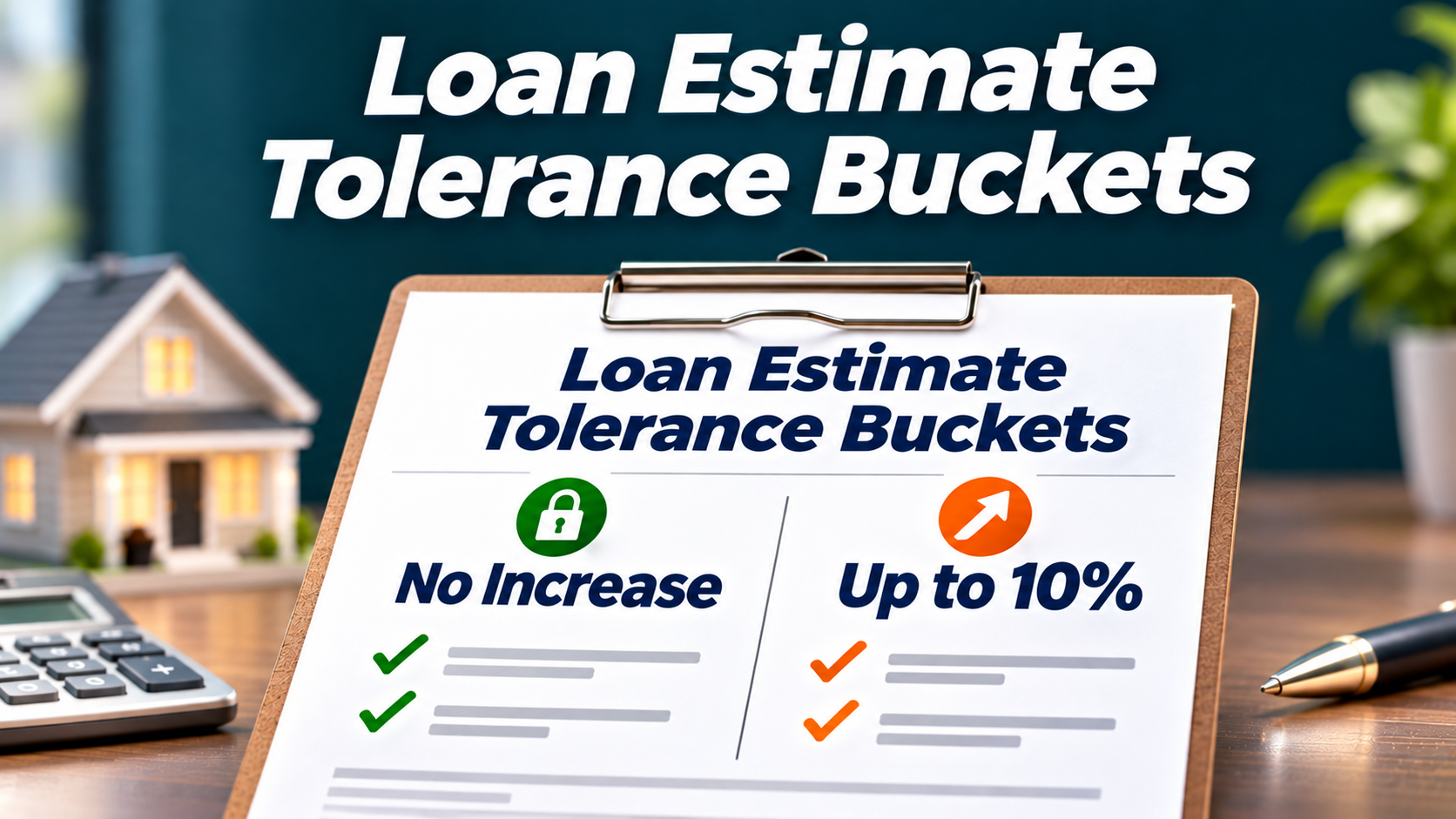
Under the TRID rule, fees in the zero tolerance bucket, such as lender origination charges, broker fees, transfer taxes and services you were not allowed to shop for, cannot increase at all. Fees in the 10% cumulative tolerance bucket, mainly recording fees and third-party services you chose from the lender’s written provider list, can rise, but their combined total cannot exceed the Loan Estimate total by more than 10%. Fees in the unlimited bucket, like prepaid interest, homeowners insurance, escrow deposits and services you shopped for on your own, can change by any amount. If a lender goes over these limits without a valid changed circumstance, it must refund the excess within 60 days after closing.
Section 02
What Are Loan Estimate Tolerance Buckets?
The Loan Estimate is the three-page form a lender must give you within three business days after you apply for a mortgage. It is supposed to be a good faith estimate of your closing costs. Under the TILA-RESPA Integrated Disclosure (TRID) rule, “good faith” has a precise meaning: the final charges on your Closing Disclosure are compared against the Loan Estimate, and each fee must stay within the tolerance allowed for its category.
These categories are what the industry calls tolerance buckets. The rules are set out in Regulation Z section 1026.19(e), which defines which fees belong to the zero tolerance, 10% cumulative tolerance and unlimited tolerance groups. The logic is simple: the more control the lender has over a fee, the less it is allowed to change.
The three buckets at a glance
Think of the buckets as a scale of lender control. Fees the lender sets itself, or picks the provider for without letting you shop, are locked. Fees set by government offices or by providers from the lender’s own list get a little room. Fees that depend on your choices, your timing or outside markets can float freely.
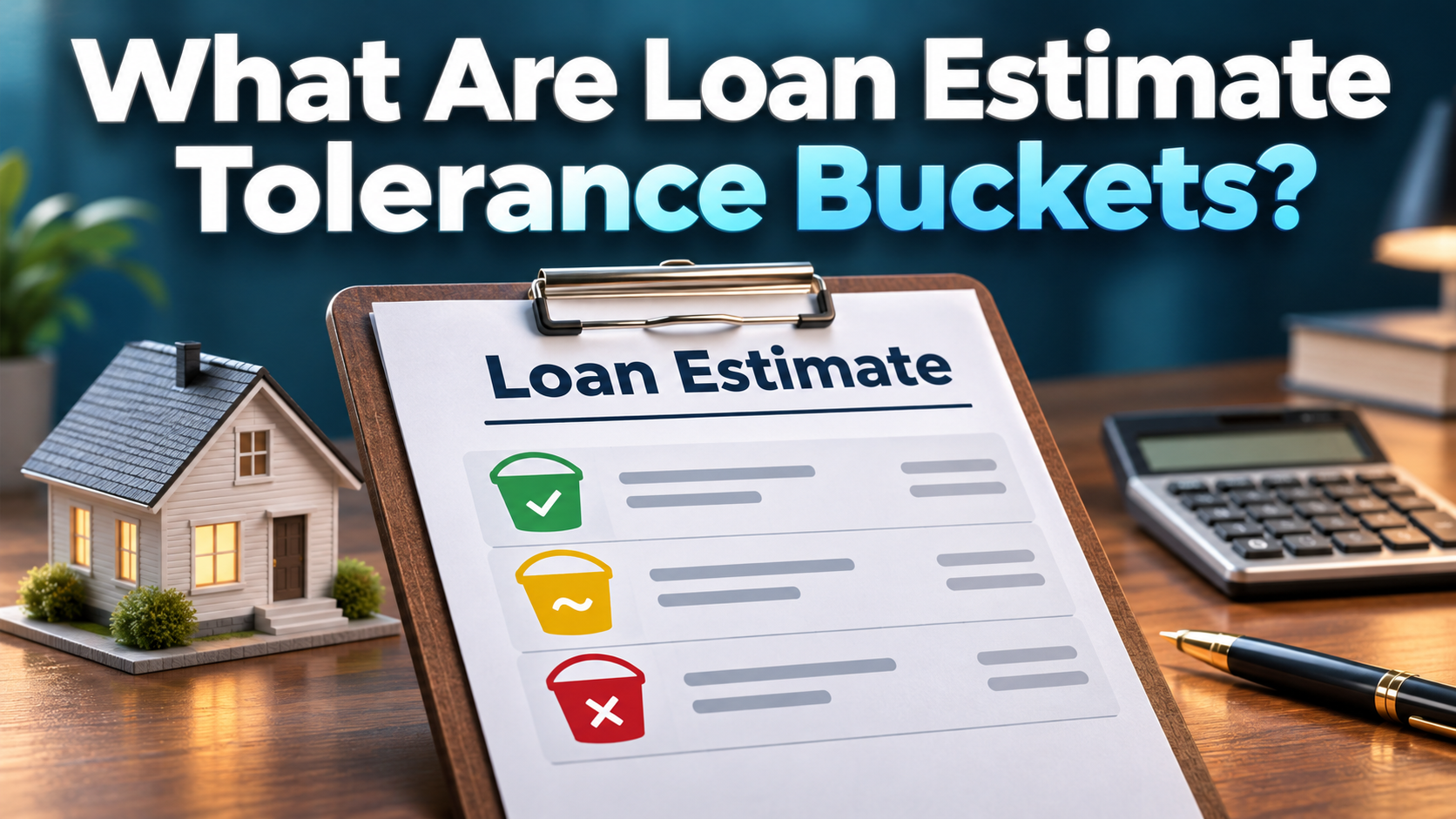
The table below summarizes the three buckets. The sections that follow explain each one in more detail, including the common exceptions that move a fee from one bucket to another.
| Bucket | How much it can increase | Typical fees |
|---|---|---|
| Zero tolerance | Cannot increase at all | Origination charges, discount points, broker fees, transfer taxes, fees paid to lender affiliates, services you could not shop for (appraisal, credit report, flood certification) |
| 10% cumulative tolerance | Total of the group can rise up to 10% | Recording fees, unaffiliated third-party services you could shop for and chose from the lender’s written list (often title and settlement services) |
| Unlimited tolerance | No limit | Prepaid interest, homeowners insurance premiums, initial escrow deposits, property taxes, services you shopped for outside the list, optional services the lender does not require |
This table is a simplified reference. How a specific fee is classified depends on who provides the service, whether you were allowed to shop and the lender’s disclosures.
Section 03
Zero Tolerance: Fees the Lender Cannot Increase
The zero tolerance bucket covers fees that the lender either charges directly or fully controls. Because the lender knows these numbers at the time it issues the Loan Estimate, the rule treats any increase as a failure of good faith. If a zero tolerance fee is higher on the Closing Disclosure than on the Loan Estimate, even by one dollar, the lender must cure the difference unless a valid changed circumstance applies.
Zero tolerance is measured fee by fee. A lender cannot offset an increase in one zero tolerance charge with a decrease in another. Each line is compared separately.
What falls in the zero tolerance bucket
Most of these fees appear in Section A (Origination Charges) and Section B (Services You Cannot Shop For) on page 2 of the Loan Estimate, plus transfer taxes in Section E. Fees paid to the lender’s affiliates also land here, even if they would normally belong to another bucket.
Common zero tolerance fees include:
- Lender origination, application, processing and underwriting fees.
- Discount points, once the rate is locked.
- Mortgage broker compensation paid by the borrower.
- Transfer taxes charged by state or local governments.
- Fees paid to an affiliate of the lender or broker.
- Third-party services the lender requires and does not let you shop for, such as the appraisal, credit report, flood determination and tax service.
Why discount points are a special case
Discount points and lender credits depend on the interest rate. If your rate is floating, the points shown on the Loan Estimate can change when you lock. The rule treats a rate lock as a changed circumstance, so the lender can issue a revised Loan Estimate within three business days of the lock that resets the points and credits.
Once the rate is locked and a revised Loan Estimate is issued, the points become zero tolerance again from that new baseline. A lender credit is the mirror image: it cannot decrease without a valid reason, because a smaller credit means you pay more.
Section 04
10% Cumulative Tolerance: Fees That Can Rise, Within Limits
The 10% bucket covers fees that the lender does not control directly but can still estimate fairly well. Recording fees are set by county offices, and third-party providers on the lender’s written list are companies the lender chose to recommend. The rule gives these fees some room to move, but not unlimited room.
The key word is cumulative. The 10% limit applies to the total of all fees in this bucket, not to each fee individually. One fee can go up by 30% as long as others go down or stay flat enough that the bucket total stays within 110% of the Loan Estimate total.
What falls in the 10% bucket
Only two kinds of charges belong here. The first is recording fees, the government charges to record your deed and mortgage. The second is fees for required third-party services where the lender allowed you to shop, gave you a written list of providers, and you picked a provider from that list.
In practice, title services such as lender’s title insurance, settlement or closing fees, title search and survey often fall into this group when you use a provider from the list. These usually appear in Section C (Services You Can Shop For) and Section E (Taxes and Other Government Fees) on the Loan Estimate.
How the written list changes the bucket
The written list of settlement service providers is what decides whether a shoppable service stays in the 10% bucket. If you choose a company from the lender’s list, the fee is limited by the 10% cumulative rule. If you shop on your own and choose a company that is not on the list, that fee moves to the unlimited bucket.
This is a trade-off worth understanding. Shopping outside the list can save money, especially on title services, but you give up the tolerance protection for that fee. If the lender did not provide a list at all, or did not let you shop, the fee is generally treated more strictly, often as zero tolerance.
Section 05
Unlimited Tolerance: Fees That Can Change Freely
The unlimited bucket covers costs that depend on things outside the lender’s control: your closing date, your choice of insurer, local tax bills, or providers you picked yourself. These fees still have to be estimated in good faith, based on the best information reasonably available, but there is no fixed cap on how much they can change.
Many of these costs appear in Section F (Prepaids), Section G (Initial Escrow Payment at Closing) and Section H (Other) on the Loan Estimate. Section H items are not part of the 10% bucket, so items like an owner’s title policy you choose, HOA transfer fees or a home warranty can change without triggering a refund.
What falls in the unlimited bucket
The most common unlimited tolerance items are tied to timing and outside pricing. Prepaid interest, for example, depends on the exact day of the month you close, so moving the closing date changes it automatically.
Typical unlimited items include:
- Prepaid interest.
- Homeowners insurance premiums and other property insurance.
- Initial escrow deposits for taxes and insurance.
- Property taxes and other prepaid government charges that are not transfer taxes or recording fees.
- Fees for services you shopped for and chose outside the lender’s written list.
- Fees for services the lender does not require, such as optional inspections or an owner’s title policy you choose to buy.
Why unlimited does not mean anything goes
Even without a numeric cap, lenders must base their estimates on the best information available when they issue the Loan Estimate. A lender that deliberately lowballs prepaid or escrow amounts to make an offer look cheaper is not acting in good faith.
For you, the practical lesson is that the cash to close on the Closing Disclosure can be higher than the Loan Estimate even if the lender follows every rule. Insurance quotes, tax prorations and closing date changes are the usual reasons.
Section 06
Changed Circumstances, Revised Loan Estimates and Tolerance Cures
Tolerance limits are not frozen forever. If something genuinely changes after the Loan Estimate is issued, the lender can issue a revised Loan Estimate, and the new figures become the baseline for measuring tolerance. But the reason has to be a valid one, and the timing rules are strict.
If no valid reason exists and the fees still exceed tolerance at closing, the lender must fix the problem by refunding the difference. This refund is commonly called a tolerance cure.
What counts as a valid changed circumstance
The rule allows revised Loan Estimates only for specific triggering events. The lender must issue the revision within three business days of learning about the change, and the increase must actually be caused by that change.
Common valid reasons include:
- An extraordinary event beyond anyone’s control, or new information about you or the property that affects the cost, such as an appraisal coming in low or a credit issue.
- Information you provided at application turns out to be inaccurate.
- You request a change, such as a different loan program, a larger loan amount or a new closing date.
- You lock or relock the interest rate after the initial Loan Estimate.
- You do not indicate intent to proceed within 10 business days after receiving the Loan Estimate.
- For new construction loans, closing is delayed more than 60 days, if the lender disclosed this possibility in advance.
A revised Loan Estimate must be received at least four business days before closing. After the Closing Disclosure has been issued, changes are reflected on a corrected Closing Disclosure instead.
How a tolerance cure works
If fees exceed their tolerance without a valid changed circumstance, the lender must refund the excess no later than 60 calendar days after consummation, along with a corrected Closing Disclosure. Many lenders handle this at the closing table as a lender credit labeled as exceeding the legal limit.
On the Closing Disclosure, look for the statement in the Calculating Cash to Close table and the line “Lender Credits (Includes $X credit for increase in Closing Costs above legal limit)”. That language tells you the lender has already identified and cured a tolerance violation.
Section 07
Example: Comparing a Loan Estimate and a Closing Disclosure
The easiest way to understand tolerance buckets is to walk through real numbers. In this example, the borrower chose title and settlement providers from the lender’s written list, did not change the loan terms and did not lock a new rate after the final Loan Estimate.
All figures are hypothetical and rounded. They show how each bucket is tested separately, and how a lender calculates what it owes.
Fee by fee comparison
The table groups each fee by bucket, then compares the Loan Estimate amount with the Closing Disclosure amount. Zero tolerance fees are tested line by line, while the 10% bucket is tested as one total.
Notice that several unlimited fees increased by more than the tolerance fees did, yet they do not trigger any refund.
| Fee | Bucket | Loan Estimate | Closing Disclosure | Change |
|---|---|---|---|---|
| Origination fee | Zero tolerance | $1,200 | $1,350 | +$150 |
| Appraisal (lender chose provider) | Zero tolerance | $650 | $650 | $0 |
| Recording fees | 10% cumulative | $150 | $175 | +$25 |
| Settlement fee (from lender’s list) | 10% cumulative | $800 | $950 | +$150 |
| Lender’s title insurance (from lender’s list) | 10% cumulative | $1,050 | $1,200 | +$150 |
| Prepaid interest | Unlimited | $600 | $900 | +$300 |
| Homeowners insurance | Unlimited | $1,500 | $1,800 | +$300 |
| Initial escrow deposit | Unlimited | $2,000 | $2,200 | +$200 |
Calculating the tolerance cure
For the zero tolerance bucket, the origination fee rose by $150 with no valid changed circumstance, so the lender owes $150. For the 10% bucket, the Loan Estimate total was $2,000, so the maximum allowed is $2,200. The Closing Disclosure total is $2,325, which is $125 over the limit.
The total cure in this example is $150 + $125 = $275, typically given as a lender credit at closing or refunded within 60 days. The $800 increase in unlimited fees is not refundable, even though it is the largest change. Try the Wonder Rates mortgage calculator to see how closing costs and rate choices affect your monthly payment.
Figures are for illustration only. Actual fees, classifications and cures depend on your loan file, providers and lender.
Section 08
Checklist: How to Review Your Loan Estimate and Closing Disclosure
You have at least three business days to review the Closing Disclosure before closing, and that is the best time to catch tolerance problems. Bring your most recent Loan Estimate, whether the original or a revised one, and compare the two documents side by side.
The list below walks you through the comparison in the same order that most lenders and closing agents use when checking tolerance.
- Confirm which Loan Estimate is the baseline: the original, or the latest revised version issued for a valid reason.
- Compare every Section A origination charge line by line. Any increase without a documented reason should be questioned.
- Check Section B services you could not shop for. These should not increase either.
- Add up recording fees and Section C services you chose from the lender’s written list. Compare the total with the Loan Estimate total and check whether it is more than 10% higher.
- Identify any services you shopped for outside the list. These are not protected by tolerance, so review them for accuracy instead.
- Review prepaids and escrow deposits for reasonableness, especially if your closing date or insurance quote changed.
- Look for a lender credit labeled as covering closing costs above the legal limit.
- Ask your loan officer in writing to explain any increase you do not understand, and to identify the changed circumstance if one is claimed.
- Keep copies of every Loan Estimate, revised Loan Estimate and Closing Disclosure you receive.
Section 09
Frequently Asked Questions About Loan Estimate Tolerance Buckets
Borrowers often ask the same handful of questions when their Closing Disclosure does not match the Loan Estimate. Most of them come down to which bucket a fee belongs in and whether the lender had a valid reason for the change.
The answers below are general. For a specific loan, ask your loan officer to walk through the tolerance calculation with you.
Can a lender increase fees after the Loan Estimate?
Yes, but only within the tolerance limits or when there is a valid changed circumstance. Zero tolerance fees cannot increase at all, and the 10% bucket total cannot rise more than 10%.
If fees go over these limits without a valid reason, the lender must refund the difference, usually at closing or within 60 days after.
Is the appraisal fee zero tolerance?
Usually yes, because most lenders choose the appraisal management company and do not let you shop for the appraiser. Services you cannot shop for are in the zero tolerance bucket.
However, if a change in the loan, such as a switch to a loan type that requires a second appraisal, creates a valid changed circumstance, the lender can issue a revised Loan Estimate with the new cost.
Are title fees in the 10% bucket?
Often, but not always. If you chose a title company from the lender’s written list, the title fees are in the 10% cumulative bucket. If the title company is an affiliate of the lender, the fees are zero tolerance.
If you shopped and chose a title company that is not on the list, the fees move to the unlimited bucket.
Does the 10% apply to each fee separately?
No. The 10% limit applies to the total of all fees in the bucket. One fee can increase by more than 10% as long as the group total stays within 110% of the Loan Estimate total.
Zero tolerance, by contrast, is tested fee by fee.
Why did my prepaid interest go up?
Prepaid interest depends on how many days remain in the month after you close. If your closing date moved earlier in the month, you prepay more days of interest.
Prepaid interest is in the unlimited bucket, so this change does not trigger a refund.
What should I do if I think a fee exceeds tolerance?
Ask your loan officer in writing before closing to explain the increase and identify any changed circumstance. Lenders often correct the issue with a lender credit before closing.
If the problem is found after closing, the lender still has 60 days after consummation to refund the excess and issue a corrected Closing Disclosure.
Section 10
Bottom Line
Loan Estimate tolerance buckets protect you from surprise fee increases by tying each closing cost to how much control the lender has over it. Zero tolerance fees, like origination charges, transfer taxes and services you could not shop for, cannot go up. Recording fees and services you chose from the lender’s written list can rise, but only 10% in total. Prepaids, escrow, insurance and services you shopped for yourself can change freely. When fees exceed these limits without a valid changed circumstance, the lender must refund the excess within 60 days after closing.
Planning to buy or refinance? Use the Wonder Rates mortgage calculator to estimate your monthly payment, then connect with Duc Pham and the Wonder Rates team to review your Loan Estimate line by line before you commit.
Disclaimer: This article is for general information only and is not legal or financial advice. TRID rules include exceptions and details not covered here, and fee classifications depend on the specific loan and providers. Confirm with a licensed loan officer or attorney before making decisions.
Duc Pham, Mortgage Broker | NMLS# 844897,
Wonder Rates, Inc. | NMLS# 1518655 | DRE# 02047445 | DFPI# 60DBO-59134 |
Equal Housing Opportunity. Equal Housing Lender. |
Licensed in: AL, AZ, CA, CO, FL, GA, LA, MI, NC, OH, OK, OR, PA, SC, TX, VA, WA.




