
Section 01
Many people pay off hospital bills through a payment plan, often interest free and not reported to the credit bureaus. When it is time to apply for a mortgage, a common question comes up: does that monthly payment count toward your debt-to-income ratio (DTI), and do you have to disclose it?
The short answer: it can. A hospital payment plan has a fixed payment and a set term, so lenders usually treat it as an installment debt if it shows up on your credit report, appears on your bank statements, or is disclosed in your application. Many loan programs allow lenders to leave out an installment debt that is close to being paid off, under specific conditions. Either way, you must disclose all of your debts on the loan application, including ones that are not on your credit report.
This article explains how each loan type looks at medical debt, walks through a DTI example, and covers legitimate ways to reduce the impact before you apply.
Section 02
What is DTI and which debts count?
Debt-to-income ratio (DTI) compares your total monthly debt payments to your gross monthly income before taxes. Lenders use it to judge whether you can afford a new mortgage payment.
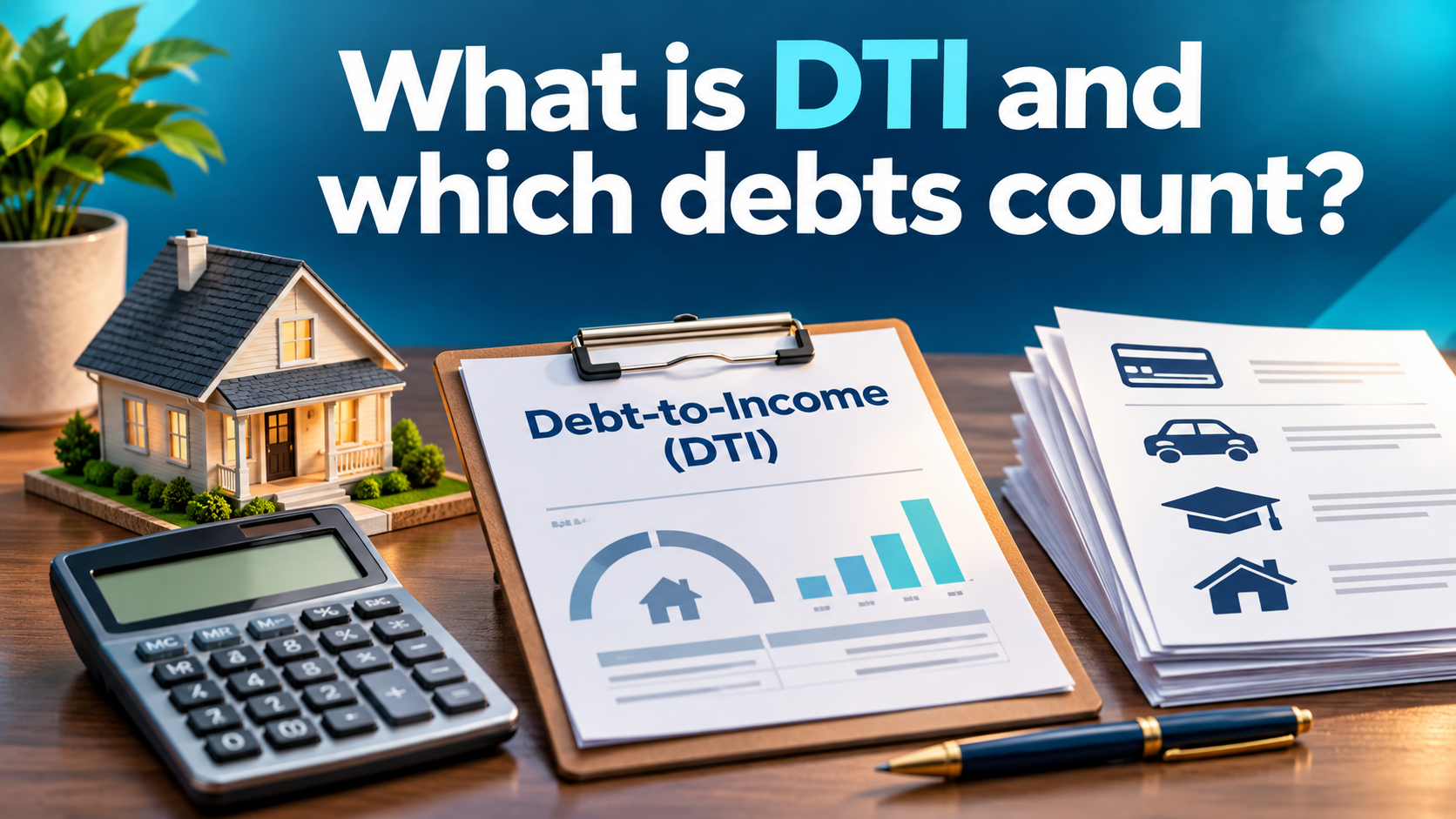
Debts that usually count toward DTI:
- The proposed housing payment: principal, interest, property taxes, homeowners insurance, mortgage insurance and HOA dues if any.
- Installment debts: auto loans, student loans, personal loans, and payment plans with a fixed schedule.
- Revolving debts: the minimum payment on credit cards.
- Other obligations: alimony, child support, and payments on other properties.
Everyday living costs such as utilities, gas and health insurance premiums usually do not count toward DTI. Maximum DTI limits vary by program and by borrower profile, so ask your loan officer about your situation.
Section 03
Do hospital payment plans count toward DTI?
A hospital payment plan has a fixed amount and a fixed term, so it is usually treated like an installment debt. The main difference between programs is how they handle debts that are almost paid off:
| Loan type | How installment debt is usually treated (for reference) | Notes on medical debt |
|---|---|---|
| Conventional (Fannie Mae) | Usually counted; debts with 10 or fewer months left may be excluded, but the lender can still count them if the payment is significant | Known debts must be considered even if they are not on the credit report |
| FHA | Usually counted; may be excluded if 10 or fewer months remain and the combined payments of such debts are no more than 5% of gross monthly income | Medical collections are excluded from the collection threshold and usually do not have to be paid off before closing |
| VA | Debts with 10 or more months left are usually counted; shorter debts may still be counted if they significantly affect the borrower | The lender looks at overall ability to repay |
| Non-QM | Depends on the program and lender | Ask the lender directly |
Important: even if a payment plan is not reported to the credit bureaus, recurring payments to a hospital can still appear on the bank statements your lender reviews. If the underwriter sees them, they will likely ask about them and may request the payment agreement to include it in your DTI.
This table is for general reference based on common guidelines, which can change. Lenders may apply stricter requirements.
Types of medical debt and how lenders view them
Not all medical debt is the same. How you pay it affects how a lender counts it:
| Type of medical debt | Usually on the credit report? | How lenders typically treat it |
|---|---|---|
| Payment plan directly with the hospital | Usually not | Installment debt; the monthly payment counts if disclosed or found on bank statements |
| Medical credit card | Yes | Revolving debt; the minimum payment counts. Watch for deferred interest when a promotional period ends |
| Medical loan through a third-party finance company | Usually yes | Installment debt; the monthly payment counts |
| Bill sent to collections | Possibly, depending on amount and timing | Usually no payment counted in DTI without a payment agreement; many programs do not require medical collections to be paid before closing |
| Bill pending with insurance | Usually not | May be questioned if it appears on statements or the credit report; keep insurance documentation |
Each type affects DTI differently. For example, moving a hospital bill to a medical credit card may lower the monthly minimum, but it can raise your credit utilization and carry high interest once the promotion ends.
Section 04
Example: how a hospital payment plan affects DTI
Illustrative assumptions:
- Gross monthly income of $7,000.
- Proposed housing payment (principal, interest, taxes, insurance) of $2,100 per month.
- Auto loan of $450 per month and credit card minimum payments of $100 per month.
- Hospital payment plan of $250 per month.
| Scenario | Monthly debts counted in DTI | DTI |
|---|---|---|
| No hospital debt | $2,650 | About 37.9% |
| A. 20 months left on the plan ($5,000), counted in DTI | $2,900 | About 41.4% |
| B. 8 months left ($2,000), qualifies for exclusion under program rules | $2,650 | About 37.9% |
| C. Pay off the $2,000 before applying | $2,650 | About 37.9%, but reserves drop by $2,000 |
| D. Move $5,000 to a medical credit card, assumed 3% minimum payment | $2,800 | About 40.0% |
For scenario B under FHA: 5% of income is $350. The $250 payment is below that, so it may qualify for exclusion if it is the only debt of this kind. For conventional loans, excluding a debt with 10 or fewer months left is up to the lender’s judgment.
Impact on how much you can borrow
At an assumed 6.5% rate on a 30-year loan, every extra $250 per month in debt reduces your borrowing power by roughly $39,500, if your DTI is already near the maximum.
Figures are illustrative, based on the assumptions above, and rounded. Maximum DTI, minimum payment calculations and rules for excluding nearly paid-off debts vary by program and lender.
Strategies before you apply
| Strategy | Benefit | Trade-off | Best when |
|---|---|---|---|
| Pay off the remaining balance | The payment drops out of DTI | Less cash and reserves | The balance is small and reserves stay sufficient |
| Pay it down to a few remaining months, if the program allows | May qualify for exclusion of a nearly paid-off debt | Depends on program rules and lender judgment | Ask your loan officer before paying |
| Apply for hospital financial assistance (charity care) | May reduce or forgive part of the bill | Requires income documents and time | Your income falls within the hospital’s assistance guidelines |
| Review the bill and your insurance | May uncover billing errors or charges insurance should cover | Takes time to follow up | Large bills or signs of errors |
| Negotiate a lower monthly payment | Lower DTI | Longer payoff period | DTI is close to the limit |
| Keep paying and disclose it fully | Transparent, no file risk | The payment still counts in DTI | DTI stays within limits |
Nonprofit hospitals in the U.S. must have a written financial assistance policy under IRS rules (section 501(r)). Ask the hospital billing office about it before signing a payment plan or putting the bill on a credit card.
Talk to your loan officer before making any major money moves while preparing to apply, so you do not reduce your reserves or create deposits and withdrawals that are hard to explain.
Section 05
Medical debt and credit reports: lesser-known points
1. The three credit bureaus changed how they report medical debt
Between 2022 and 2023, Equifax, Experian and TransUnion voluntarily changed their policies: paid medical collections are removed from reports, medical debt must wait one year before it can be reported, and medical collections under $500 are not reported.
2. Federal rules on medical debt can still change
The CFPB issued a rule intended to remove medical debt from credit reports used in lending decisions, but that rule was vacated by a federal court. Some states have their own laws limiting medical debt reporting. Check the rules in your state and watch for updates.
3. Credit scoring models used for mortgages
Newer FICO versions give less weight to medical collections than older versions. However, many mortgage lenders still use older scoring models, so a medical collection that remains on your report can still affect your score.
4. Payment plans do not build credit
Because they are usually not reported, paying a hospital plan on time typically does not raise your score. If you fall behind and the bill goes to collections, your score can be affected.
5. Plans can be transferred to a third party
Some hospitals move payment plans to an outside finance company. The debt may then become a reported loan that charges interest. Read the paperwork carefully before signing.
Section 06
Common mistakes
| Mistake | Consequence | How to avoid it |
|---|---|---|
| Not disclosing a payment plan because it is not on the credit report | The underwriter finds it on bank statements; the file is delayed or flagged for incomplete disclosure | Disclose every debt on the loan application |
| Stopping plan payments to save for the home purchase | The bill may be sent to collections | Keep paying on time until you have another plan |
| Using all your reserves to pay off medical debt | Not enough cash for closing or required reserves | Ask your loan officer before making a large payment |
| Moving hospital debt to a credit card without reading the terms | Deferred interest after the promotion, higher utilization, lower score | Compare minimum payment, interest rate and promotion length |
| Not reviewing the bill | Paying charges insurance should have covered | Match the bill against your insurance EOB |
| Not asking about financial assistance | Missing a chance to reduce or forgive the debt | Ask the hospital about financial assistance before signing a plan |
Section 07
Frequently asked questions
Does a hospital payment plan count toward DTI?
Usually yes, if it is disclosed, appears on your credit report, or shows up on your bank statements. Some programs allow it to be excluded if only a few months remain, under specific conditions.
Do I have to disclose a payment plan that is not on my credit report?
Yes. The loan application requires you to list all of your debts, including those not on your credit report. Leaving debts out can cause serious problems with your loan file.
Do medical collections have to be paid before closing?
Many programs, including conventional and FHA, generally do not require medical collections to be paid before closing. Lenders may have their own requirements, so ask your loan officer.
Should I pay off medical debt before applying?
It depends on your balance and reserves. Paying it off removes the payment from DTI but reduces your cash. Weigh both sides with your loan officer before paying.
Does moving hospital debt to a medical credit card help DTI?
It may lower the monthly minimum payment, but it raises utilization and carries the risk of high interest after the promotion ends. It is not always a better deal.
Does paying a hospital plan on time raise my credit score?
Usually not, because payment plans directly with a hospital are usually not reported to the credit bureaus.
Section 08
Conclusion
A hospital payment plan is usually treated as an installment debt and can count toward your DTI, even if it is not on your credit report. Some programs allow a nearly paid-off debt to be excluded under specific conditions. The safest approach is to disclose everything, review your bill and insurance benefits, ask the hospital about financial assistance, and talk to your loan officer before paying off or restructuring the debt.
Want to know what your monthly housing payment might be so you can estimate your DTI? Try the Wonder Rates team’s mortgage calculator before you talk to a loan officer.
Disclaimer: This article is for general information only and is not financial, legal or medical advice. All figures are illustrative examples based on assumptions. DTI rules, installment debt treatment and medical debt reporting vary by loan program, lender and state, and may change. Confirm with a licensed loan officer before making decisions.
Sources
- Fannie Mae Selling Guide: sections on DTI and installment debt.
- HUD (hud.gov): Handbook 4000.1, sections on installment debt and collections for FHA loans.
Duc Pham, Mortgage Broker | NMLS# 844897,
Wonder Rates, Inc. | NMLS# 1518655 | DRE# 02047445 | DFPI# 60DBO-59134 |
Equal Housing Opportunity. Equal Housing Lender. |
Licensed in: AL, AZ, CA, CO, FL, GA, LA, MI, NC, OH, OK, OR, PA, SC, TX, VA, WA.




