
Section 01
Many people think they need 20% down before they can buy a home. For a $300,000 house, that would be $60,000, which can feel out of reach. The good news is that the real answer depends on the type of loan you use. This guide walks through the minimum down payment requirements by loan type. You will see what it takes to qualify for each one. You will also learn how much cash to really plan for when you buy.
Section 02
What Is the Minimum Down Payment Required to Buy a House?
There is no single minimum down payment that applies to every buyer. Depending on the loan and whether you qualify, a purchase mortgage may need as little as 0% or 3% down. In other cases, a lender may ask for much more.
A down payment is the part of the home’s price that you pay up front. The rest is usually covered by your mortgage. How much you need depends on a few things. These include the loan program, your credit, and whether you will live in the home. The type of home, the loan size, and the lender’s rules count too.
It also helps to keep two ideas apart. One is the smallest amount a program allows. The other is the amount that makes sense for you. The Consumer Financial Protection Bureau (CFPB) notes that low down payment options can mean higher costs over the life of the loan. So qualifying for a small down payment does not always make it the least costly choice over time.
Do You Need a 20% Down Payment to Buy a House?
No, 20% down is not a rule for every mortgage. It is best known as the point where many conventional loans drop private mortgage insurance, or PMI. It is not a bar that every buyer has to clear.
Still, there is a trade-off. A smaller down payment can help you buy sooner. But you will borrow more, and you may pay for mortgage insurance. A larger down payment shrinks the loan, yet it leaves you with less cash for emergencies, moving, and repairs. So 20% is neither a magic goal for everyone nor a meaningless number. Its value depends on your loan and your money situation. To dig deeper, read our guide on why a 20% down payment is not always required.
What Determines Your Minimum Down Payment?
Your credit is often the first factor. Your score and history can affect which programs you can use. They can also shape the price a lender offers. FHA loans, for example, tie the smallest down payment option to a minimum credit score.
How you will use the home matters too. A home you live in as your main residence usually has lower down payment options. A second home or rental often needs more.
The property itself plays a role as well. A home has to meet the rules of the loan you choose. Some programs, like USDA loans, also depend on where the home sits.
Finally, the lender looks at your loan amount, income, savings, and its own approval rules. That is why the numbers in the next section are only starting points. They help you understand common purchase loan programs, but they do not promise that every buyer can use them.
Section 03
Minimum Down Payment Requirements by Loan Type
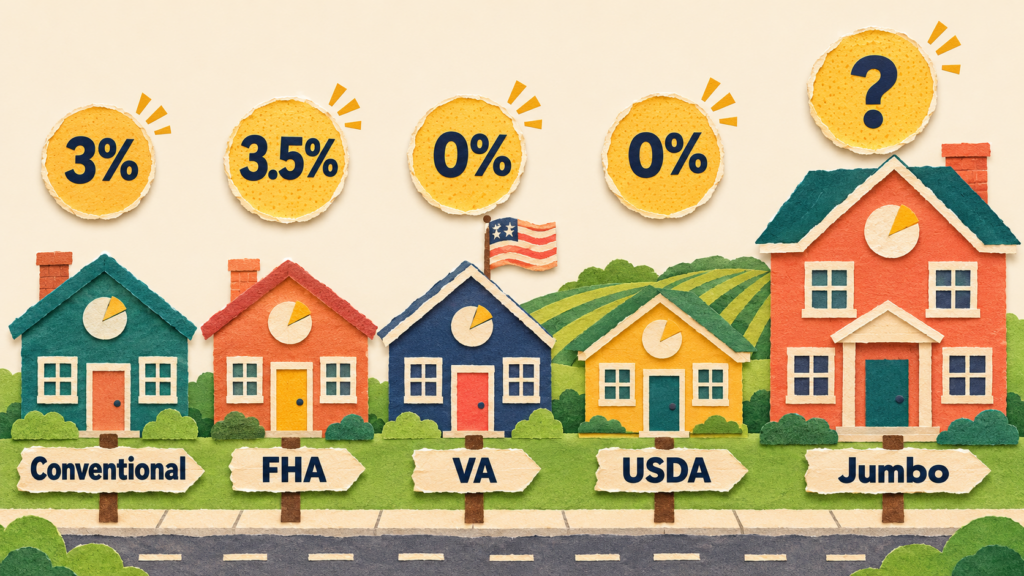
Here is a quick look at the most common loan types and their typical starting points. The sections after the table explain who may qualify and what each option really costs.
| Loan type | Common minimum down payment | Who may qualify? |
|---|---|---|
| Conventional | As low as 3% for eligible programs | Qualified borrowers who meet program and lender requirements |
| FHA | 3.5% in qualifying cases | Borrowers who meet FHA and lender requirements |
| VA | 0% in eligible cases | Eligible veterans, service members, and certain surviving spouses |
| USDA | 0% in eligible cases | Qualified borrowers buying eligible properties under program income and location rules |
| Jumbo | Varies by lender and loan scenario | Borrowers who meet the lender’s requirements for larger loans |
These are general program-level starting points, not guaranteed offers. Actual down payment requirements depend on borrower eligibility, loan terms, property characteristics, lender guidelines, and any applicable program restrictions.
The CFPB says conventional loans backed by Fannie Mae or Freddie Mac can need as little as 3% down. FHA loans can need as little as 3.5%. The zero-down options for VA and USDA loans depend on meeting each program’s rules. Jumbo loans have no single required minimum.
Which Loan Types Offer the Lowest Down Payment?
VA and USDA loans may let eligible buyers finance the full purchase price. Some conventional programs allow as little as 3% down, and FHA generally allows 3.5% for buyers who qualify.
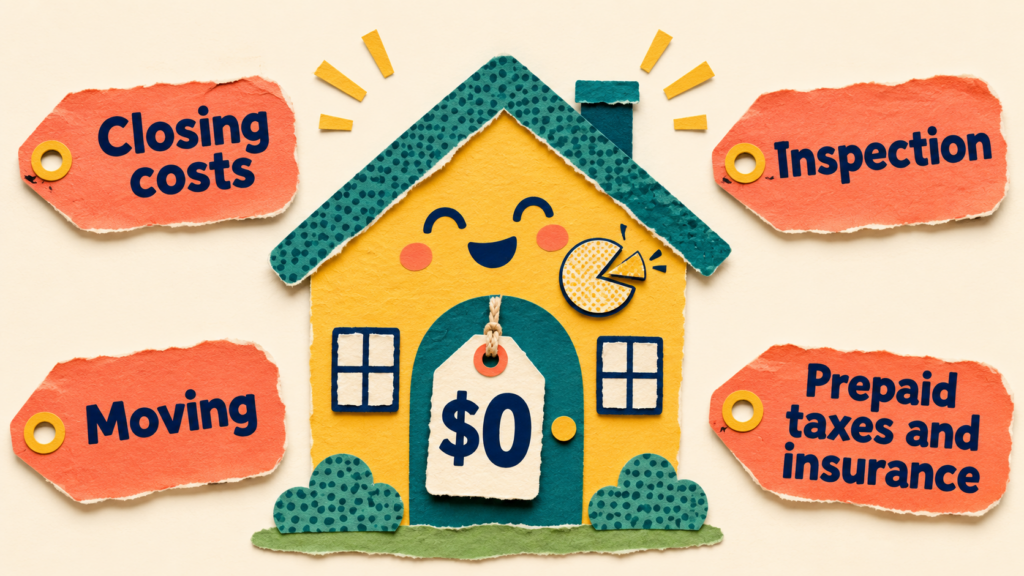
Zero down does not mean zero dollars.
Even with no down payment, you still need cash for other things. Think closing costs, prepaid taxes and insurance, an inspection, moving, and savings. In some cases, aid programs or seller credits can cover part of these costs. It depends on the deal and the program rules.
Why the Lowest Minimum Is Not Always the Best Loan
When you compare loans, the down payment is just one line. Also look at mortgage insurance, the rate, lender fees, and closing costs. Then check the monthly payment and the cash you will have left.
Two buyers can look at the same home with the same savings and still end up with different loans. Their credit, their eligibility, their plans for the home, and their goals may not match. The right comparison looks at the whole loan, not just the starting percentage.
Section 04
Conventional Loan Down Payment Requirements
A conventional loan is a mortgage that is not insured or guaranteed by a federal agency the way FHA, VA, and USDA loans are. Many of these loans follow the rules of Fannie Mae or Freddie Mac. Some programs set the conventional loan minimum down payment as low as 3%. The exact minimum depends on the program, your profile, how you use the home, and the home itself.
It also helps to know the difference between conforming and nonconforming loans. A conforming loan stays within the size limits and rules set for Fannie Mae and Freddie Mac. A nonconforming loan, such as a jumbo loan, falls outside them. Not every conventional loan has the same down payment rule, and not every buyer qualifies for a 3% option.
Conventional Loans With 3% Down
Certain conventional programs offer low down payment options for eligible buyers purchasing a main home. Fannie Mae, for example, offers 97% loan-to-value options, which work out to 3% down. Its standard 97% option requires at least one borrower to be a first-time homebuyer. Its HomeReady program does not require first-time buyer status. It does have an income limit of 80% of the area median income. If all buyers living in the home are first-time buyers, at least one must take a homebuyer class.
These options can suit buyers with steady finances who want to keep more cash on hand.
Conventional Loans With 5%, 10%, or 20% Down
You can always choose to put down more than the minimum. A larger down payment usually lowers your loan balance. Depending on the loan and your profile, it may also improve your pricing or lower your mortgage insurance cost.
At 20% down, many conventional loans do not need borrower-paid PMI. The loan setup and rules still matter, though. Even so, 20% down does not promise the best rate or the lowest total cost. Those depend on many other factors.
How PMI Affects Conventional Loan Costs
Private mortgage insurance protects the lender, not you. It does not pay your mortgage if you run into trouble. Conventional borrowers who put down less than 20% usually pay PMI, though the exact rules depend on the program. The CFPB’s guide to PMI explains how it can end. On many conventional loans, you can generally ask to cancel PMI once your balance hits 80% of the home’s original value. It generally ends on its own at 78%, as long as you are current on payments.
PMI is one piece of the cost, alongside principal, interest, taxes, insurance, and closing costs. So compare real quotes. Do not assume a conventional loan with a small down payment always costs more than an FHA loan.
Section 05
FHA Loan Down Payment Requirements
An FHA loan is a mortgage made by an approved lender and insured by the Federal Housing Administration, which is part of HUD. Buyers often look at FHA loans when they need more flexible credit rules or a fairly low down payment.
HUD says an FHA down payment can be as low as 3.5% of the price. That minimum does not apply to every credit profile, and some lenders set stricter rules of their own.
When Can You Buy With 3.5% Down on an FHA Loan?
Under the FHA Single Family Housing Policy Handbook, the 3.5% minimum is tied to credit score. Buyers with a credit score of 580 or higher may qualify for 3.5% down. Buyers with a score from 500 to 579 generally need at least 10% down. Many lenders also set their own minimum scores above these levels, so check with your lender.
Meeting the down payment rule is not the same as getting approved. The lender will still look at your income, debts, savings, the property, the appraisal, and other factors.
FHA Mortgage Insurance and Upfront Costs
FHA loans generally come with two kinds of mortgage insurance. One is an upfront premium, called the UFMIP. The other is an annual premium, called MIP, which is usually paid as part of your monthly payment. How much you pay, and for how long, depends on FHA rules and your loan terms.
This insurance raises your monthly payment, so it matters when you compare an FHA loan with a conventional loan. A small down payment makes it easier to start. Still, look at the full monthly payment, not just the down payment.
Who Should Compare FHA and Conventional Loans?
Picture a buyer who likes the low down payment and flexible credit rules of an FHA loan. That same buyer wonders if a conventional loan might cost less over time. That buyer is a great fit for a side-by-side comparison.
If you look eligible for both, ask for estimates on both. Then choose based on real quotes, the cash you need up front, and the monthly cost. How long you plan to stay matters too. Neither loan is always the better choice.
Section 06
VA Loan Down Payment Requirements
VA-backed purchase loans are for eligible veterans, active-duty service members, and certain surviving spouses, based on the rules of the U.S. Department of Veterans Affairs. Through its VA home loan program, the VA notes that nearly 90% of its backed loans have no down payment.
Being eligible for VA benefits is not the same as being approved for a loan, though. You still need to meet the VA’s and your lender’s standards for credit and income. You must also plan to live in the home.
When Can a VA Loan Require No Down Payment?
The VA’s page on purchase loans sets out the key rule. A VA-backed purchase loan often needs no down payment as long as the sales price is not higher than the appraised value. With full entitlement, VA does not impose a county loan limit. You may be able to borrow above the conforming loan limit without a down payment if you meet the lender’s requirements and the appraisal supports the price. With remaining entitlement, county loan limits help determine how much VA can guarantee and whether a down payment may be needed.
If the price is higher than the appraised value, you may need to cover the gap in cash. You could also work out another option with the seller. So 0% down is real, but it comes with conditions.
VA Funding Fee and Other Upfront Costs
Many VA borrowers pay a one-time VA funding fee. The VA’s funding fee page explains how it works. The fee depends on your loan amount, your down payment, and whether you have used the benefit before. For first-time use on a purchase with less than 5% down, the fee is 2.15% of the loan amount. Some borrowers do not pay it at all. One example is someone who gets VA pay for a service-connected disability.
You can pay the funding fee at closing or add it to your loan. If you add it to the loan, your balance goes up. On a purchase loan, the funding fee is the only cost you can roll into the loan. You pay all other fees at closing, though the seller may agree to cover some.
Who Should Consider a VA Loan?
A VA loan is worth a close look for eligible buyers who want to keep more cash on hand. VA loans also do not require private mortgage insurance or FHA-style mortgage insurance. Even so, it helps to compare the VA option with a conventional loan. Look at the down payment rules and whether you owe the funding fee. Then compare the monthly payment and full loan terms.
Section 07
USDA Loan Down Payment Requirements
The USDA Single Family Housing Guaranteed Loan Program helps low- and moderate-income households buy a home in eligible rural areas. Under the USDA Single Family Housing Guaranteed Loan Program, eligible buyers can get 100% financing. That means no money down for those who qualify.
Both you and the home have to qualify. A home outside a big city is not automatically eligible. And not every buyer in an eligible area meets the income or approval rules.
When Can a USDA Loan Offer 0% Down?
Qualified buyers may finance the full eligible price. Program rules, the appraisal, and the lender’s rules still apply. You still need to show that you are eligible and that you can repay the loan. The USDA says the program has no credit score rule of its own. Still, buyers must show they can manage debt, and lenders may set their own standards.
Before you count on zero down, check the address on the USDA map. Then review the income limits for your area.
USDA Income and Property Eligibility Requirements
Under the program rules, household income cannot be more than 115% of the median household income for the area. You must agree to live in the home as your main residence, and you must be a U.S. citizen, a U.S. non-citizen national, or a qualified alien. The home must be in an eligible rural area, and it cannot be a property that earns income.
Income limits change by county and household size, so there is no single national number that applies to everyone. Use the USDA tools linked on the program page to check your own situation.
What Costs Remain With a Zero-Down USDA Loan?
No down payment does not wipe out closing costs, prepaid items, or the ongoing costs of owning a home. USDA loans also carry guarantee fees and other loan costs set by the program and your lender. The USDA notes that closing costs tied to the purchase may be included in the loan in some cases. USDA guaranteed loans are offered as 30-year fixed-rate loans only.
So look at your total cash to close and your monthly payment, not just the zero-down headline.
Section 08
Jumbo Loan Down Payment Requirements
A jumbo loan is a mortgage that is larger than the conforming loan limit for the home’s county. The Federal Housing Finance Agency (FHFA) sets these limits. For 2026, the limit for a one-unit home is $832,750 in most of the country. In high-cost areas, the limit can go as high as $1,249,125. Loans above the limit for your county generally fall into jumbo territory.
Jumbo loans are not one standard program with one minimum down payment. Lenders may ask for a larger down payment, stronger credit, a lower debt-to-income ratio, or more cash savings. Some lenders may allow less for very strong borrowers. So it is not true that every jumbo loan needs 20% or 25% down.
What Determines the Minimum Down Payment for a Jumbo Loan?
The main factors are the loan amount, where the home is, and how you will use it. Your credit, debts, savings, and the lender’s rules count too. A buyer of a high-priced main home may face different rules than a buyer of a second home or rental.
How to Compare Jumbo Loan Options
When you compare jumbo loans, look at the cash you need up front, the rate, and the monthly payment. Also check lender fees, savings rules, and any pricing changes. For jumbo financing, a real quote from a lender tells you far more than a general percentage you find online.
Section 09
Minimum Down Payment Requirements for First-Time Homebuyers
Being a first-time homebuyer does not set one single minimum down payment. Some conventional programs offer low down payment options for eligible first-time buyers. FHA, VA, and USDA loans follow their own rules, which are not based on first-time buyer status alone.
Low-Down-Payment Programs for First-Time Buyers
Depending on your situation, you may qualify for a conventional loan with 3% down or an FHA loan with 3.5% down. Some state or local programs also offer help with the down payment through grants or second loans.
These assistance programs often have their own rules. They may cap your income or the price. Some require you to live in the home, take a class, or buy in certain areas.
Can You Combine Down Payment Assistance With a Mortgage?
Help may come from a state housing agency, a local government, a nonprofit, or another approved source. The CFPB suggests talking with a local housing counselor to explore programs in your area. Whether you can pair it with a loan depends on the program rules and your lender. How the funds are set up matters too.
Not every buyer qualifies, and assistance is not always a free grant. Some programs are loans you must repay, and some let you delay repayment until later. For the bigger picture, read our guide to the total cash needed to buy a house.
Section 10
How Much Is the Minimum Down Payment on a $300,000 Home?
Using one home price makes it easy to compare. This example looks only at the down payment, before closing costs or monthly payments come into play.
Compare the Down Payment Amount by Loan Type
| Down payment assumption | Calculation | Down payment |
|---|---|---|
| Conventional at 3% | $300,000 × 3% | $9,000 |
| FHA at 3.5% | $300,000 × 3.5% | $10,500 |
| Conventional at 5% | $300,000 × 5% | $15,000 |
| Conventional at 10% | $300,000 × 10% | $30,000 |
| Conventional at 20% | $300,000 × 20% | $60,000 |
| Eligible VA or USDA at 0% | $300,000 × 0% | $0 |
The conventional rows show common down payment levels. They do not mean every buyer can use every option. The VA and USDA row depends on meeting each program’s eligibility rules.
Disclaimer: This comparison uses a hypothetical $300,000 purchase price to illustrate down payment arithmetic. It does not establish eligibility for any mortgage program or represent a loan offer. Actual minimum down payments depend on borrower qualifications, property eligibility, loan terms, and lender requirements. The figures exclude closing costs, prepaid expenses, mortgage insurance, funding or guarantee fees, and other transaction costs. A zero-down scenario does not mean that no cash will be required to complete the purchase.
Why the Down Payment Is Not the Same as Cash to Close
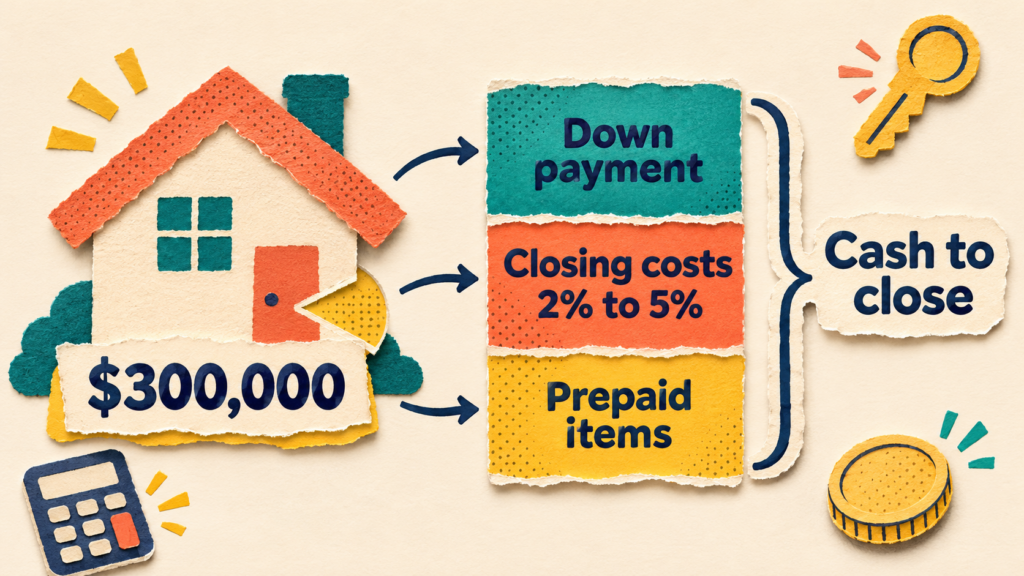
Cash to close is the total amount you bring to the closing table. It can include your down payment, closing costs, and prepaid taxes and insurance. It may also cover the first deposits into your escrow account. Money you already paid, like an earnest money deposit, and any credits you receive can lower the final amount.
Here is a simple way to see the gap. Say a buyer has $15,000 saved for a $300,000 home and plans to put 5% down, which is also $15,000. The CFPB says closing costs typically range from 2% to 5% of the purchase price. On this home, that could mean another $6,000 to $15,000. So the savings would cover the down payment but not the rest. The buyer would also want some cash left after closing.
Disclaimer: This example is hypothetical and is for illustration only. Actual closing costs vary by home price, location, lender, loan type, and transaction, and credits or assistance may change the amount due.
The CFPB’s guide to how much you want to spend shows how to set your down payment. It has you set aside closing costs and savings goals first. For a full list of other upfront costs, see our home buying costs checklist.
Section 11
How Your Down Payment Affects Monthly Mortgage Payments
Your down payment changes how much you borrow. But your monthly payment also depends on your rate and the length of the loan. Taxes, insurance, mortgage insurance, and HOA dues count too.
Compare 5%, 10%, and 20% Down
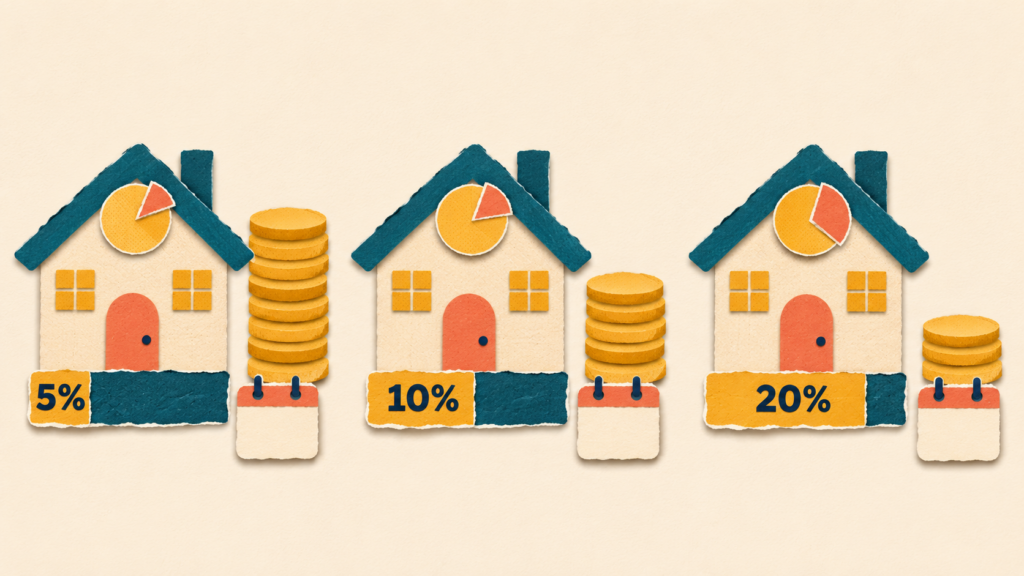
Let’s keep the same $300,000 home and use a 30-year fixed loan at 6.5% for every option. Here is how the principal and interest part of the payment changes:
| Down payment | Loan amount | Estimated principal and interest |
|---|---|---|
| 5% ($15,000) | $285,000 | About $1,801 per month |
| 10% ($30,000) | $270,000 | About $1,707 per month |
| 20% ($60,000) | $240,000 | About $1,517 per month |
Going from 5% down to 20% down lowers this part of the payment by about $284 a month. But it also takes $45,000 more in cash at the start.
Disclaimer: These figures are hypothetical, rounded estimates of principal and interest only, based on an assumed 6.5% rate over 30 years. They exclude taxes, insurance, mortgage insurance, HOA dues, and other costs. They are not rate quotes or loan offers, and actual rates and payments vary by lender, loan program, and borrower.
A lower monthly payment is not the only sign of a better loan. A larger down payment can lower your borrowing cost, but it may leave less money for emergencies and upkeep.
How Mortgage Insurance Changes the Comparison
Conventional PMI and FHA mortgage insurance follow different rules, so include the right one in your monthly estimate when it applies. In the table, the 5% and 10% options would likely add mortgage insurance on top. The 20% option on a conventional loan generally would not. VA and USDA loans have their own fees too. So do not assume a zero-down loan has no extra costs.
Calculate Your Own Monthly Payment
The Wonder Rates Mortgage Payment Calculator can help you compare estimated monthly mortgage payments. It estimates principal, interest, property taxes, insurance, PMI, and HOA dues. Try changing only the down payment first while keeping everything else the same. Then adjust the other inputs to match real quotes and the actual costs of the home you want.
Section 12
How to Choose the Right Down Payment for Your Financial Situation
Knowing the minimum is step one. The bigger question is how much you should put down while keeping the purchase affordable over time.
Balance Upfront Cash With Monthly Affordability
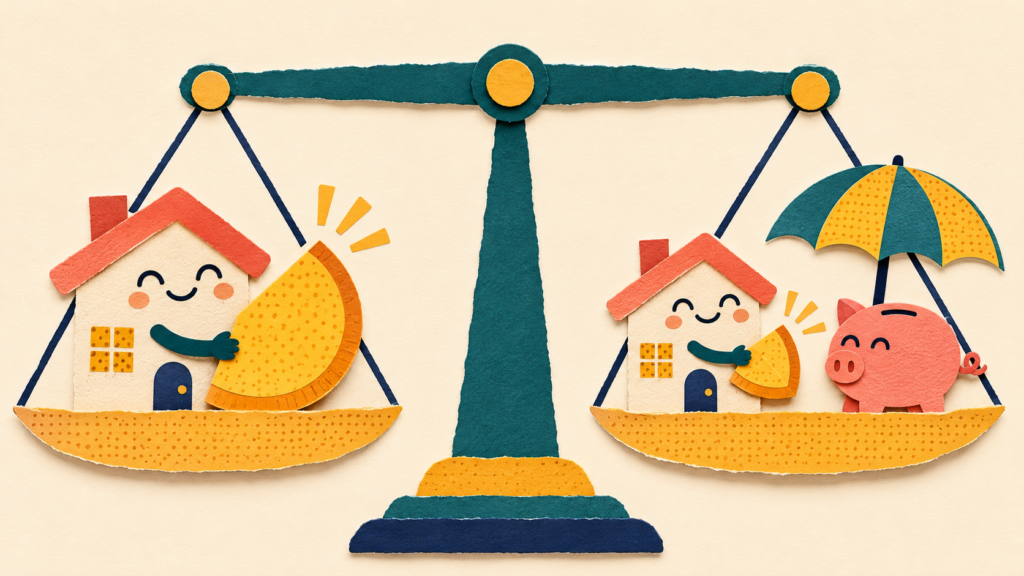
Putting less down keeps more cash in your pocket for closing costs, moving, repairs, and emergencies. On the other hand, it raises the amount you borrow and may raise your monthly costs. Putting more down usually lowers your loan balance, but it locks up money you could otherwise keep on hand.
So think about both sides. Look at how much cash you have today and what costs you expect once you move in.
Keep Closing Costs and Emergency Savings in the Budget
Try not to use every dollar you have just to reach a higher down payment. Surprise repairs, rising insurance, or a drop in income can strain a budget that looked fine on paper. Keeping some savings after closing gives you breathing room when life does not go as planned.
The smallest down payment is not always the cheapest loan, and the biggest is not always the safest.
Compare Loan Estimates Before Making a Decision
The same buyer can get different rates, fees, and mortgage insurance costs from one loan option to the next. A Loan Estimate is a standard form lenders give you after you apply. It makes side-by-side checks easier. Use real Loan Estimates when you can. Review the cash to close, the monthly payment, and the other terms.
In the end, the smallest down payment allowed is not always the best choice for your money.
Section 13
Use a Down Payment Calculator to Estimate Your Upfront Costs
Once you understand the minimums, the next step is to run your own numbers. The Wonder Rates Down Payment Calculator helps you estimate your down payment and cash to close. It adds your down payment to closing costs, based on a closing cost percentage you choose. That way, you see your total upfront cash, not just the down payment.
Enter the Purchase Price and Down Payment
Start with a realistic home price for the area where you want to buy. Then test different down payment percentages, such as 3%, 5%, 10%, or 20%, to see how much cash each one takes. Set the closing cost percentage to match what you expect for your area and lender. The calculator notes that closing costs are typically 2% to 5% of the price and vary by state and lender.
Compare Cash Needed With the Monthly Payment
Next, pair your results with the Mortgage Payment Calculator. Using both tools helps you weigh the cash you need now against the payment you make each month.
Keep in mind that calculator results are estimates. Your real cash to close, rate, and final payment depend on the home, the lender, and the loan. Your own situation matters too.
Section 14
Minimum Down Payment Requirements Are Only the Starting Point
Conventional programs may allow as little as 3% down. FHA may allow 3.5%. Eligible VA and USDA borrowers may qualify for zero-down financing, and jumbo loan requirements vary by lender and deal.
Each program comes with its own eligibility rules, fees, and long-term costs. A loan you can close on is not always a loan you can live with. The amount you can put down is just one factor in deciding whether a mortgage truly fits your finances.
Explore Your Home-Buying Options With Wonder Rates
You do not necessarily need 20% down to buy a home, but choosing the right mortgage means looking beyond the minimum requirement. Compare your upfront cash, estimated monthly payment, and the money you will have left after closing.
If you are planning to buy a home, Wonder Rates can help you review available mortgage options based on your purchase goals and financial situation. Explore home-buying options or get started with Wonder Rates to discuss your mortgage options.
Section 15
Disclaimer
This article is for general educational and informational purposes only and does not constitute financial, legal, tax, real estate, or mortgage advice, an offer to lend, a commitment to lend, or a guarantee of mortgage approval or program eligibility. Down payment percentages and program descriptions are general examples and may not reflect every available mortgage product or the requirements applicable to a specific borrower or property. Actual requirements depend on current program guidelines, lender overlays, credit profile, income, assets, occupancy, property type, loan amount, location, and other underwriting factors. Zero-down financing does not necessarily eliminate closing costs, prepaid expenses, funding or guarantee fees, or other cash requirements. Calculator results and hypothetical examples are estimates for illustrative purposes only and do not represent a loan offer or a guaranteed payment. Consult a qualified mortgage professional and review current program requirements before making a borrowing decision.
Duc Pham, Mortgage Broker | NMLS# 844897, Wonder Rates, Inc. | NMLS# 1518655 | DRE# 02047445 | DFPI# 60DBO-59134 | Equal Housing Opportunity. Equal Housing Lender. | Licensed in: AL, AZ, CA, CO, FL, GA, LA, MI, NC, OH, OK, OR, PA, SC, TX, VA, WA.



