
Section 01
You found a building with a shop downstairs and living space upstairs. It is perfect for living and running a business under one roof. Then the lender asks a question that stalls many deals: is this a residential loan or a commercial loan?
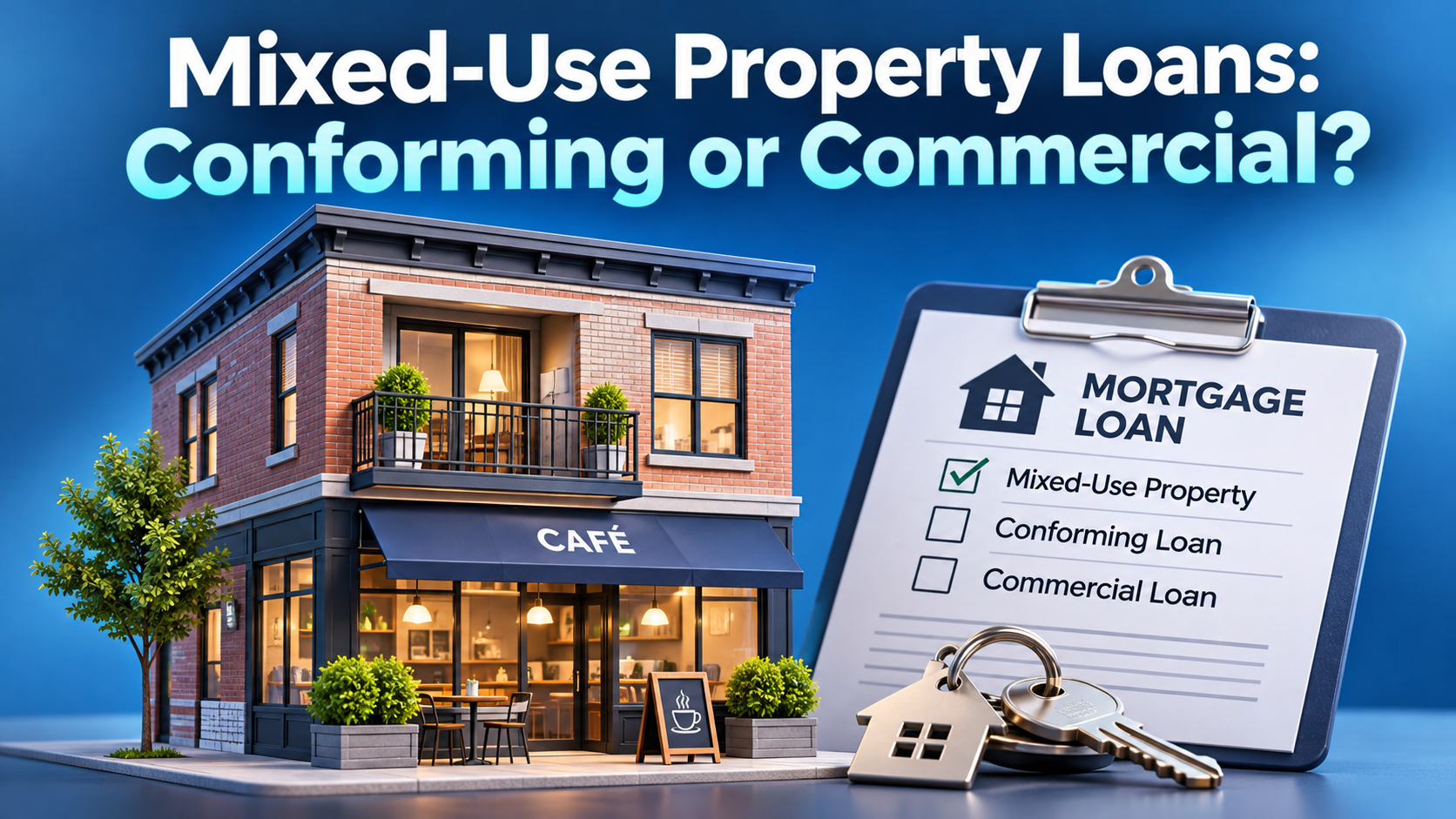
There is no single answer, because lenders do not classify mixed-use property by a simple label. They look at how the building is used, how many dwelling units it has, who lives there, who runs the business, and how much space the business occupies. This guide shows how those factors decide your loan type.
Section 02
What counts as a mixed-use property?
A mixed-use property combines residential living with commercial activity in one building. Typical examples include a home with a salon, a small medical office, or a day care, or a storefront with living space above it.
The loan type depends on whether the property still looks and functions like a home, or whether it has become a commercial building with a residence attached.
Section 03
What “conforming” really means
A conforming loan is a mortgage that meets the rules set by the Federal Housing Finance Agency (FHFA) and the standards of Fannie Mae and Freddie Mac. Two tests matter most for mixed-use buyers: loan size and property type.
Loan size. FHFA announced that the 2026 conforming loan limit for one-unit properties in most of the United States is $832,750, with a ceiling of $1,249,125 in high-cost areas. A loan above the county conforming limit may require jumbo financing, subject to the lender’s property eligibility rules. Exceeding the limit does not by itself turn a home into a commercial property.
Property type. For standard residential properties, Fannie Mae purchases first-lien mortgages on buildings with one to four units, and five or more units fall into commercial or multifamily lending. Mixed-use properties are a special case, though. Fannie Mae’s mixed-use rule is much narrower than the general one-to-four-unit rule, as the next section explains.
When a mixed-use property can qualify for a conforming loan
Fannie Mae allows mixed-use properties only when all of these conditions are met:
- The property is a one-unit dwelling.
- The borrower occupies it as their principal residence.
- The borrower is both the owner and the operator of the business.
- The property is primarily residential in nature, and the dwelling has not been modified in a way that hurts its marketability as a residence.
- The business use is legal under local zoning.
Fannie Mae gives day care space, a beauty or barber shop, and a doctor’s office as examples of acceptable business uses.
Fannie Mae’s guide does not publish a fixed percentage for commercial space. The appraiser and lender judge “primarily residential in nature” case by case.
The appraisal has its own requirements. The appraiser must describe the mixed-use features, confirm the use is legal under local zoning, report any market resistance to the commercial use, and value the property based on its residential characteristics rather than the business use.
This rule excludes several common setups. A two-to-four-unit building with commercial space does not fit Fannie Mae’s mixed-use provision. Neither does a property where you lease the commercial space to an outside business, because you must own and operate the business yourself.
Freddie Mac has its own mixed-use requirements, which are not identical to Fannie Mae’s. If a lender proposes a Freddie Mac loan, ask for the specific Freddie Mac guideline that applies rather than assuming the Fannie Mae conditions above carry over.
When you will likely need a commercial loan
A commercial loan becomes the realistic path when one or more of these apply:
- The building has five or more units.
- The commercial portion dominates the building, such as a retail or office property with a small apartment.
- The property sits on a commercial strip and does not read as residential. For example, a building on a busy strip of mostly retail and offices would not meet Fannie Mae’s “primarily residential” standard.
- The commercial space is leased to outside tenants rather than used for a business you own and operate.
- You will not live in the property as your principal residence.
Loan size is a separate question. A loan above the county conforming limit may require jumbo financing, subject to the lender’s property eligibility rules, but it does not automatically make the deal commercial.
Section 04
Government-backed alternatives: FHA and SBA
Two programs often fill the gap between conforming and fully commercial financing.
FHA loans. FHA rules on non-residential space have changed over time. One industry source reports that HUD Handbook 4000.1, effective for case numbers assigned on or after September 14, 2015, allows the non-residential portion to reach 49% of total floor area if the use is legally permitted and conforms to zoning. Other consumer websites still repeat an older 25% figure, so confirm the current rule directly with your FHA lender and the HUD handbook before relying on either number.
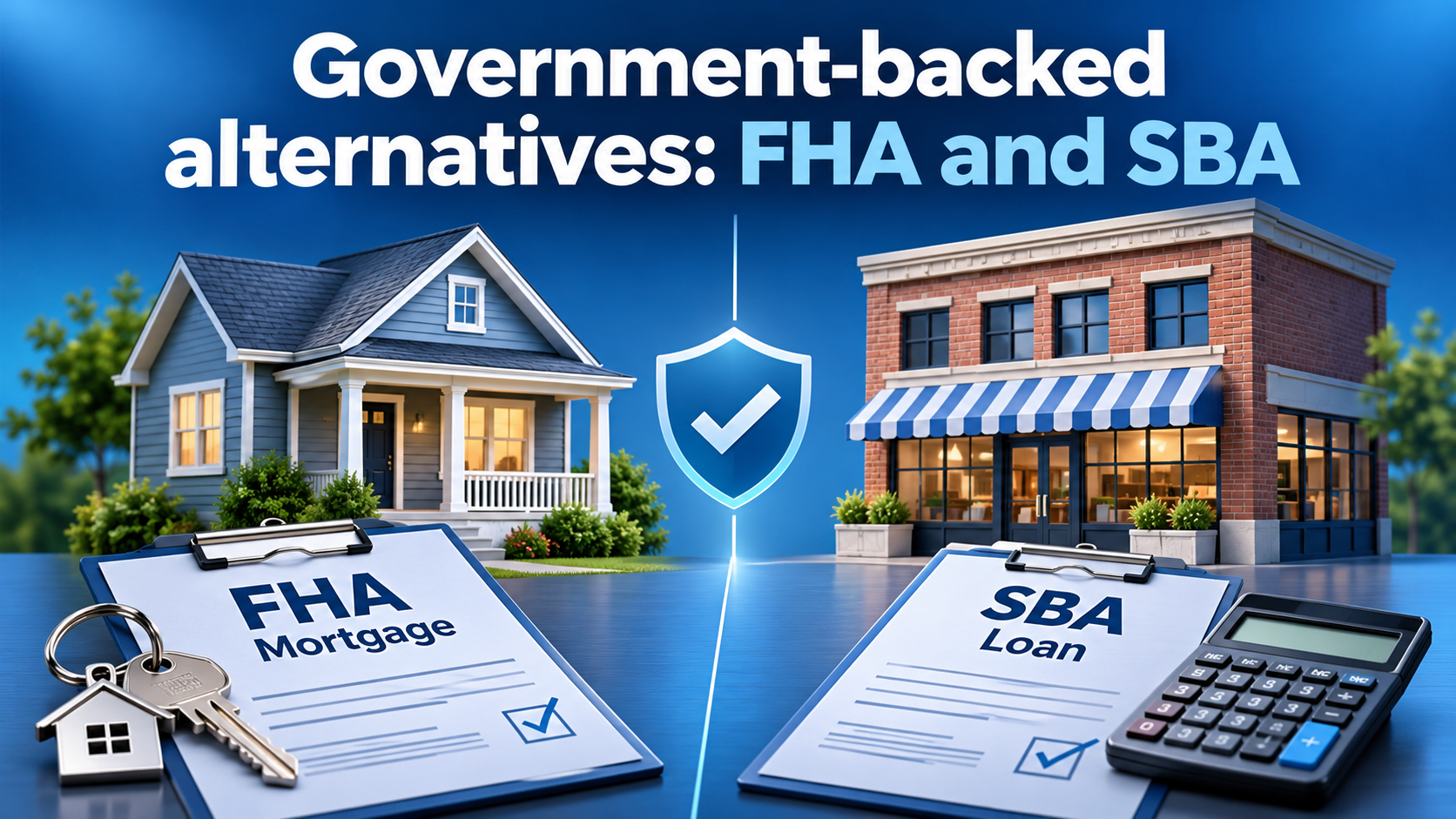
SBA 504 loans. These suit business owners whose business will occupy a large share of the building. The test is business occupancy, not whether the owner lives there: the business must occupy at least 51 percent of an existing building, or at least 60 percent of a new one, and the borrower must meet SBA’s other eligibility requirements. This program is built for owner-users, not investors.
Comparison table: which loan fits your mixed-use property?
| Factor | Fannie Mae conforming (mixed-use) | FHA | SBA 504 | Commercial loan |
|---|---|---|---|---|
| Units | One unit only | 1 to 4 (residential) | Not unit-based | 5 or more, or any |
| Occupancy and business | Borrower’s principal residence; borrower owns and operates the business | Owner-occupied; verify mixed-use rules with lender | Business occupies at least 51% (existing) or 60% (new), plus other SBA requirements | Set by lender |
| Character of property | Primarily residential, legal zoning | Residential character, non-residential portion limited | Business-focused | Commercial or mixed |
| Commercial space limit | No fixed percentage published | Verify current HUD rule (49% reported by one source, 25% by others) | Business must occupy 51% (existing) or 60% (new) | Set by lender |
| Loan size cap | $832,750 baseline in 2026, higher in high-cost areas; above the limit may mean jumbo, not commercial | Set by FHA area limits | Varies by structure | Set by lender |
| Best for | One-unit home where you live and run your own small business | Buyers wanting a lower down payment on a live-work home | Business owners whose business occupies most of the building | Investors, multi-unit, or retail-heavy buildings |
Sources:
- *Conforming loan limits: FHFA, https://www.fhfa.gov/news/news-release/fhfa-announces-conforming-loan-limit-values-for-2026*
- *Fannie Mae general unit rule: https://homebuyer.com/guidelines/fannie-mae/general-property-eligibility-b2-3-01*
- *SBA occupancy: https://cdcnewengland.com/post/how-to-buy-commercial-real-estate-in-massachusetts-with-an-sba-504-loan*
SBA 504 funding structure at a glance
| Component | Typical share |
|---|---|
| Bank or credit union first mortgage | 50% |
| SBA-backed CDC debenture | 40% |
| Borrower contribution | 10% (can be higher for start-ups or special-use property) |
Section 05
6 questions that decide your loan type
- How many dwelling units does the building have? Fannie Mae’s mixed-use rule requires a one-unit property. Five or more units rules out conforming financing entirely.
- Is the building primarily residential? If not, expect commercial underwriting.
- Will you live there as your principal residence? Fannie Mae’s mixed-use rule requires it, and FHA is designed for owner-occupants.
- Will you own and operate the business, and how much of the building will it use? Fannie Mae requires you to own and operate the business. SBA 504 looks at how much space the business occupies: at least 51% of an existing building or 60% of a new one.
- Is the commercial use legal under local zoning? Appraisers must confirm this for conforming loans.
- Does your loan amount fit the county limit? Check FHFA’s 2026 list. A larger loan may need jumbo financing, subject to the lender’s property eligibility rules.
Practical tips before you apply
- Get zoning confirmation in writing before you make an offer.
- Ask the lender early how they classify the property. Policies differ between lenders even when the agency rules are the same.
- Prepare a floor plan that clearly separates living and business areas.
- Expect to discuss insurance. Mixed-use buildings typically need both residential and commercial coverage, and some insurers charge more or hesitate to cover them.
- Compare at least one residential lender and one commercial lender, since the same building can be underwritten differently.
Section 06
FAQ
Can I get a conforming loan on a building with a store and living space?
Possibly, under Fannie Mae’s mixed-use rule, but only if the property is a one-unit dwelling, you live there as your principal residence, you own and operate the business, the property is primarily residential in nature, and the business use is legal under local zoning. A building with two or more dwelling units does not fit Fannie Mae’s mixed-use provision. A one-unit property with business space must be evaluated against all of the criteria above, including its primarily residential character.
Does Fannie Mae set a maximum percentage for commercial space?
No. Its Selling Guide uses the phrase “primarily residential in nature” and does not state a numeric cap.
What is the conforming loan limit in 2026?
For one-unit properties in most areas it is $832,750, and up to $1,249,125 in high-cost areas. Above that, you may need jumbo financing, subject to the lender’s property eligibility rules.
Can I rent out the commercial space to a tenant on a conforming loan?
Not under Fannie Mae’s mixed-use rule. It requires the borrower to be both the owner and the operator of the business, so leasing the commercial space to a third party takes the property outside this financing path. In that case, commercial financing or another program is the more realistic route.
Is an SBA 504 loan better than a commercial loan?
It can be, if your business will occupy at least 51 percent of an existing building (or 60 percent of a new one) and you meet SBA’s other eligibility requirements. It is not designed for investors.
Section 07
Bottom line
Fannie Mae conforming loans work for a narrow case: a one-unit home that is your principal residence, where you own and operate a modest business. Commercial loans fit multi-unit, retail-heavy, tenant-leased, or five-plus-unit buildings. FHA and SBA programs bridge the middle, with SBA depending on how much of the building your business occupies. A loan above the conforming limit is a jumbo question, not automatically a commercial one. Because lender policies vary, talk to a mortgage professional and confirm current guidelines before you sign a purchase contract.
This article is general information, not financial or legal advice.
Duc Pham, Mortgage Broker | NMLS# 844897,
Wonder Rates, Inc. | NMLS# 1518655 | DRE# 02047445 | DFPI# 60DBO-59134 |
Equal Housing Opportunity. Equal Housing Lender. |
Licensed in: AL, AZ, CA, CO, FL, GA, LA, MI, NC, OH, OK, OR, PA, SC, TX, VA, WA.




