
Section 01
For first-time buyers, every extra hundred dollars of income can decide whether you qualify. Few people know there is a program that both cuts your federal taxes every year and can help you qualify for a larger loan from the start. It is called the Mortgage Credit Certificate.
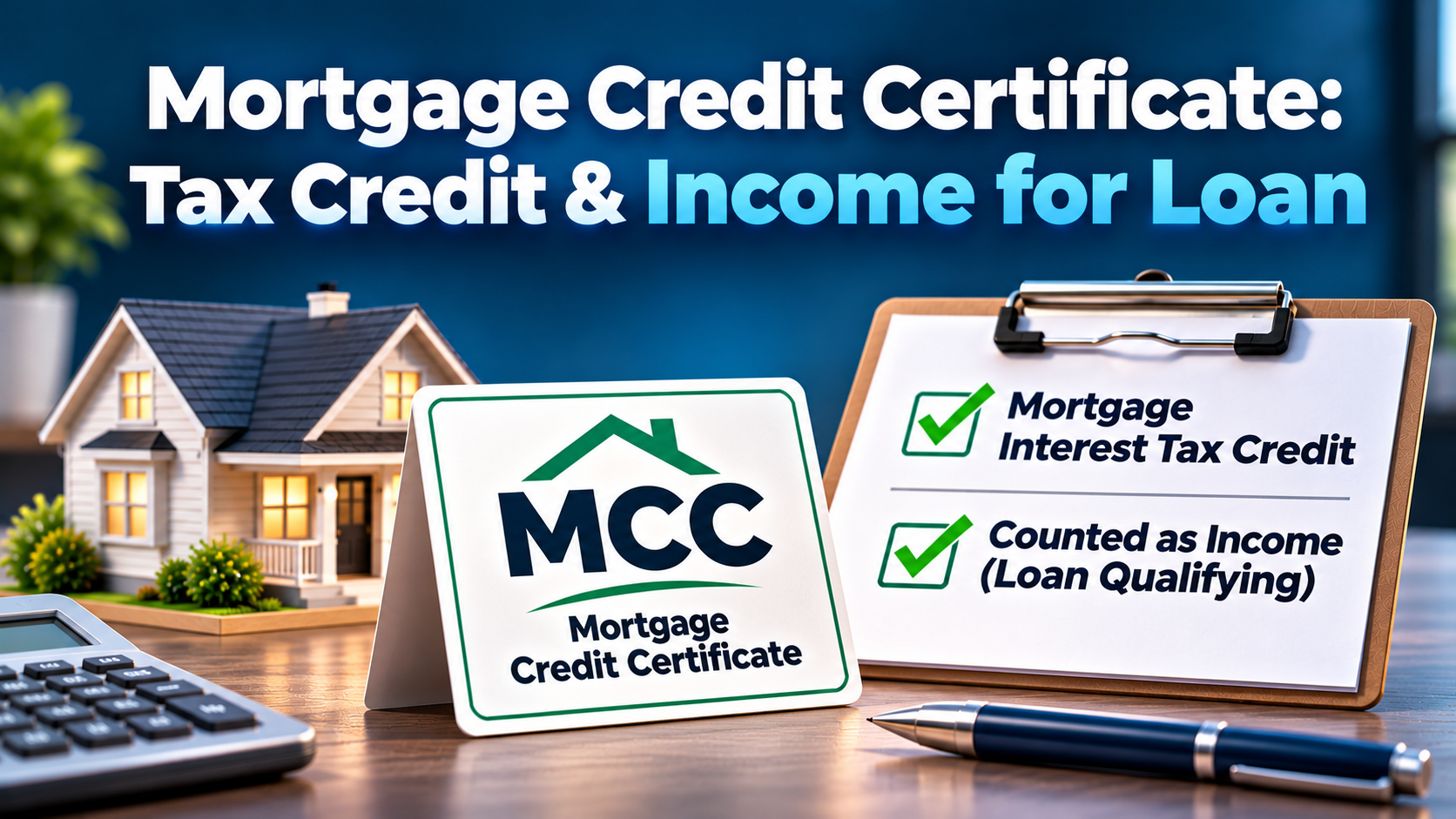
Mortgage Credit Certificate (MCC) is issued by a state or local housing agency and lets you claim a federal tax credit equal to a share of the mortgage interest you pay each year, typically 20% to 40%. If the rate is above 20%, the credit is capped at $2,000 a year. Unlike a deduction, a tax credit reduces your tax bill dollar for dollar. When you apply for a loan, Fannie Mae allows lenders to add the MCC’s value to your monthly income using the formula loan amount times note rate times MCC percentage, divided by 12. MCCs are usually limited to first-time buyers under income and price limits, and they can carry a recapture tax if you sell within nine years.
Section 02
What Is a Mortgage Credit Certificate (MCC)?
According to Fannie Mae’s MCC guidance, states and municipalities can issue mortgage credit certificates in place of, or as part of, their authority to issue mortgage revenue bonds. Instead of lowering your interest rate like a bond-funded loan, an MCC gives you an annual federal tax credit.
An MCC is not a loan. You still take out a regular mortgage from a participating lender, whether conventional, FHA, VA or USDA, and the MCC is issued alongside it. The credit lasts as long as you keep that loan and live in the home as your primary residence.
How a tax credit differs from a deduction
This is what makes an MCC worth more than many people expect. A deduction only lowers your taxable income, so a $1,000 deduction saves just $120 in the 12% bracket. A credit reduces your tax bill directly, so a $1,000 credit saves the full $1,000.
The mortgage interest deduction also helps only if you itemize, while most first-time buyers take the standard deduction. An MCC still has value even if you do not itemize.
| Feature | Mortgage interest deduction | MCC tax credit |
|---|---|---|
| How it works | Lowers taxable income | Reduces tax owed dollar for dollar |
| Value of $1,000 in the 12% bracket | About $120 | $1,000 |
| Requires itemizing | Yes | No |
| Eligibility | Borrowers who itemize and have eligible interest on a qualified home loan. | MCC holders, usually first-time buyers under income limits |
| Effect on loan qualifying | None | Can be added to income |
Section 03
How the MCC Tax Credit Is Calculated, and Its Limits
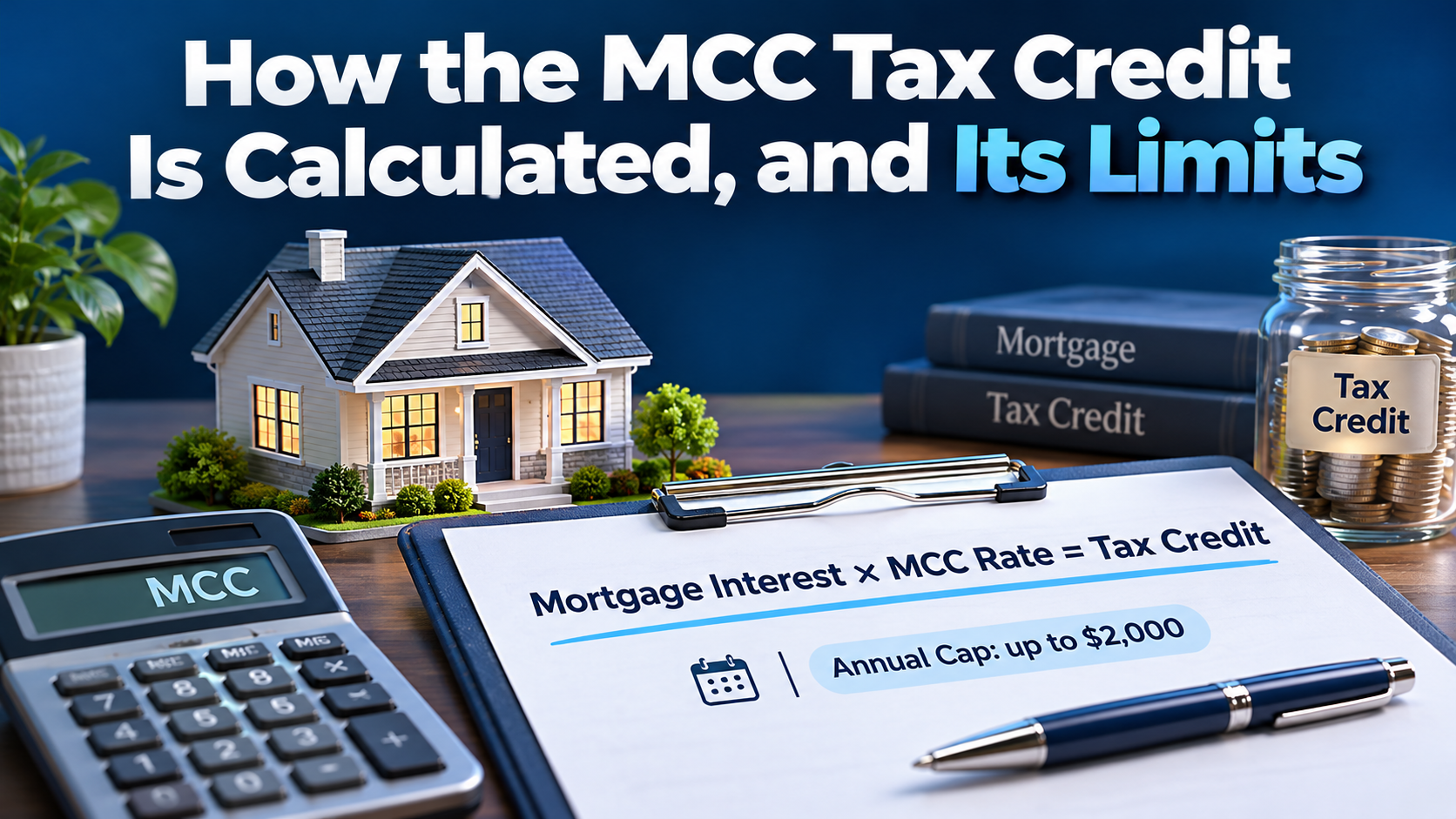
The basic formula is simple: your tax credit equals the mortgage interest you pay during the year multiplied by the credit rate on your certificate. The issuing agency sets the rate, usually between 20% and 40% depending on the program.
You claim the credit on IRS Form 8396, Mortgage Interest Credit, filed with your federal return each year. Your lender or servicer sends Form 1098 showing the interest you paid, and that number is the input to the formula.
Three limits to know
The MCC credit is not unlimited cash. Three main limits decide how much you actually receive each year.
Understanding them helps you estimate the real benefit instead of seeing a high credit rate and expecting too much.
| Limit | What it means |
|---|---|
| $2,000 cap | If the credit rate is above 20%, the credit cannot exceed $2,000 a year |
| Nonrefundable | The credit cannot exceed your federal tax liability; unused credit can carry forward up to 3 years |
| Reduced interest deduction | If you itemize, the interest you deduct must be reduced by the amount claimed as a credit |
The credit shrinks over time
Because the credit is based on interest actually paid, and interest falls as you pay down principal, the MCC’s value declines over the years. That is how amortization works: early payments are mostly interest, later payments mostly principal.
At a 20% rate, the decline is more noticeable. Above 20%, if interest times the rate still exceeds $2,000, you keep receiving the full $2,000 for many early years until interest drops below that threshold.
Section 04
How Lenders Add the MCC to Your Income
What makes an MCC especially useful for first-time buyers is that it does not just cut taxes after you buy; it can help you qualify in the first place. Because the credit increases the money you actually have each month, many loan programs let lenders treat it as additional income.
Fannie Mae gives a specific formula: loan amount times the note rate times the MCC percentage, divided by 12, is the amount added to the borrower’s monthly income. That figure then goes into the debt-to-income ratio like any other income, which can make a real difference for buyers who are qualifying on a single income.
The formula and how other programs handle it
Because Fannie Mae’s formula is based on the loan amount and rate, the added income is usually close to first-year interest times the MCC rate. The $2,000 figure is the federal tax-credit cap. Fannie Mae gives a separate underwriting formula. For the 40% DTI example below, assume the lender confirms it will use $2,000 a year, or about $167 a month.
Other programs have their own approach. USDA, for example, changed how it treats MCCs, moving from a reduction of the housing payment to an addition to repayment income in its new GUS system. Some HFAs do not allow an MCC to be used for qualifying on their own loans, as CalHFA does for CalHFA first mortgages.
| Program | Common treatment (reference) |
|---|---|
| Fannie Mae | Added to income: (loan amount × note rate × MCC %) ÷ 12 |
| USDA | Added to repayment income in GUS |
| FHA, VA, Freddie Mac | Program-specific guidance; ask your lender |
| Some HFA loans | May not allow the MCC for qualifying |
This table is for reference. Actual treatment depends on current program guidelines and lender policy.
What the lender needs
To add the MCC to income, the lender needs proof that you have been issued, or committed, an MCC, usually the commitment letter or the certificate itself showing the credit rate. The MCC must be applied for before closing through a participating lender; it cannot be added afterward.
Because the MCC adds a review by the issuing agency, tell your loan officer at the start that you want to use one, so processing time does not delay your closing.
Section 05
Example: How Much Can an MCC Save and Add to Your Buying Power?
The example below compares two common MCC rates, 20% and 40%, on the same loan. It shows that a higher rate is not always better, because of the $2,000 cap.
Assumed figures: a $350,000 loan at a 6.5% fixed rate over 30 years, with first-year interest of about $22,600. The borrower earns $6,000 a month before taxes, total monthly debt payments after buying are $2,800, and federal tax liability each year is large enough to use the full credit.
First-year tax credit
At a 20% rate, the first-year credit is about $22,600 × 20% = $4,520, with no cap because the rate does not exceed 20%. At a 40% rate, interest times the rate is about $9,040, but the credit is capped at $2,000.
This surprises many buyers: in this example, a 20% MCC delivers more than twice the credit of a 40% MCC. With these two certificate rates and enough tax liability to use the credit, the 40% certificate gives a larger credit when eligible annual interest is below $10,000. At $10,000 both give $2,000. Above $10,000, the 20% certificate gives a larger credit.
| Measure | MCC 20% | MCC 40% |
|---|---|---|
| First-year interest × rate | About $4,520 | About $9,040 |
| $2,000 cap applies | No | Yes |
| First-year tax credit | About $4,520 | $2,000 |
| Monthly equivalent | About $377 | About $167 |
Effect on DTI when you apply
Under Fannie Mae’s formula, a 20% MCC adds $350,000 × 6.5% × 20% ÷ 12 ≈ $379 a month to income. Qualifying income rises from $6,000 to about $6,379, and DTI falls from about 46.7% to about 43.9%.
For the 40% MCC illustration, assume the lender confirms it will use $2,000 a year, or about $167 a month, as additional qualifying income. This brings total monthly income to about $6,167 and DTI to about 45.4%. Use the Wonder Rates mortgage calculator to see the maximum payment that fits your new qualifying income.
| Measure | No MCC | MCC 20% | MCC 40% (illustrative $167/month) |
|---|---|---|---|
| Monthly income | $6,000 | About $6,379 | About $6,167 |
| Total monthly debts | $2,800 | $2,800 | $2,800 |
| DTI | About 46.7% | About 43.9% | About 45.4% |
Figures are illustrative, rounded and based on the assumptions above. Actual credit depends on interest paid, your tax liability and current rules.
Section 06
MCC Eligibility and How to Apply
MCCs are authorized under federal tax law, so the basic rules are similar nationwide, but each state, county or city sets its own income limits, price limits and credit rate. Not every area has an active MCC program.
An MCC is issued only with a new home purchase loan through a participating lender, and it must be applied for before closing. You cannot get an MCC for a home you have already bought.
Typical eligibility requirements
The requirements below apply to most MCC programs. Some targeted areas may relax the first-time buyer rule or the income limits.
The income used for MCC eligibility usually includes all adults who will live in the home, which can differ from the income the lender uses to qualify you for the loan.
| Requirement | What it usually means |
|---|---|
| First-time homebuyer | No ownership of a primary residence in the past 3 years; exceptions for targeted areas and some veterans |
| Household income limit | Set by the issuing agency, varying by household size and area |
| Purchase price limit | Based on the area’s price cap |
| Primary residence | The home must be your principal residence |
| New loan | Issued with a new purchase loan, not an existing mortgage |
| Loan types | Usually works with conventional, FHA, VA and USDA loans |
Steps to get an MCC
The process usually runs alongside your loan application. A participating lender submits the MCC application to the issuing agency, and you may pay a processing fee.
A typical sequence looks like this:
- Find out whether an MCC program is active in the state or area where you are buying.
- Choose a participating lender and say at the start that you want an MCC.
- Provide income documents for all adults in the household and proof that you are a first-time buyer.
- The lender submits the file, and the issuing agency approves and issues a commitment before closing.
- After closing, you receive the official MCC; keep it to file Form 8396 each year.
Section 07
What Most Buyers Don't Know About MCCs
The MCC is one of the least discussed first-time buyer benefits, and one of the most misunderstood. Many people receive an MCC but do not use it fully, or are unaware of the obligations that come with it.
The points below help you get the most value from an MCC and avoid surprises later.
1. You may owe recapture tax if you sell early
Because an MCC is a federal subsidy, it is subject to the same recapture tax rules as a bond-funded loan. If you sell within nine years, your income in the year of sale exceeds the adjusted limit and you have a gain, you may have to repay part of the benefit on Form 8828.
The tax applies only when all three conditions are met, and it is always capped at 50% of your gain. Keep the recapture notice you receive at closing so you can check it when needed.
. Adjust your W-4 to get the benefit monthly
If you wait until tax season, you see the MCC benefit only once a year. Many borrowers adjust their W-4 withholding with their employer so less tax is withheld from each paycheck, putting more cash in hand every month to cover the mortgage.
This better matches your actual cash flow to the income the lender added when qualifying you. Ask a CPA to calculate the right adjustment so you do not end up owing at year end.
3. Refinancing can end the MCC
The MCC is tied to the original loan. If you refinance, the MCC may end unless the issuing agency allows it to be reissued under its own conditions, which typically require the new loan to be no larger than the old balance.
Before refinancing to a lower rate, ask the issuing agency about reissuance and weigh the interest savings against the tax credit you might lose.
4. Low tax liability can waste the credit
The MCC credit is not refundable as cash. If your federal tax liability is lower than the credit, the excess carries forward for up to three years, and anything still unused after that is lost.
Borrowers with other large credits, such as the child tax credit, may not use the full MCC. Estimate your tax liability before counting on the full value.
Section 08
MCC Checklist
An MCC delivers the most value when it is planned at the start of your home search, not when your loan file is nearly done. A few well-timed questions tell you whether an MCC fits and whether it will help you qualify.
The list below follows the order from research to after closing.
- Check whether your state or local area has an active MCC program and what the credit rate is.
- Compare the credit rate with the $2,000 cap based on your expected loan to estimate the real credit.
- Estimate your annual federal tax liability to make sure you can use the credit.
- Choose a participating lender and ask whether they add the MCC to qualifying income.
- Gather income documents for every adult in the household.
- Confirm MCC processing time so it does not delay closing.
- Keep your MCC and recapture notice after closing.
- File Form 8396 every year and consider adjusting your W-4.
- Ask about reissuance before you refinance.
Section 09
Mortgage Credit Certificate FAQs
First-time buyers tend to ask the same questions when they hear about MCCs. Most center on how much an MCC is worth, whether it helps you qualify and what the risks are.
The answers below are general. For your situation, ask a participating lender and a CPA.
Is an MCC a loan?
No. An MCC is a federal tax credit certificate issued with your home loan. You do not repay it like a debt.
You still have a regular mortgage, and the MCC reduces the federal tax you owe each year.
What is the maximum MCC credit each year?
If the credit rate is 20% or less, the credit equals interest times the rate, with no separate cap. If the rate is above 20%, the credit is capped at $2,000 a year.
The credit also cannot exceed your federal tax liability; unused credit can carry forward up to three years.
Will a lender count the MCC as income?
It can. Fannie Mae allows lenders to add it to monthly income using loan amount times note rate times MCC percentage, divided by 12. USDA also adds it to repayment income.
Treatment varies by program and lender, so ask before you apply.
Can I use an MCC with an FHA loan?
Usually yes. An MCC can be paired with conventional, FHA, VA or USDA loans, depending on the local MCC program.
Some HFA loans may limit the use of an MCC for qualifying, so check the specific rules.
Do I lose the MCC if I refinance?
Possibly. The MCC is tied to the original loan and continues only if the issuing agency allows it to be reissued for the new loan under its own conditions.
Ask the issuing agency before you refinance.
Do I have to pay back the MCC when I sell?
Possibly, through the recapture tax, if you sell within nine years, your income exceeds the limit and you have a gain.
If any one of those conditions is missing, you owe nothing.
Section 10
Bottom Line
A Mortgage Credit Certificate (MCC) gives first-time buyers a federal tax credit equal to part of the mortgage interest they pay each year, reducing taxes dollar for dollar and helping even if they do not itemize. Above a 20% rate, the credit is capped at $2,000 a year, so a higher rate is not always better. When you apply, Fannie Mae allows lenders to add the MCC’s value to monthly income, lowering DTI and potentially increasing how much you can borrow. In exchange, MCCs come with income and price limits, can end when you refinance and may trigger a recapture tax if you sell early.
Looking for ways to boost your buying power on your first home? Connect with Duc Pham and the Wonder Rates team to check the MCC programs in your area and how to build an MCC into your loan application.
Disclaimer: This article is for general information only and is not tax, financial or legal advice. Figures without a cited source are illustrative assumptions. MCC eligibility, credit rates and how lenders count them as income vary by program, area and lender, and can change. Confirm with the issuing agency, a CPA and a licensed loan officer before making decisions.
Duc Pham, Mortgage Broker | NMLS# 844897,
Wonder Rates, Inc. | NMLS# 1518655 | DRE# 02047445 | DFPI# 60DBO-59134 |
Equal Housing Opportunity. Equal Housing Lender. |
Licensed in: AL, AZ, CA, CO, FL, GA, LA, MI, NC, OH, OK, OR, PA, SC, TX, VA, WA.




